Lesson 8: Liquidity Pools

🎧 Lesson Podcast

🎬 Video Overview

Lesson 8: Liquidity Pools

Header

Core concept: Liquidity pools are shared pots of tokens that enable trading on DEXs—anyone can contribute to the pot and earn fees from trades.


Community Potluck

Inline Analogy

Imagine a community potluck:

  • Everyone brings a dish (contributes)

  • Everyone can take from any dish (trade)

  • The more food, the better the selection

  • Contributors help everyone else eat

Liquidity pools work similarly:

  • Users contribute tokens (provide liquidity)

  • Traders swap using the pooled tokens

  • Larger pools mean better trades (less slippage)

  • Liquidity providers earn fees for their contribution

The "potluck" keeps trading possible without needing individual counterparties.


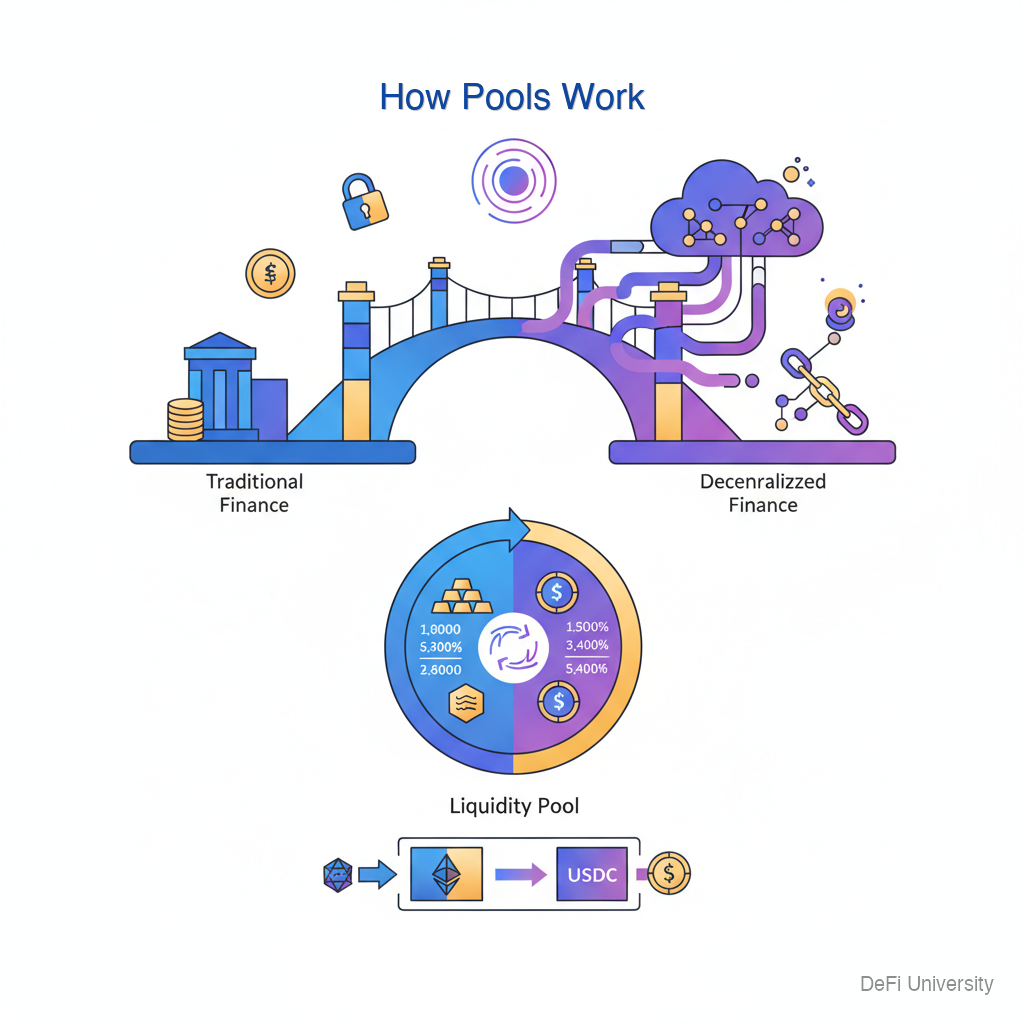
How Pools Work

Infographic

A typical liquidity pool contains two tokens in a pair:

Example: ETH/USDC pool

  • Pool holds $1,000,000 of ETH

  • Pool holds $1,000,000 of USDC

  • Total value: $2,000,000 in liquidity

When someone trades: They send ETH to the pool and receive USDC (or vice versa). The pool's ratio changes. A mathematical formula (like x*y=k for simple AMMs) determines how much they receive.

The result: No order matching needed. Trades execute instantly against the pool. Pool ratios adjust automatically.


Becoming a Liquidity Provider

Anyone can add liquidity:

  1. Prepare tokens: You need both tokens in the pair (e.g., ETH and USDC)

  2. Add to pool: Deposit equal value of both tokens

  3. Receive LP tokens: You get tokens representing your share of the pool

  4. Earn fees: Trading fees accumulate to your share

  5. Withdraw anytime: Return LP tokens to get your share back

If the pool earns 0.3% on every trade and does $10M daily volume, that's $30,000/day in fees distributed to liquidity providers.


Impermanent Loss: The Hidden Risk

The problem: When token prices change, liquidity providers can end up with less value than if they'd just held the tokens.

Simple example:

  • You deposit 1 ETH + $2,000 USDC (ETH = $2,000)

  • ETH price doubles to $4,000

  • Pool mechanics mean you now have roughly 0.7 ETH + $2,800 USDC

  • Value: ~$5,600

But if you'd just held:

  • 1 ETH = $4,000 + $2,000 USDC = $6,000

You "lost" $400 by providing liquidity instead of holding.

Why "impermanent"? If prices return to original levels, the loss disappears. It only becomes permanent if you withdraw while prices have diverged.

The trade-off: Fees earned might exceed impermanent loss, making it worthwhile. Or they might not. Depends on trading volume, fee rates, and price movements.


Pool Selection Factors

When considering providing liquidity:

Trading volume: Higher volume = more fees. Check historical volume data.

Fee tier: Some pools have higher fees (0.3% vs 0.05%). Higher fees mean more per trade but might have less volume.

Token volatility: Stable pairs (USDC/USDT) have minimal impermanent loss. Volatile pairs have more.

Incentives: Some pools offer extra token rewards. Factor this into total returns.

Protocol reputation: Established protocols with audited contracts are safer.


Liquidity for the Ecosystem

Liquidity providers serve a crucial role:

  • They make trading possible

  • More liquidity = better prices for traders

  • They get compensated via fees

  • The system depends on them

Understanding this relationship helps you see why DeFi protocols work to attract liquidity and why "liquidity mining" incentives exist.


Summary

Key Takeaways

  • Liquidity pools are shared token reserves enabling DEX trading

  • Anyone can provide liquidity and earn a share of trading fees

  • Impermanent loss occurs when token prices diverge—a real risk for volatile pairs

  • Pool selection involves volume, fees, volatility, and incentives

  • More liquidity benefits everyone—better prices, less slippage

  • Understand risks before providing—impermanent loss can exceed fees earned

Last updated