Lesson 4: 24/7 Never Closed
🎧 Lesson Podcast
🎬 Video Overview
24/7 Never Closed
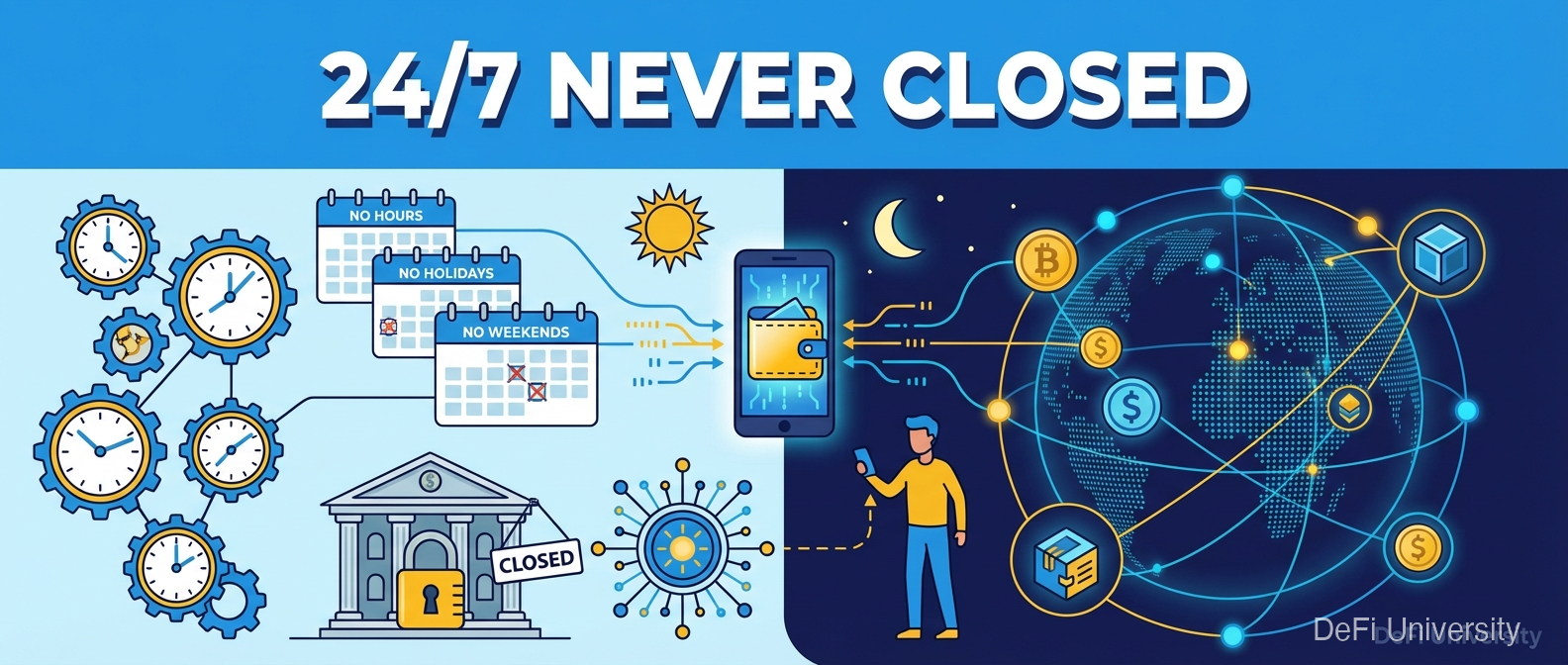
Core concept: Cryptocurrency networks run continuously—no banking hours, no holidays, no weekends off. Your money is always accessible.
The ATM That Never Sleeps

Imagine an ATM that:
Works at 3 AM on a Tuesday
Works on Christmas Day
Works during hurricane power outages (if you have internet)
Works in every country simultaneously
Never has "system maintenance" downtime
That's what cryptocurrency networks are like. They don't have operating hours because there's no office to close.
Traditional finance runs on business hours:
Banks close at 5 PM
Markets close on weekends
Holidays shut everything down
International transfers wait for both time zones
Cryptocurrency runs on computer hours:
Networks operate continuously
Transactions process at 2 AM
Sunday is the same as Monday
There's no "after hours"
Why Traditional Finance Has Hours
Banks have operating hours because:
Human processing: Historically, people processed transactions. People need sleep, weekends, and holidays.
Batch systems: As covered earlier, many banking systems batch transactions overnight rather than processing them continuously.
Synchronized settlement: Markets and banks coordinate with each other, requiring agreed-upon hours.
Risk management: Having defined hours helps institutions manage risk and reconcile accounts.
These reasons made sense when humans handled everything. They're increasingly outdated in a digital world—but changing deeply embedded systems is slow.
How Crypto Stays "Always On"
Cryptocurrency networks don't need business hours because:
Decentralized operation: Thousands of computers worldwide run the network. When it's midnight in New York, it's noon in Tokyo. Someone's always "awake."
Automated processing: Transactions are verified by code, not people. Code doesn't need lunch breaks.
No single point of control: There's no central office that can "close." The network IS all the computers running it.
Aligned incentives: The people running network computers (miners/validators) are paid for processing transactions, so they keep running 24/7.
The result: Bitcoin has had 99.98% uptime since 2009. Traditional banks might go down for maintenance. Bitcoin doesn't.
Real-World Impact
Always-on matters when:
Time-sensitive transactions: Need to pay someone urgently on Sunday night? Crypto can do that. Bank transfer will wait until Monday.
Global business: Working with people in different time zones? No need to coordinate around banking hours.
Emergencies: Financial crises don't wait for Monday. Neither should your ability to access money.
Market opportunities: While stock markets sleep, crypto markets trade. Some see opportunity; others see stress.
Always-on matters less when:
You're not in a hurry: If Tuesday is fine, 24/7 is just theoretical.
You prefer markets to close: Some appreciate forced breaks from market watching.
The Flip Side: Always On Trading
There's a psychological dimension to 24/7 operation:
No forced breaks: Stock markets close, giving everyone time to step away. Crypto never pauses.
FOMO potential: "What if something happens while I sleep?" becomes a real concern for active traders.
Volatility at any hour: Price swings can happen at 4 AM when you're not watching.
For long-term holders, this doesn't matter—you're not checking prices hourly anyway.
For active traders, 24/7 markets can be exhausting. Many find they need to set personal boundaries since the market won't impose them.
What "Uptime" Means for Your Money
Traditional banking downtime scenarios:
"System maintenance, try again later"
"Transaction processing is delayed"
"Bank holiday, closed today"
"International wire will process next business day"
Crypto uptime scenarios:
Transaction confirmed in 10 minutes at 3 AM Sunday
Same experience on Christmas as any other day
Network works identically regardless of your location
This reliability makes crypto useful for applications that require always-available money—like automated payments, global operations, or situations where traditional hours are problematic.
Key Takeaways
Crypto networks run 24/7/365—no banking hours, holidays, or weekend closures
Decentralization enables this—thousands of computers worldwide, always someone operating
Traditional hours exist for historical reasons that are increasingly outdated
Always-on matters for global business, emergencies, and time zones
The flip side is always-on trading—markets never force breaks, which some find stressful
Near-perfect uptime makes crypto reliable for applications requiring continuous access
Last updated