Lesson 8: Different Blockchains Explained
🎧 Lesson Podcast
Different Blockchains Explained
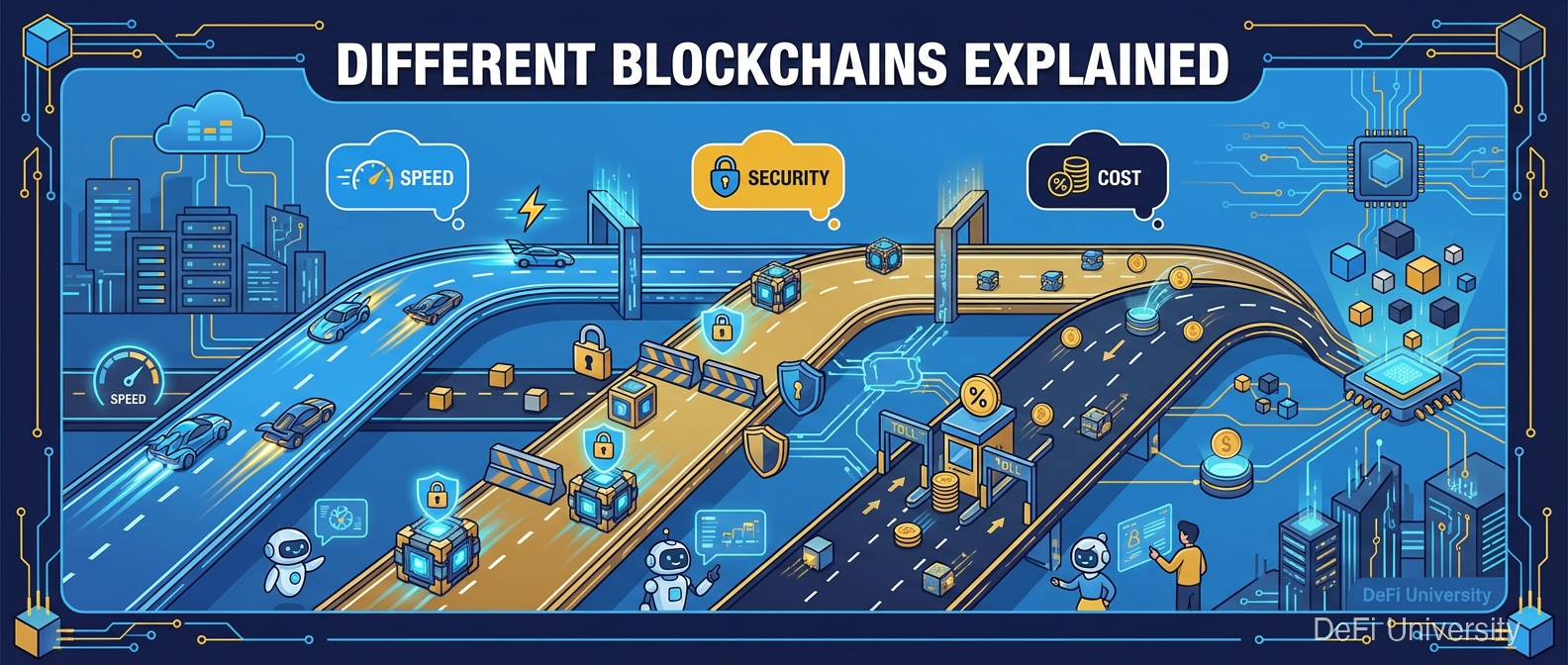
Core concept: Different blockchains are like different highways—some prioritize speed, others security, others cost. No single blockchain is "best" for everything.
Different Highways for Different Traffic
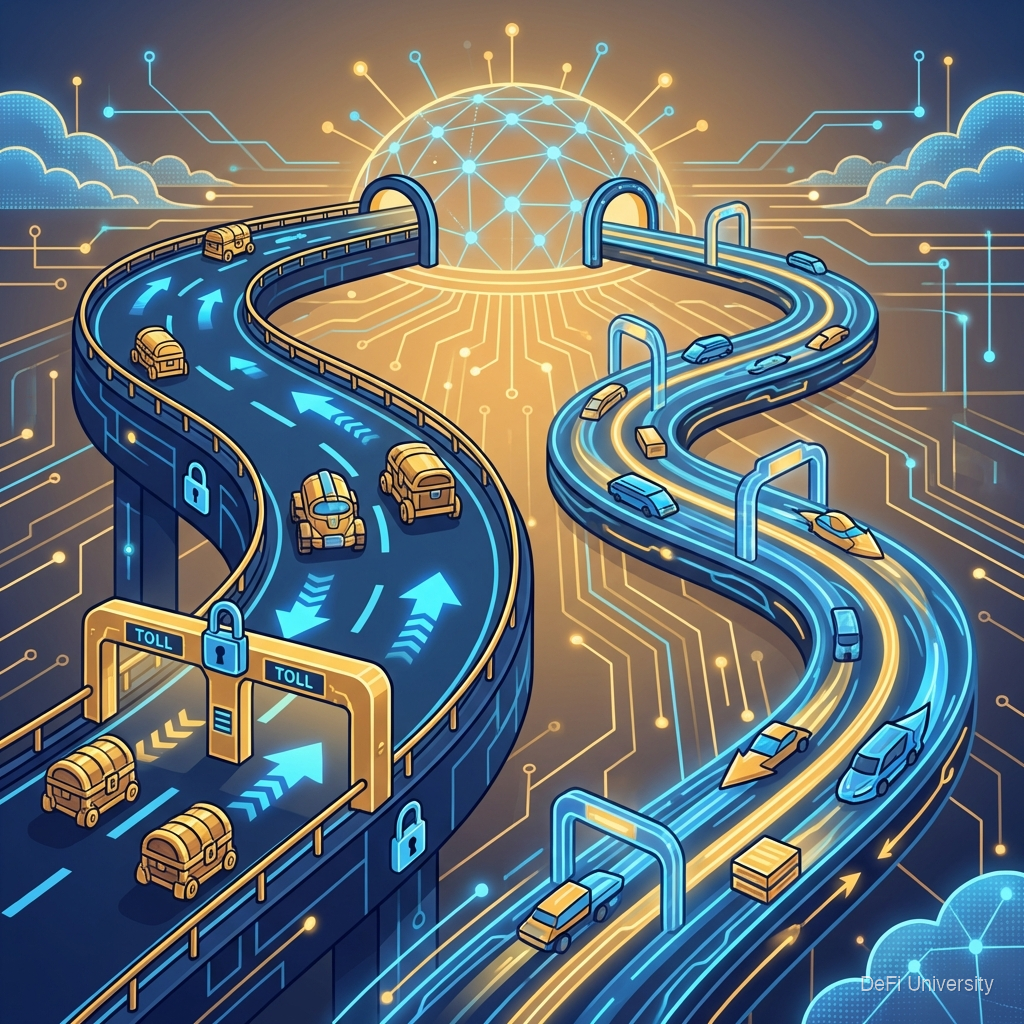
Imagine three highways:
Highway A (Interstate): Extremely secure, well-maintained, but has toll booths causing slow-downs during rush hour. Best for valuable cargo that needs maximum protection.
Highway B (State road): Faster than the interstate, lower tolls, pretty secure. Good for most everyday traffic.
Highway C (Local expressway): Very fast, almost free, but newer and less proven. Great for quick trips where speed matters more than perfect security.
Blockchains work similarly. There's no "best" highway—it depends on what you're transporting and your priorities.
The Big Three (And Why They Exist)
Bitcoin
What it is: The original blockchain (2009). Focused solely on being digital money.
Strengths:
Most secure and decentralized
Largest, most battle-tested network
Strongest "store of value" narrative
Simple and focused
Trade-offs:
Slow (~10 min blocks, 7 transactions/second)
Expensive during high demand
Limited functionality (just payments)
Best for: Long-term value storage, large value transfers, maximum security.
Ethereum
What it is: Programmable blockchain (2015). Enables smart contracts and applications.
Strengths:
Largest smart contract ecosystem
Most developer activity
Supports DeFi, NFTs, DAOs, and more
Transitioning to more efficient technology
Trade-offs:
Can get expensive during high demand
Faster than Bitcoin but still limited
More complex = more potential bugs
Best for: DeFi applications, NFTs, complex programmable money.
Solana
What it is: High-speed blockchain (2020). Optimized for performance.
Strengths:
Very fast (~400ms blocks)
Low fees (fractions of cents)
Growing ecosystem
Trade-offs:
Less decentralized than Bitcoin/Ethereum
Has had network outages
Younger, less battle-tested
Best for: High-frequency use, gaming, applications needing speed over maximum decentralization.
The Blockchain Trilemma
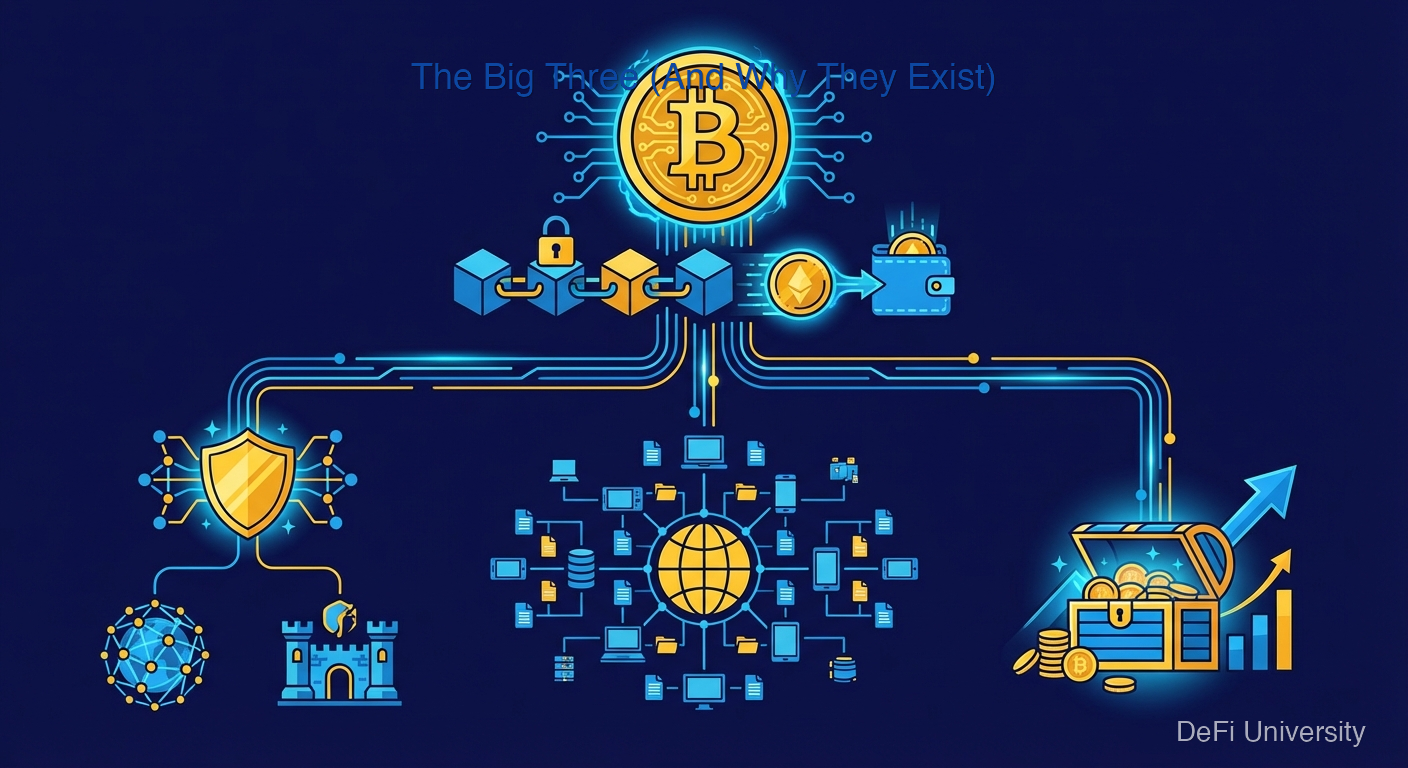
There's a common saying in blockchain: "Pick two of three: Security, Decentralization, Scalability."
Security: How hard is it to attack or manipulate?
Decentralization: How distributed is control? How many validators/nodes?
Scalability: How many transactions can it handle? How fast?
Optimizing one often weakens another:
More speed → usually requires fewer validators → less decentralized
More security → usually requires more confirmation time → slower
More decentralization → usually harder to coordinate → less scalable
Different blockchains make different choices about this trade-off.
Layer 2: The Best of Both Worlds?
To get around the trilemma, "Layer 2" solutions build on top of base blockchains:
How it works: Bundle many transactions together, process them quickly off the main chain, then post summaries to the main chain.
Examples:
Lightning Network (Bitcoin): Near-instant Bitcoin payments
Arbitrum, Optimism (Ethereum): Faster, cheaper Ethereum transactions
The idea: Get the security of a major blockchain + the speed/cost of optimized systems.
This is like using the secure interstate for important checkpoints while using local roads for the journey between them.
How to Think About Choices
When choosing a blockchain, consider:
What are you doing? Storing life savings? Use the most secure. Quick payments? Use the fastest.
How much risk can you tolerate? Less established chains may offer better features but more uncertainty.
What ecosystem do you need? Specific applications only exist on specific chains.
What's the cost/speed requirement? Different needs favor different chains.
Most experienced users hold assets on multiple chains depending on use case—Bitcoin for savings, Ethereum for DeFi, Solana for gaming, etc.
The Evolving Landscape
Blockchain technology is still young. What's true today may change:
New chains emerge with different innovations.
Existing chains upgrade to address weaknesses.
Layer 2s improve to offer best of both worlds.
Interoperability grows making it easier to move between chains.
Understanding the trade-offs helps you evaluate both current options and future developments.
Key Takeaways
Different blockchains optimize for different things—security, speed, cost, features
Bitcoin is most secure and simple but slow and limited
Ethereum enables applications but can be expensive
Solana is fast and cheap but less decentralized
The trilemma (security, decentralization, scalability) forces trade-offs
Layer 2 solutions try to offer best of both worlds
No single "best" blockchain—choice depends on use case
Last updated