Lesson 6: Network Selection Matters

🎧 Lesson Podcast

🎬 Video Overview

Lesson 6: Network Selection Matters
Header

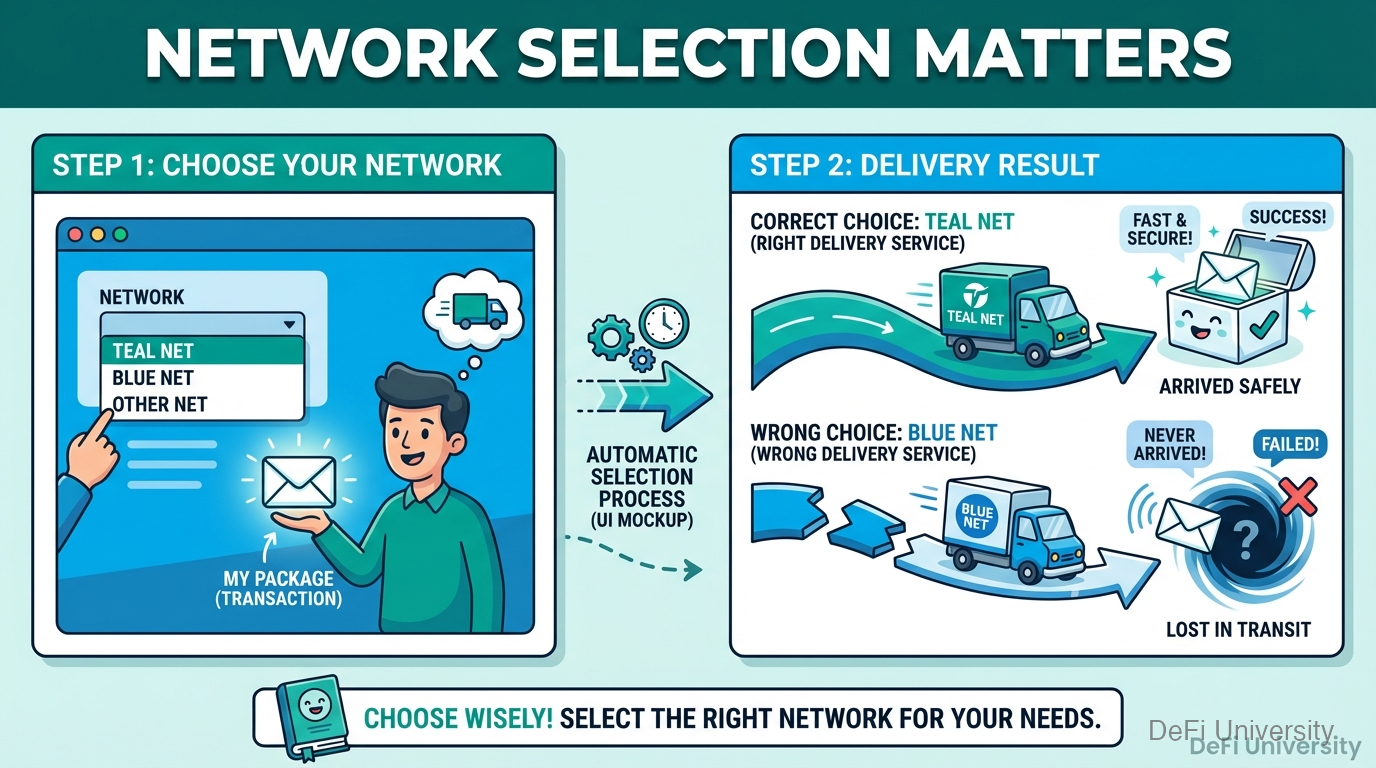
Core concept: Choosing the right network is like choosing the right delivery service—send via the wrong one and your package never arrives.


Choosing the Right Delivery Service

Inline Analogy

You want to ship a package. You can choose:

  • FedEx (fast, works everywhere in their network)

  • UPS (different network, doesn't deliver to FedEx locations)

  • Local courier (only works in your city)

If you ship FedEx but give a UPS-only pickup location, the package can't be delivered.

Blockchain networks work similarly. A transaction on Ethereum only arrives at Ethereum addresses. Sending the "same" token via the wrong network can mean permanent loss.


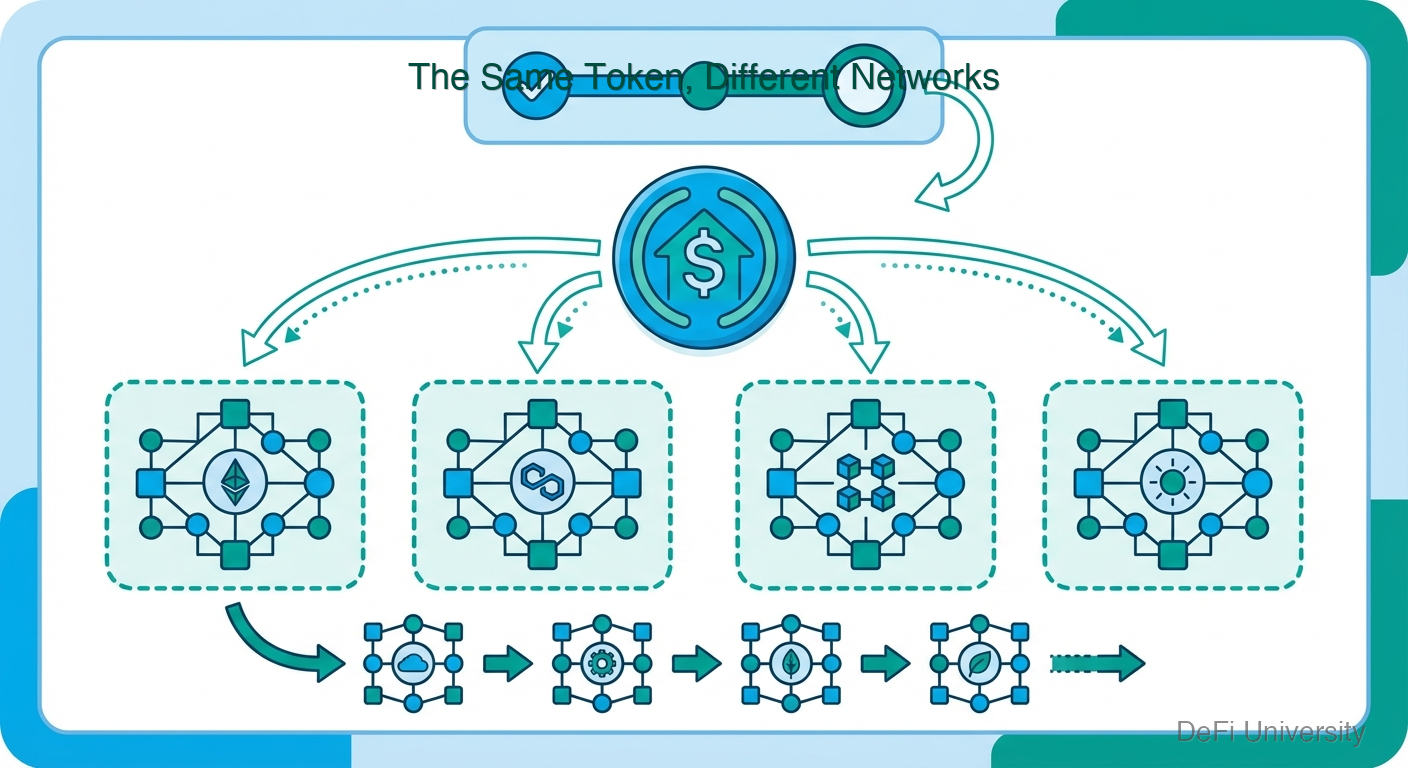
The Same Token, Different Networks

Infographic

Here's where confusion happens:

USDC (a stablecoin) exists on:

  • Ethereum (original)

  • Polygon

  • Arbitrum

  • Solana

  • Many others

The token has the same name and value, but each version lives on a different blockchain.

If you send USDC via Polygon to an exchange that only accepts USDC via Ethereum, you might lose those funds forever. The tokens exist, but on a network the recipient can't access.


How Network Selection Appears

When withdrawing from exchanges, you'll see network choices:

Example withdrawal screen:

Each option has different:

  • Fees: Ethereum often most expensive, L2s cheaper

  • Speed: Some faster than others

  • Compatibility: Not all destinations support all networks

You must match the network to what the receiving wallet/exchange supports.


Checking What Networks Are Supported

Before sending:

If sending to an exchange: Check their deposit page for that specific crypto. It will list supported networks. Only use those networks.

If sending to your own wallet: Check what networks your wallet app supports. Most support Ethereum and popular L2s, but verify.

If sending to someone else: Ask them which network they want to receive on.

Never assume. Always verify.


What Happens With Wrong Network

Scenario 1: Exchange doesn't support the network You send USDC via Polygon to Coinbase, which only accepts Ethereum USDC.

  • Funds arrive at the address

  • But Coinbase doesn't monitor Polygon

  • Your funds sit there inaccessible

  • Recovery sometimes possible (expensive, not guaranteed)

Scenario 2: Wallet doesn't support the network You send tokens via Arbitrum to a wallet that doesn't support Arbitrum.

  • If you control the wallet keys, you can add the network and access funds

  • If you don't control keys (like an exchange), might be lost

Scenario 3: Incompatible chains entirely You try to send Bitcoin to an Ethereum address (or vice versa).

  • Transaction usually fails before sending (different address formats)

  • But some edge cases can result in loss


Network Selection Best Practices

Always verify supported networks first: Check both sending and receiving sides.

Use matching networks: If they support Ethereum, send via Ethereum. Don't get creative.

Consider fees: If multiple networks supported, cheaper networks save money.

Test with small amount: Especially for new networks or destinations.

Read the warnings: Exchanges show network warnings. Don't skip them.

When in doubt, ask: Contact support or ask the recipient before sending.


Summary

Key Takeaways

  • Same tokens can exist on multiple networks—USDC on Ethereum ≠ USDC on Polygon

  • Sender and receiver must use matching networks—mismatches cause losses

  • Always check supported networks on both ends before sending

  • Cheaper networks exist but only use if supported by destination

  • Wrong network = potentially permanent loss—transactions are irreversible

  • When uncertain, verify first—no shame in asking or testing with small amounts

Last updated