Exercise 6: Risk Psychology Mastery Protocol
⏰ Time Investment: 45-60 minutes initial setup + 5 minutes daily monitoring 🎯 Goal: Master position sizing psychology to protect capital and maximize sustainable growth
📚 Required Reading Integration 📖 Primary: "The Psychology of Trading" by Brett Steenbarger - Chapters 5-7 📖 Primary: "Trading in the Zone" by Mark Douglas - Chapters 8-9 📖 Supporting: "Thinking, Fast and Slow" by Kahneman - Chapters 25-28 (Prospect Theory) 📖 Livermore Focus: "Reminiscences" - Chapters 20-22 (position sizing mastery)
🔍 Phase 1: Personal Risk Psychology Assessment (15 minutes) Your True Risk Tolerance Discovery
Before you can manage risk properly, you must know your actual risk tolerance — not what you think it is, but what it really is under stress.
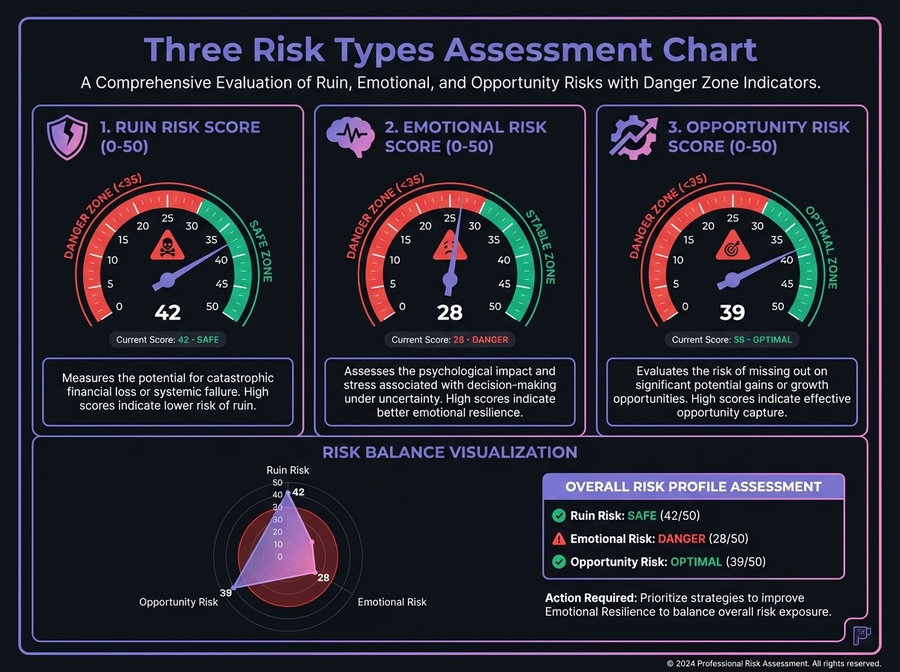
💀 The Three Risk Types Assessment
Ruin Risk Evaluation Rate your current situation 1-10 (1=extremely risky, 10=very safe):
□ My largest single position is ____% of my portfolio ___/10 (10=<2%, 7=2-5%, 5=5-10%, 3=10-20%, 1=>20%)
□ I could lose my largest position completely and continue trading ___/10
□ I never use leverage on volatile DeFi assets ___/10
□ I only invest capital I can afford to lose 100% ___/10
□ My portfolio drawdown tolerance is ____% before I quit ___/10
📊 Ruin Risk Score: ___/50 (Below 35 = DANGER ZONE)
Most dangerous position right now:
Protocol: _________________________________________
Position size: ____% of portfolio
If this went to zero tomorrow: □ I'd be fine and continue □ I'd be stressed but survive □ I'd be financially/psychologically devastated
Emotional Risk Evaluation Rate yourself 1-10 (1=completely emotional, 10=completely calm):
□ I check my portfolio ____ times per day ___/10 (10=1-2x, 7=3-4x, 5=5-8x, 3=9-15x, 1=>15x)
□ I can sleep peacefully regardless of market volatility ___/10
□ I never make impulsive decisions during big swings ___/10
□ My position sizes don't cause me constant anxiety ___/10
□ I can watch a position drop 30% without panic ___/10
📊 Emotional Risk Score: ___/50 (Below 35 = Positions too large)
Position causing most emotional distress:
Protocol: _________________________________________
Anxiety level (1-10): ___/10
Times checked today: _____
Sleep quality impact (1-10): ___/10
Opportunity Risk Evaluation Rate yourself 1-10:
□ My positions are large enough to create meaningful wealth ___/10
□ I'm not over-trading due to position sizes being too small ___/10
□ My risk capital is appropriately allocated (not too conservative) ___/10
□ I can participate in quality opportunities when they arise ___/10
□ My fees-to-gains ratio is favorable (low trading frequency) ___/10
📊 Opportunity Risk Score: ___/50 (Below 35 = Too conservative)
🎯 Your Primary Risk Issue Highest vulnerability: _______________________________
Action required: __________________________________
💸 Current Portfolio Risk Analysis
Total Portfolio Value: $__________
Largest Position: __________ ($______ / ____%)
Top 3 Positions Total: ______%
Single Sector Concentration (largest): ______%
Acceptable Loss per Position: $______ (2% max)
Current Actual Loss Tolerance: $______
Gap (if any): $______ (This is your overexposure)
🧠 
Phase 2: Position Sizing Psychology Framework (20 minutes)
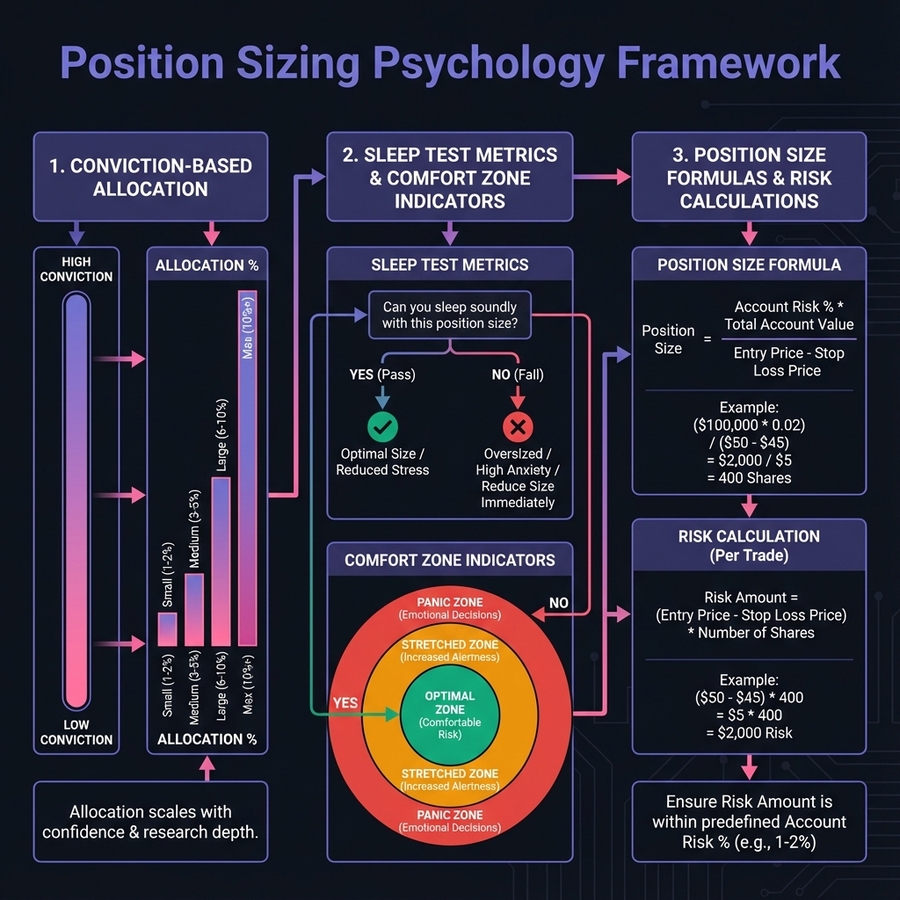
📏 The Conviction-Based Position Sizing System
For each position, rate your conviction level and assign appropriate size:
Current Position #1: ______________________________
Conviction Level (1-10): ___/10
Appropriate Max Size: • 9-10/10 conviction = 5% max • 7-8/10 conviction = 3% max • 5-6/10 conviction = 1% max • Below 5/10 = NO POSITION
Current Size: ____% Target Size: ____% Action: _______
Reason for conviction level:
What would lower conviction: _________________________
What would raise conviction: _________________________
Current Position #2: ______________________________
Conviction Level (1-10): ___/10
Current Size: ____% Target Size: ____% Action: _______
Reason for conviction level:
What would lower conviction: _________________________
What would raise conviction: _________________________
Current Position #3: ______________________________
Conviction Level (1-10): ___/10
Current Size: ____% Target Size: ____% Action: _______
Reason for conviction level:
What would lower conviction: _________________________
What would raise conviction: _________________________
Current Position #4: ______________________________
Conviction Level (1-10): ___/10
Current Size: ____% Target Size: ____% Action: _______
Reason for conviction level:
What would lower conviction: _________________________
What would raise conviction: _________________________
Current Position #5: ______________________________
Conviction Level (1-10): ___/10
Current Size: ____% Target Size: ____% Action: _______
Reason for conviction level:
What would lower conviction: _________________________
What would raise conviction: _________________________
Total Adjustments Needed: $________ (rebalancing required)
😴 The Emotional Sizing Tests
The Sleep Test Review each position and rate sleep quality impact:
Position: ____________ Sleep Impact (1-10): ___ If 8-10 (ruins sleep) = Position too large, reduce by 50%
Position: ____________ Sleep Impact (1-10): ___ Position: ____________ Sleep Impact (1-10): ___ Position: ____________ Sleep Impact (1-10): ___ Position: ____________ Sleep Impact (1-10): ___
Positions requiring reduction: _______________________
The Comfort Zone Test Rate emotional state for each position (1-10): • 1-3 = Too small to care • 4-7 = Optimal psychological size • 8-10 = Overleveraged emotionally
Position: ____________ Emotional State: ___/10 Action: ______ Position: ____________ Emotional State: ___/10 Action: ______ Position: ____________ Emotional State: ___/10 Action: ______ Position: ____________ Emotional State: ___/10 Action: ______ Position: ____________ Emotional State: ___/10 Action: ______
The "Zero Tomorrow" Test For each position, complete: "If this went to zero tomorrow, I would feel..."
Position 1: ___________________________________________ Feeling: □ Fine (good size) □ Stressed (too large) □ Devastated (way too large)
Position 2: ___________________________________________ Feeling: □ Fine (good size) □ Stressed (too large) □ Devastated (way too large)
Position 3: ___________________________________________ Feeling: □ Fine (good size) □ Stressed (too large) □ Devastated (way too large)
Position 4: ___________________________________________ Feeling: □ Fine (good size) □ Stressed (too large) □ Devastated (way too large)
Position 5: ___________________________________________ Feeling: □ Fine (good size) □ Stressed (too large) □ Devastated (way too large)
Any position marked "Devastated" = Reduce immediately to 50% or less Any position marked "Stressed" = Reduce to achieve "Fine" status
📊 Livermore's Pyramiding Protocol
"I never buy a stock at the top or sell at the bottom. I wait for the market to prove my case."
Your Pyramiding Plan (building positions gradually):
Target Protocol: ______________________________________
Total Target Position: ____% (of portfolio)
Pyramiding Structure:
Initial Test Position: % (25% of total target) Entry price: $__ Conditions to add: _________________________________
Second Tier: _% (25% of total target) Only add if: Price up % AND ___________________ Target entry: $
Third Tier: _% (25% of total target) Only add if: Price up % AND ___________________ Target entry: $
Final Tier: _% (25% of total target) Only add if: Price up % AND ___________________ Target entry: $
Never Average Down Rule: "I will NEVER add to a losing position. Only the market confirming my thesis justifies additional capital allocation."
Signed: _________________ Date: _______
📅 
Phase 3: Pre-Commitment Risk Protection System (10 minutes)
The Pre-Trade Risk Contract Before entering ANY new position, complete this contract:
New Position: _________________________________________
Position Size Decision:
Portfolio value: $__________ Maximum risk per position: $______ (2% recommended) Position size: $______ Percentage of portfolio: ____%
Conviction level: ___/10 Appropriate for conviction: Yes/No
Pre-Commitment Stop Loss:
Entry price: $______ Stop loss price: $______ (Never change this) Maximum loss: $______ (Must be ≤ 2% of portfolio)
"I commit to exiting at $______ without hesitation, regardless of hope, conviction, or belief in recovery. I understand the market doesn't care about my entry price."
Signed: _________________ Date: _______
Emotional Sizing Check:
□ I can sleep peacefully with this position size □ I won't need to check this position constantly □ I can lose the maximum loss amount without panic □ This size aligns with my conviction level □ I have capital reserved for other opportunities
If ANY box is unchecked, reduce position size by 50% and re-evaluate.
Exit Conditions (Non-Emotional):
I will exit this position if:
I will take profits if:
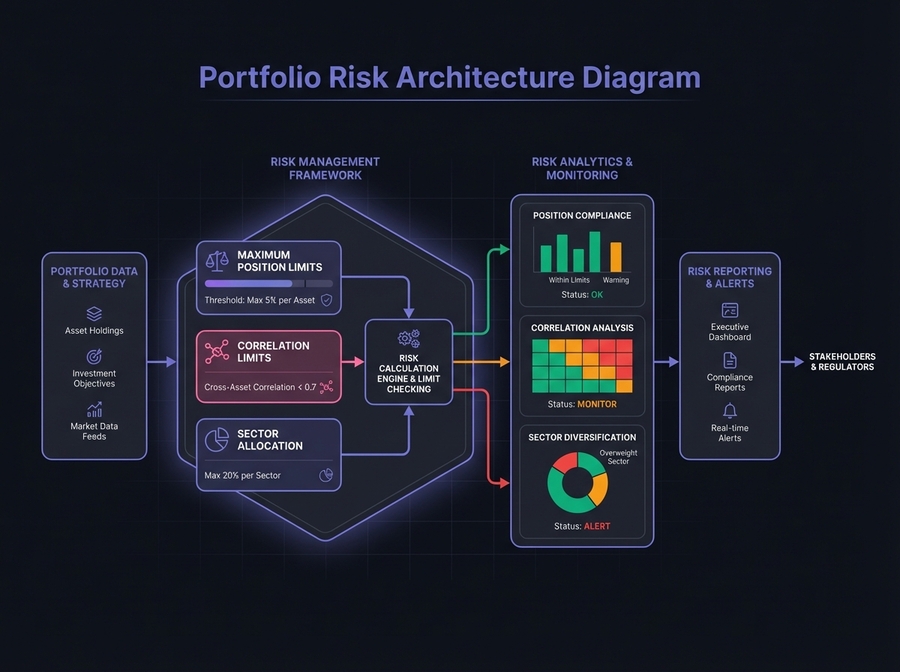
🎯 Phase 4: Portfolio Risk Architecture (15 minutes)
DeFi Sector Allocation Limits Prevent concentration risk across sectors:
Layer 1 Blockchains: ____% (Max 25%) Current: ____% - Action: _____________
Layer 2 Solutions: ____% (Max 20%) Current: ____% - Action: _____________
DEXs & AMMs: ____% (Max 15%) Current: ____% - Action: _____________
Lending Protocols: ____% (Max 15%) Current: ____% - Action: _____________
Derivatives: ____% (Max 10%) Current: ____% - Action: _____________
Stablecoins: ____% (Min 15%, Max 40%) Current: ____% - Action: _____________
Other/Speculative: ____% (Max 15%) Current: ____% - Action: _____________
Total: 100%
The Barbell Risk Strategy Combine extreme safety with extreme upside:
80% Foundation (Safe Assets): • BTC: ____% • ETH: ____% • Stablecoins: ____% • Blue Chip DeFi (Aave, Uni, etc.): ____%
Total Foundation: ____% (Target: 75-85%)
20% Asymmetric Bets (High Risk/Reward): • New protocols: ____% • Small caps: ____% • Experimental: ____%
Total Asymmetric: ____% (Target: 15-25%)
Avoid Mediocre Middle: ____% (Medium risk, medium reward - worst risk/reward profile) Target: <10%
Chain Diversification Don't put all capital on one chain:
Ethereum: ____% Polygon: ____% Arbitrum/Optimism: ____% Other L2s: ____% Alt L1s (Solana, etc.): ____% Multi-chain: ____%
Largest chain exposure: ____% (Maximum 50% recommended)
🚨 
Phase 5: Drawdown Response Protocols (10 minutes)
Pre-Program Your Responses Set these triggers NOW before emotions take over:
10% Portfolio Drawdown Trigger Current portfolio value: $__________ 10% trigger point: $__________ (90% of current)
Automatic Actions: □ Pause all new investments for 48 hours □ Review and rate conviction on all positions □ Consider taking profits on remaining winners □ Reduce position sizes on speculative plays by 50% □ Review risk management rules for violations
"At $_________, I will execute the 10% protocol without debate."
20% Portfolio Drawdown Trigger 20% trigger point: $__________ (80% of starting value)
Automatic Actions: □ Reduce ALL positions by 50% immediately □ Move to 50% stablecoins minimum □ Keep only highest conviction positions (9-10/10) □ Stop ALL speculative trading □ Review strategy for fundamental flaws
"At $_________, I will execute the 20% protocol without hesitation."
35% Portfolio Drawdown Trigger 35% trigger point: $__________ (65% of starting value)
Automatic Actions: □ Move to 75% stablecoins immediately □ Preserve remaining capital at all costs □ Take 1-4 week complete break from markets □ Seek mentor/accountability partner guidance □ Start over with 1% position sizes
"At $_________, I will execute the 35% protocol. Survival > Recovery."
Monthly Risk Review Checklist
Completed on: ________ (First of each month)
□ Current portfolio drawdown: ____% □ Largest position size: ____% (Max 5%) □ Top 3 positions combined: ____% (Max 15%) □ Largest sector concentration: ____% (Max 25%) □ Number of positions causing sleep issues: _____ (Target: 0) □ Risk per position average: ____% (Target: 1-2%) □ Times I violated position sizing rules: _____ (Target: 0) □ Times I violated stop losses: _____ (Target: 0) □ Emotional risk score (1-10): _____ (Target: 7+) □ Risk management grade: A B C D F
Actions required this month: _________________________
🎯 Implementation Action Plan
⚡ Immediate Actions (Today) □ Complete personal risk psychology assessment □ Calculate appropriate position sizes for all holdings □ Identify and reduce any oversized positions □ Set pre-commitment stops for all positions □ Create drawdown trigger alerts
📅 30-Day Risk Mastery Goals □ Rebalance portfolio to appropriate position sizes □ Implement conviction-based sizing for all positions □ Use pre-trade risk contract for 100% of new positions □ Pass sleep test on all positions (0 sleepless nights) □ Maintain risk per position below 2% □ Document and follow drawdown protocols if triggered
🏆 Success Metrics
Primary: Zero positions causing sleep issues or anxiety
Secondary: All positions sized appropriately for conviction level
Behavioral: Pre-trade risk contract used 100% of time
Financial: Maximum drawdown <15% despite market volatility
Psychological: Emotional risk score improved to 7+/10
📖 Book Integration Exercises
🧠 From Trading in the Zone (Douglas)
Probability Mindset Applied to Position Sizing "Anything can happen. I don't need to know what will happen next to make money."
Complete this reframe: Old mindset: "This WILL go up, so I'll bet big" New mindset: "This MIGHT go up, so I'll bet appropriately"
Your position sizing rules based on probability: High probability (>70%): ___% max position Medium probability (50-70%): ___% max position Low probability (<50%): ___% max position or no position
💡 From The Psychology of Trading (Steenbarger)
The Risk Management Self-Audit Answer honestly:
How often do you violate your position sizing rules? Never / Rarely / Sometimes / Often / Always
What triggers the violations?
What's the cost of these violations this year? $__________
Commitment to change: "Starting today, I will ______________________________"
📚 From Thinking, Fast and Slow (Kahneman)
Prospect Theory and Loss Aversion You feel losses 2x more intensely than equivalent gains.
This means: A $1,000 loss feels like losing $2,000 psychologically.
Your loss aversion impact assessment: How many times have you held losers too long? _____ Average additional loss from holding: $______ Total cost of loss aversion this year: $______
New commitment: "I will honor all pre-commitment stops to prevent loss aversion from controlling my decisions."
Signed: _________________ Date: _______
👥 Community Integration
🎯 Weekly Risk Management Mastermind:
Share your largest position size challenge this week
Discuss drawdown triggers and whether you followed protocols
Celebrate successful position sizing decisions
Hold each other accountable to risk rules
🤝 Accountability Structure:
Risk Management Partner: ___________________________
Weekly Check-in: Every _______ at _______ (day/time)
What we share: • Current largest position size and conviction level • Any violations of position sizing or stop loss rules • Emotional risk score (1-10) • Portfolio drawdown percentage
Support protocol: If partner reports position sizing violation:
Identify the psychological trigger
Discuss appropriate position size
Create commitment to adjust
Follow up in 24 hours
🚀 Quick Reference Card
⚡ Before Every Trade (2 min) Complete pre-trade risk contract
Calculate maximum loss (≤2% portfolio)
Set pre-commitment stop loss
Pass emotional sizing tests
Confirm conviction level matches size
📅 Weekly Risk Review (10 min) Check all position sizes vs conviction levels
Verify no positions causing sleep issues
Confirm sector allocations within limits
Review and log any risk rule violations
Calculate current portfolio drawdown
Monthly Deep Audit (30 min) Complete full risk psychology assessment
Recalibrate position sizes for changed convictions
Update drawdown trigger levels
Review risk management performance
Grade yourself and set improvement goals
💎 Key Takeaway
"Position sizing is 80% psychology, 20% math. Master the psychology, and the math will protect you. Ignore the psychology, and no math will save you."
The most important question in trading isn't "Will this go up?" — it's "How much should I risk to find out?"
👇 Comment below with your largest position size as a % of your portfolio and whether it passes the sleep test!
Last updated