Exercise 8: Peak Performance Optimization System
⏰ Time Investment: 45-60 minutes initial setup + daily implementation 🎯 Goal: Optimize cognitive performance for superior DeFi research and decision-making
📚 Required Reading Integration 📖 Primary: "Peak Performance" by Brad Stulberg & Steve Magness - Chapters 1-8 📖 Supporting: "Deep Work" by Cal Newport - Chapters 1-3 📖 Supporting: "The Psychology of Trading" by Brett Steenbarger - Chapters 8-9 📖 Livermore Focus: Mental discipline and preparation routines
🔍 Phase 1: Cognitive Performance Audit (15 minutes) Your Current Mental State Assessment
Before optimizing performance, you must understand your current cognitive patterns.
🧠 Brain State Analysis
Track your predominant brain state during trading activities:
Stress/Survival Mode 🔴 (Emotional, reactive, poor decisions) Frequency during trading: % of time Triggers: __________________________________________ Cost this month: $___
Default/Comfortable Mode 🟡 (Autopilot, average performance) Frequency during trading: ___% of time Typical activities: _________________________________ Results: Mediocre / Inconsistent
Flow/Peak Performance Mode 🟢 (Optimal focus, best decisions) Frequency during trading: ___% of time Conditions that create it: __________________________ Results: Excellent / Profitable
Goal: 70%+ time in Flow, <10% in Stress
⚡ Energy and Cognitive Clarity Tracking
Complete this assessment for a typical trading day:
6:00 AM - Cognitive clarity (1-10): ___ Energy: ___ 8:00 AM - Cognitive clarity (1-10): ___ Energy: ___ 10:00 AM - Cognitive clarity (1-10): ___ Energy: ___ 12:00 PM - Cognitive clarity (1-10): ___ Energy: ___ 2:00 PM - Cognitive clarity (1-10): ___ Energy: ___ 4:00 PM - Cognitive clarity (1-10): ___ Energy: ___ 6:00 PM - Cognitive clarity (1-10): ___ Energy: ___ 8:00 PM - Cognitive clarity (1-10): ___ Energy: ___ 10:00 PM - Cognitive clarity (1-10): ___ Energy: ___
📊 Peak Performance Windows Identified:
Primary peak (best 2-3 hours): ______ AM/PM to ______ AM/PM Secondary peak: ______ AM/PM to ______ AM/PM Low energy periods: ______ AM/PM to ______ AM/PM
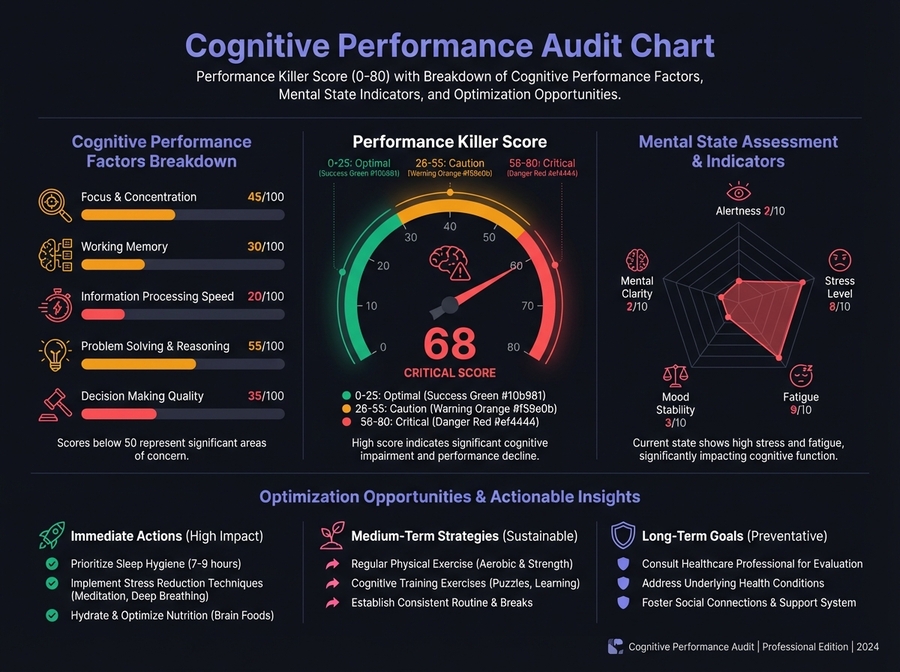
🎯 Current Performance Killers
Rate how often these destroy your cognitive performance (1=rarely, 10=constantly):
□ Checking portfolio/charts constantly ___/10 □ Social media and information overload ___/10 □ Poor sleep quality (< 7 hours) ___/10 □ No exercise or physical movement ___/10 □ Working during low-energy periods ___/10 □ Multitasking during research ___/10 □ Caffeine/stimulant dependency ___/10 □ Never disconnecting from markets ___/10
📊 Performance Killer Score: ___/80 (Higher = More optimization needed)
Top 3 killers to address immediately:
🌊 
Phase 2: Flow State Creation System (20 minutes)
The Four Flow Triggers for DeFi Research
Trigger 1: Clear Goals (Eliminates mental wandering)
Vague Goal: "Research some DeFi protocols today" ❌ Flow Goal: "Evaluate 3 lending protocols using my 10-point scorecard to identify best risk-adjusted yield by 2 PM" ✅
Your Flow Goals Template:
Research Session Goal: "I will [specific action] on [specific protocols/topics] using [specific framework] to [specific outcome] by [specific time]"
Today's Research Goal:
Tomorrow's Research Goal:
This Week's Major Goals:
Trigger 2: Immediate Feedback (Engages brain continuously)
Create feedback loops during research:
□ Use checklists that confirm completion of critical steps □ Score protocols immediately using your framework (1-10) □ Note when analysis reveals clear answers □ Track time to complete each research phase □ Compare your assessment to market pricing immediately
Your Immediate Feedback System:
Research checklist created: Yes/No Scoring framework defined: Yes/No Timer system implemented: Yes/No
Trigger 3: Challenge-Skill Balance (The "Goldilocks Zone")
Too Easy: Researching protocols you already understand completely Brain disengages → No flow state → Poor retention
Too Hard: Analyzing complex derivatives without foundational knowledge Frustration → Stress response → Terrible decisions
Just Right: Stretching current knowledge by 10-15% Engagement → Flow state → Optimal learning
Your Challenge-Skill Assessment:
Current skill level in DeFi: Beginner / Intermediate / Advanced
Appropriate challenges for flow: • Beginner: Core protocol mechanics, basic tokenomics • Intermediate: Protocol comparisons, risk assessment frameworks • Advanced: Novel mechanism design, complex integration analysis
Your Flow Zone Challenges:
Trigger 4: Deep Concentration (Eliminate all distractions)
The Distraction Elimination Protocol:
□ Phone on airplane mode or in different room □ Close all social media and chat apps □ Disable all price alerts and notifications □ Close email and communication tools □ Use website blocker for non-essential sites □ Clear workspace of visual distractions □ Inform others you're unavailable □ Set "Do Not Disturb" on all devices
Time-Box: 90-120 minutes max (cognitive fatigue after)
Single-Task Focus: One protocol, one analysis at a time Multitasking is the enemy of excellence.
🎯 The Peak Performance Research Protocol
Pre-Research Preparation (10 minutes)
Physical Optimization: □ Hydrate (16-20 oz water) □ Optimal temperature (68-72°F) □ Good lighting (natural preferred) □ Comfortable but alert posture
Mental Preparation: □ 5-minute meditation or breathing exercise □ Set clear intention: "I will accomplish _________" □ Remove all potential distractions proactively □ Set timer for focus session (90-120 min)
Cognitive Priming: □ Review research framework/checklist □ Spend 3 minutes on protocol overview □ Set specific success metrics for session □ Enter mindset: "I am focused, clear, analytical"
The Flow Research Session (90-120 minutes)
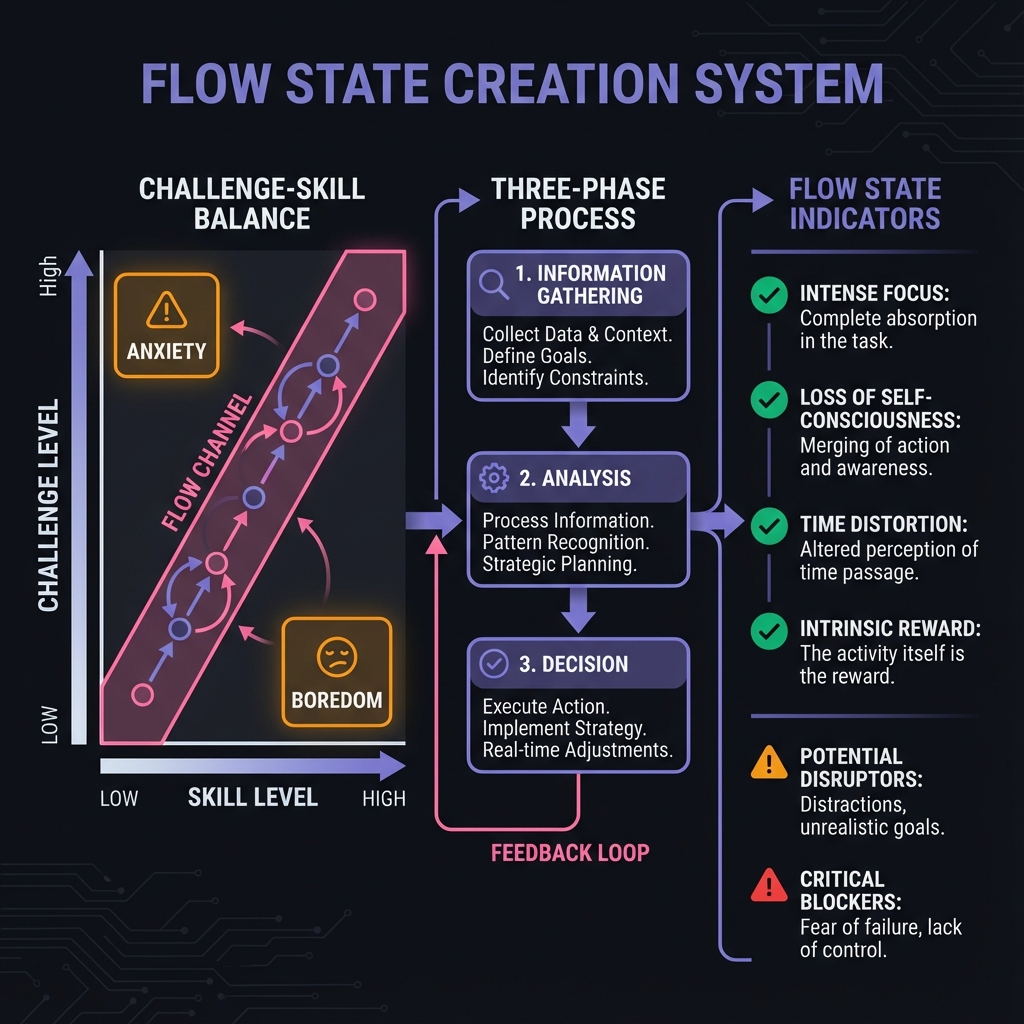
Phase 1: Information Gathering (30-40 min) → Read protocol documentation systematically → Gather quantitative data (TVL, volume, tokenomics) → Note questions and knowledge gaps → Resist evaluation — just collect information
Phase 2: Analysis and Synthesis (40-60 min) → Apply evaluation framework systematically → Compare with similar protocols → Identify key risks and opportunities → Build investment thesis with confidence levels
Phase 3: Decision and Documentation (20 min) → Make go/no-go decision with position sizing → Document reasoning for future reference → Set up monitoring and review triggers → Plan next steps if warranted
Post-Research Recovery (15 minutes) □ Step away from screens completely □ Physical movement (walk or stretch) □ Reflect on session quality and learnings □ Plan next research session while fresh
📊 
Phase 3: Information Diet Architecture (15 minutes)
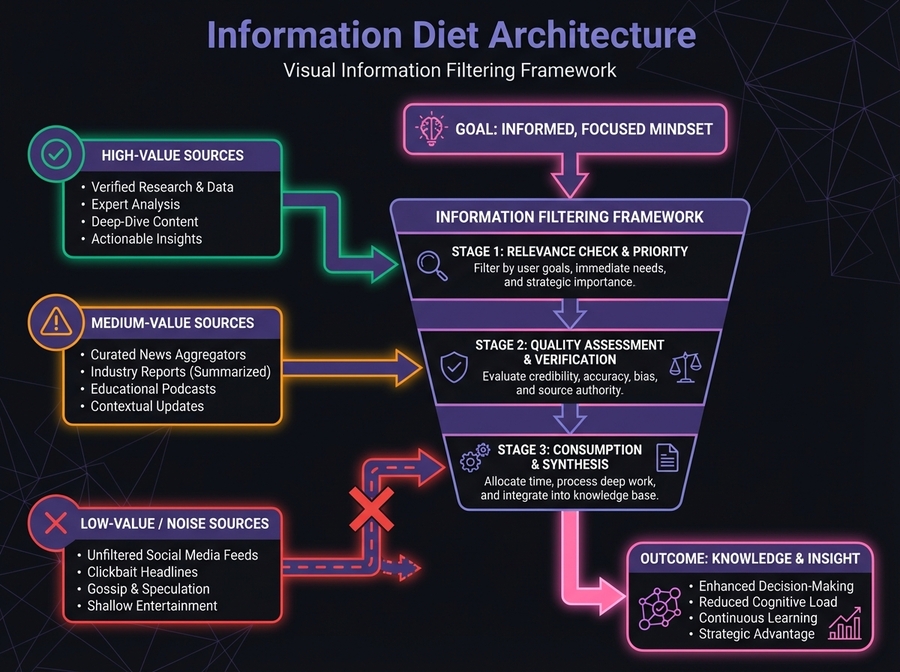
The Four-Tier Information Hierarchy
Design your information consumption based on signal-to-noise ratio:
Tier 1: Essential (Daily Consumption)
Sources:
Time allocated: _____ minutes daily Consumption schedule: _____ AM/PM
Content: Portfolio performance, major protocol updates affecting positions, market structure changes, high-signal research reports
Tier 2: Important (2-3x Weekly)
Sources:
Time allocated: _____ minutes per session Consumption schedule: Mon/Wed/Fri or _____________
Content: Industry trends, ecosystem developments, quality podcasts/long-form content, peer discussions
Tier 3: Optional (Weekly or Less)
Sources:
Time allocated: _____ minutes weekly Consumption schedule: Weekends or ______________
Content: Social media sentiment checks, community forums, entertainment value
Tier 4: Never (Cognitive Poison)
Eliminate completely: □ Gambling/get-rich-quick content □ Emotional manipulation and fear-mongering □ Low-quality influencer hype □ Constant price prediction content □ Pump group and signal services
"I commit to zero consumption of Tier 4 content starting today."
Signed: _________________ Date: _______
📅 Phase 4: Stress + Rest = Growth Formula (15 minutes)
The Performance Equation
Peak performance = Productive Stress + Complete Recovery
Most traders add stress until they break. Elite traders balance stress and rest.
💪 Productive Stress (Grows your capabilities)
Schedule these during peak cognitive hours:
□ Challenging research projects (new protocols/concepts) □ Complex analysis requiring full attention □ Learning new DeFi mechanisms □ Major portfolio decisions
Your Productive Stress Activities:
Scheduled during: ______ to ______ (peak hours)
🛌 Essential Recovery (Restores cognitive resources)
Non-Negotiable Recovery Practices:
Sleep Quality Protocol: Target: 7-9 hours per night Bedtime: ______ PM (consistent) Wake time: ______ AM (consistent) No screens 30 min before bed: Committed Yes/No
Physical Exercise: Type: _______________ Frequency: _____ days per week Duration: _____ minutes per session Scheduled: _____ AM/PM
Complete Market Disconnection: Evening cutoff: ______ PM (no checking after this) Weekend disconnect: Yes/No Days completely off per month: _____
Non-Trading Activities (Cognitive reset):
Schedule: _________________________________________
🔋 Cognitive Load Management
Allocate mental energy like venture capital allocates money:
High Cognitive Load Activities (Peak Hours Only) • New protocol research and analysis • Complex DeFi strategy development • Major portfolio decisions • Learning new concepts
Schedule: ______ to ______ (your peak window)
Medium Cognitive Load Activities (Good Hours) • Familiar protocol monitoring • Market condition assessment • Portfolio review and adjustments • Planning and preparation
Schedule: ______ to ______
Low Cognitive Load Activities (Off-Peak Hours) • Routine portfolio monitoring • Reading familiar content • Administrative tasks • Social media (if any)
Schedule: ______ to ______
The Energy Management Calendar
Monday: Peak hours (_____ to ): ______________________ Good hours ( to ): ______________________ Low hours ( to _____): _______________________
Tuesday: Peak hours: ________________________________________ Good hours: ________________________________________ Low hours: _________________________________________
Wednesday: Peak hours: ________________________________________ Good hours: ________________________________________ Low hours: _________________________________________
Thursday: Peak hours: ________________________________________ Good hours: ________________________________________ Low hours: _________________________________________
Friday: Peak hours: ________________________________________ Good hours: ________________________________________ Low hours: _________________________________________
Weekend Recovery Protocol: Saturday: __________________________________________ Sunday: ___________________________________________
🎯 Phase 5: Decision Fatigue Prevention System (10 minutes)
Every decision depletes mental energy. Automate ruthlessly.
Decisions to Automate (Zero Mental Energy)
Daily Routine: Market check times: _____, _____, _____ (fixed times only) Research block: _____ to _____ (same time daily) Evening review: _____ PM (same time daily)
Position Sizing: Use formula: ___% for 9-10/10 conviction, ___% for 7-8/10, ___% for 5-6/10 No in-the-moment decisions allowed.
Stop Losses: Set before entry using formula: Entry price - ____% Never adjust after entry.
Information Consumption: Tier 1: Daily at _____ AM/PM Tier 2: Mon/Wed/Fri at _____ AM/PM Tier 3: Weekends only Tier 4: Never
"I will automate these decisions starting today."
Decisions Worth Your Best Mental Energy
Reserve cognitive resources for: □ Protocol selection and thesis development □ Position sizing for new opportunities □ Portfolio allocation and rebalancing □ Strategy pivots based on market changes
These get your peak hours only: _____ to _____
The Decision Fatigue Emergency Protocol
When you feel mentally exhausted:
Stop making decisions immediately
Take 15-minute break (walk, breathe, hydrate)
If still exhausted, defer decision to tomorrow
Never make major decisions when depleted
"I will not make important decisions when mentally fatigued."
Signed: _________________ Date: _______
🎯 Implementation Action Plan
⚡ Immediate Actions (Today) □ Complete energy and cognitive clarity tracking □ Identify peak performance windows □ Eliminate top 3 performance killers □ Set up distraction elimination protocol □ Schedule first flow research session
📅 30-Day Performance Optimization Goals □ Establish consistent sleep schedule (7-9 hours) □ Implement daily peak performance routine □ Create and follow information diet hierarchy □ Schedule work based on cognitive energy levels □ Automate all routine decisions □ Achieve 3+ flow states per week during research □ Reduce Tier 3-4 information consumption by 80%
🏆 Success Metrics
Primary: 70%+ of work happens during identified peak hours
Secondary: 3+ flow research sessions achieved per week
Behavioral: Zero Tier 4 information consumed
Physical: 7+ hours sleep 90%+ of nights
Psychological: Mental energy rated 7+/10 during peak hours
📖 Book Integration Exercises
🧠 From Peak Performance (Stulberg & Magness)
Stress + Rest = Growth Track your balance:
This Week's Productive Stress: _____ hours This Week's Complete Recovery: _____ hours Ratio: _____ (Target: 3:1 to 2:1)
If ratio is off, adjust: _____________________________
💡 From Deep Work (Newport)
Deep Work Capacity Building
Week 1: _____ minutes deep work daily (start small) Week 2: _____ minutes deep work daily (+15 min) Week 3: _____ minutes deep work daily (+15 min) Week 4: _____ minutes deep work daily (target: 90-120 min)
Your deep work capacity grows with practice.
📚 From The Psychology of Trading (Steenbarger)
Performance State Management
Before each trading session, rate yourself: Physical state (1-10): ___ Mental state (1-10): ___ Emotional state (1-10): ___
If any score <6, defer major decisions.
👥 Community Integration
🎯 Weekly Performance Optimization Group:
Share peak performance discoveries and protocols
Discuss flow state triggers that work for you
Compare information diet hierarchies
Hold each other accountable to recovery practices
🤝 Accountability Structure:
Performance Optimization Partner: ___________________
Weekly Check-in: Every _______ at _______ (day/time)
What we share: • Flow states achieved this week • Sleep quality (hours + subjective rating) • Peak hours utilized effectively • Information diet adherence • Performance killer elimination progress
Support protocol: If partner reports poor performance:
Check sleep, exercise, recovery
Verify peak hours being used optimally
Identify performance killers to eliminate
Commit to one improvement for next week
🚀 Quick Reference Card
⚡ Daily Peak Performance Routine
Morning (Peak Hours): □ Physical prep (hydrate, environment) □ Mental prep (meditation, intention) □ Flow session (90-120 min deep work) □ No distractions, single-task focus
Afternoon (Good Hours): □ Medium cognitive load activities □ Portfolio review and adjustments □ Planning for tomorrow □ Light research or monitoring
Evening (Recovery): □ Complete market disconnection □ Physical exercise or movement □ Non-trading activities □ Early screens-off for quality sleep
Weekly Performance Review: □ Flow states achieved: _____ (target: 3+) □ Peak hours utilized: ___% (target: 80%+) □ Sleep quality: _____ hrs avg (target: 7-9) □ Information diet adherence: ___% □ Energy levels: _____/10 average
💎 Key Takeaway
"Your brain is your most valuable trading asset. Optimize it like you would optimize a million-dollar algorithm. Peak performance isn't about working more hours — it's about working your best hours with your best energy on your most important work."
The elite trader's advantage: Superior cognitive performance during decision moments.
👇 Comment below with your peak performance window and one performance killer you're eliminating this week!
Last updated