Lesson 9: Advanced Protocols and Hooks

Lesson 9: Advanced Protocols and Hooks

🎯 Core Concept: The Future of Programmable Liquidity

Uniswap V4 introduces hooks—customizable smart contracts that execute at key moments in a pool's lifecycle. This enables dynamic fees, limit orders, and automated liquidity management. This lesson explores V4's architecture and how hooks will transform LPing.

🏗️ Uniswap V4 Architecture

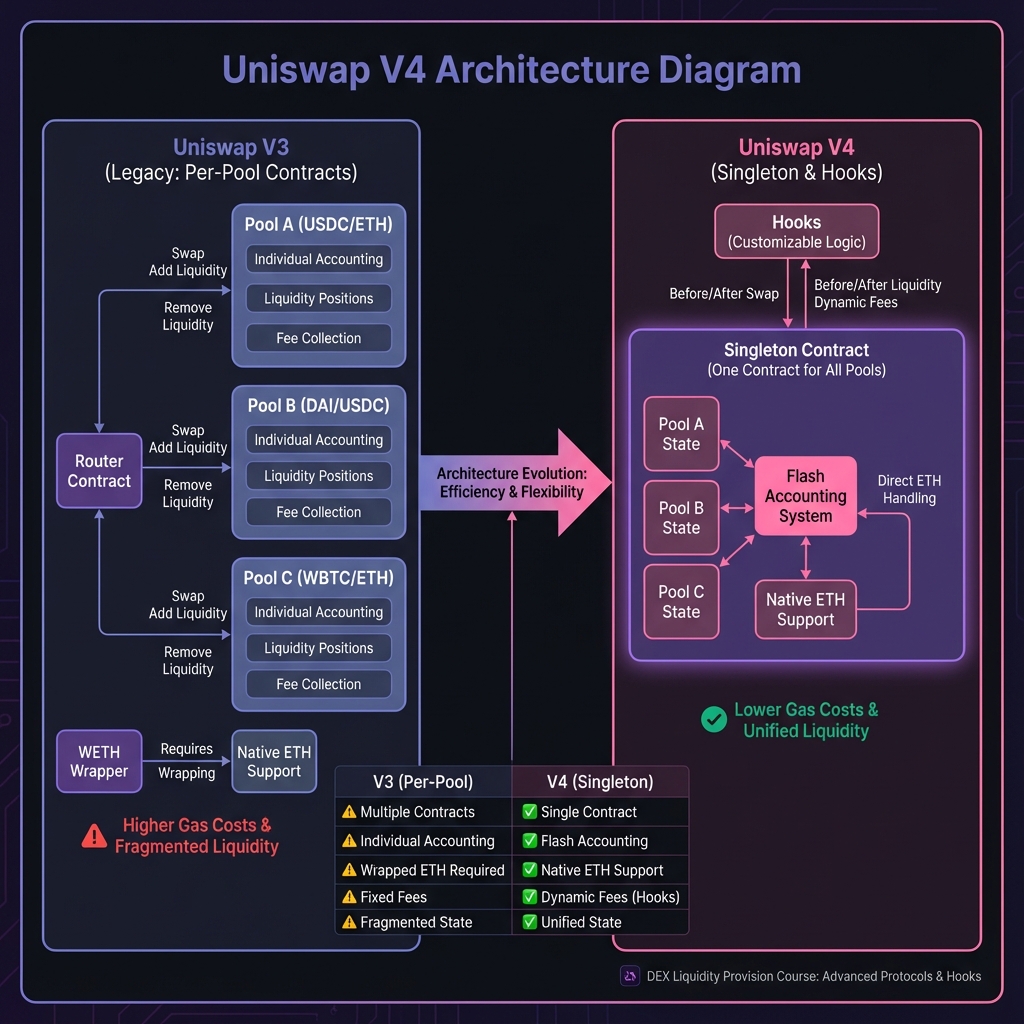
The Singleton Design

V3 Problem: Each pool = separate contract (expensive, fragmented) V4 Solution: All pools in one contract (PoolManager)

Benefits:

  • 99% reduction in pool creation gas

  • Multi-hop swaps without token transfers

  • Unified liquidity management

Flash Accounting

Concept: Net settlement at transaction end (EIP-1153: Transient Storage)

How It Works:

  1. Swaps occur in memory (no transfers)

  2. Net balances calculated

  3. Final settlement at end

Gas Savings: Massive reduction in ERC-20 transfers

Native ETH Support

V3: Must wrap ETH to WETH V4: Native ETH pairs supported

Benefit: One less token conversion, lower gas

Uniswap V4 Architecture Diagram

🪝 Understanding Hooks

What Are Hooks?

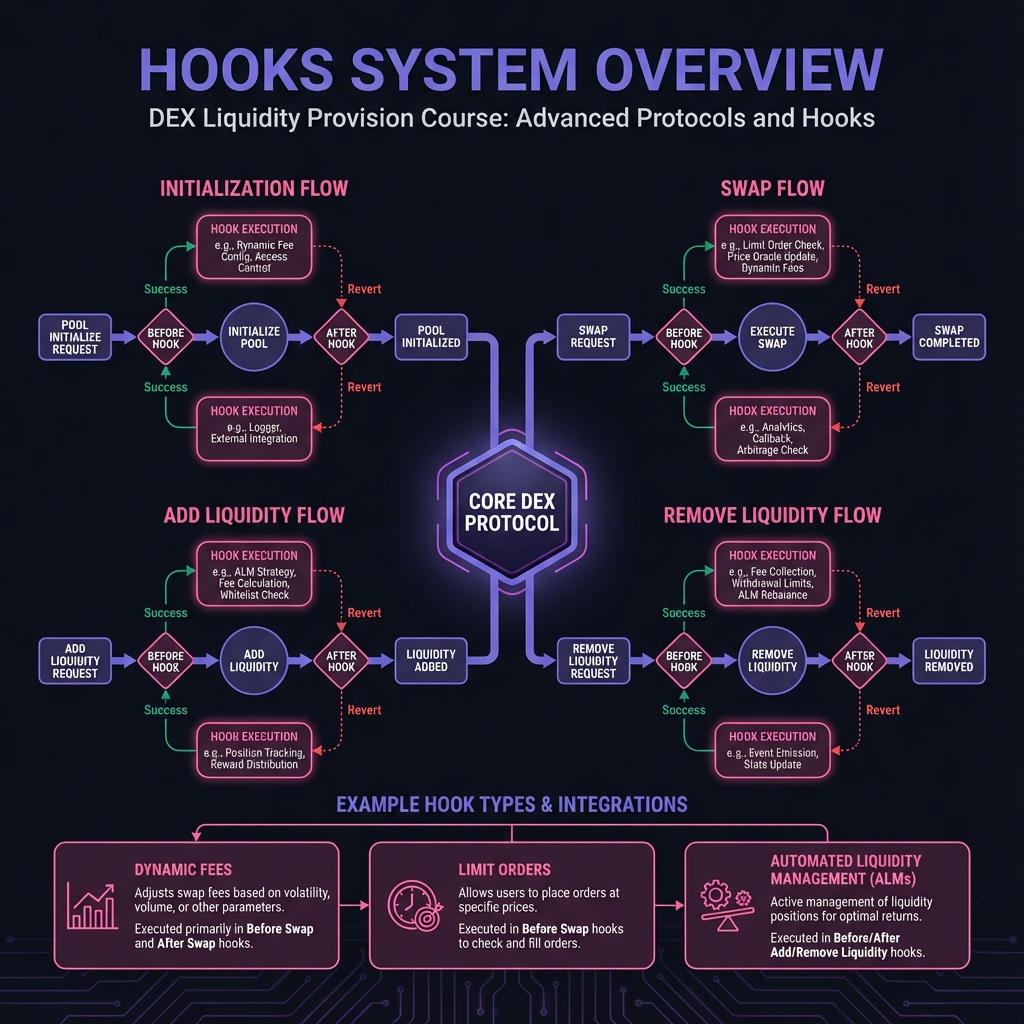
Hooks are external smart contracts that execute custom logic at specific points:

Before Initialize: Set custom parameters After Initialize: Post-setup actions Before Swap: Modify swap behavior After Swap: Post-swap actions Before Add Liquidity: Pre-deposit checks After Add Liquidity: Post-deposit actions Before Remove Liquidity: Pre-withdrawal checks After Remove Liquidity: Post-withdrawal actions

Hook Use Cases

1. Dynamic Fees:

  • Adjust fees based on volatility

  • Time-weighted fees

  • Utilization-based fees

2. Limit Orders:

  • Execute swaps at target prices

  • Automated DCA strategies

  • Stop-loss protection

3. Active Liquidity Management (ALM):

  • Auto-rebalancing ranges

  • Volatility-based range adjustment

  • Mean reversion strategies

4. Oracle Integration:

  • Custom price feeds

  • TWAP (Time-Weighted Average Price) oracles

  • Cross-chain price feeds

5. Access Control:

  • Whitelisted LPs

  • Permissioned pools

  • KYC integration

Hooks System Overview

🔧 Hook Architecture

Hook Interface

interface IHooks {
    function beforeInitialize(...) external returns (bytes4);
    function afterInitialize(...) external returns (bytes4);
    function beforeSwap(...) external returns (bytes4);
    function afterSwap(...) external returns (bytes4);
    // ... other hook functions
}

Hook Permissions

Hooks can be:

  • Permissionless: Anyone can use

  • Permissioned: Only approved hooks

  • Custom: Pool-specific hooks

Gas Optimization

Hooks add gas costs. V4 optimizes by:

  • Optional hooks (only pay if used)

  • Efficient hook execution

  • Batch operations

📊 Active Liquidity Managers (ALMs)

What Are ALMs?

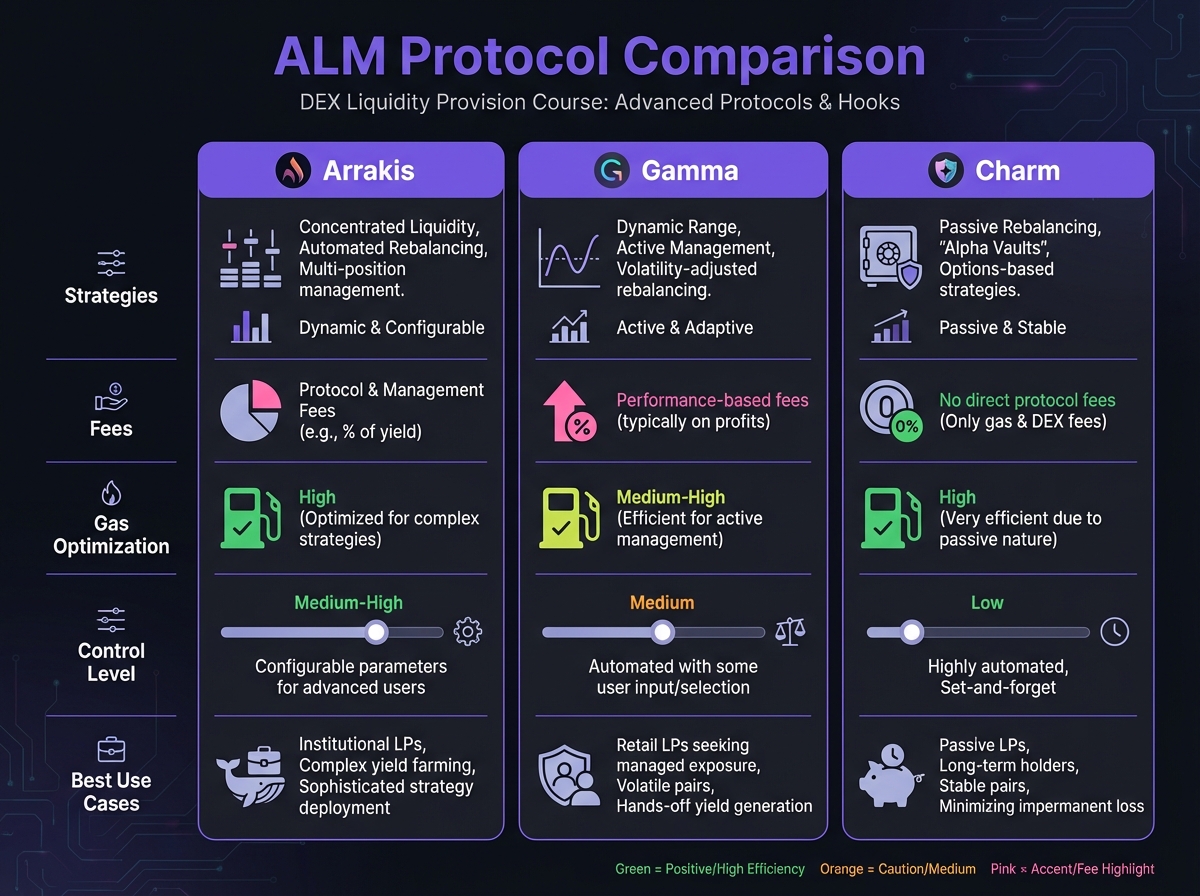
ALMs are protocols that manage V3/V4 positions automatically:

  • Rebalance ranges

  • Collect and compound fees

  • Optimize for maximum yield

Arrakis Finance:

  • Automated V3 range management

  • Fee compounding

  • Multi-strategy vaults

Gamma Strategies:

  • Volatility-based rebalancing

  • Mean reversion strategies

  • Risk-adjusted returns

Charm Finance:

  • Options-based strategies

  • Delta-neutral positions

  • Advanced hedging

Using ALMs

Benefits:

  • ✅ Automated management

  • ✅ Professional strategies

  • ✅ Fee compounding

  • ✅ Gas optimization

Risks:

  • ❌ Smart contract risk (additional layer)

  • ❌ Management fees (typically 10-20% of fees)

  • ❌ Less control

Best For: LPs who want passive management with professional strategies

ALM Protocol Comparison

🎯 V4 Hook Strategies

Strategy 1: Dynamic Fee Hook

Concept: Adjust fees based on volatility

Implementation:

  • Monitor price volatility

  • Increase fees during high volatility

  • Decrease fees during low volatility

Benefit: Compensates LPs for increased IL/LVR risk

Strategy 2: Limit Order Hook

Concept: Execute swaps at target prices

Implementation:

  • Set target price

  • Hook executes swap when price reached

  • Automated DCA or profit-taking

Benefit: Combines AMM with order book functionality

Strategy 3: Auto-Rebalancing Hook

Concept: Automatically adjust ranges

Implementation:

  • Monitor price vs. range

  • Rebalance when price approaches boundaries

  • Maintain optimal range width

Benefit: Maximizes fee capture, minimizes out-of-range risk

Strategy 4: TWAP Oracle Hook

Concept: Custom price oracle for pool

Implementation:

  • Calculate time-weighted average price

  • Use for limit orders, rebalancing

  • More accurate than spot price

Benefit: Reduces front-running, improves execution

🔬 Advanced Deep-Dive: Hook Security

Security Considerations

Hook Risks:

  • Bugs in hook code

  • Malicious hooks

  • Gas griefing attacks

Mitigation:

  • Audit all hooks before use

  • Use only verified hooks

  • Test on testnet first

  • Start with small positions

Hook Best Practices

  1. Verify Hook Source: Only use audited hooks

  2. Test First: Always test on testnet

  3. Start Small: Test with minimal capital

  4. Monitor: Watch hook behavior closely

  5. Understand Logic: Read hook code before using

🎓 Beginner's Corner: V4 and Hooks

Q: Do I need to understand hooks? A: Not immediately. V4 will work like V3 initially. Hooks are optional enhancements.

Q: Are hooks safe? A: Depends on the hook. Only use audited, verified hooks. Test thoroughly.

Q: Will V4 replace V3? A: Gradually. V3 will remain active. V4 offers new capabilities but more complexity.

Q: Should I wait for V4? A: No. Learn V3 now. V4 knowledge builds on V3. Start with V3, migrate when ready.

Q: How do I use hooks? A: Through ALM protocols initially. Direct hook interaction is advanced. Start with ALMs.

📈 Real-World V4 Example

Scenario: ETH/USDC pool with dynamic fee hook

Setup:

  • Base fee: 0.05%

  • Volatility multiplier: 0.1% per 10% volatility

  • Current volatility: 5%

Fee Calculation:

  • Base: 0.05%

  • Volatility adjustment: 5% ÷ 10% × 0.1% = 0.05%

  • Total fee: 0.10%

If volatility increases to 15%:

  • Volatility adjustment: 15% ÷ 10% × 0.1% = 0.15%

  • Total fee: 0.20%

Benefit: LPs earn more during volatile periods (compensating IL/LVR)

🎯 Key Takeaways

  1. V4's Singleton reduces gas by 99% for pool creation

  2. Hooks enable customization - dynamic fees, limit orders, ALMs

  3. Flash Accounting eliminates intermediate transfers

  4. ALMs automate complex strategies for passive LPs

  5. Hook security is critical - only use audited hooks

  6. V4 is optional - V3 remains viable, learn V3 first

  7. Future of LPing will be increasingly automated via hooks

🚀 Next Steps

Lesson 10 covers MEV, JIT liquidity, and advanced tactics used by professional LPs. Understanding these concepts helps you protect your positions and optimize returns.

Complete Exercise 9 to explore V4 hooks and ALM integration strategies.


Remember: V4 and hooks represent the future, but V3 is the present. Master V3 first, then explore V4 when you're ready. Hooks are powerful but add complexity and risk.

← Back to Summary | Next: Exercise 9 → | Previous: Lesson 8 ←

Last updated