Lesson 12: Building Your Professional LP System

Lesson 12: Building Your Professional LP System

🎯 Core Concept: Integration and Automation

A professional LP system integrates all concepts: risk management, multi-protocol strategies, fee optimization, governance participation, and automation. This lesson shows you how to build a complete, operational system.

🏗️ System Architecture

Core Components
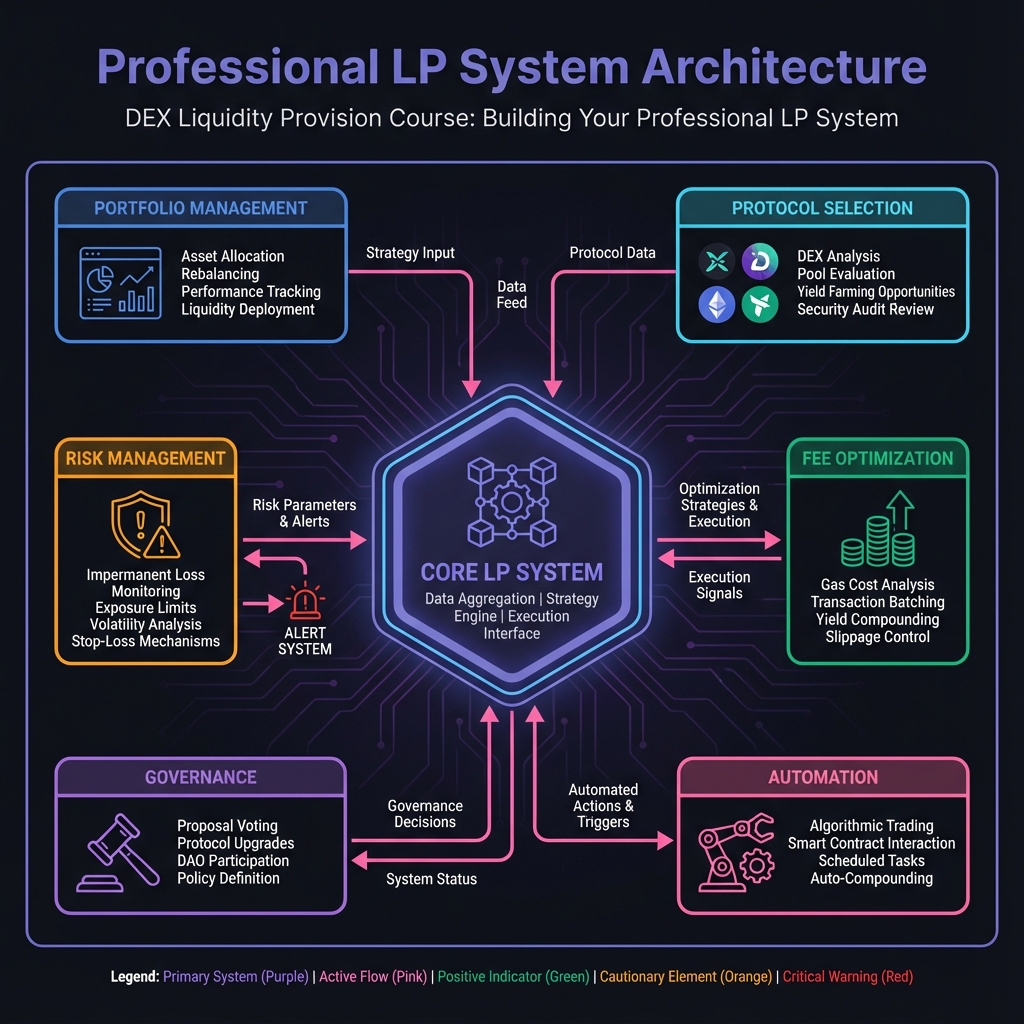
1. Portfolio Management:

  • Position sizing

  • Risk limits

  • Diversification framework

2. Protocol Selection:

  • Multi-protocol strategy

  • Chain diversification

  • Pair optimization

3. Risk Management:

  • IL monitoring

  • Hedging strategies

  • Portfolio limits

4. Fee Optimization:

  • Volume/TVL analysis

  • Gas cost management

  • Fee tier selection

5. Governance Participation:

  • ve-token strategies

  • Bribe optimization

  • Voting systems

6. Automation:

  • Monitoring tools

  • Alert systems

  • Rebalancing protocols

Professional LP System Architecture

📊 The Professional LP Dashboard

Essential Metrics

Daily Tracking:

  • Total portfolio value

  • Fees earned (by position)

  • IL by position

  • Net PnL (fees - IL - gas)

  • Price vs. ranges (V3)

Weekly Analysis:

  • Return by protocol

  • Return by pair

  • Risk limit compliance

  • Best/worst performers

  • Rebalancing needs

Monthly Review:

  • Total return vs. benchmarks

  • Strategy effectiveness

  • System improvements

  • Capital allocation adjustments

Dashboard Tools

Manual Tracking:

  • Spreadsheet (Google Sheets, Excel)

  • Custom metrics

  • Full control

Analytics Platforms:

  • APY.vision: Real-time PnL tracking

  • Revert Finance: V3 backtesting and analysis

  • Zapper.fi: Multi-protocol portfolio view

  • DefiLlama: TVL and volume trends

Custom Solutions:

  • Dune Analytics dashboards

  • Python scripts

  • API integrations

🔄 Operational Workflows

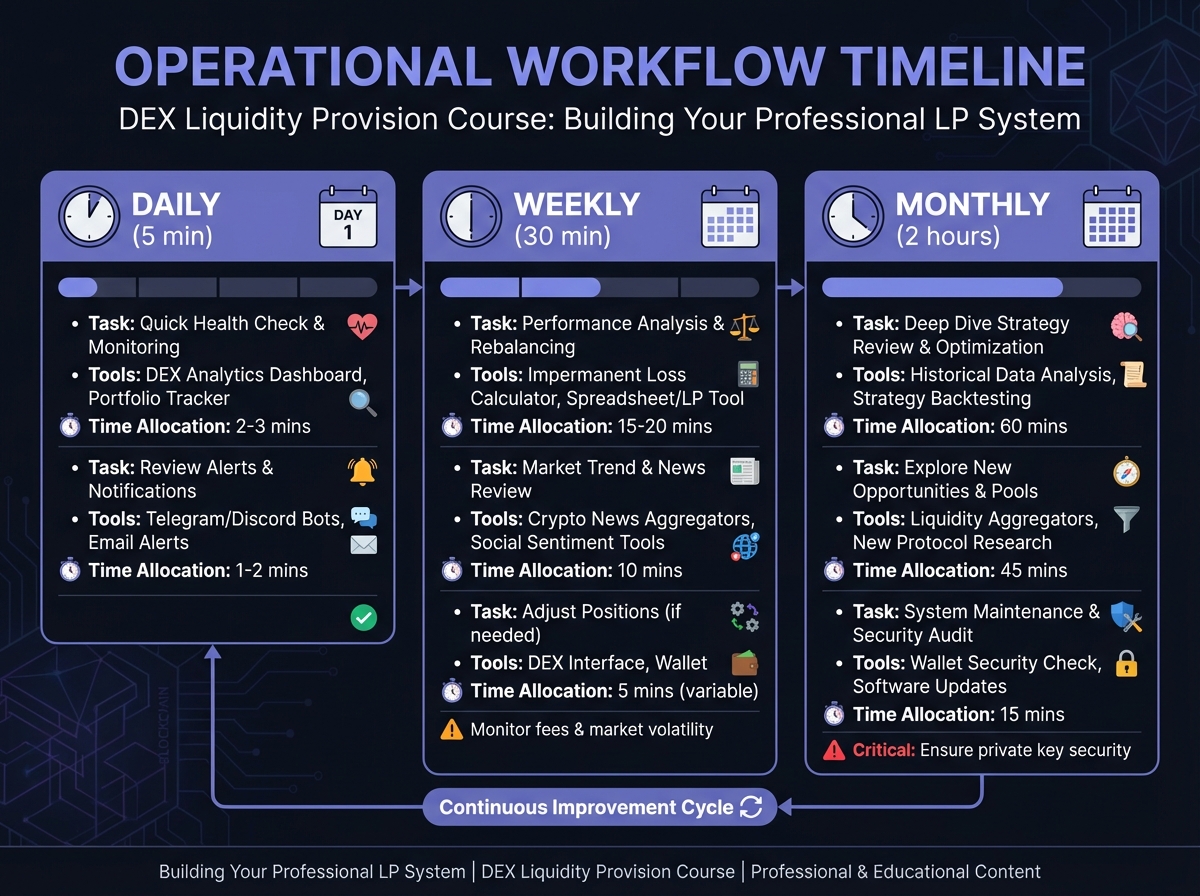
Daily Workflow (5 minutes)

  1. Check Positions:

    • Review all positions

    • Note any out-of-range (V3)

    • Check for alerts

  2. Monitor Metrics:

    • Fees earned

    • IL changes

    • Price movements

  3. Review Alerts:

    • IL exceeds fees?

    • Price exiting range?

    • Risk limits breached?

Weekly Workflow (30 minutes)

  1. Performance Analysis:

    • Calculate net returns

    • Compare to holding

    • Identify winners/losers

  2. Rebalancing Decisions:

    • Which positions need adjustment?

    • Any new opportunities?

    • Risk limit compliance?

  3. Governance Updates (if applicable):

    • Check bribe efficiency

    • Review voting results

    • Adjust voting strategy

  4. System Maintenance:

    • Collect fees (V3)

    • Update tracking

    • Review alerts

Monthly Workflow (2 hours)

  1. Comprehensive Review:

    • Total portfolio performance

    • Strategy effectiveness

    • Protocol comparison

  2. Rebalancing:

    • Adjust allocations

    • Close underperformers

    • Open new positions

  3. System Optimization:

    • Improve workflows

    • Update tools

    • Refine strategies

  4. Planning:

    • Set next month goals

    • Adjust risk limits

    • Plan capital deployment

Operational Workflow Timeline

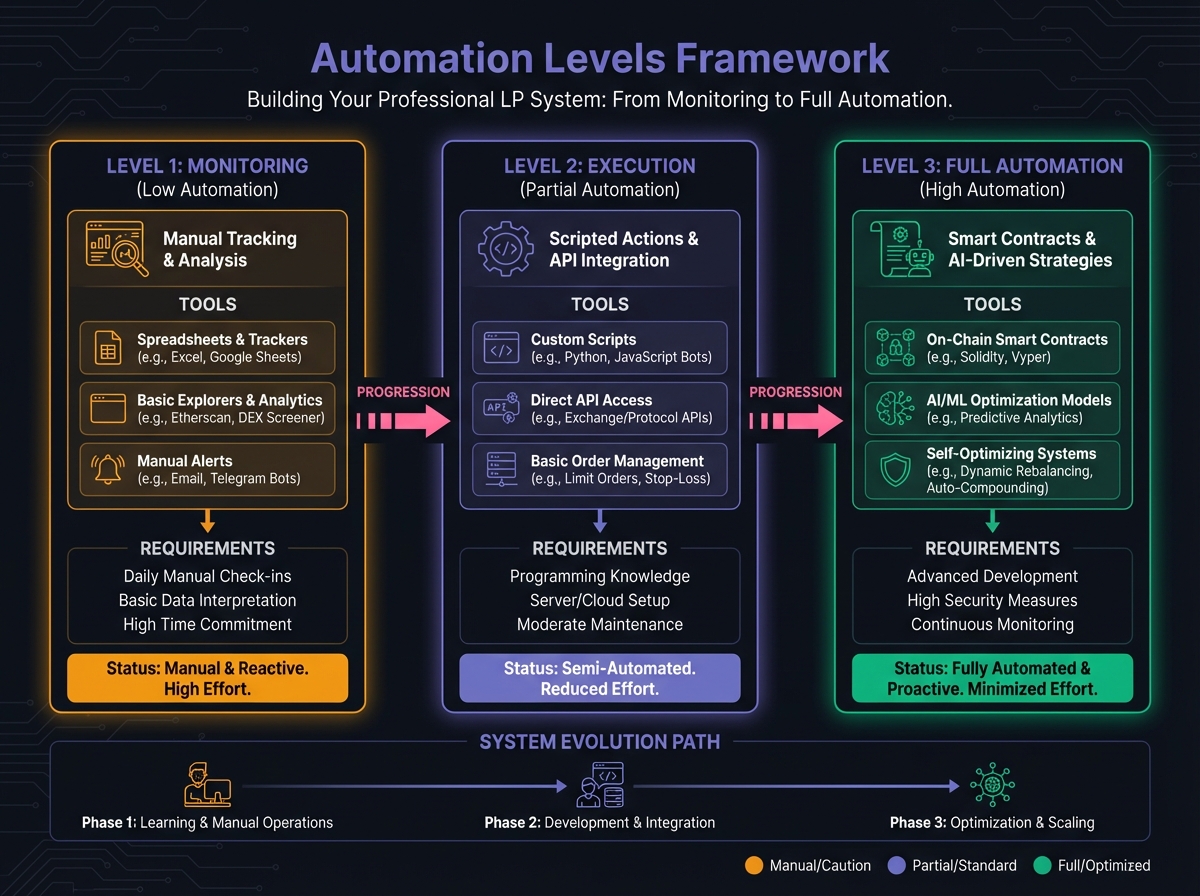
🤖 Automation Strategies

Level 1: Monitoring Automation

Tools:

  • Price alerts (Telegram bots, Discord)

  • IL calculators (APY.vision)

  • Portfolio trackers (Zapper)

Setup:

  • Alert when IL > fees

  • Alert when price exits range

  • Daily portfolio summary

Level 2: Execution Automation

Tools:

  • Active Liquidity Managers (ALMs)

  • Rebalancing bots

  • Fee collection scripts

Examples:

  • Arrakis Finance: Auto-rebalancing V3 positions

  • Gamma Strategies: Volatility-based management

  • Custom scripts: Automated fee collection

Level 3: Full Automation

Advanced:

  • MEV bot integration

  • Cross-protocol arbitrage

  • Dynamic strategy adjustment

Requires: Technical expertise, significant capital

Automation Levels Framework

📋 Complete System Checklist

Setup Phase

Operational Phase

Optimization Phase

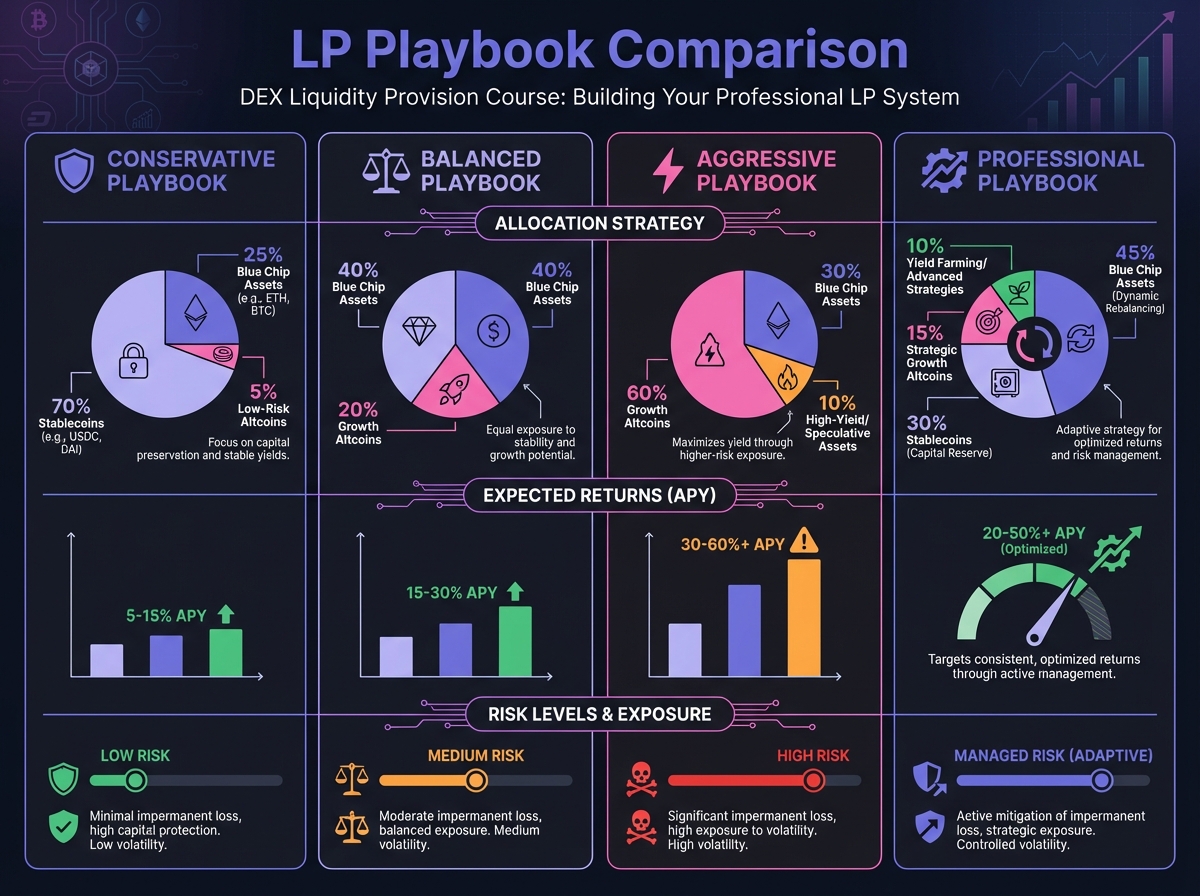
🎯 Professional LP Playbook

Playbook 1: Conservative LP

Profile: Capital preservation, steady returns

Strategy:

  • 80% stablecoin pairs (USDC/USDT)

  • 20% correlated pairs (wstETH/ETH)

  • Uniswap V2 or wide V3 ranges

  • L2 only (low gas)

  • No governance participation

Expected Returns: 5-10% APY Risk Level: Low

Playbook 2: Balanced LP

Profile: Moderate risk, balanced returns

Strategy:

  • 50% stablecoins

  • 30% correlated pairs

  • 20% blue-chip volatile (ETH/USDC)

  • V3 medium ranges (±10-20%)

  • Multi-protocol (Uniswap + Aerodrome)

  • Basic governance participation

Expected Returns: 10-20% APY Risk Level: Moderate

Playbook 3: Aggressive LP

Profile: High risk, maximum returns

Strategy:

  • 30% stablecoins

  • 40% volatile pairs

  • 30% governance tokens (ve-token protocols)

  • V3 narrow ranges (±1-5%)

  • Multi-chain, multi-protocol

  • Active governance participation

  • Hedging strategies

Expected Returns: 20-50% APY (variable) Risk Level: High

Playbook 4: Professional LP

Profile: Institutional-grade, systematic

Strategy:

  • Diversified across all categories

  • Delta hedging

  • ALM protocols

  • Custom automation

  • Full governance participation

  • MEV protection

  • Risk management systems

Expected Returns: 15-30% APY (consistent) Risk Level: Managed

LP Playbook Comparison

🔬 Advanced Deep-Dive: System Integration

API Integration

Connect:

  • DEX APIs (Uniswap, Aerodrome)

  • Price oracles (Chainlink, Uniswap TWAP)

  • Analytics platforms (APY.vision, Revert)

Build:

  • Custom dashboards

  • Automated monitoring

  • Alert systems

  • Performance tracking

Smart Contract Integration

Deploy:

  • Custom rebalancing contracts

  • Fee collection automation

  • Multi-protocol managers

Requires: Solidity development, security audits

Data Pipeline

Collect:

  • Position data

  • Price feeds

  • Volume metrics

  • Fee data

Process:

  • Calculate metrics

  • Generate alerts

  • Produce reports

Store:

  • Historical data

  • Performance tracking

  • Strategy backtesting

📈 Real-World Professional System

Complete Example

Portfolio: $100,000 across 3 chains

Allocation:

  • $40,000 Uniswap V3 (Arbitrum): ETH/USDC, WBTC/ETH

  • $30,000 Aerodrome (Base): WETH/USDC, veAERO participation

  • $30,000 Raydium (Solana): SOL/USDC, RAY/USDC

Management:

  • Daily: Automated alerts, position checks

  • Weekly: Performance analysis, rebalancing decisions

  • Monthly: Comprehensive review, strategy optimization

Tools:

  • APY.vision: PnL tracking

  • Revert Finance: V3 analysis

  • Custom spreadsheet: Portfolio management

  • Telegram bots: Price alerts

Returns (monthly):

  • Uniswap: $400 fees, $100 IL = $300 net

  • Aerodrome: $600 emissions+fees, $50 IL = $550 net

  • Raydium: $300 fees, $80 IL = $220 net

  • Total: $1,070/month (1.07% = 12.8% APY)

Risk Management:

  • Per-position limit: 10%

  • Per-protocol limit: 40%

  • Per-chain limit: 50%

  • All within limits ✅

🎓 Beginner's Corner: Building Your System

Q: Do I need all this complexity? A: No. Start simple: one protocol, one pair, basic tracking. Add complexity as you learn.

Q: What's the minimum viable system? A: One position, weekly check, basic spreadsheet. That's enough to start.

Q: Should I automate everything? A: Not initially. Learn manually first, then automate repetitive tasks.

Q: How much time does this take? A: 5 min/day, 30 min/week, 2 hours/month. Scale with portfolio size.

Q: What if I can't build custom tools? A: Use existing platforms (APY.vision, Revert). They're sufficient for most LPs.

🎯 Key Takeaways

  1. Professional systems integrate all concepts into workflows

  2. Daily/weekly/monthly routines ensure consistent management

  3. Automation scales with portfolio size and complexity

  4. Multiple playbooks suit different risk profiles

  5. Tools and dashboards are essential for professional LPing

  6. Start simple, add complexity gradually

  7. Systematic approach beats ad-hoc management

🚀 Course Completion

Congratulations! You've completed the DEX Liquidity Provision Mastery course. You now understand:

  • ✅ AMM fundamentals and mathematics

  • ✅ Impermanent loss and risk management

  • ✅ Uniswap V2, V3, and V4

  • ✅ Multi-protocol strategies

  • ✅ Fee optimization and gas economics

  • ✅ Advanced tactics (MEV, governance, hooks)

  • ✅ Building professional LP systems

Next Steps:

  1. Complete Exercise 12 to build your personal LP system

  2. Start with small positions

  3. Track everything

  4. Learn from experience

  5. Scale gradually

  6. Never stop learning

Remember: Liquidity provision is a skill that improves with practice. Start conservative, learn systematically, and build your expertise over time. The markets reward disciplined, educated LPs.


Final Thought: Professional liquidity provision combines mathematics, risk management, and systematic execution. Master these fundamentals, and you'll build sustainable returns in DeFi's most important role.

← Back to Summary | Next: Exercise 12 → | Previous: Lesson 11 ←

Last updated