Lesson 3: Impermanent Loss and Risk Fundamentals
🎯 Core Concept: The Hidden Cost of Liquidity Provision
Impermanent Loss (IL) is the single biggest risk most liquidity providers don't understand. It's called "impermanent" because it only becomes permanent when you withdraw, but the reality is: most LPs lose money to IL, even when earning fees.
The Brutal Truth
Many LPs see "100% APY" and think they're making money. But when they account for impermanent loss, they discover they would have been better off just holding their tokens. Understanding IL is the difference between profitable and unprofitable liquidity provision.
💸 What is Impermanent Loss?
Simple Definition
Impermanent Loss = The difference between:
What your LP position is worth
What your tokens would be worth if you just held them
Key Point: IL occurs when the price ratio of the two tokens changes from when you deposited.
Why It Happens
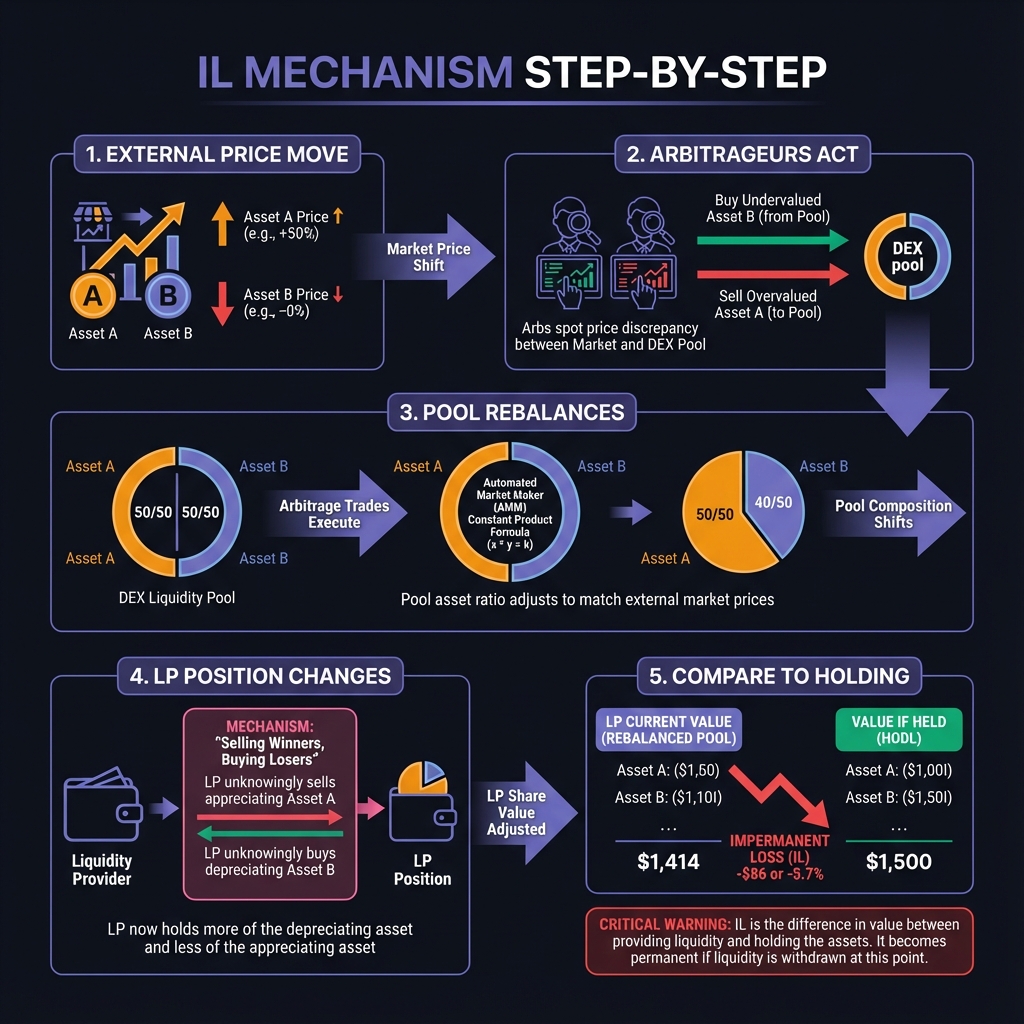
AMMs automatically rebalance your position as prices change:
When Token A goes up → The pool sells your Token A to buy Token B
When Token A goes down → The pool buys more Token A with your Token B
The Problem: You're always selling winners and buying losers. This is the opposite of what profitable traders do.
📊 Impermanent Loss: Step-by-Step Example
Scenario Setup
You deposit liquidity when:
ETH price: $2,000
You deposit: 1 ETH + 2,000 USDC
Total value: $4,000
What Happens When ETH Rises to $2,500
Step 1: External market moves
ETH price on Binance: $2,500 (25% increase)
Step 2: Arbitrageurs act
They see ETH is "cheap" in your pool ($2,000)
They buy ETH from your pool, adding USDC
Pool price adjusts to $2,500
Step 3: Your position rebalances
Pool automatically sold some of your ETH
You now have: ~0.894 ETH + ~2,236 USDC
New value: (0.894 × $2,500) + $2,236 = $4,471
Step 4: Compare to holding
If you just held: 1 ETH + 2,000 USDC
Holding value: (1 × $2,500) + $2,000 = $4,500
IL = $4,500 - $4,471 = $29 (0.65%)
What Happens When ETH Drops to $1,500
Step 1: ETH price falls 25% to $1,500
Step 2: Arbitrageurs buy "cheap" USDC
They add ETH, remove USDC from pool
Pool price adjusts to $1,500
Step 3: Your position rebalances
Pool automatically bought more ETH with your USDC
You now have: ~1.155 ETH + ~1,732 USDC
New value: (1.155 × $1,500) + $1,732 = $4,465
Step 4: Compare to holding
If you just held: 1 ETH + 2,000 USDC
Holding value: (1 × $1,500) + $2,000 = $3,500
IL = $3,500 - $4,465 = -$965 (negative IL = you're better off!)
Wait, that doesn't make sense! Let me recalculate...
Actually, when price drops, you have:
LP value: $4,465
Holding value: $3,500
IL = $3,500 - $4,465 = -$965
But this is misleading. The real comparison:
You started with: $4,000
LP position now: $4,465 (up 11.6%)
Holding would be: $3,500 (down 12.5%)
So you're actually better off in the LP when price drops? No—let's think about this correctly.
Correct Calculation:
You started with: 1 ETH ($2,000) + 2,000 USDC = $4,000
After 25% drop: 1 ETH ($1,500) + 2,000 USDC = $3,500
LP position: 1.155 ETH ($1,732.50) + 1,732 USDC = $3,464.50
IL = $3,500 - $3,464.50 = $35.50 (1.0%)
You still lost money compared to holding, just less than if you held only ETH.

📈 The Impermanent Loss Formula
Mathematical Formula
For a price change of r (where r = new_price / old_price):
Simplified for equal value deposits:
IL Table: Price Changes vs. Loss
±5%
0.1%
±10%
0.5%
±25%
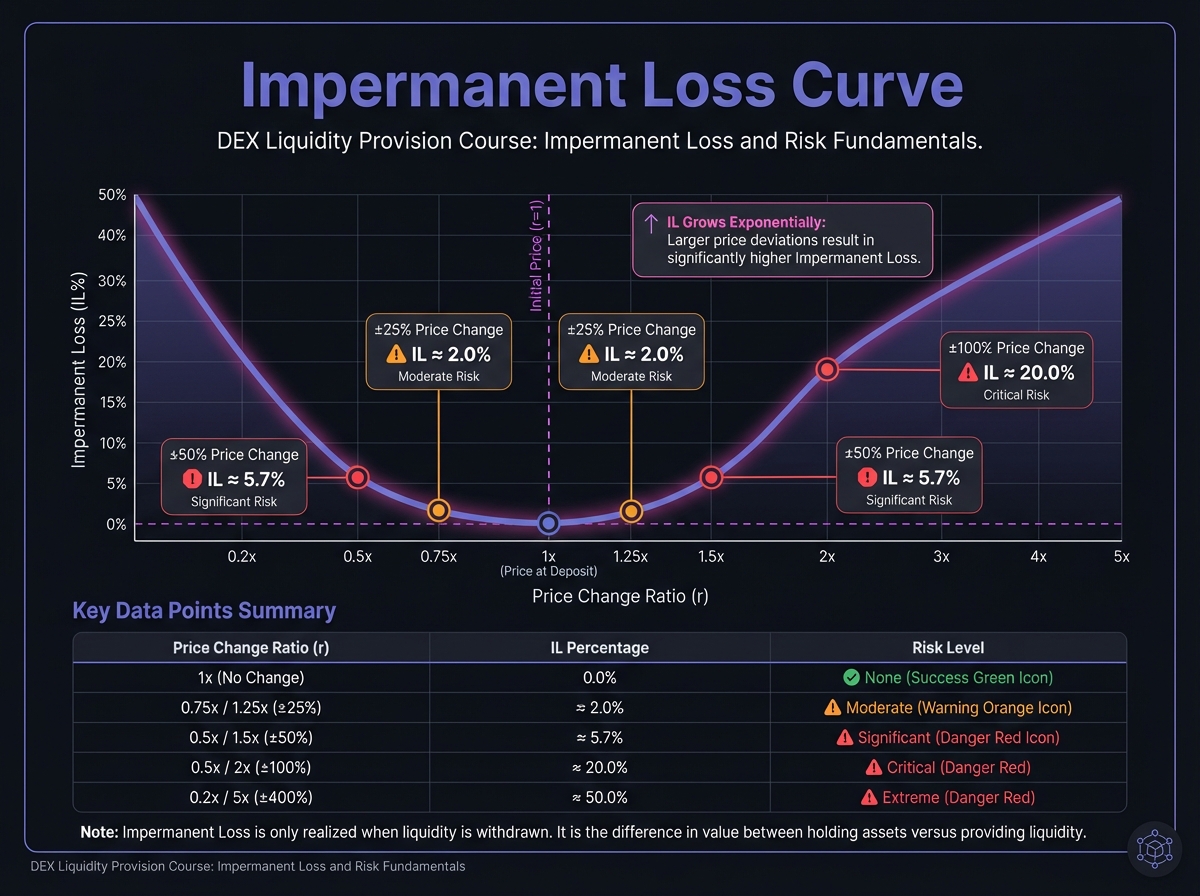
2.0%
±50%
5.7%
±100% (2x)
20.0%
±300% (4x)
50.0%
Key Insight: IL grows exponentially with price divergence. A 2x price move causes 20% IL. A 4x move causes 50% IL!
Visual Representation

The curve shows:
IL is symmetric (same loss for +50% and -50% moves)
IL increases faster as price moves further
IL is always negative (you lose compared to holding)
⚠️ When IL Becomes Permanent
Impermanent Loss becomes Permanent Loss when you:
Withdraw your liquidity while prices are divergent
Realize the loss by converting back to your original tokens
Example:
You deposit at ETH = $2,000
ETH rises to $3,000 (50% increase)
IL = 5.7% ($228 on $4,000 position)
You withdraw: Loss is now permanent
If you wait and ETH returns to $2,000: IL disappears
The Catch: Most LPs withdraw during volatility (when IL is highest), locking in losses.
🔄 IL vs. Fees: The Break-Even Analysis
The Critical Question
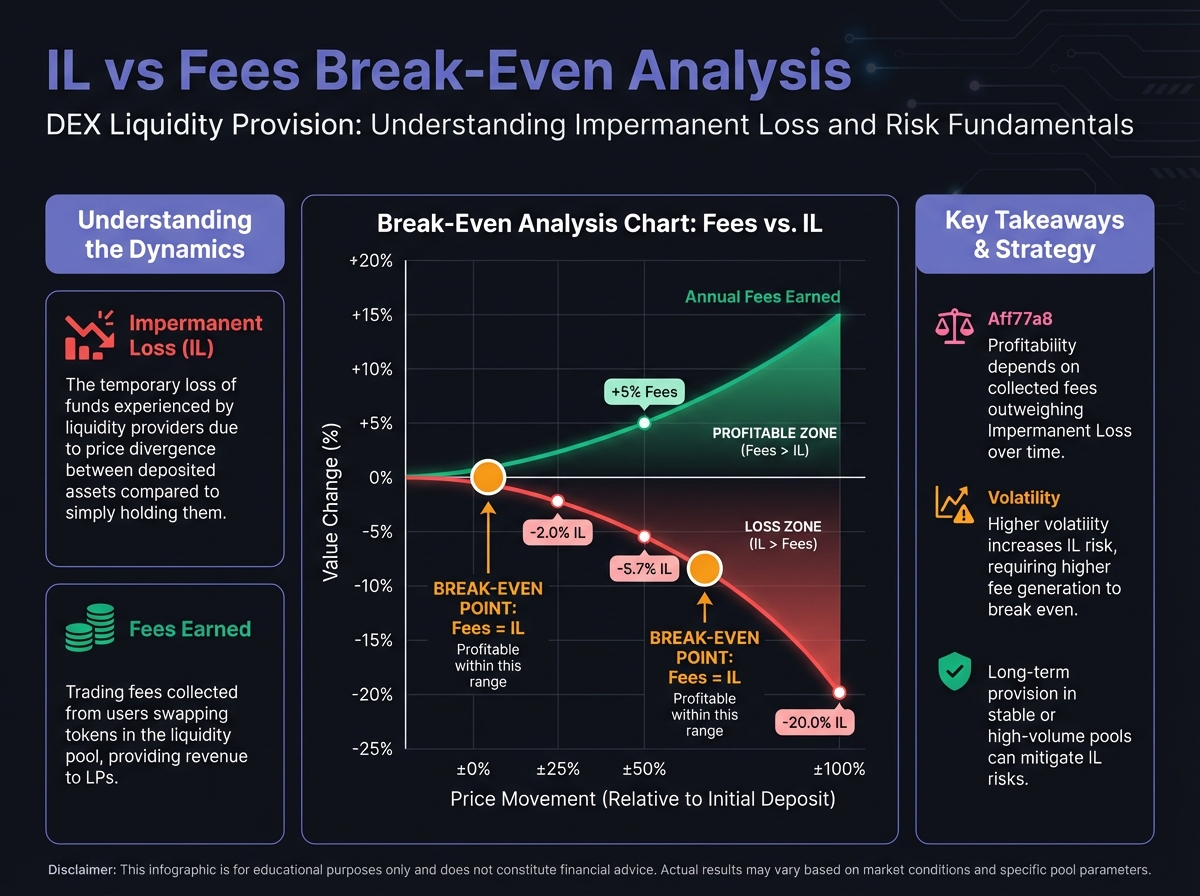
Do fees earned exceed impermanent loss?
This determines if LPing is profitable.
Break-Even Calculation
Example: ETH/USDC pool
Your capital: $10,000
Daily volume: $100,000
Fee rate: 0.3%
Your share: 1% of pool
Daily fees: $100,000 × 0.003 × 0.01 = $3/day Annual fees: $3 × 365 = $1,095/year
IL scenarios:
If ETH moves ±25%: IL = 2% = $200
If ETH moves ±50%: IL = 5.7% = $570
If ETH moves ±100%: IL = 20% = $2,000
Analysis:
Small moves (±25%): Fees ($1,095) > IL ($200) ✅ Profitable
Medium moves (±50%): Fees ($1,095) > IL ($570) ✅ Still profitable
Large moves (±100%): Fees ($1,095) < IL ($2,000) ❌ Losing money
Reality: In volatile markets, IL often exceeds fees, making LPing unprofitable.

🎯 Risk Factors That Increase IL
1. High Volatility
Volatile pairs (e.g., meme coins):
Experience frequent large price swings
IL accumulates quickly
Fees rarely compensate
Stable pairs (e.g., USDC/USDT):
Minimal price divergence
IL is negligible
Fees can be profitable
2. Low Correlation
Uncorrelated pairs (e.g., ETH/BTC):
Prices move independently
Higher IL risk
Requires active management
Correlated pairs (e.g., wstETH/ETH):
Prices move together
Lower IL (ratio stays stable)
More predictable
3. Long Time Horizons
Long-term positions:
More time for prices to diverge
IL compounds over time
Requires rebalancing
Short-term positions:
Less time for divergence
Lower IL risk
But higher gas costs
💡 Strategies to Minimize IL
1. Choose Stable Pairs
Best: Stablecoin pairs (USDC/USDT, DAI/USDC)
IL is minimal (<0.1% even with depegs)
Fees are consistent
Lower risk overall
Good: Correlated pairs (wstETH/ETH, WBTC/ETH)
Ratio stays relatively stable
IL is manageable
Still earn decent fees
Avoid: Volatile uncorrelated pairs (unless you're hedging)
2. Use Narrow Ranges (V3)
In Uniswap V3, you can concentrate liquidity:
Narrow range = higher fees per dollar
But higher IL if price exits range
Requires active management
Trade-off: More fees vs. more IL risk
3. Hedge Your Position
Delta-neutral strategy:
Provide liquidity (long both assets)
Short one asset using perpetuals
Neutralize price exposure
Profit from fees only
Advanced: Requires understanding derivatives and higher capital
4. Active Rebalancing
Rebalance when:
Price moves significantly (±20%+)
IL exceeds fees earned
Better opportunities elsewhere
Cost: Gas fees for rebalancing (use L2!)
🔬 Advanced Deep-Dive: Loss Versus Rebalancing (LVR)
Beyond Impermanent Loss
Loss Versus Rebalancing (LVR) is a more sophisticated metric that measures the cost of providing liquidity against informed traders (arbitrageurs).
The LVR Concept
LVR quantifies how much value arbitrageurs extract from LPs due to:
Stale prices: AMM prices lag behind market prices
Block time delays: Price updates only happen on-chain
Adverse selection: Arbitrageurs trade when it's profitable for them
LVR Formula
Where:
σ = volatility
t = time
Key Insight: LVR is proportional to volatility squared. High volatility = massive LVR.
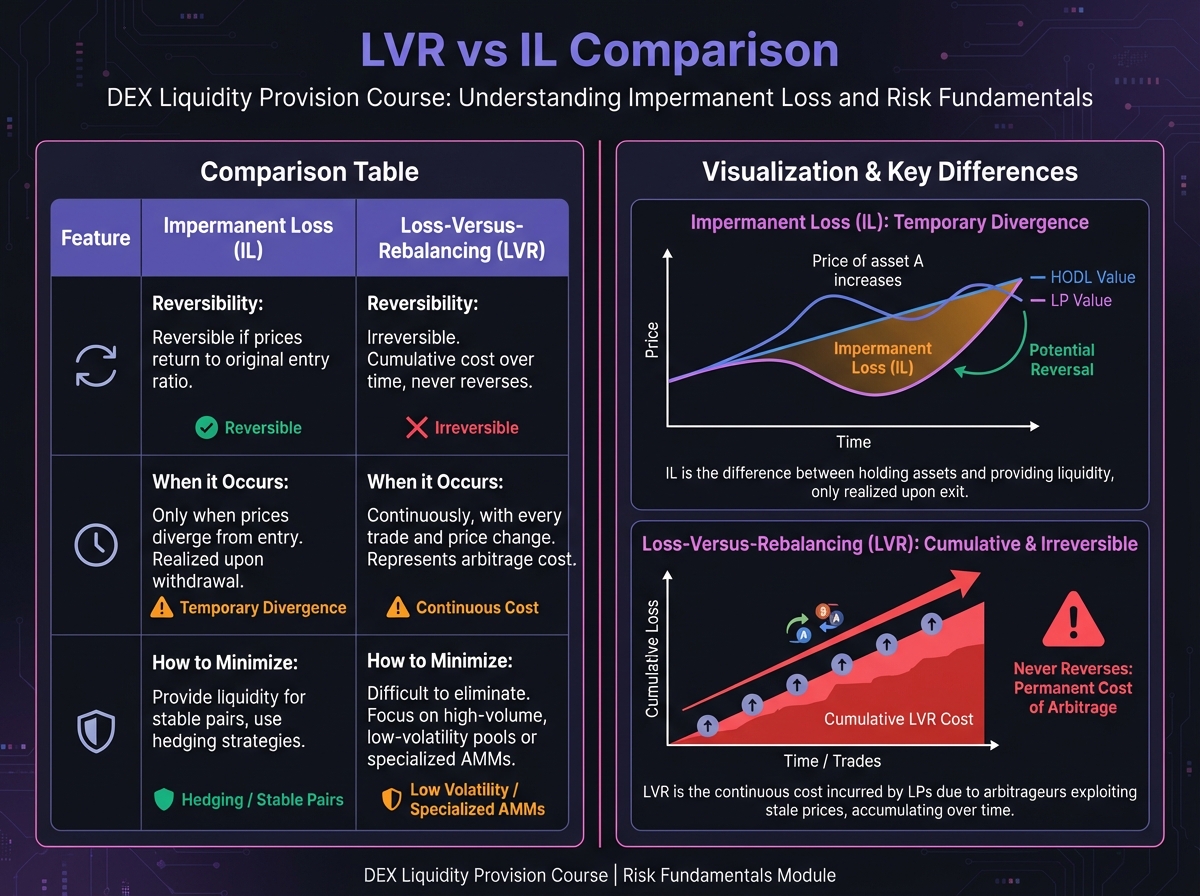
LVR vs. IL
IL
Opportunity cost vs. holding
Reversible if price returns
LVR
Value extracted by arbitrageurs
Never reversible (monotonic)
Critical Difference: LVR is cumulative and never decreases. Every price movement extracts value permanently.
Real-World Impact
In high-volatility pools:
LVR can exceed 50% annually
Fees might be 20% APY
Net result: -30% APY (losing money!)
This is why professional LPs hedge their positions.

🎓 Beginner's Corner: IL Myths Debunked
Myth 1: "IL is only temporary"
Reality: It becomes permanent when you withdraw during divergence
Myth 2: "Fees always cover IL"
Reality: In volatile markets, IL often exceeds fees
Myth 3: "IL only happens when prices go up"
Reality: IL happens with any price divergence (up or down)
Myth 4: "Stablecoin pairs have no IL"
Reality: They have minimal IL, but depegs can cause massive losses
Myth 5: "I can avoid IL by choosing the right pair"
Reality: You can minimize IL, but never eliminate it completely
📊 Risk Assessment Framework
Before Providing Liquidity, Ask:
What's the volatility?
High volatility = high IL risk
Check historical price movements
What's the correlation?
Correlated pairs = lower IL
Uncorrelated = higher IL
What's the fee rate?
Higher fees = more buffer against IL
Lower fees = need lower volatility
What's the expected volume?
High volume = more fees
Low volume = fees might not cover IL
Can I afford the IL?
Calculate worst-case IL scenarios
Ensure you can handle the loss
🎯 Key Takeaways
Impermanent Loss is real and often exceeds fees
IL = opportunity cost of LPing vs. holding
IL grows exponentially with price divergence
IL becomes permanent when you withdraw during divergence
Stable pairs minimize IL but have lower fees
LVR is cumulative and never reverses
Always calculate IL before providing liquidity
🚀 Next Steps
Now that you understand the risks, Lesson 4 will show you how to set up your first LP position safely, minimizing IL while maximizing fees.
Complete Exercise 3 to calculate IL for different scenarios and build your risk assessment skills.
Remember: IL is the hidden cost that destroys LP profits. Always calculate it before depositing. If IL exceeds expected fees, don't provide liquidity—just hold your tokens.
← Back to Summary | Next: Exercise 3 → | Previous: Lesson 2 ←
Last updated