Lesson 8: Risk Management and Hedging Strategies

Lesson 8: Risk Management and Hedging Strategies

🎯 Core Concept: Protect Capital First

Professional LPs don't just earn feesβ€”they manage risk. This lesson teaches advanced risk management techniques including delta hedging, LVR mitigation, and portfolio-level risk controls.

πŸ›‘οΈ The Risk Management Framework

Three Types of Risk
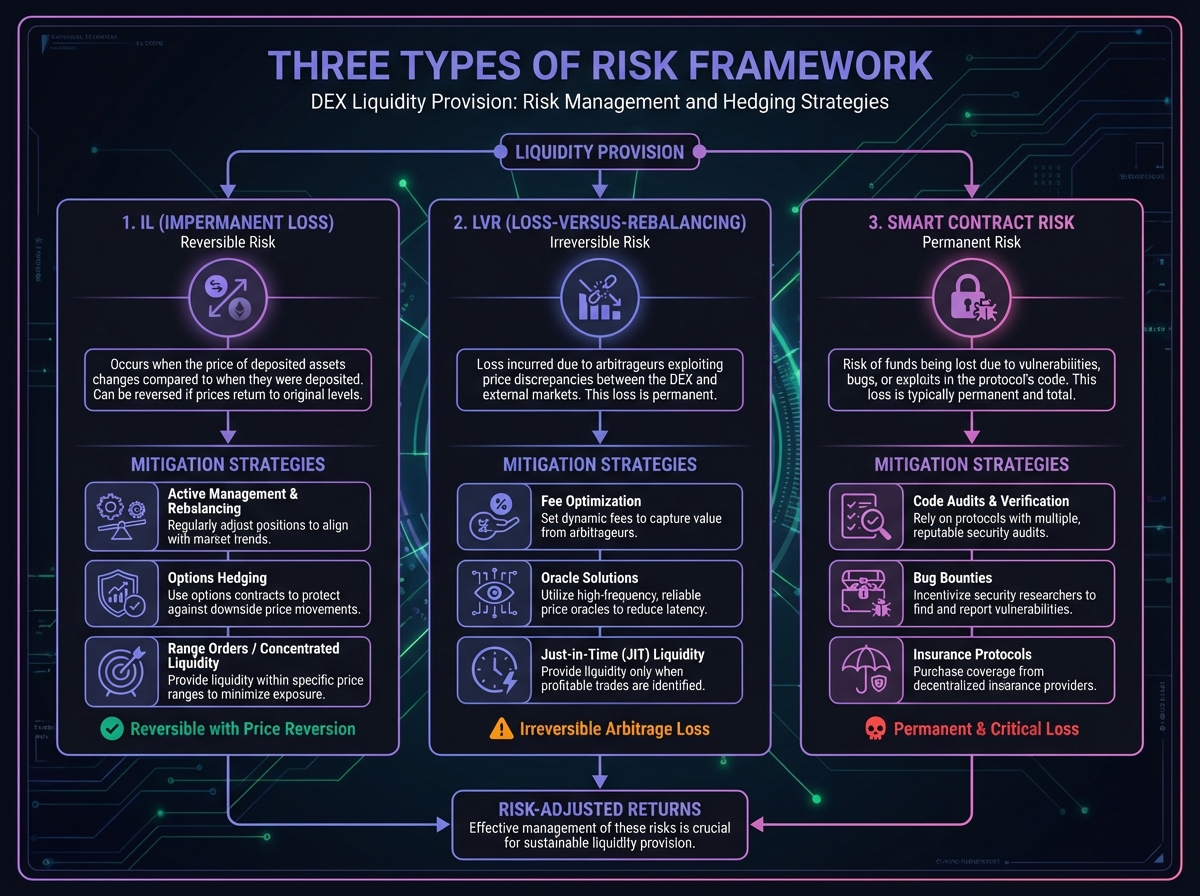
1. Impermanent Loss (IL):

  • Opportunity cost vs. holding

  • Reversible if price returns

  • Mitigated by: Stable pairs, hedging

2. Loss Versus Rebalancing (LVR):

  • Value extracted by arbitrageurs

  • Never reversible (monotonic)

  • Mitigated by: Lower volatility pairs, faster chains

3. Smart Contract Risk:

  • Bugs, exploits, hacks

  • Permanent loss

  • Mitigated by: Audited protocols, diversification

Three Types of Risk Framework

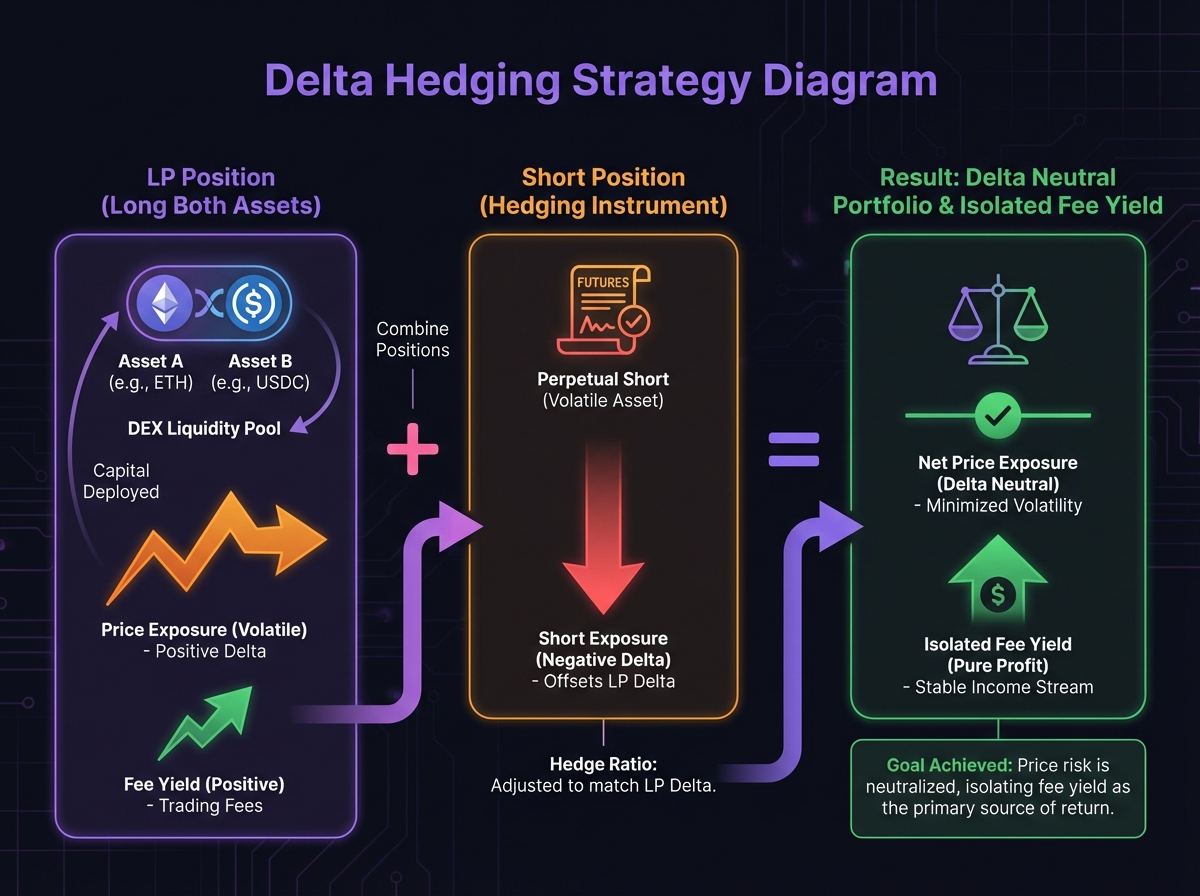
πŸ“Š Delta Hedging Strategy

The Concept

Delta = Sensitivity of position to price changes

Delta Hedging = Neutralize price exposure, profit only from fees

How It Works

Step 1: Provide liquidity (long both assets)

  • Example: 1 ETH + 2,000 USDC in pool

  • Delta: Long ETH exposure

Step 2: Short ETH to hedge

  • Borrow ETH on Aave

  • Sell ETH for USDC

  • Delta: Short ETH exposure

Step 3: Net position

  • Long ETH (from LP) + Short ETH (from borrow) = Delta neutral

  • Profit: Fees - Borrowing costs

Complete Example

Setup:

  • LP Position: $10,000 (5 ETH + 10,000 USDC at $2,000/ETH)

  • Borrow: 5 ETH on Aave (50% LTV)

  • Sell: 5 ETH for 10,000 USDC

  • Net: Delta neutral

Monthly:

  • LP Fees: $100

  • Borrowing cost: $50 (5% APY on ETH)

  • Net: $50/month (0.5% monthly = 6% APY)

If ETH drops 20%:

  • LP IL: -$1,000

  • Short profit: +$1,000

  • Net: $0 (hedged!)

If ETH rises 20%:

  • LP IL: -$1,000

  • Short loss: -$1,000

  • Net: $0 (hedged!)

Result: Isolated fee yield, no price exposure!

When to Hedge

Hedge if:

  • βœ… Large positions ($50k+)

  • βœ… Volatile pairs

  • βœ… Want pure fee yield

  • βœ… Can afford borrowing costs

Don't hedge if:

  • ❌ Small positions (costs too high)

  • ❌ Stable pairs (IL minimal)

  • ❌ Want price exposure

  • ❌ Can't afford borrowing

Delta Hedging Strategy Diagram

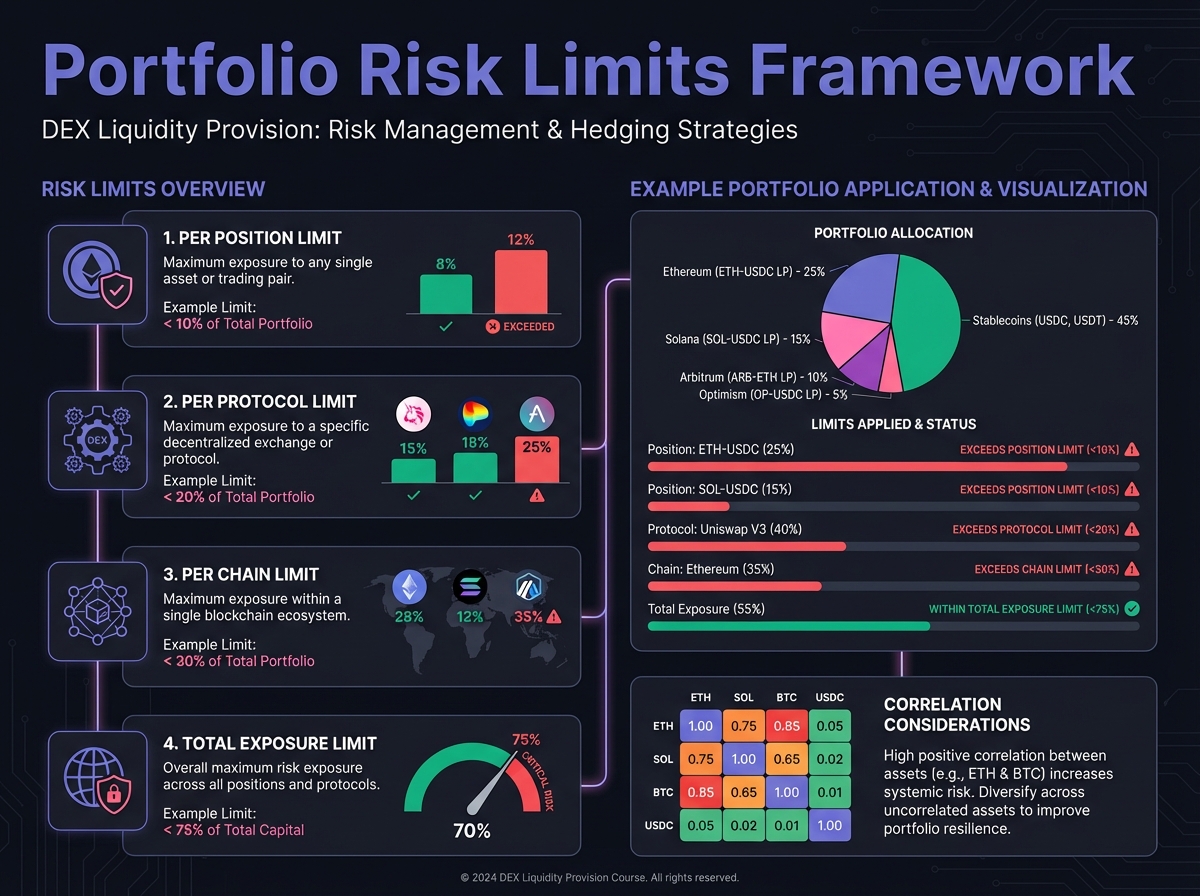
πŸ”„ Portfolio Risk Management

Position Sizing

Rule 1: Never risk more than 5-10% per position Rule 2: Diversify across pairs, protocols, chains Rule 3: Correlated pairs count as one position

Correlation Matrix

High Correlation (count as 1 position):

  • ETH/BTC

  • wstETH/ETH

  • USDC/USDT

Low Correlation (separate positions):

  • ETH/meme coin

  • Stablecoin/volatile asset

Risk Limits

Maximum Exposure:

  • Single pair: 10% of portfolio

  • Single protocol: 25% of portfolio

  • Single chain: 50% of portfolio

Example ($100k portfolio):

  • Uniswap V3 ETH/USDC: $10k (10%)

  • Aerodrome WETH/USDC: $10k (10%)

  • Raydium SOL/USDC: $10k (10%)

  • Reserve: $70k (70%)

Portfolio Risk Limits Framework

🎯 LVR Mitigation Strategies

Strategy 1: Lower Volatility Pairs

LVR Formula: LVR ∝ σ² (volatility squared)

Implication: Halving volatility = 4x less LVR

Action: Choose stable or correlated pairs

Strategy 2: Faster Chains

LVR is block-time sensitive:

  • Ethereum (12s blocks): Higher LVR

  • Arbitrum (0.25s blocks): Lower LVR

  • Solana (0.4s blocks): Lower LVR

Action: Use L2s or alternative chains

Strategy 3: Dynamic Fees

Meteora adjusts fees with volatility:

  • Higher volatility = Higher fees

  • Compensates for increased LVR

Action: Consider Meteora for volatile pairs

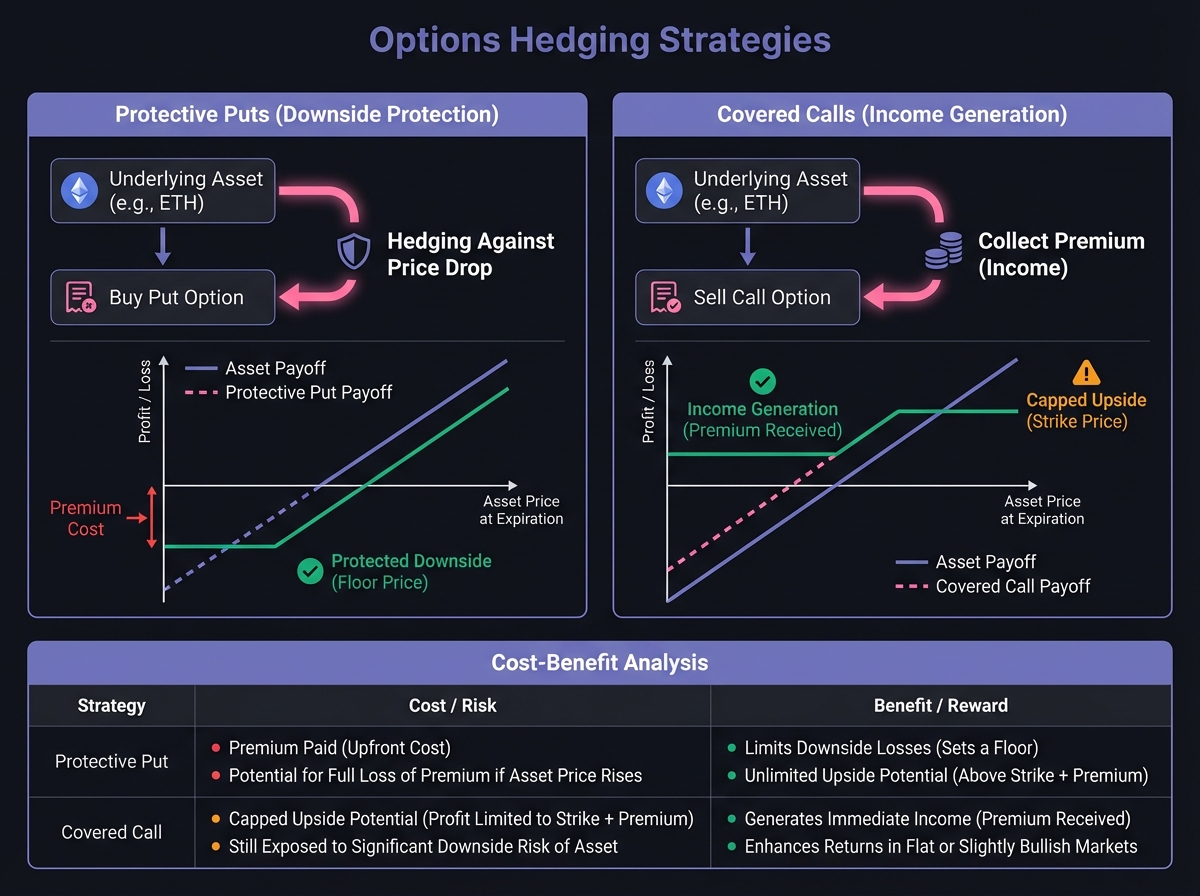
πŸ”¬ Advanced Deep-Dive: Options-Based Hedging

Protective Puts

Strategy: Buy put options to protect downside

Example:

  • LP Position: $10,000 ETH/USDC

  • Buy: $10,000 put option (strike $1,800)

  • Cost: $200 (2%)

If ETH drops to $1,600:

  • LP Loss: -$1,000

  • Put Profit: +$1,000

  • Net: -$200 (just option cost)

If ETH stays above $1,800:

  • LP: Normal returns

  • Put: Expires worthless

  • Net: -$200 (option cost)

Covered Calls

Strategy: Sell call options to generate income

Example:

  • LP Position: $10,000 ETH/USDC

  • Sell: $10,000 call option (strike $2,200)

  • Premium: $150 (1.5%)

If ETH stays below $2,200:

  • LP: Normal returns

  • Call: Expires worthless

  • Net: +$150 (premium earned)

If ETH rises above $2,200:

  • LP: Normal returns (capped)

  • Call: Exercised (sell ETH at $2,200)

  • Net: Premium + capped gains

Options Hedging Strategies

πŸ“ˆ Risk Monitoring Dashboard

Key Metrics to Track

Daily:

  • Current IL vs. fees earned

  • Position value changes

  • Price vs. range boundaries

Weekly:

  • Net PnL (fees - IL - gas)

  • Comparison to holding

  • Risk limit compliance

Monthly:

  • Total return analysis

  • Portfolio rebalancing

  • Strategy adjustments

Risk Alerts

Set Alerts For:

  • IL exceeds fees (losing money)

  • Price exits range (V3)

  • Position exceeds risk limits

  • Gas costs exceed fees

πŸŽ“ Beginner's Corner: Risk Management Basics

Q: Do I need to hedge? A: Only for large positions ($50k+) or very volatile pairs. Start without hedging, learn first.

Q: How much should I risk? A: Start with 1-5% of portfolio per position. Increase as you learn.

Q: What if IL exceeds fees? A: Withdraw and reassess. Don't wait hoping it improves.

Q: Should I diversify? A: Yes! Across pairs, protocols, and chains. Don't put all eggs in one basket.

Q: How do I monitor risk? A: Use analytics tools (APY.vision, Revert Finance) or track manually weekly.

🎯 Key Takeaways

  1. Risk management protects capital - fees alone aren't enough

  2. Delta hedging isolates fee yield from price exposure

  3. Portfolio limits prevent catastrophic losses

  4. LVR mitigation requires low volatility or fast chains

  5. Options hedging is advanced but powerful

  6. Monitor risk metrics weekly to catch problems early

  7. Start conservative - increase risk as you learn

πŸš€ Next Steps

Module 3 covers elite operations: Uniswap V4, MEV tactics, governance, and building complete LP systems. These advanced topics require solid risk management foundations.

Complete Exercise 8 to develop your risk management framework and calculate hedging strategies.


Remember: Professional LPs manage risk first, optimize returns second. Protect your capital, and the fees will follow. Unmanaged risk destroys more LP positions than low fees.

← Back to Summary | Next: Exercise 8 β†’ | Previous: Lesson 7 ←

Last updated