Lesson 2: The Mathematics of Liquidity Provision
🎧 Lesson Podcast
🎬 Video Overview
Lesson 2: The Mathematics of Liquidity Provision
🎯 Core Concept: Math is Your Protection
Understanding the mathematics behind AMMs isn't just academic—it's your primary defense against losses. The formulas determine:
How much you'll receive when swapping
What price impact your trade will have
How fees are calculated and distributed
Why impermanent loss occurs
Master these calculations, and you'll make better decisions, avoid costly mistakes, and optimize your returns.
📐 The Constant Product Formula: Deep Dive
The Fundamental Equation
x⋅y=k
This simple equation governs every trade in a constant product AMM. Let's break it down:
Variables:
x: Reserve of token X (e.g., ETH)
y: Reserve of token Y (e.g., USDC)
k: Constant product (must remain unchanged after fees)
Rule: After any trade (excluding fees), x × y must equal k.
Calculating Swap Amounts
When you want to swap Δx tokens of X for tokens of Y:
Without fees: (x+Δx)⋅(y−Δy)=k
With fees (fee rate φ, e.g., 0.003 for 0.3%): (x+Δx⋅(1−ϕ))⋅(y−Δy)=k
The fee is deducted from the input amount before the swap calculation.
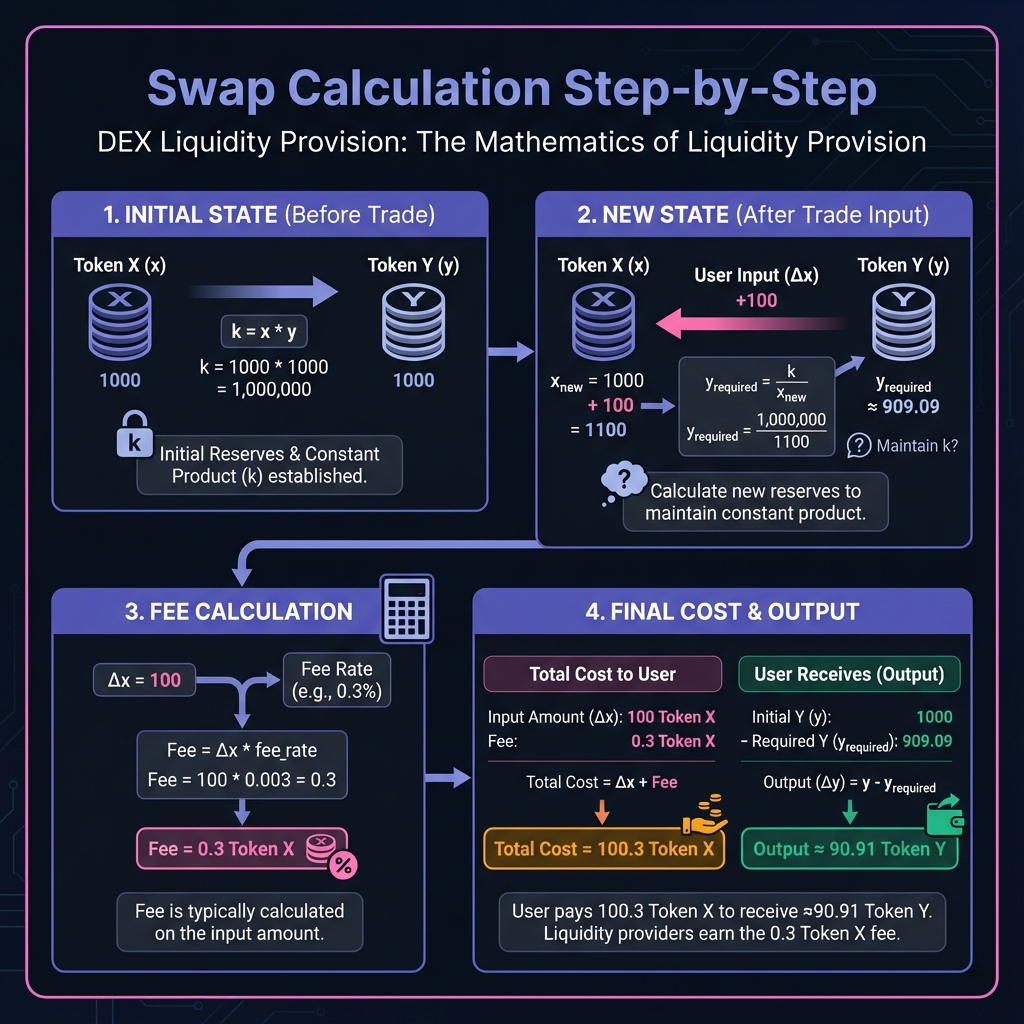
Step-by-Step Calculation
Example: Pool has 10 ETH (x) and 20,000 USDC (y)
k = 10 × 20,000 = 200,000
Fee rate: 0.3% (φ = 0.003)
You want to buy 1 ETH with USDC
Step 1: Calculate new x after your trade
x_new = 10 + 1 = 11 ETH
Step 2: Calculate required y to maintain k
y_new = k ÷ x_new = 200,000 ÷ 11 = 18,181.82 USDC
Step 3: Calculate how much USDC you need to deposit
Δy = 20,000 - 18,181.82 = 1,818.18 USDC
Step 4: Add fee (0.3% of input)
Fee = 1,818.18 × 0.003 = 5.45 USDC
Total you pay = 1,818.18 + 5.45 = 1,823.63 USDC
Result: You pay 1,823.63 USDC to receive 1 ETH
Effective price: 1,823.63 USDC per ETH
Original price: 2,000 USDC per ETH
Price impact: (1,823.63 - 2,000) ÷ 2,000 = -8.8%
Price Impact Formula
The larger your trade relative to the pool, the more price impact:
Price Impact=xΔx×100%
For the example above:
Δx = 1 ETH, x = 10 ETH
Price impact ≈ 10% (simplified calculation)
Key Insight: Trade size matters. A $100,000 trade in a $1M pool will have significant impact. A $100 trade in the same pool will have minimal impact.
📊 Understanding Price Curves
The Hyperbolic Price Curve
The constant product formula creates a hyperbolic price curve:
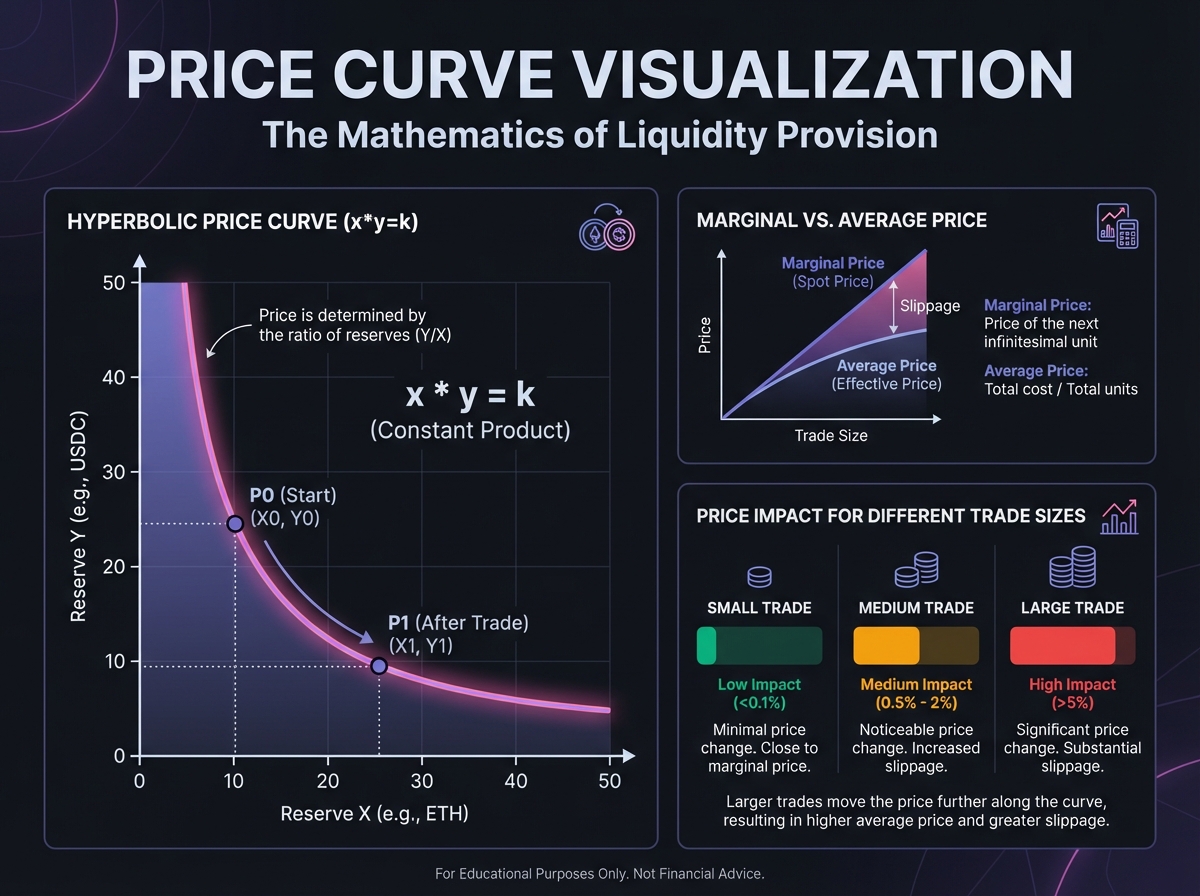
Characteristics:
As x approaches 0, price approaches infinity
As y approaches 0, price approaches 0
The curve is always decreasing (more X = lower price of X)
Price changes smoothly with each trade
Price Calculation
The current price of token X in terms of token Y:
P=xy
Example:
Pool: 10 ETH, 20,000 USDC
Price: 20,000 ÷ 10 = 2,000 USDC per ETH
After buying 1 ETH:
Pool: 11 ETH, 18,181.82 USDC
New price: 18,181.82 ÷ 11 = 1,653 USDC per ETH
The price moved down because ETH supply increased (you added ETH to the pool by buying it).
Marginal Price vs. Average Price
Marginal Price: The price for the next infinitesimal trade
Formula: P = y/x
This is what you see on interfaces
Average Price: The price you actually pay for your trade
Formula: (Total USDC paid) ÷ (ETH received)
Always worse than marginal price due to slippage
Example:
Marginal price: 2,000 USDC/ETH
You buy 1 ETH for 1,823.63 USDC
Average price: 1,823.63 USDC/ETH
Difference: 176.37 USDC (8.8% worse)
💧 Liquidity Depth and Capital Efficiency
Measuring Pool Depth
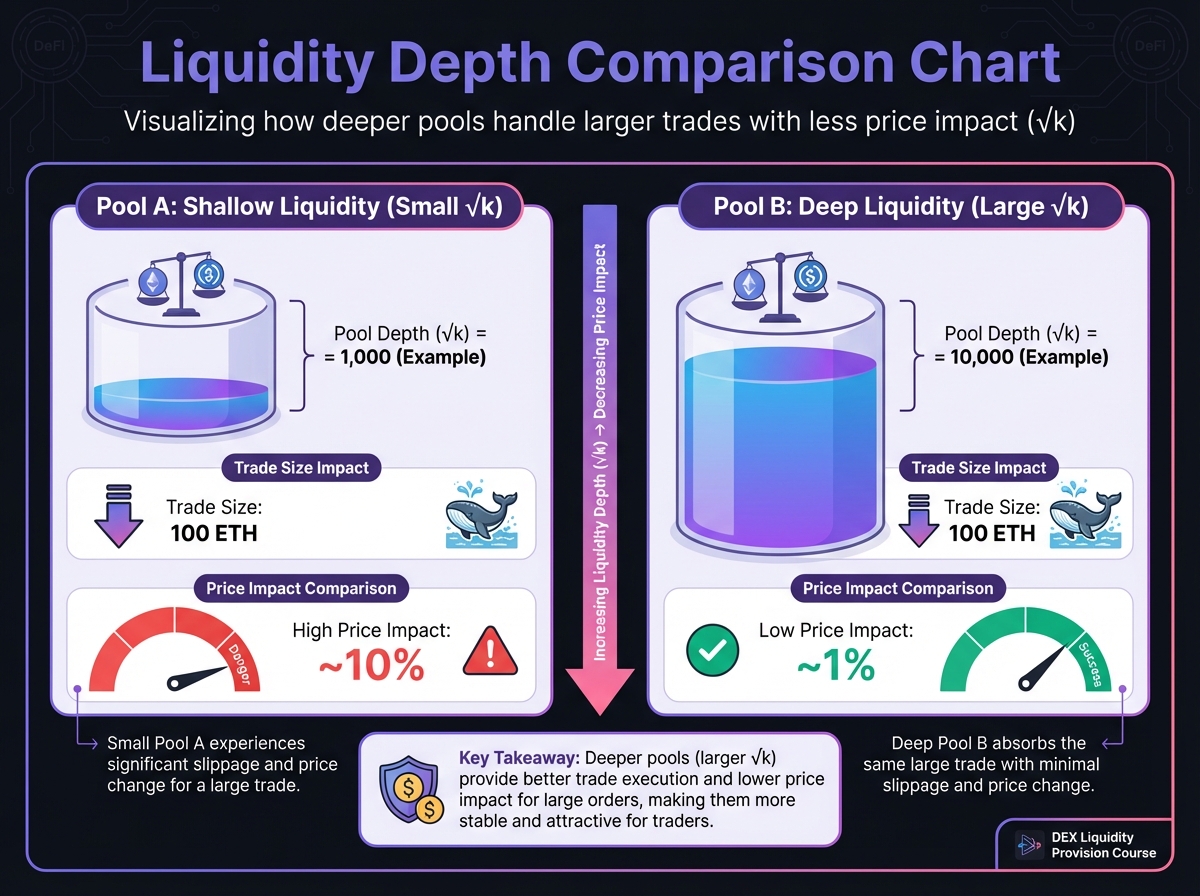
Pool depth determines how much you can trade before significant price impact:
D=x⋅y=k
Deeper pools (larger k):
Can handle larger trades
Less price impact per trade
More stable prices
Shallow pools (smaller k):
Large trades cause significant slippage
Prices move dramatically
Higher risk for LPs
Capital Efficiency Problem
In Uniswap V2, liquidity is distributed across the entire price curve (0 to ∞). For a stablecoin pair trading at $1.00:
99.9% of liquidity sits at prices like $0.01 or $100.00
Only 0.1% is active near the current price
This means 99.9% of capital earns no fees
Example:
Pool: 1,000,000 USDC + 1,000,000 DAI (trading at 1:1)
Active liquidity: ~$2,000 (0.1% of $2M)
Idle liquidity: $1,998,000 (99.9%)
This inefficiency led to Uniswap V3's concentrated liquidity (Lesson 5).
🧮 Fee Mathematics
How Fees Accumulate
Fees are added to the pool, increasing the value of LP tokens:
Before trade:
Pool: 10 ETH, 20,000 USDC
Your share: 10% (1 ETH, 2,000 USDC)
Trade occurs: Someone swaps 1 ETH for 1,823.63 USDC
Fee: 5.45 USDC added to pool
New pool: 11 ETH, 18,181.82 + 5.45 = 18,187.27 USDC
Pool value increased by 5.45 USDC
Your new position:
Still 10% of pool
Value: 1.1 ETH + 1,818.73 USDC
Gained: 0.1 ETH worth of fees (increased share)
Fee Distribution
Fees are distributed proportionally to LP token holders:
Your Fee Share=Total LP TokensYour LP Tokens×Total Fees
Example:
Total fees this week: 1,000 USDC
Your LP tokens: 100
Total LP tokens: 10,000
Your share: (100 ÷ 10,000) × 1,000 = 10 USDC
APY Calculation (Simplified)
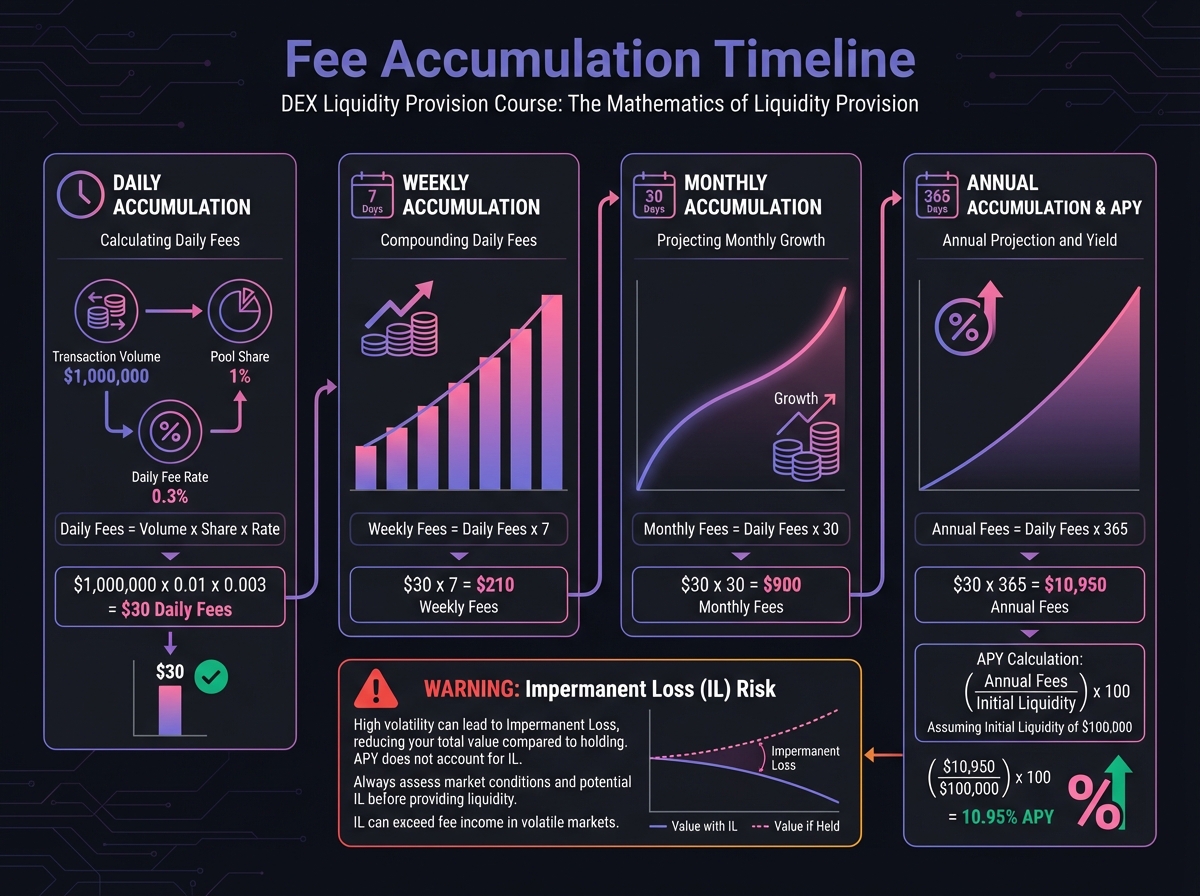
Daily Fee Calculation: Daily Fees=Daily Volume×Fee Rate
Your Daily Earnings: Your Earnings=Daily Fees×Total TVLYour Capital
Annualized: APY=(Your CapitalYour Earnings×365)×100%
Example:
Daily volume: $1,000,000
Fee rate: 0.3%
Daily fees: $3,000
Your capital: $10,000
Total TVL: $1,000,000
Your daily earnings: $3,000 × ($10,000 ÷ $1,000,000) = $30
APY: ($30 ÷ $10,000) × 365 × 100% = 109.5%
⚠️ Critical Warning: This APY doesn't account for impermanent loss, which can easily exceed 100% in volatile markets!
Interactive Fee Accumulation Calculator
Use this calculator to estimate your potential fee earnings and accumulation over time based on position size, pool TVL, volume, and fee tier:
Launch Fee Accumulation Calculator →
🔬 Advanced Deep-Dive: Mathematical Properties
Invariant Preservation
The constant product formula ensures the invariant k is preserved:
Proof: After a trade of Δx for Δy: (x+Δx)⋅(y−Δy)=x⋅y+Δx⋅y−Δy⋅x−Δx⋅Δy
For small trades, Δx · Δy ≈ 0, so: (x+Δx)⋅(y−Δy)≈x⋅y=k
Price Elasticity
The price elasticity of the pool determines how sensitive prices are to trades:
ϵ=%ΔQ%ΔP
Where:
ε = elasticity
%ΔP = percentage change in price
%ΔQ = percentage change in quantity
For constant product AMMs, elasticity is always negative (price decreases as quantity increases).
Optimal Trade Size
To minimize price impact, traders should split large orders:
Single large trade: 10 ETH
Price impact: ~50%
Average price: 1,500 USDC/ETH
10 smaller trades: 1 ETH each
Price impact per trade: ~5%
Average price: ~1,900 USDC/ETH
Better execution by ~27%
This is why aggregators like 1inch split orders across multiple pools.
📈 Real-World Calculation: Complete Example
Let's work through a complete example:
Pool State:
ETH reserves: 100 ETH
USDC reserves: 200,000 USDC
k = 100 × 200,000 = 20,000,000
Current price: 2,000 USDC/ETH
You want to: Buy 5 ETH
Step 1: Calculate new ETH reserves
x_new = 100 + 5 = 105 ETH
Step 2: Calculate required USDC to maintain k
y_new = 20,000,000 ÷ 105 = 190,476.19 USDC
Step 3: Calculate USDC needed
Δy = 200,000 - 190,476.19 = 9,523.81 USDC
Step 4: Add 0.3% fee
Fee = 9,523.81 × 0.003 = 28.57 USDC
Total cost = 9,523.81 + 28.57 = 9,552.38 USDC
Results:
You pay: 9,552.38 USDC
You receive: 5 ETH
Effective price: 1,910.48 USDC/ETH
Price impact: (1,910.48 - 2,000) ÷ 2,000 = -4.5%
New pool price: 190,476.19 ÷ 105 = 1,814.06 USDC/ETH
🎓 Beginner's Corner: Common Math Mistakes
Mistake 1: Assuming linear price relationships
Wrong: "If 1 ETH = 2,000 USDC, then 10 ETH = 20,000 USDC"
Right: Price changes with each ETH bought. 10 ETH might cost 25,000 USDC due to slippage.
Mistake 2: Ignoring fees in calculations
Wrong: Calculating swap amount without fees
Right: Always include fees (typically 0.3%) in your calculations
Mistake 3: Using average price as marginal price
Wrong: "The price is 2,000, so I'll get 1 ETH for 2,000 USDC"
Right: You'll pay more than 2,000 due to price impact and fees
Mistake 4: Not accounting for pool depth
Wrong: "I'll trade $100k in this $10k pool"
Right: Check pool depth first. Your trade might move price 50%+.
🔑 Key Takeaways
x · y = k governs all trades in constant product AMMs
Price = y/x determines the current exchange rate
Larger trades = more price impact due to the hyperbolic curve
Fees compound by increasing pool reserves
Pool depth (√k) determines how much you can trade
APY calculations are misleading without impermanent loss
🚀 Next Steps
Now that you understand the mathematics, Lesson 3 will show you the dark side: Impermanent Loss. This is where many LPs lose money despite earning fees.
Complete Exercise 2 to practice these calculations and build your mathematical intuition.
Remember: Math protects your capital. Master these formulas, and you'll make informed decisions. Ignore them, and you'll lose money to traders who understand them better.
← Back to Summary | Next: Exercise 2 → | Previous: Lesson 1 ←
Last updated