Lesson 10: MEV, JIT Liquidity, and Advanced Tactics
π― Core Concept: The Dark Forest of DeFi
Maximal Extractable Value (MEV) and Just-In-Time (JIT) liquidity are advanced tactics that can extract value from your positions. Understanding these concepts helps you protect your capital and, for advanced LPs, potentially participate in MEV strategies.
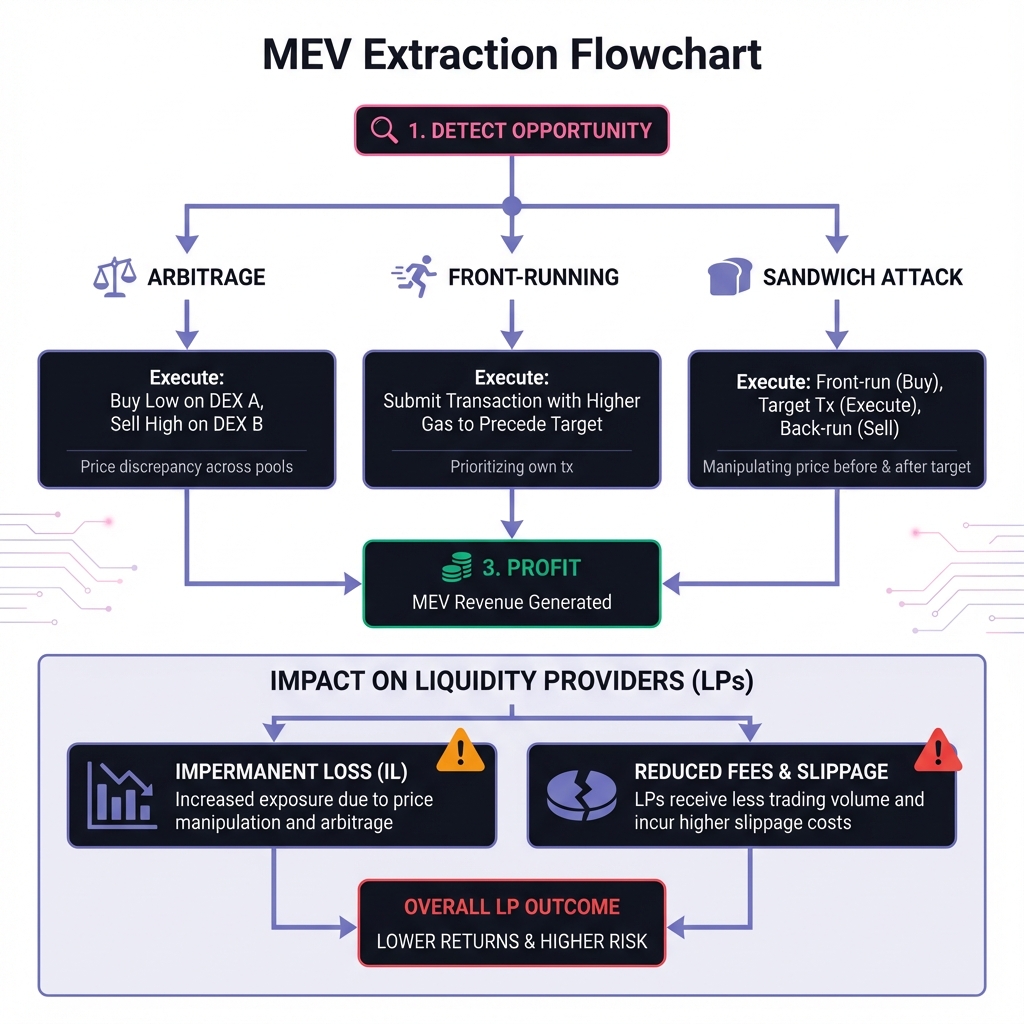
π Understanding MEV
What is MEV?
MEV = Value extracted by reordering, inserting, or censoring transactions
Sources:
Arbitrage opportunities
Liquidations
Front-running
Back-running
Sandwich attacks
How MEV Affects LPs
The Problem: MEV bots extract value that could go to LPs
Example - Arbitrage:
ETH price moves on Binance
MEV bot sees opportunity
Bot front-runs your LP position
Bot captures arbitrage profit
You get less favorable execution
Result: LPs effectively subsidize MEV extraction

β‘ Just-In-Time (JIT) Liquidity
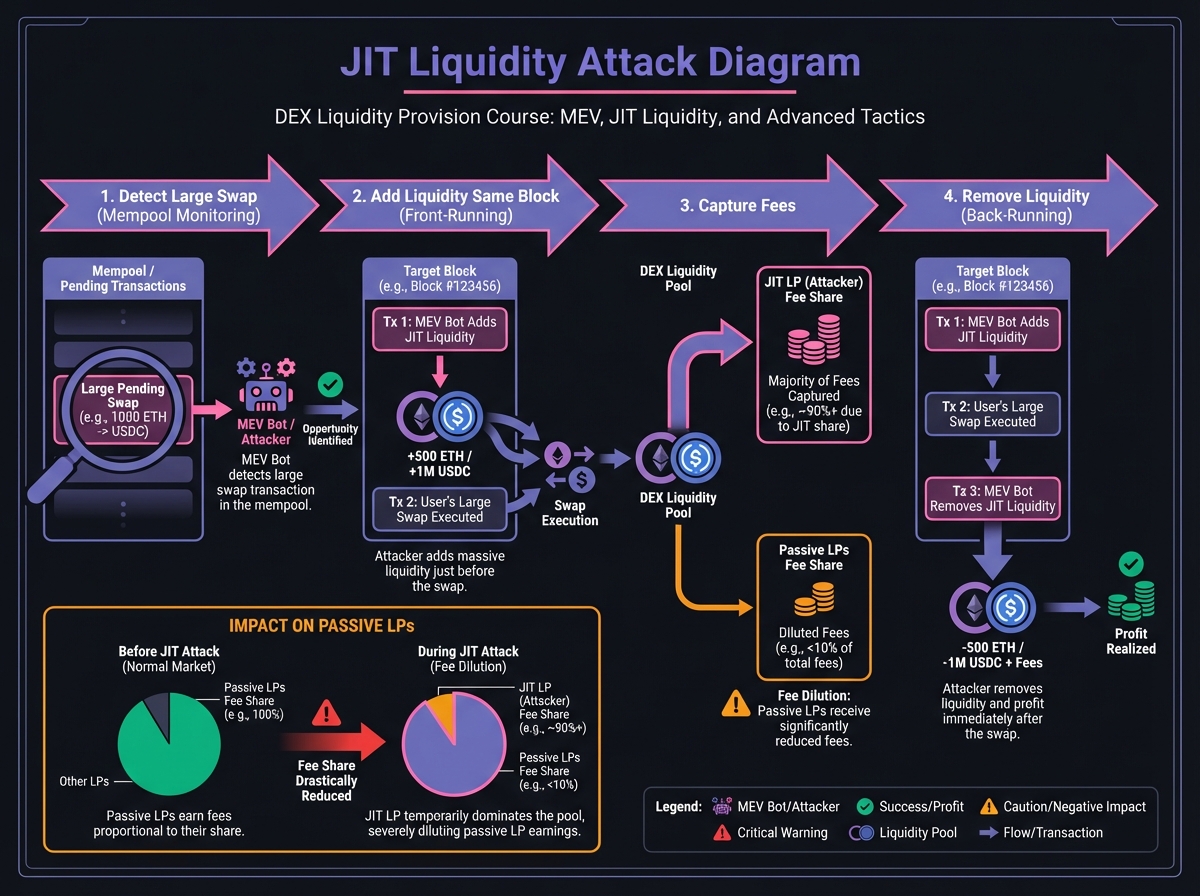
The JIT Attack
How It Works:
MEV searcher detects large pending swap in mempool
Searcher adds massive liquidity at current tick (same block)
Large swap executes (searcher captures fees)
Searcher removes liquidity immediately (same block)
Searcher holds position for <1 second
Impact on Passive LPs:
JIT provider captures 100% of fees from that trade
Takes almost zero risk (holds for one block)
Passive LPs get diluted (less fees per dollar)
JIT Example
Scenario: $1M ETH swap pending
Before JIT:
Pool liquidity: $10M
Your share: 1% = $100k
Fee from swap: $1M Γ 0.003 = $3,000
Your share: $30
With JIT:
JIT provider adds $5M liquidity (same block)
Total liquidity: $15M
Your share: $100k Γ· $15M = 0.67%
Fee from swap: $3,000
Your share: $20 (33% less!)
JIT Provider:
Added $5M, captured $1,500 in fees
Removed immediately
ROI: 0.03% in <1 second!
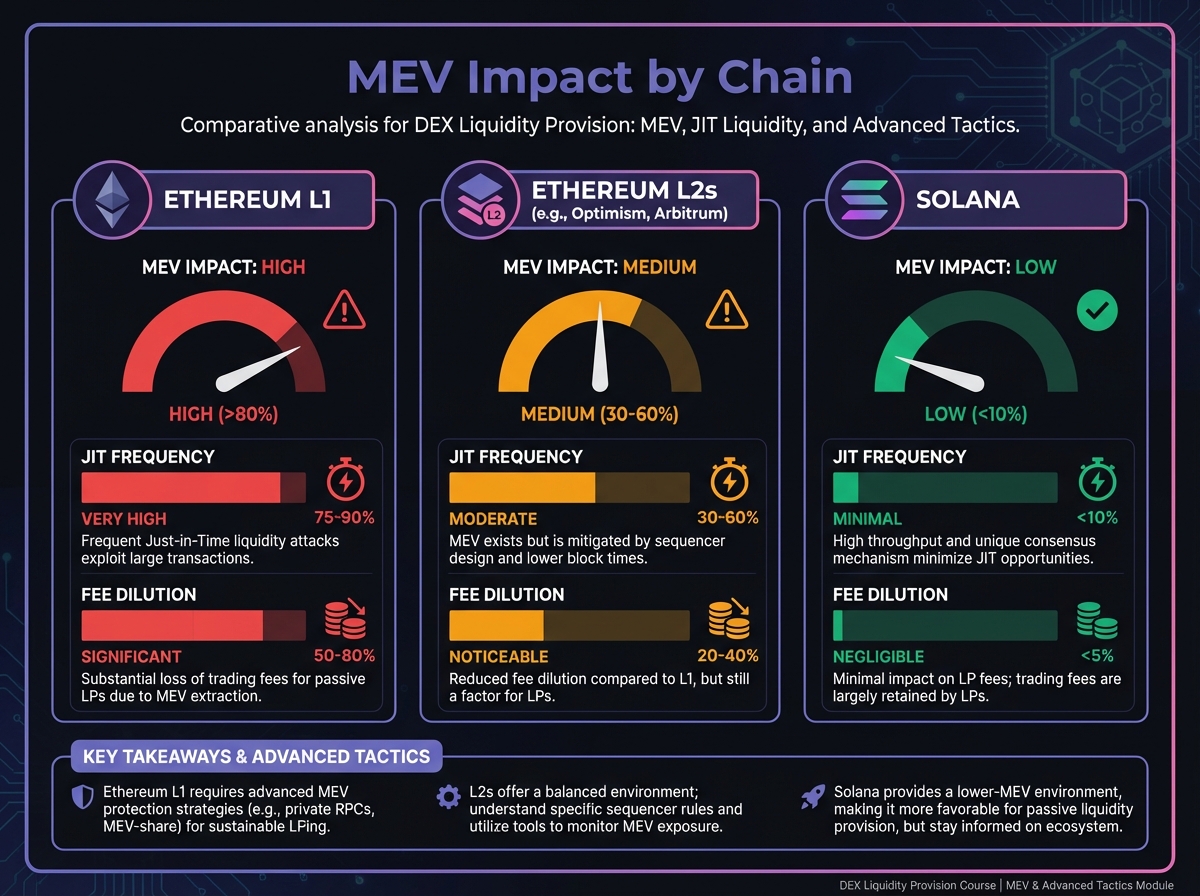
JIT Frequency
On Ethereum L1:
Very common (high MEV activity)
Affects 10-30% of large swaps
Significant fee dilution
On L2s:
Less common (sequencer mechanics)
Still occurs but less frequently
Lower impact
On Solana:
Rare (faster blocks, different mechanics)
Minimal JIT impact

π‘οΈ Protecting Against MEV/JIT
Strategy 1: Use Private Pools
Concept: Private mempools (Flashbots, Eden Network)
How It Works:
Submit transactions to private mempool
Not visible to MEV bots
Reduced front-running
Limitation: Not available for all operations
Strategy 2: Use DEX Aggregators
Concept: Aggregators (1inch, CowSwap) route through multiple pools
Benefit:
Less toxic flow
Better execution
Reduced MEV exposure
Result: More sustainable fee generation
Strategy 3: Wider Ranges (V3)
Concept: Wider ranges = less JIT impact
Why: JIT providers target specific ticks. Wider ranges dilute their impact.
Trade-off: Lower capital efficiency
Strategy 4: Use L2s or Alternative Chains
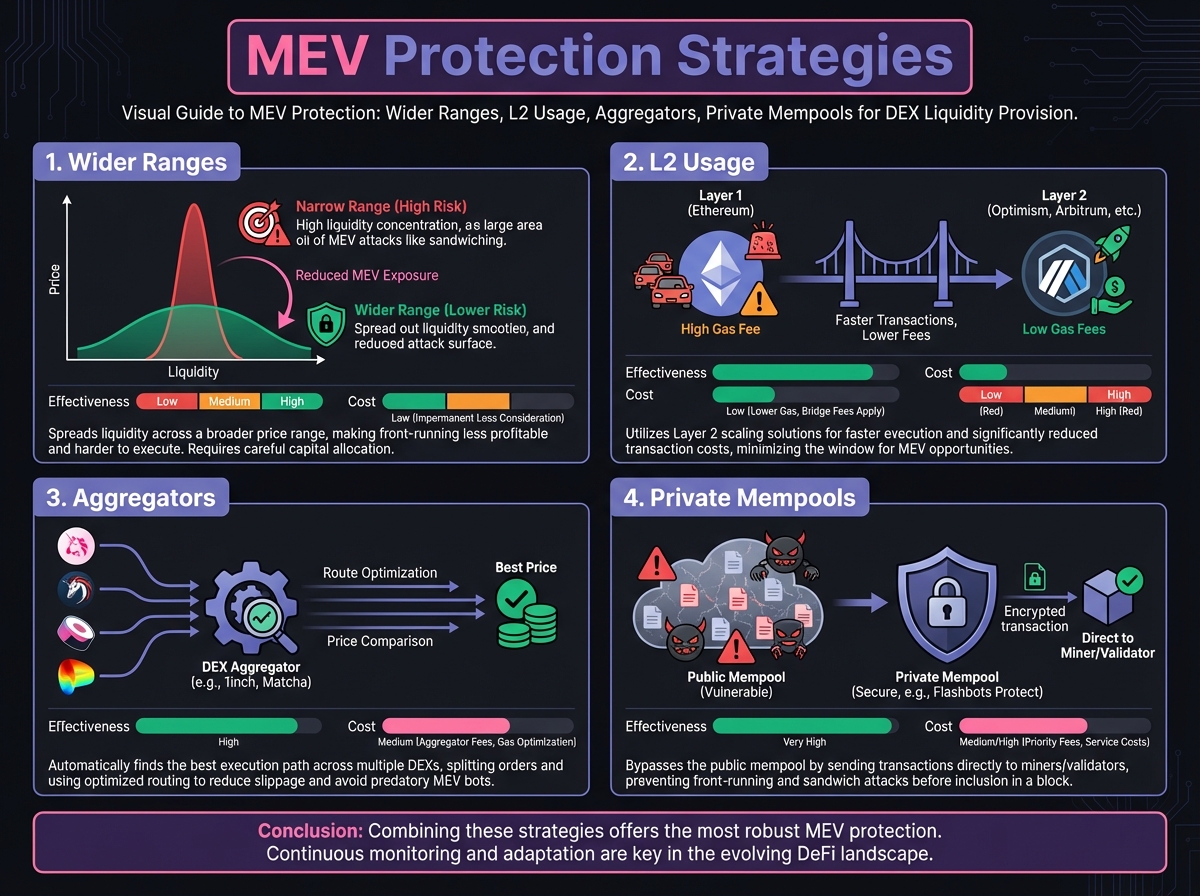
Concept: Different MEV dynamics
Benefit:
Less MEV activity
Faster blocks (less JIT opportunity)
Lower impact

π¬ Advanced Deep-Dive: Participating in MEV
Can LPs Participate in MEV?
Yes, but it's advanced:
Strategy 1: Run your own MEV bot
Monitor mempool
Identify opportunities
Execute JIT liquidity
Requires: Technical skills, capital, infrastructure
Strategy 2: Use MEV-protected protocols
Flashbots Protect
Eden Network
Benefit: Share in MEV profits
Strategy 3: MEV-sharing pools
Some protocols share MEV with LPs
Benefit: Passive MEV participation
MEV Bot Requirements
Technical:
Mempool monitoring
Fast execution
Gas optimization
Smart contract interaction
Capital:
Large positions for JIT
Gas for failed attempts
Buffer for losses
Infrastructure:
Low-latency connections
Reliable node access
Monitoring systems
Reality: Most LPs should focus on protection, not participation
π MEV Impact Analysis
Measuring MEV Impact
Metrics:
Fee dilution percentage
JIT frequency
MEV extraction rate
Tools:
Dune Analytics dashboards
Flashbots data
Protocol analytics
Typical Impact
Ethereum L1:
JIT affects 10-30% of large swaps
Fee dilution: 5-15%
Significant impact on returns
L2s:
JIT affects 2-10% of swaps
Fee dilution: 1-5%
Moderate impact
Solana:
JIT rare
Fee dilution: <1%
Minimal impact

π Beginner's Corner: MEV Basics
Q: Should I worry about MEV? A: Yes, but don't overthink it. Use L2s, wider ranges, and aggregators to minimize impact.
Q: Can I stop JIT attacks? A: Not completely, but you can reduce impact with wider ranges and L2 usage.
Q: Should I run an MEV bot? A: Only if you're technically advanced. Most LPs should focus on protection.
Q: Does MEV make LPing unprofitable? A: No, but it reduces returns. Factor into your calculations.
Q: Which chains have less MEV? A: L2s and Solana have less MEV activity than Ethereum L1.
π― Key Takeaways
MEV extracts value from LPs through various tactics
JIT liquidity dilutes passive LP fees significantly
Protection strategies include L2s, wider ranges, aggregators
MEV participation is advanced and requires technical skills
Impact varies by chain - L1 worst, L2s better, Solana best
Factor MEV into returns - expect 5-15% fee dilution on L1
Focus on protection unless you're building MEV infrastructure
π Next Steps
Lesson 11 covers governance and incentive optimization - understanding ve-tokens, bribes, and how to maximize yields through protocol participation.
Complete Exercise 10 to analyze MEV impact and develop protection strategies.
Remember: MEV is a reality of DeFi. You can't eliminate it, but you can minimize its impact. Use L2s, wider ranges, and understand that some fee dilution is inevitable. Focus on what you can control.
β Back to Summary | Next: Exercise 10 β | Previous: Lesson 9 β
Last updated