Lesson 7: Fee Optimization and Gas Economics
🎯 Core Concept: Fees Must Exceed Costs
Gas costs can eat your profits. This lesson teaches you to optimize fee tiers, minimize gas expenses, and calculate when LPing is actually profitable after accounting for all costs.
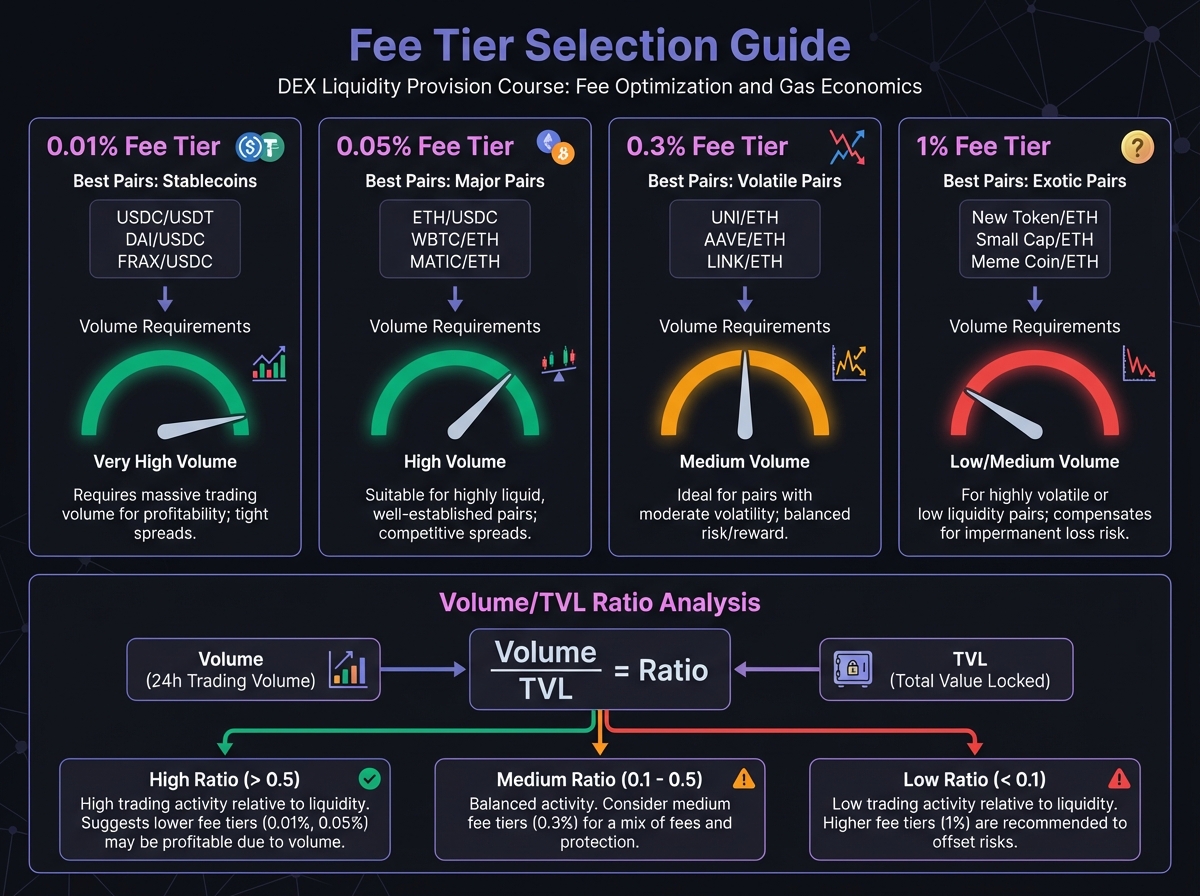
💸 Understanding Fee Tiers
Uniswap Fee Tiers
0.01% (1 bp): Ultra-stable pairs (USDC/DAI, USDT/USDC)
Lowest fees for traders
Highest volume
Requires tight ranges (V3) or high TVL (V2)
0.05% (5 bp): Standard for major pairs (ETH/USDC, WBTC/ETH)
Balance of fees and volume
Most popular tier
Best for beginners
0.3% (30 bp): Volatile pairs, legacy V2 standard
Higher fees compensate for IL risk
Lower volume than 0.05%
Good for exotic pairs
1% (100 bp): Highly volatile, exotic pairs
Maximum fee protection
Lowest volume
Use only for very risky pairs
Fee Tier Selection Framework
Choose 0.01% if:
Stablecoin pair
High correlation (wstETH/ETH)
Can manage tight ranges
Choose 0.05% if:
Major blue-chip pairs
Moderate volatility
Want balance of fees and volume
Choose 0.3% if:
Volatile pairs
Lower liquidity
Need higher fees to offset IL
Choose 1% if:
Meme coins
Very new tokens
Extreme volatility expected

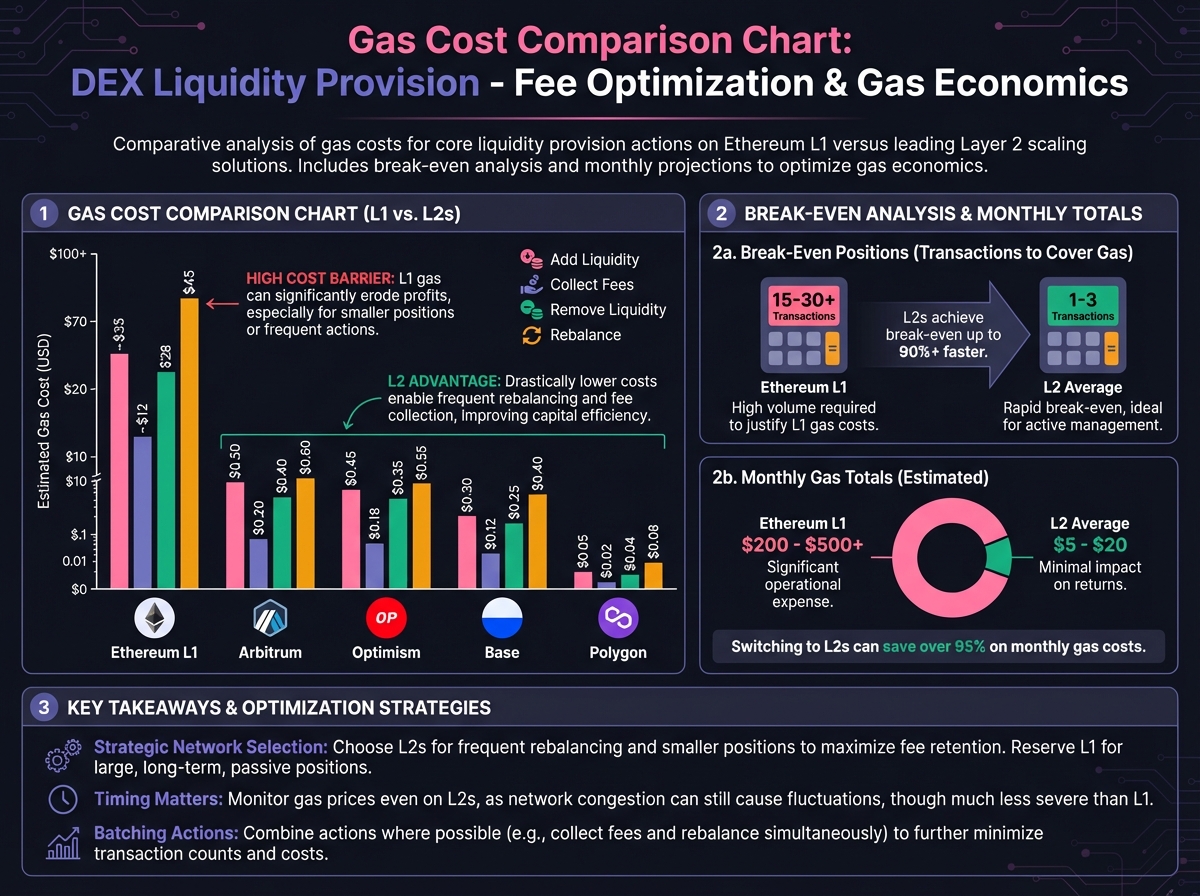
⛽ Gas Economics: L1 vs L2
Ethereum Mainnet (L1) Costs
Typical Gas Costs:
Add liquidity: $50-150
Remove liquidity: $30-100
Collect fees (V3): $20-50
Rebalance: $100-300
Break-Even Analysis:
Minimum position: $25,000-50,000
Need fees > $200/month to justify gas
Only viable for large, passive positions
Layer 2 Costs
Arbitrum/Optimism:
Add liquidity: $0.50-2.00
Remove liquidity: $0.30-1.50
Collect fees: $0.20-1.00
Rebalance: $1.00-5.00
Break-Even Analysis:
Minimum position: $500-1,000
Viable for active management
Can rebalance frequently
Base/Polygon:
Even lower costs ($0.10-0.50 per transaction)
Minimum position: $100-500
Best for small LPs
Gas Optimization Strategies
1. Batch Operations:
Approve both tokens in one session
Add liquidity immediately after approval
Don't let approvals expire
2. Time Your Transactions:
Gas is lower on weekends
Avoid high-traffic times (US market hours)
Use gas trackers (ETH Gas Station)
3. Use L2:
100x cheaper than L1
Same security (inherited)
Growing liquidity
4. Minimize Rebalancing:
Set wider ranges (less frequent rebalancing)
Use stable pairs (less IL, less rebalancing)
Monitor but don't over-manage

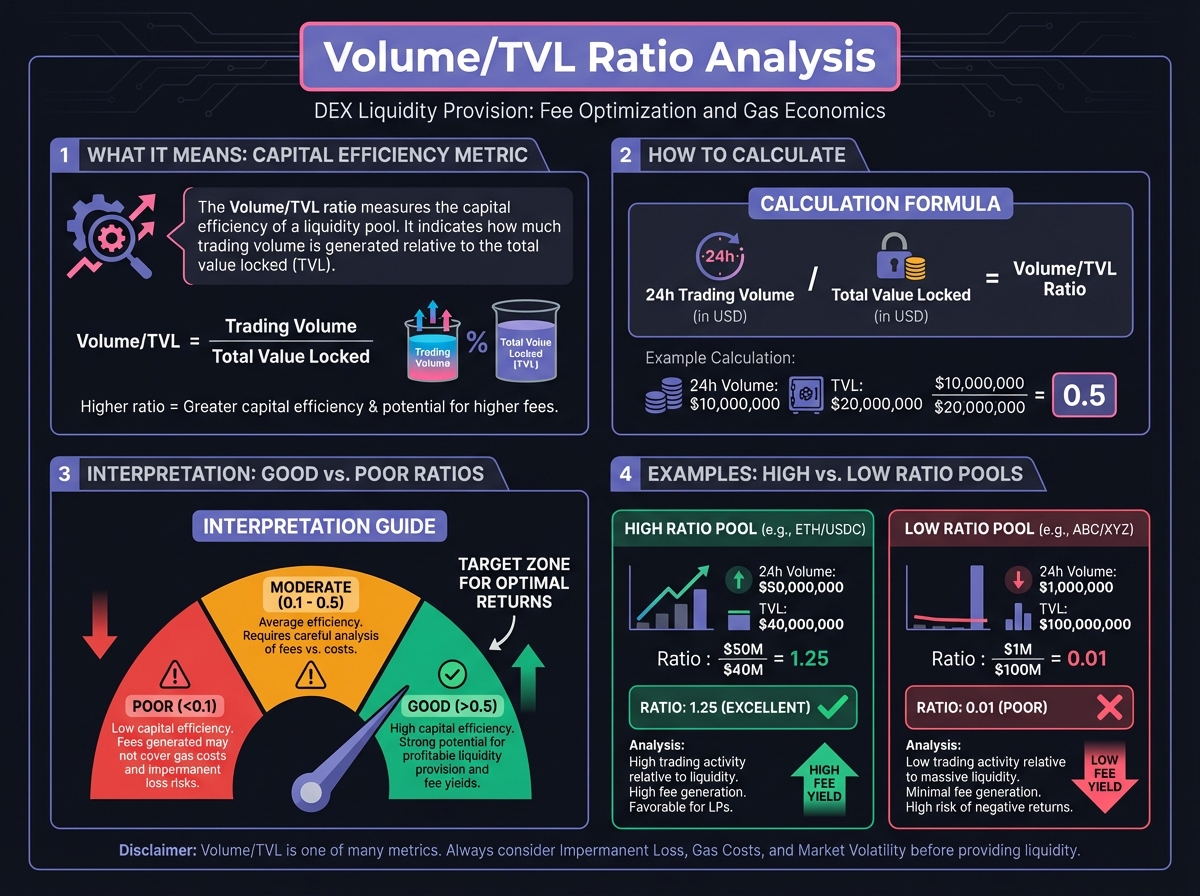
📊 Volume/TVL Ratio Analysis
The Critical Metric
Formula: Volume/TVL Ratio = Daily Volume ÷ Total Value Locked
Interpretation:
Ratio > 0.5: Excellent (high fees per dollar)
Ratio 0.1-0.5: Good
Ratio < 0.1: Poor (low fees, avoid)
Real-World Example
Pool A:
TVL: $10,000,000
Daily Volume: $2,000,000
Ratio: 0.2 (Good)
Pool B:
TVL: $100,000,000
Daily Volume: $1,000,000
Ratio: 0.01 (Poor - avoid!)
Your $10,000 position:
Pool A: $10,000 ÷ $10M = 0.1% share
Daily fees: $2M × 0.003 × 0.001 = $6/day
Monthly: $180
Pool B: $10,000 ÷ $100M = 0.01% share
Daily fees: $1M × 0.003 × 0.0001 = $0.30/day
Monthly: $9
Result: Pool A generates 20x more fees despite lower TVL!

💰 Fee Calculation Framework
Expected Fee Formula
Daily Fees = (Daily Volume × Fee Rate × Your Share) - Gas Costs
Your Share = Your Capital ÷ Total TVL
Monthly Fees = Daily Fees × 30
Annual Fees = Monthly Fees × 12
Complete Example
Setup:
Capital: $10,000
Pool TVL: $1,000,000
Daily Volume: $500,000
Fee Rate: 0.05%
Network: Arbitrum (L2)
Calculations:
Your share: $10,000 ÷ $1,000,000 = 1%
Daily fees: $500,000 × 0.0005 × 0.01 = $2.50
Monthly fees: $2.50 × 30 = $75
Annual fees: $75 × 12 = $900
Gas costs (monthly):
Add liquidity: $2 (one-time, amortized)
Collect fees: $1 × 4 = $4 (weekly)
Rebalance: $3 × 2 = $6 (bi-weekly)
Total gas: $12/month
Net fees: $75 - $12 = $63/month = $756/year
APY: $756 ÷ $10,000 = 7.56% (before IL!)
🎯 Fee Optimization Strategies
Strategy 1: High Volume Pools
Target: Volume/TVL ratio > 0.3 Benefit: Maximum fees per dollar Risk: May have higher competition
Strategy 2: Emerging Pools
Target: New pools with growing volume Benefit: Get in early, capture growth Risk: Volume may not materialize
Strategy 3: Fee Tier Arbitrage
Target: Same pair, different fee tiers Benefit: Capture volume shifts Risk: Requires monitoring multiple positions
Strategy 4: Cross-Protocol Optimization
Target: Same pair on different protocols Benefit: Capture best fees/emissions Risk: More complex management
🔬 Advanced Deep-Dive: Dynamic Fee Models
Meteora's Dynamic Fees
Meteora adjusts fees based on:
Volatility: Higher volatility = higher fees
Utilization: Higher usage = higher fees
Market conditions: Adaptive to market state
Formula (simplified):
Benefit: LPs earn more during high volatility (compensating IL risk)
Uniswap V4 Hooks (Future)
V4 will allow custom fee logic via hooks:
Time-weighted fees
Volatility-based fees
Utilization-based fees
Implication: More sophisticated fee optimization strategies coming
🎓 Beginner's Corner: Fee Optimization Mistakes
Mistake 1: Choosing wrong fee tier
Fix: Match tier to pair volatility
Mistake 2: Ignoring gas costs
Fix: Always calculate net fees (fees - gas)
Mistake 3: Low Volume/TVL ratio
Fix: Check ratio before depositing
Mistake 4: Using L1 for small positions
Fix: Always use L2 for positions <$25k
Mistake 5: Over-optimizing fees
Fix: Balance fees with IL risk and management time
📈 Real-World Optimization Example
Scenario: $20,000 to deploy
Option A: Uniswap V3 (L1), ETH/USDC, 0.05% tier
TVL: $50M, Daily Volume: $10M
Your share: 0.04%
Daily fees: $10M × 0.0005 × 0.0004 = $2
Monthly: $60
Gas (monthly): $50
Net: $10/month
Option B: Uniswap V3 (Arbitrum), ETH/USDC, 0.05% tier
Same pool, L2
Daily fees: $2 (same)
Monthly: $60
Gas (monthly): $5
Net: $55/month
Option C: Aerodrome (Base), WETH/USDC, sAMM
TVL: $5M, Daily Volume: $2M
Your share: 0.4%
Daily fees: $2M × 0.0005 × 0.004 = $4
Daily emissions: $6 (estimated)
Monthly: $300
Gas (monthly): $3
Net: $297/month
Winner: Option C (Aerodrome) - 30x better than Option A!
🎯 Key Takeaways
Fee tiers matter - match to pair volatility
Volume/TVL ratio is critical - check before depositing
Gas costs kill small positions - use L2
Calculate net fees - fees minus gas, minus IL
High volume pools generate more fees per dollar
Cross-protocol comparison can reveal better opportunities
Dynamic fees (Meteora) adapt to market conditions
🚀 Next Steps
Lesson 8 covers advanced risk management and hedging - essential for protecting capital when fees alone aren't enough. Learn to hedge IL and manage portfolio risk.
Complete Exercise 7 to calculate optimal fee tiers and analyze gas economics for your positions.
Remember: Fees must exceed gas costs + IL to be profitable. Always calculate net returns, not just gross fees. Optimization is the difference between profitable and unprofitable LPing.
← Back to Summary | Next: Exercise 7 → | Previous: Lesson 6 ←
Last updated