Lesson 1: The Problem Money Solves
🎧 Lesson Podcast
🎬 Video Overview
The Problem Money Solves
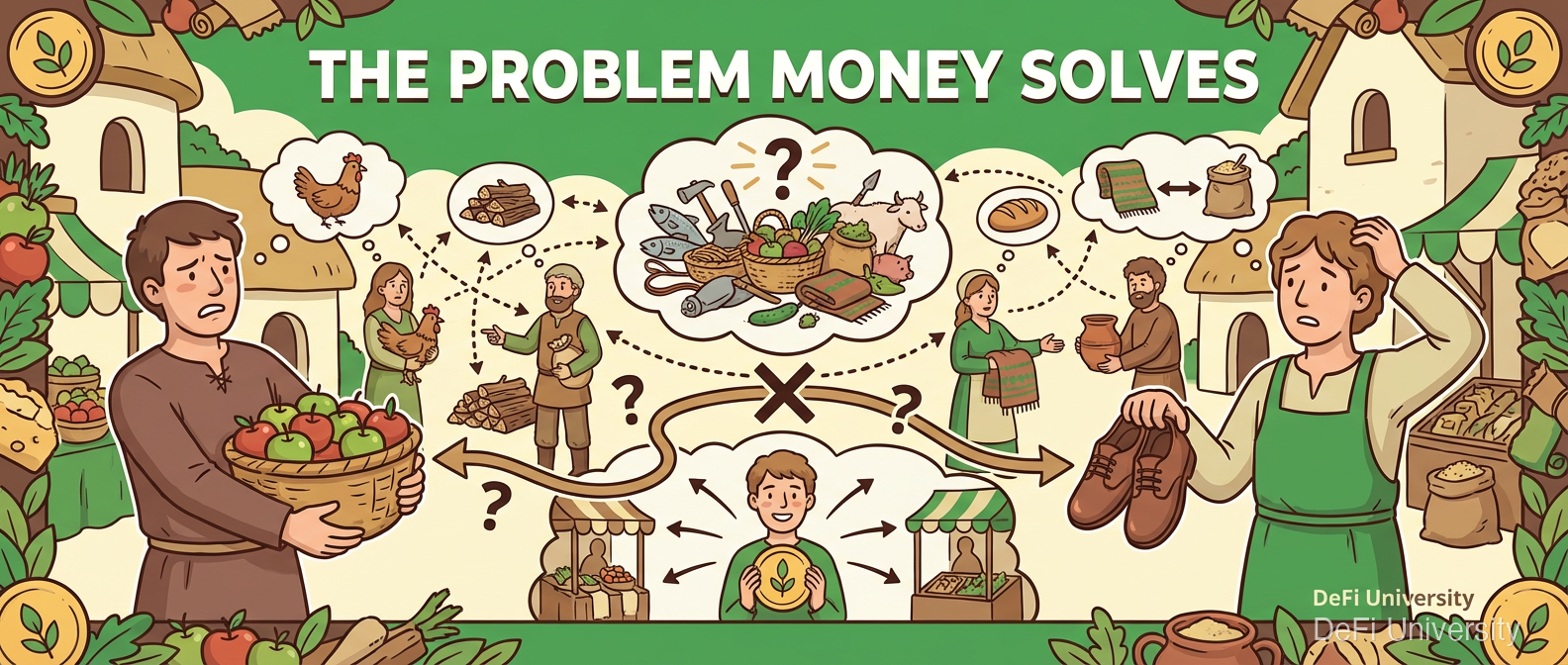
Core concept: Money exists because trading directly (I have apples, you have shoes) gets really complicated really fast.
The Apple Farmer's Dilemma

Imagine you're a farmer who grows the best apples in town. Your shoes are worn out, and you need a new pair. Simple, right? Just go find the shoemaker and trade some apples for shoes.
But here's the problem: the shoemaker doesn't want apples. She wants bread.
Okay, so you need to find the baker. But the baker has plenty of apples already—he wants eggs. So now you need to find someone with eggs who actually wants your apples, trade for eggs, bring those eggs to the baker, get bread, take the bread to the shoemaker, and finally get your shoes.
A fifteen-minute errand just became an all-day adventure. And what if your apples go bad while you're running around town?
This mess has a name: the double coincidence of wants. For a direct trade to work, both people need to want exactly what the other person has, at the exact same time. It's like trying to find someone who wants to swap their Netflix password for your Spotify password—possible, but inconvenient.
Enter Money: The Universal Translator
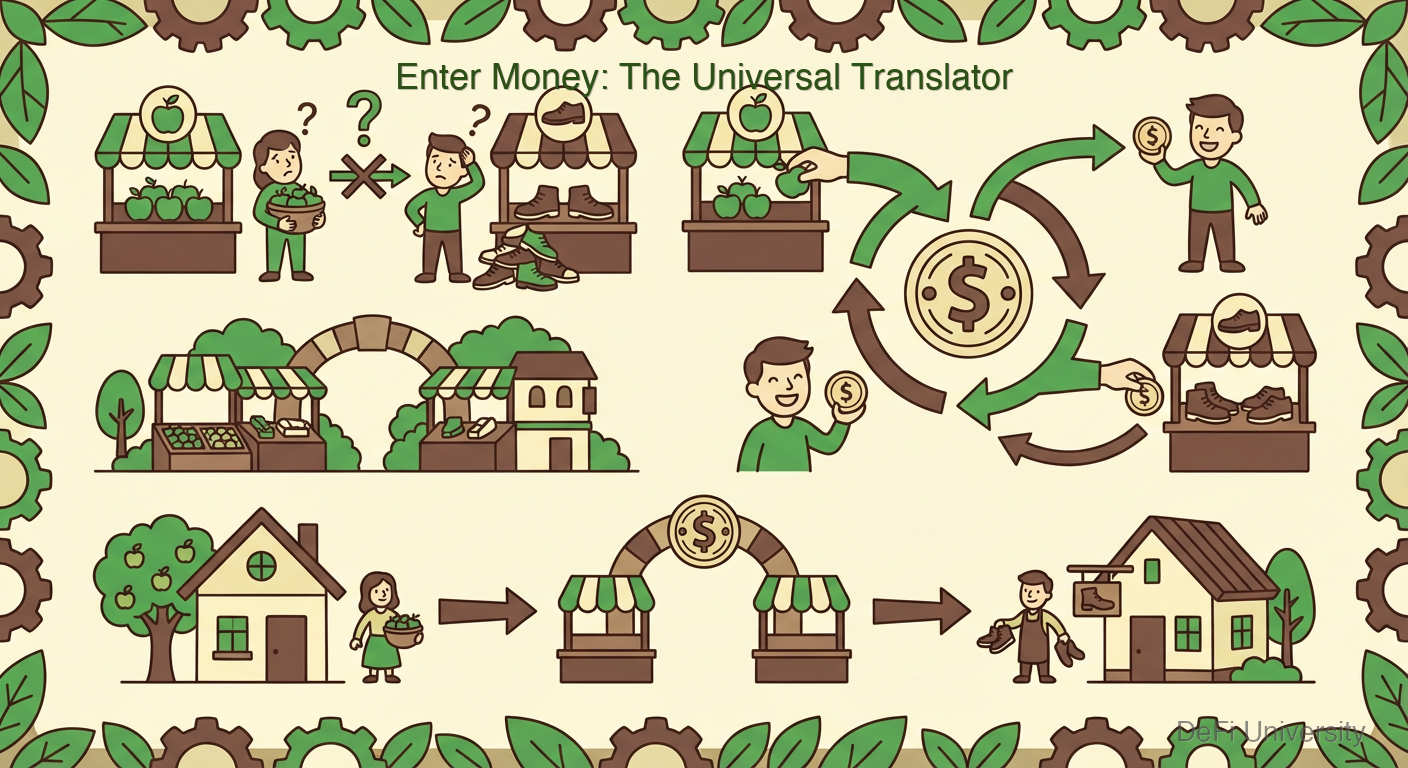
Money solves this problem elegantly. Instead of finding someone who wants your specific thing, you sell your apples to anyone who wants apples and receive money. Then you take that money to anyone selling shoes.
Money becomes the middleman that everyone accepts.
Think of it like a universal gift card. Instead of giving someone a gift card to one specific store (hoping they shop there), you give them cash—a gift card that works everywhere.
The key insight: money is just something everyone agrees to accept. It doesn't matter what the money actually is—shells, metal coins, paper, or numbers on a screen. What matters is that when you hand it over, the other person believes they can use it later for something they want.
Three Jobs Money Does
Once people started using money, they discovered it could do three important things:
1. Medium of Exchange
This is the basic job—money helps you trade. Instead of bartering apples for shoes through a chain of trades, you use money as the go-between.
2. Store of Value
Unlike apples that rot in a week, money (usually) holds its value over time. You can sell your apples today and buy shoes next month. Money lets you save purchasing power for later.
3. Unit of Account
Money gives us a standard way to measure value. Instead of saying "these shoes are worth 50 apples," we say "these shoes cost $80." It's like having a ruler for value—everyone measures using the same units.
Why This Matters for Your Crypto Journey
Understanding what money is helps you understand what cryptocurrency does. At its core, Bitcoin and other cryptocurrencies are trying to do the same three jobs—just without needing banks or governments to run the system.
Before we explore those alternatives, we need to understand the current system. In the next lesson, we'll look at how money works as a record-keeping system—because modern money isn't really "things" you hold anymore. It's numbers that get written down.
Key Takeaways
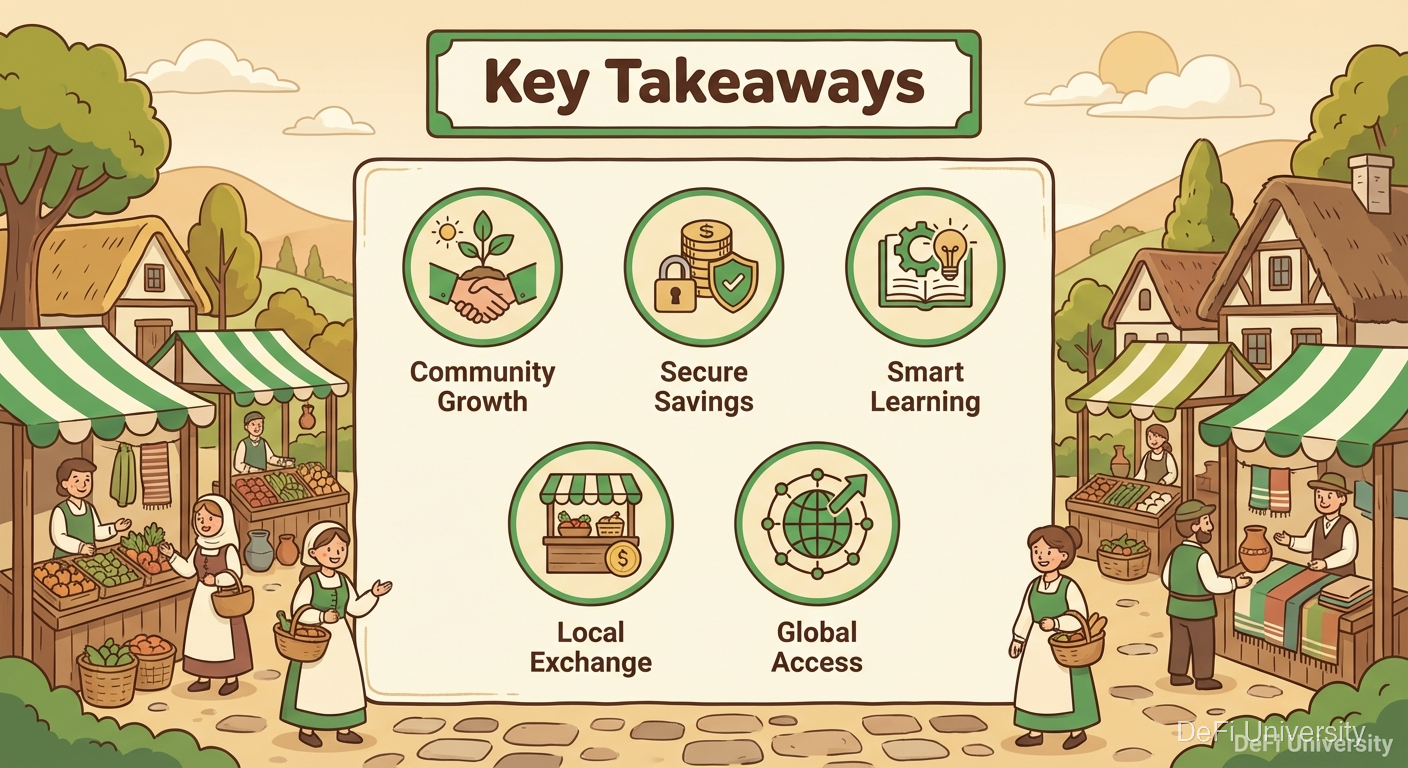
Bartering is inefficient because you need to find someone who wants exactly what you have
Money is any widely accepted medium that solves the "double coincidence of wants" problem
Money serves three functions: medium of exchange, store of value, and unit of account
The specific form doesn't matter—what matters is shared agreement that it has value
Cryptocurrency is attempting the same jobs using new technology
Last updated