Lesson 5: Hyperliquid - The L1 Performance Leader
🎧 Lesson Podcast
🎬 Video Overview
Lesson 5: Hyperliquid - The L1 Performance Leader
🎯 Core Concept: Purpose-Built for Trading
Hyperliquid is not just another perpetual DEX—it's a vertically integrated Layer 1 blockchain engineered from first principles to solve the specific demands of high-frequency derivatives trading. By building a custom consensus mechanism, dual-state architecture, and zero-gas trading model, Hyperliquid delivers CEX-like performance while maintaining non-custodial sovereignty.
Why Hyperliquid Matters
Hyperliquid represents a paradigm shift in DeFi infrastructure:
Sub-second latency: 0.2s median end-to-end (rivals CEXs)
Zero-gas trading: No gas fees for orders (only trading fees on execution)
Fully on-chain order book: Transparent and verifiable
200,000 orders/second: Institutional-grade throughput
HLP vault: Democratized market making for retail
🏗️ The HyperBFT Consensus Mechanism
Understanding HyperBFT
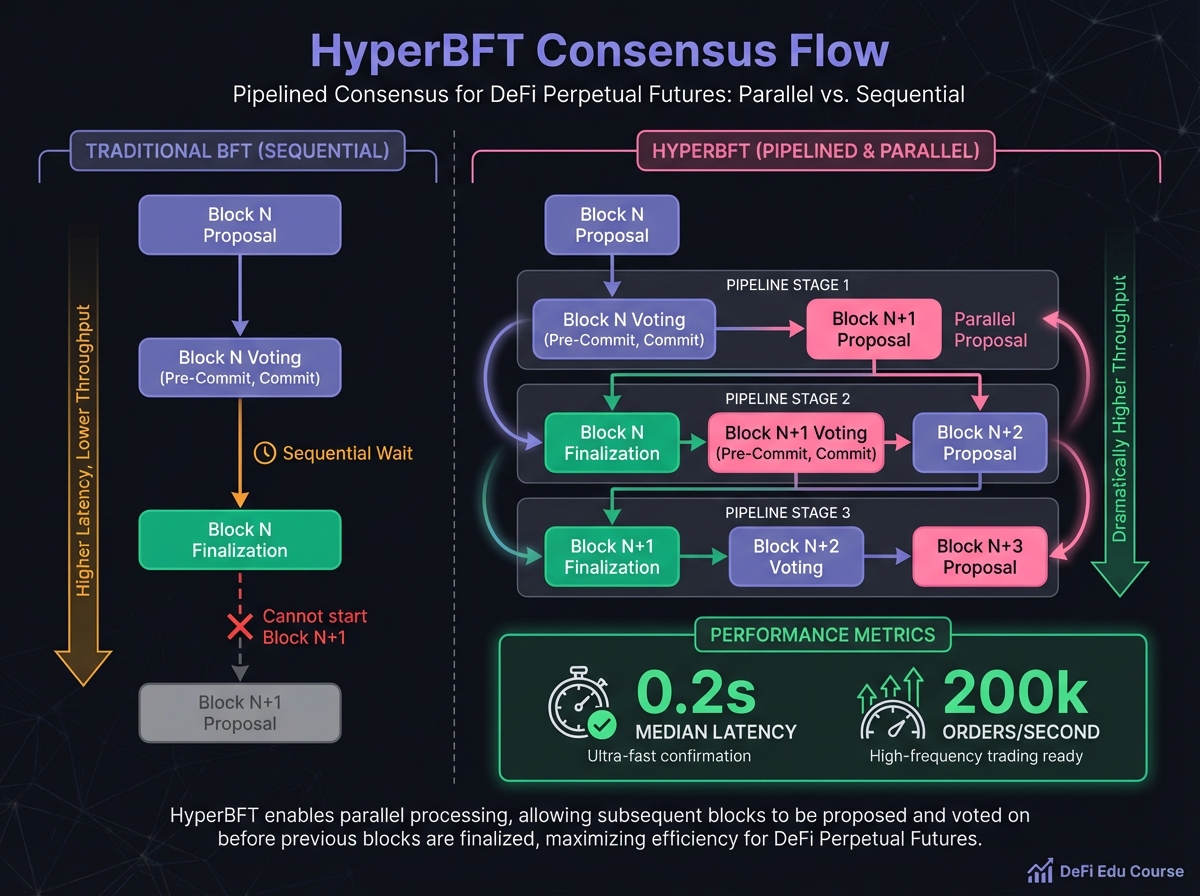
HyperBFT is Hyperliquid's custom consensus algorithm derived from HotStuff protocol. Unlike traditional BFT (Byzantine Fault Tolerance) mechanisms that process consensus sequentially, HyperBFT uses pipelined consensus.
How Pipelining Works:
Traditional BFT: Wait for Block N to finalize → Propose Block N+1
HyperBFT: Propose Block N+1 while Block N is still voting
Result: Parallel processing = dramatically higher throughput
Performance Characteristics
Latency Profile:
Median: 0.2 seconds (end-to-end)
99th Percentile: 0.9 seconds
Comparison: Ethereum = 12s, Solana = 400ms (with jitter)
Throughput Capacity:
200,000 orders per second (practical, not theoretical)
Achieved because order matching is native (not smart contract)
Why This Matters: For market makers managing delta-neutral portfolios, 200ms is the difference between capturing a spread and suffering toxic flow. This performance allows automated strategies from CEXs to operate with minimal modification.
🔄 Dual-State Architecture: HyperCore and HyperEVM
The Innovation
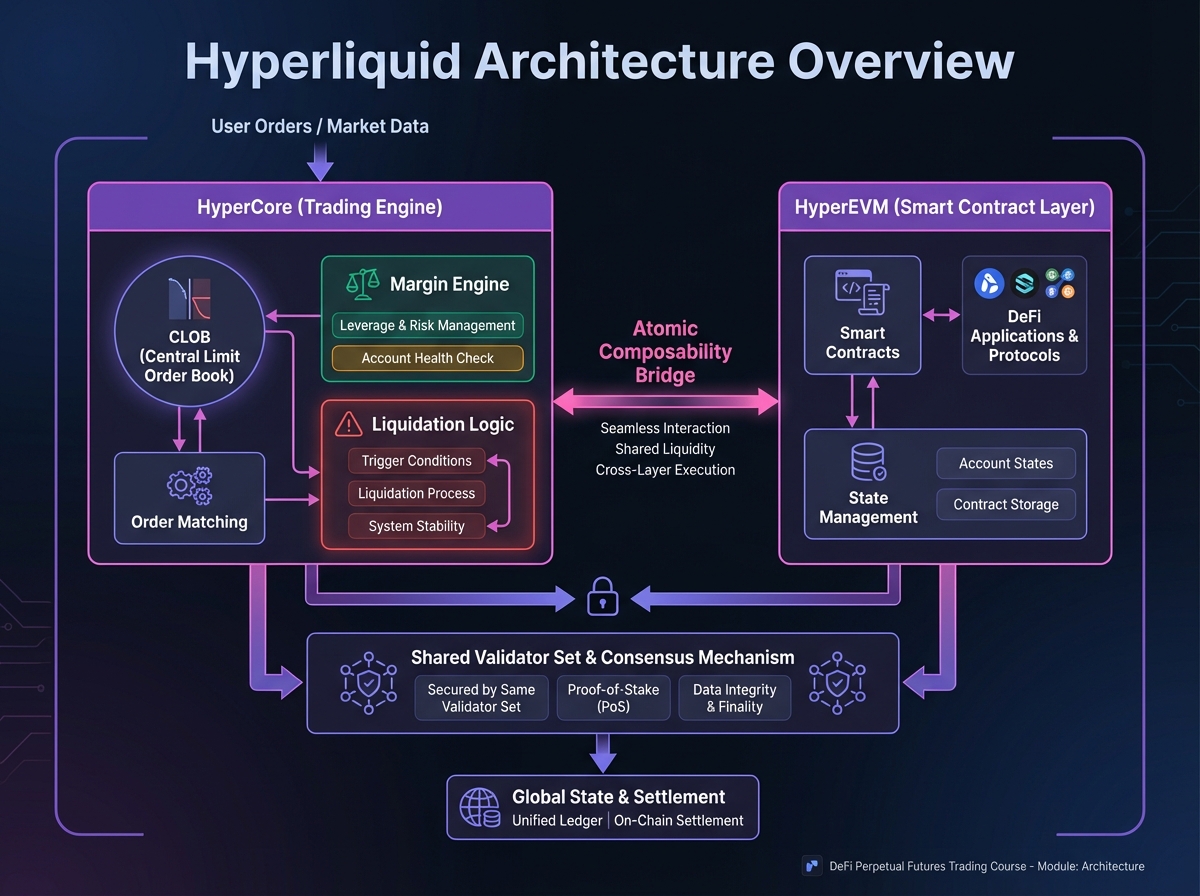
Hyperliquid splits its state into two layers:
HyperCore: Specialized trading engine (fast)
HyperEVM: General-purpose smart contracts (flexible)
Both secured by the same validator set, maintaining atomic composability.
HyperCore: The Trading Engine
What It Contains:
Central Limit Order Book (CLOB)
Margin engine
Liquidation logic
Order matching (native Rust code)
Key Features:
Fully On-Chain: Every order placement, cancellation, and execution is on-chain
No Off-Chain Matching: Unlike dYdX v3, matching happens on-chain
Transparency: Complete order book state is verifiable
Why Native Code Matters: On general-purpose chains, order matching requires:
Gas metering
EVM opcode processing
State trie updates
In HyperCore, matching is a native primitive—stripped of overhead, enabling speeds comparable to NASDAQ.
HyperEVM: The Smart Contract Layer
Purpose: Support broader ecosystem (yield aggregators, stablecoins, governance)
Dual-Block Architecture:
Fast Blocks (Small Blocks):
Frequency: ~1 second
Gas Limit: 2 million
Purpose: High-speed interactions, simple transfers
Slow Blocks (Big Blocks):
Frequency: ~1 minute
Gas Limit: 30 million
Purpose: Complex contracts, heavy computations
Why Two Block Types: Prevents a single complex deployment from clogging the mempool and causing latency spikes for traders.
Interoperability: Read Precompiles
How They Connect:
HyperEVM contracts can query HyperCore state (prices, funding rates, OI)
No external oracles needed
Contracts can trigger trades on HyperCore
Atomic composability enables DeFi-native algorithmic strategies
Example: A vault contract on HyperEVM can programmatically execute a trade on HyperCore CLOB in response to an on-chain trigger.
⚡ Zero-Gas Trading Model
The Innovation
Users pay zero gas for:
Placing orders
Canceling orders
Modifying orders
Users only pay trading fees (maker/taker) upon successful execution.
Why This Matters
On Gas-Based Chains:
Market makers pay gas to update quotes
"Cost to cancel" incentivizes wider spreads
High-frequency trading becomes expensive
On Hyperliquid:
No gas cost to update quotes
Tighter spreads
Deeper liquidity
Better execution for traders
Spam Mitigation: The "Pay-to-Play" Model
Without gas as Sybil resistance, Hyperliquid uses sophisticated rate limiting:
1. Volume-Based Rate Limiting:
~1 request per 1 USDC traded (cumulatively)
Initial burst buffer: 10,000 requests
After buffer depleted: Must generate trading volume
Spammers get throttled to 1 request per 10 seconds
2. Stake-Weighted Priority:
During congestion, priority based on HYPE staking
Can purchase "Request Weight" directly
Capital commitment = priority (not transient gas)
3. Open Order Caps:
Default: 1,000 open orders
Scales up to 5,000 based on volume
Prevents order book spam
Economic Sustainability
Why Zero-Gas Works:
Sovereign L1 (no "rent" to parent chain)
Validators compensated via HYPE token appreciation
Trading fees accumulate in ecosystem
No need for ETH for gas
Comparison to L2 "Gasless" Models:
L2s: Usually subsidized (may not be sustainable)
dYdX v4: Off-chain matching (less transparent)
Hyperliquid: Native zero-gas (sustainable)
💰 The HLP (Hyperliquidity Provider) Vault
What Is HLP?
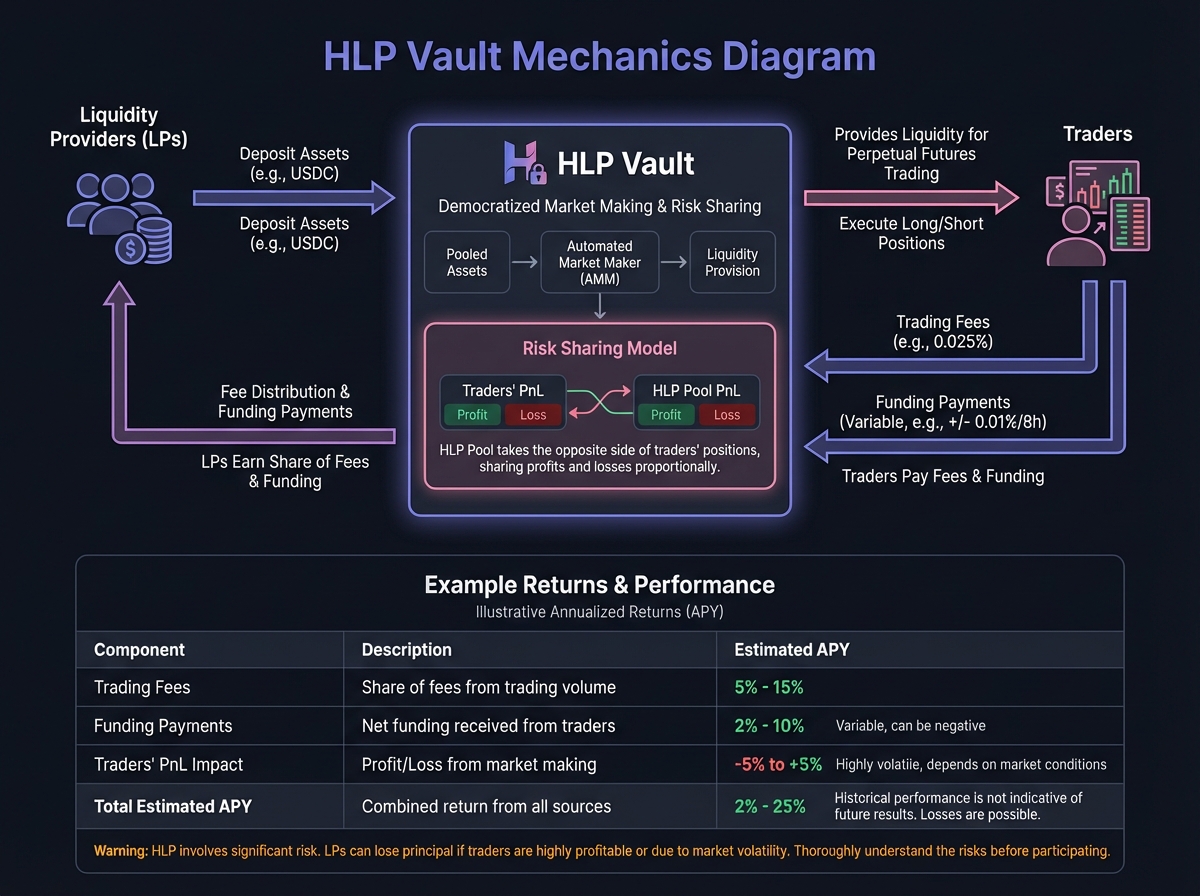
The HLP vault is Hyperliquid's unified liquidity pool that:
Acts as automated market maker on the CLOB
Provides liquidity algorithmically
Functions as liquidation backstop
Allows retail to participate in market making
How HLP Works
Quoting Strategy:
Algorithmically places bid/ask orders around mid-price
Spread based on volatility and inventory risk
Takes directional risk (not delta-neutral)
Inventory Skew:
If vault accumulates long position (traders selling):
Widens bid spread (cheaper to buy)
Tightens ask spread (attractive to sell)
Incentivizes market to rebalance vault
Liquidation Backstop:
When trader position breaches maintenance margin
HLP "buys" the distressed position
Attempts to unwind in market
Earns liquidation fees (high yield)
Exposed to "toxic flow" risk
HLP Performance
Historical Fee Generation:
Q4 2024: $281,005
Q1 2025: $3.57 million
Q2 2025: $5.25 million
Q3 2025: $7.25 million
Risk-Adjusted Returns:
Sharpe ratio improved from ~2.89 to ~5.2
Lower volatility than holding BTC
But exposed to tail risk (black swan events)
HLP Risks: POPCAT and JELLY Incidents
POPCAT Incident (November 2025):
Attack: Buy wall manipulation → triggered copy-traders → HLP went short
Result: Attacker pulled wall, price collapsed, HLP left holding long positions
Loss: $4.9 million
Lesson: Algorithmic quoting can be gamed by manipulation
JELLY Incident:
Attack: Whale accumulated massive position, manipulated price
Result: HLP became short while price skyrocketed
Crisis: Potential $4M+ bad debt
Intervention: Validators executed "Oracle Override" (controversial)
Lesson: Hyperliquid has social consensus layer (not pure "code is law")
Structural Changes After Incidents:
Open Interest caps for low-liquidity assets
Leverage reductions (50x → 25x-40x for majors)
Updated liquidation logic to protect HLP
🎓 Beginner's Corner: Using Hyperliquid
Getting Started
Step 1: Connect Wallet
Navigate to Hyperliquid interface
Connect MetaMask (Arbitrum network)
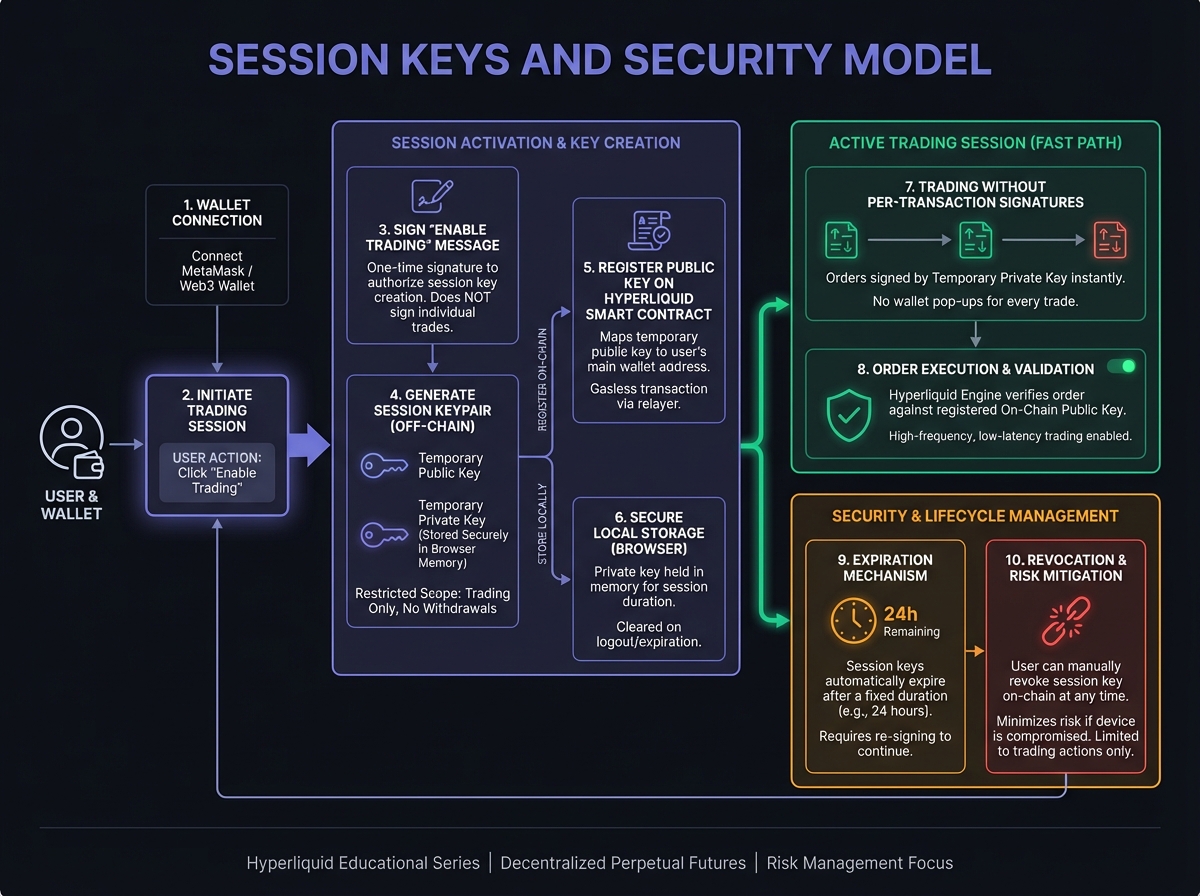
Sign message to enable trading (session keys)
Step 2: Deposit
Click "Deposit"
Bridge USDC.e from Arbitrum to Hyperliquid L1
Approve bridge transaction
Wait for confirmation
Important: The bridge is a trust point—funds are locked in bridge contract.
Step 3: Enable Trading
Protocol prompts for "Enable Trading" signature
Generates session keys (stored locally in browser)
Allows one-click trading without wallet popup
Master key remains secure
Trading on Hyperliquid
Order Types:
Market: Execute immediately at best available price
Limit: Execute only at your specified price
Stop Loss: Triggered when price hits level
Take Profit: Close position at target
Session Keys Benefit: No wallet popup for every order (faster execution)
Zero-Gas Benefit: Update quotes freely without cost
🔬 Advanced Deep-Dive: Technical Architecture
HyperCore State Machine
Native Primitives:
Order matching (Rust)
Margin calculations
Liquidation logic
Funding rate settlement
On-Chain Order Book:
Every order is on-chain
Complete transparency
Verifiable execution sequence
No hidden matching logic
HyperEVM Composability
Read Precompiles:
Query CLOB state from smart contracts
Access mark prices, funding rates, OI
No external oracles needed
Event Passing:
Contracts can trigger HyperCore actions
Enables algorithmic trading strategies
Atomic composability
Example Use Case: Vault contract automatically hedges exposure by trading on HyperCore when certain conditions are met.
⚠️ Risks and Considerations
Bridge Risk
The Trust Point:
Hyperliquid L1 bridge on Arbitrum is a multisig wallet
If signers collude or are compromised, funds could be drained
This is the primary custody risk
Mitigation:
Monitor bridge security
Consider bridge insurance if available
Understand this is different from trading risk
Validator Centralization
Current State:
Validator set is permissioned (not fully decentralized)
Validators can intervene (Oracle Override in JELLY incident)
Moves toward "CeDeFi" model
Implications:
Not pure "code is law"
Social consensus layer exists
Validators can protect protocol (or abuse power)
HLP Risk
Toxic Flow Exposure:
HLP absorbs liquidations
During cascading crashes, can accumulate large positions
Tail risk during black swan events
Mitigation:
Diversify across multiple protocols
Monitor HLP performance
Understand you're counterparty to traders
📊 Real-World Example: Trading on Hyperliquid
Setup:
Protocol: Hyperliquid
Market: ETH/USD
Strategy: Scalping (many small trades)
Advantages for This Strategy:
Zero gas = can update quotes frequently
Low latency = fast execution
Session keys = one-click trading
Deep liquidity = tight spreads
Example Trade:
Connect wallet, enable trading
Deposit $1,000 USDC
Place limit buy at $2,499 (below market)
Order fills instantly (no gas paid)
Place limit sell at $2,501 (above market)
Order fills, profit captured
Repeat without gas costs
ROI Calculation:
Profit per trade: $2 (0.08% on $2,500 position)
Gas saved: $0 (would be $0.50-2.00 on L2)
Net advantage: Can make many small trades profitably
⚖️ Compare Protocols
See how Hyperliquid stacks up against other perpetual DEXs:
🔑 Key Takeaways
Hyperliquid is a purpose-built L1 optimized for trading
HyperBFT enables sub-second latency and high throughput
Dual-state architecture (HyperCore + HyperEVM) offers both speed and flexibility
Zero-gas trading removes friction for market makers
HLP vault democratizes market making but carries risks
Bridge and validator centralization are trust points to consider
Best for: Active traders, scalpers, market makers
🚀 Next Steps
Proceed to Lesson 6 to learn about GMX V2's oracle-based model
Complete Exercise 5 to practice Hyperliquid position setup
Explore Hyperliquid interface to see zero-gas trading in action
Consider HLP vault for passive market making exposure
Last updated