Lesson 7: Drift Protocol - Solana's Hybrid Architecture

🎯 Core Concept: The Liquidity Trifecta

Drift Protocol V2 represents a "third-generation" derivatives protocol that combines the best of multiple models. Instead of choosing between AMM or order book, Drift uses a three-layer liquidity system that protects LPs from toxic flow while providing traders with optimal execution.

Why Drift Matters

Drift's hybrid approach solves key problems:

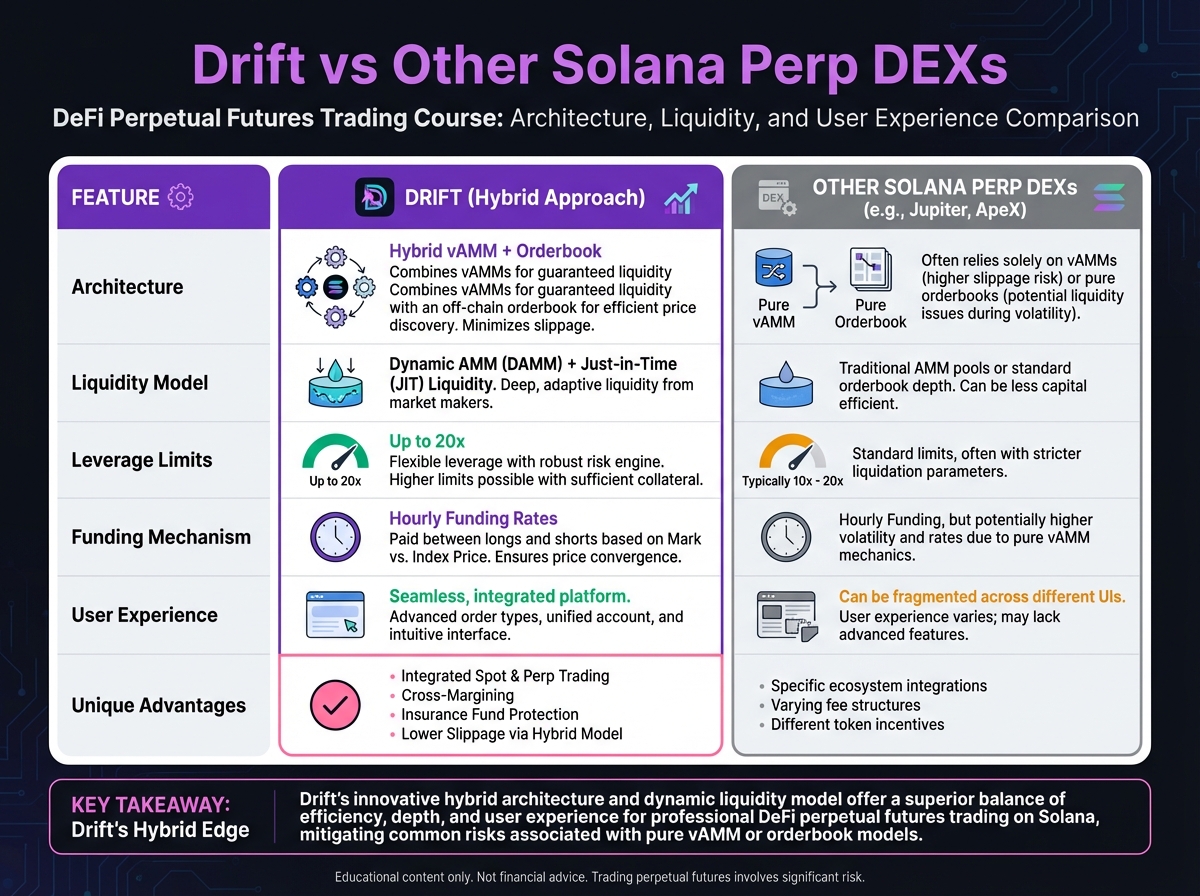
Drift vs Other Solana Perp DEXs
  • LP Protection: JIT auction prevents toxic flow from hitting AMM first

  • Price Precision: DLOB provides limit orders and precise pricing

  • Always-On Liquidity: DAMM ensures liquidity always exists

  • MEV Internalization: Value goes to traders, not arbitrageurs

  • Cross-Margin: Unified margin across spot, perps, lending, and prediction markets

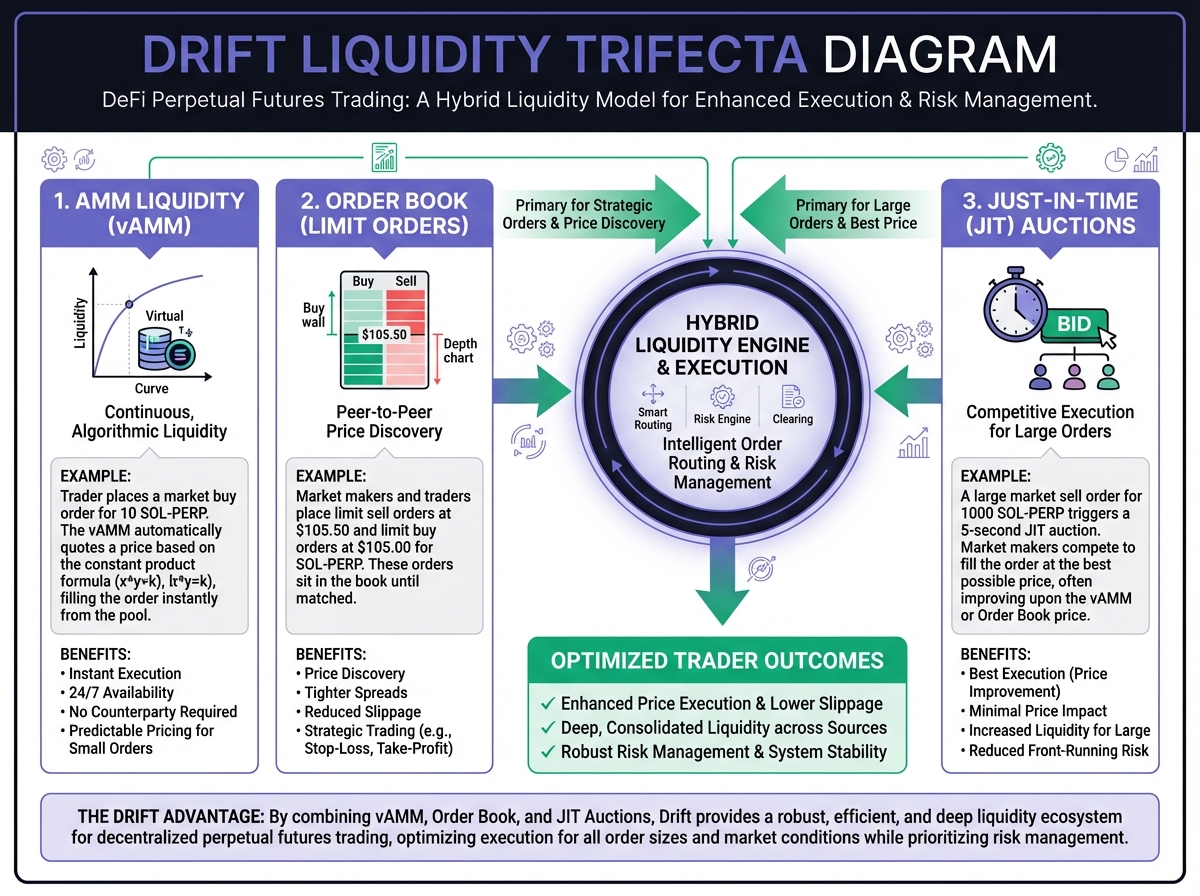
Drift Liquidity Trifecta Diagram

🏗️ The Liquidity Trifecta Architecture

Layer 1: Just-In-Time (JIT) Auction

How It Works:

  • When trader submits market order, it enters 5-second auction

  • Market makers compete to fill order at better price than AMM

  • Best price wins the fill

  • If no maker fills, order moves to next layer

The Innovation:

  • Inverts toxic flow dynamic

  • Makers must compete (not just pick off stale AMM)

  • Traders get price improvement

  • LPs protected (AMM is last resort)

Example:

  • Trader wants to buy 100 SOL-PERP

  • AMM price: $150

  • Maker 1 offers: $149.50 (better!)

  • Maker 2 offers: $149.00 (even better!)

  • Maker 2 wins, trader gets $1 better execution

Layer 2: Decentralized Limit Orderbook (DLOB)

How It Works:

  • Off-chain order network maintained by Keepers

  • Orders matched off-chain, settled on-chain

  • Supports advanced order types (limit, stop, oracle-pegged)

Order Types:

  • Limit Orders: Standard maker orders

  • Stop-Market/Stop-Limit: Risk management orders

  • Oracle-Pegged: Float at fixed offset to oracle (e.g., "Oracle - $0.50")

Why Off-Chain Matching:

  • Solana allows high-speed state updates

  • But full on-chain orderbook = expensive and state bloat

  • Hybrid: Computation off-chain, settlement on-chain

Security: Keepers can't manipulate execution—smart contract verifies signed intent.

Layer 3: Dynamic AMM (DAMM)

How It Works:

  • Virtual AMM using constant product formula ($x \cdot y = k$)

  • Dynamic adjustments (re-pegging and k-adjustment)

  • Serves as backstop (only fills residual flow)

Re-Pegging (Oracle Offset):

  • Curve mid-price updated to align with oracle

  • Prevents permanent price deviation

  • Reduces arbitrage opportunities

Dynamic k (Liquidity Depth):

  • Increase k: Low volatility, balanced OI → reduce slippage

  • Decrease k: High volatility, extreme imbalance → widen spreads, protect fund

Key Design: DAMM is last resort—JIT and DLOB fill first, protecting passive LPs.

🔄 Trade Execution Lifecycle

The Waterfall Process

Step 1: Order Submission

  • User submits market order (e.g., "Buy 100 SOL-PERP")

Step 2: JIT Auction (5 seconds)

  • Order broadcast to market makers

  • Makers compete to fill at better price

  • Best price wins

Step 3: DLOB Execution

  • If JIT expires or partially fills, remaining goes to DLOB

  • Matches against resting limit orders

Step 4: DAMM Execution

  • Any remaining quantity routes to DAMM

  • AMM fills residual flow

Result: Traders get best execution, LPs protected from toxic flow.

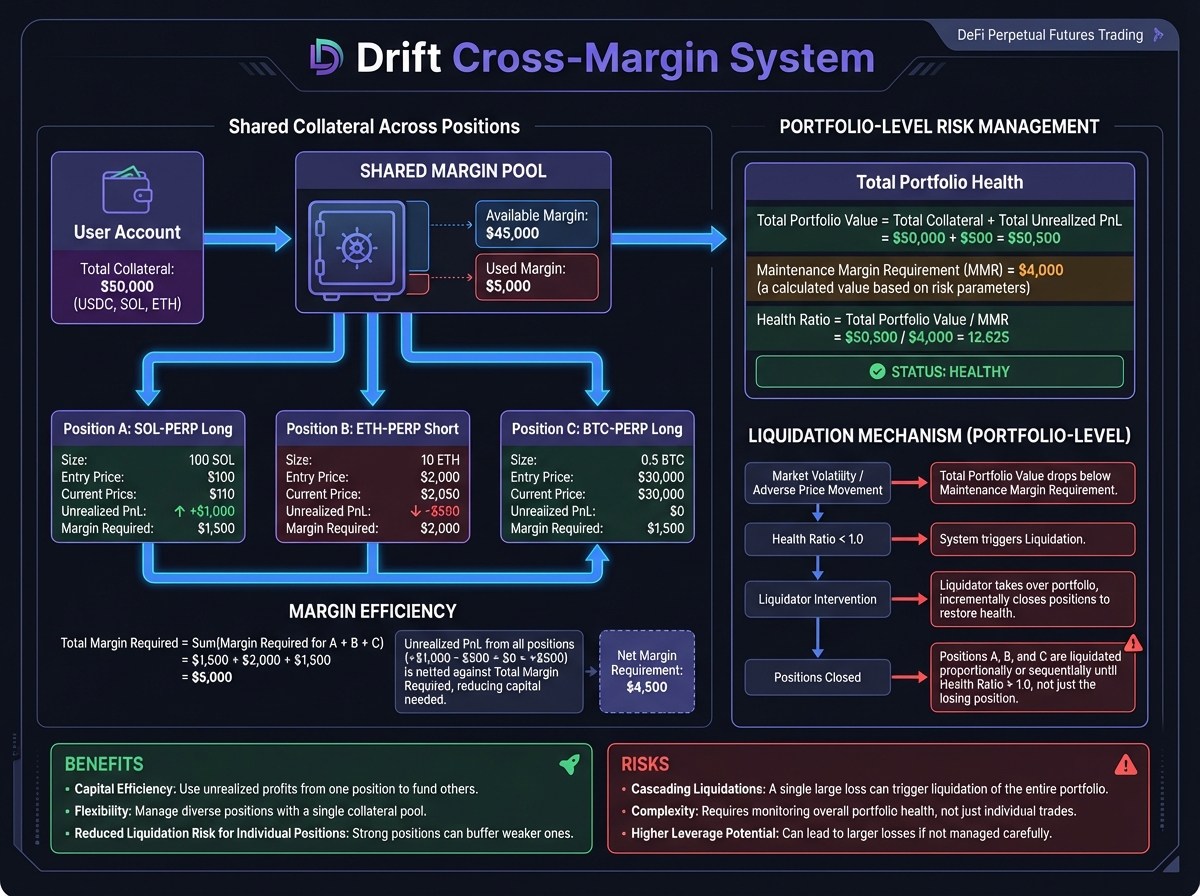
💰 Cross-Margin System

Unified Margin Across Products

Drift's cross-margin system is unique—it integrates:

  • Spot Trading: Buy/sell actual assets

  • Perpetual Swaps: Leveraged derivatives

  • Money Markets: Borrow/lend

  • Prediction Markets: B.E.T platform

How It Works:

  • All positions share same collateral pool

  • Portfolio value = sum of all assets

  • Margin calculated across entire portfolio

  • Profits in one position offset losses in another

Asset Weightings

Tiered System (not all collateral equal):

Asset Type
Example
Initial Weight
Maintenance Weight

Stablecoin

USDC

1.00x

1.00x

Blue Chip

SOL

0.80x

0.90x

Volatile

BONK

0.50x

0.70x

Why Weightings:

  • Riskier assets discounted for margin calculation

  • Prevents over-leveraging on volatile collateral

  • Protects protocol from liquidation failures

Cross-Margin Benefits

Hedging Example:

  • Long BTC perpetual: $10,000

  • Short ETH perpetual: $10,000

  • If BTC pumps and ETH dumps, profits offset losses

  • Prevents premature liquidation

Capital Efficiency:

  • One collateral pool for all positions

  • No need to allocate margin per position

  • Better utilization of capital

Drift Cross-Margin System

🎓 Beginner's Corner: Using Drift

Getting Started

Step 1: Solana Wallet

  1. Install Phantom or Solflare wallet

  2. Fund with SOL (for gas) and USDC (for trading)

Step 2: Connect to Drift

  1. Navigate to Drift interface

  2. Connect wallet

  3. Approve permissions

Step 3: Deposit

  1. Click "Deposit"

  2. Select asset (USDC recommended)

  3. Enter amount

  4. Approve transaction

Opening a Position

Step-by-Step:

  1. Select market (e.g., SOL-PERP)

  2. Choose direction (Long/Short)

  3. Set size and leverage

  4. Review funding rate

  5. Set stop loss (recommended)

  6. Submit order

  7. JIT auction runs (5 seconds)

  8. Order fills at best available price

Key Features:

  • Cross-margin: All positions share collateral

  • Advanced orders: Limit, stop, oracle-pegged

  • Unified interface: Spot, perps, lending in one place

🔬 Advanced Deep-Dive: JIT Auction Mechanics

The Dutch Auction Formula

Pricing Formula: Quote=DAMMbid(Xt)+DAMMest_entrytXQuote = \frac{DAMM_{bid} \cdot (X-t) + DAMM_{est\_entry} \cdot t}{X}

Where:

  • $X$ = Total auction duration (5 seconds)

  • $t$ = Time elapsed

  • $DAMM_{bid}$ = Current AMM bid price

  • $DAMM_{est_entry}$ = Estimated AMM entry price

Interpretation: As auction progresses, price converges toward AMM price, incentivizing early bids.

MEV Internalization

Traditional AMM Problem:

  • Arbitrageur sees stale AMM price

  • Front-runs trader order

  • Extracts value from LPs

Drift's Solution:

  • JIT auction forces arbitrageurs to fill order

  • Must offer better price than AMM

  • Value goes to trader (price improvement)

  • LPs protected (AMM not hit first)

Result: MEV is internalized for trader benefit, not extracted by bots.

⚠️ Risks and Considerations

Solana-Specific Risks

Network Congestion:

  • Solana can experience congestion

  • Transactions may fail or delay

  • Monitor network status

Validator Centralization:

  • Solana has fewer validators than Ethereum

  • Potential for coordination

  • Monitor validator health

Cross-Margin Risks

Contagion Risk:

  • One bad position can affect entire portfolio

  • All positions share collateral

  • Monitor portfolio health factor

Complexity Risk:

  • Multiple products in one system

  • Harder to track all positions

  • Requires active management

Keeper Network Risk

Centralization:

  • If Keepers collude, could manipulate

  • Monitor keeper performance

  • Check keeper decentralization

📊 Real-World Example: Trading on Drift

Scenario: Cross-margin strategy with hedging

Setup:

  • Deposit: $5,000 USDC

  • Long BTC-PERP: $10,000 (2x leverage)

  • Short ETH-PERP: $10,000 (2x leverage)

  • Net exposure: ~0 (hedged)

Execution:

  1. Connect Phantom wallet

  2. Deposit $5,000 USDC

  3. Open Long BTC-PERP ($10,000, 2x)

  4. Open Short ETH-PERP ($10,000, 2x)

  5. Monitor portfolio health

Benefits:

  • Hedged position (BTC/ETH correlation)

  • Cross-margin efficiency

  • Unified interface

  • Advanced order types

Monitoring:

  • Portfolio health factor

  • Individual position P&L

  • Funding costs

  • Cross-margin utilization

🎯 Key Takeaways

  • Drift uses three-layer liquidity (JIT, DLOB, DAMM) for optimal execution

  • JIT auction protects LPs and improves trader prices

  • Cross-margin system integrates spot, perps, lending, and prediction markets

  • Solana's speed enables off-chain matching with on-chain settlement

  • Asset weightings manage risk for volatile collateral

  • Best for: Active traders, cross-margin strategies, Solana ecosystem users

🚀 Next Steps

  • Proceed to Lesson 8 to learn about alternative chain protocols

  • Complete Exercise 7 to practice Drift strategy analysis

  • Explore Drift's cross-margin system

  • Consider JIT participation for market making

Last updated