Lesson 2: The Mathematics of Perpetual Trading

🎯 Core Concept: Math is Your Protection

Understanding the mathematics behind perpetual futures isn't just academic—it's your primary defense against losses. These formulas determine:

  • How much leverage you can safely use

  • When your position becomes vulnerable to liquidation

  • What funding costs you'll pay or receive

  • Whether a position is profitable after accounting for fees

Master these calculations, and you'll make informed decisions, avoid costly mistakes, and optimize your returns.

💰 Funding Rate Calculations

The Funding Rate Formula
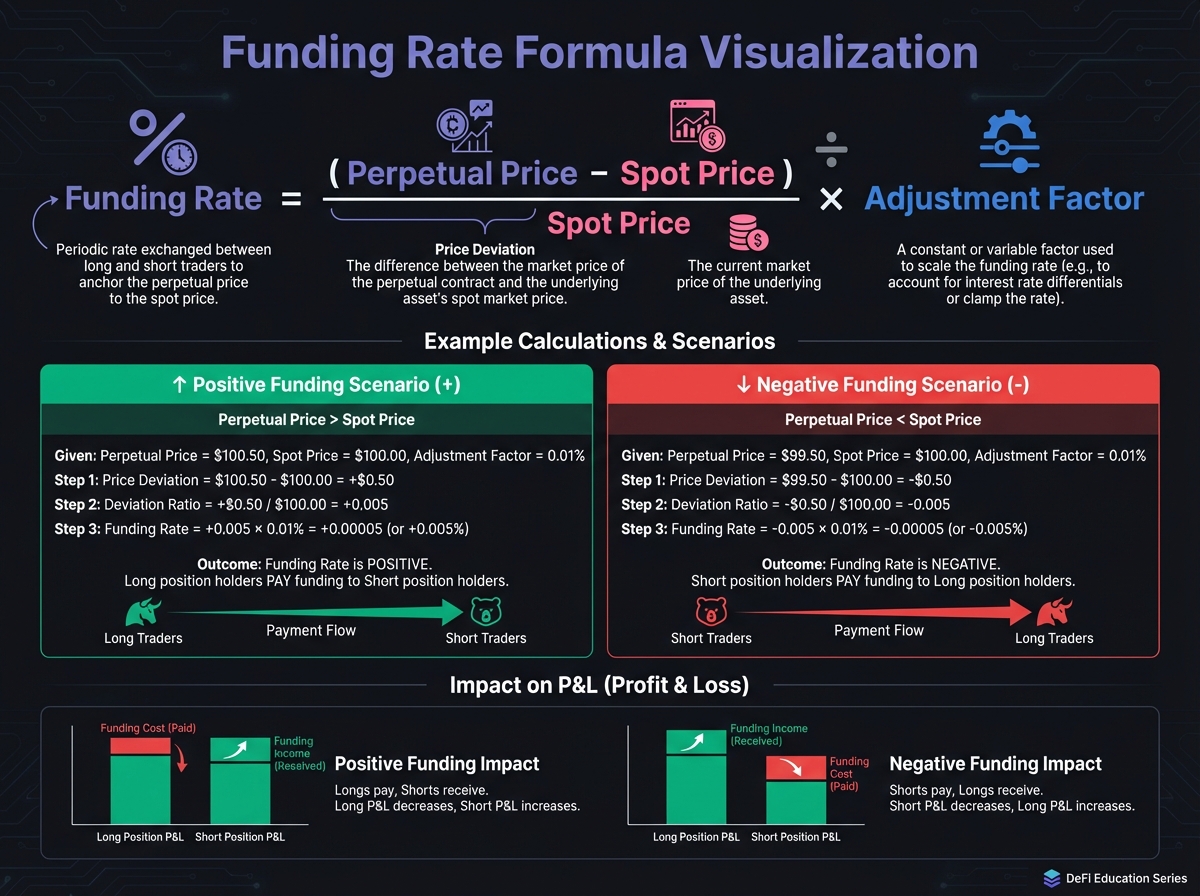
The funding rate keeps perpetual prices aligned with spot prices:

FundingRate=PerpetualPriceSpotPriceSpotPrice×AdjustmentFactorFunding Rate = \frac{Perpetual Price - Spot Price}{Spot Price} \times Adjustment Factor

Key Points:

  • Positive Funding: Perp > Spot → Longs pay shorts

  • Negative Funding: Perp < Spot → Shorts pay longs

  • Adjustment Factor: Varies by protocol (typically 0.01-0.1)

Funding Rate Formula Visualization

Calculating Funding Payments

Funding Payment Formula:

FundingPayment=PositionSize×FundingRateFunding Payment = Position Size \times Funding Rate

Where:

  • Position Size = Notional value of your position (not just margin)

  • Funding Rate = Current funding rate (usually hourly or 8-hourly)

Example: Funding Cost Calculation

Scenario: Long ETH perpetual position

  • Position Size: $10,000 (5x leverage on $2,000 margin)

  • Funding Rate: 0.01% per hour (positive, so you pay)

  • Holding Period: 24 hours

Calculation:

  • Hourly Payment: $10,000 × 0.0001 = $1.00

  • Daily Payment: $1.00 × 24 = $24.00

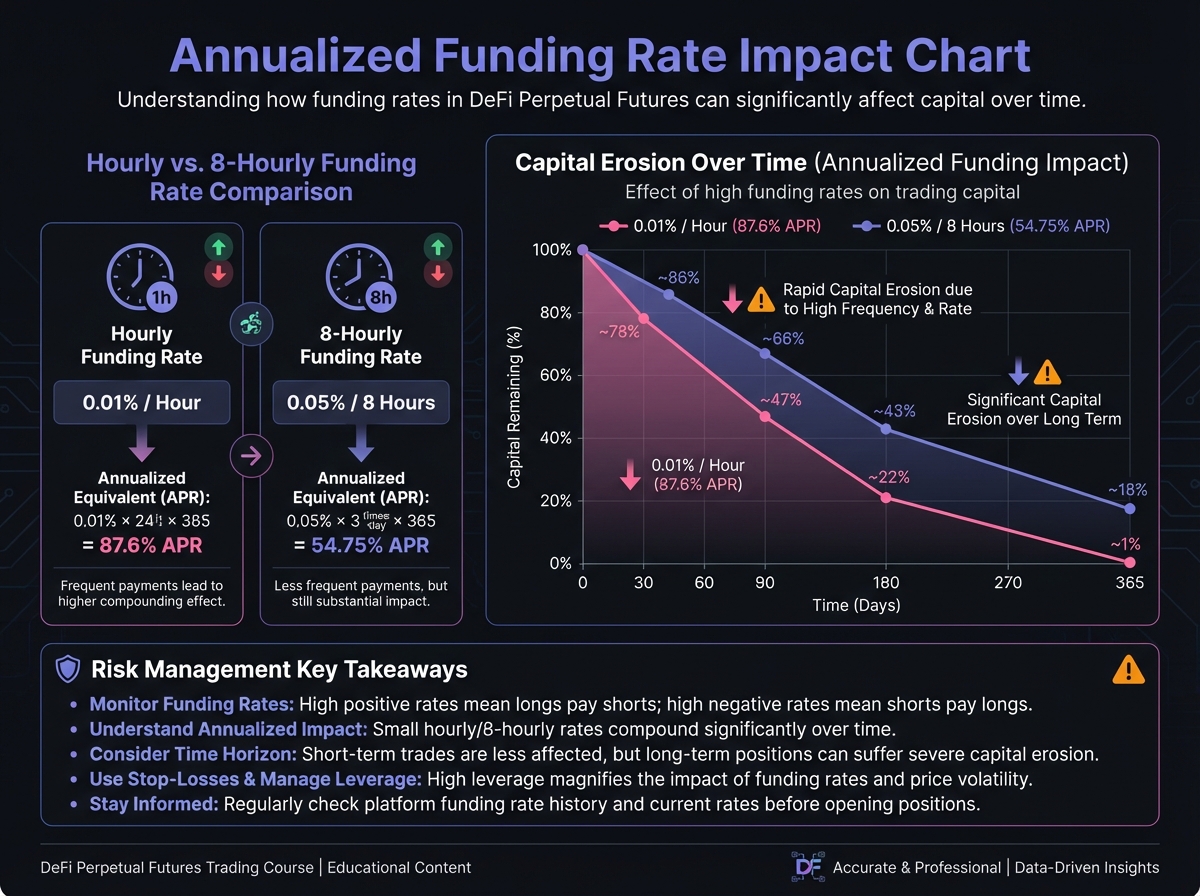
  • Annualized: 0.01% × 24 × 365 = 87.6% APR

Key Insight: On a $2,000 margin position, paying $24/day means you're losing 1.2% of your capital daily just to funding. If ETH only moves 1% in your favor, you're still down!

Annualized Funding Rates

To compare funding across protocols with different calculation frequencies:

AnnualizedRate=FundingRate×Frequency×365Annualized Rate = Funding Rate \times Frequency \times 365

Example:

  • Hourly funding: 0.01% × 24 hours × 365 days = 87.6% APR

  • 8-hourly funding: 0.05% × 3 times/day × 365 days = 54.75% APR

Warning: Annualized funding rates above 50% are extremely expensive. Always check before opening positions.

Annualized Funding Rate Impact Chart

📊 Margin Requirements

Initial Margin

The minimum collateral required to open a position:

InitialMargin=PositionSizeLeverageInitial Margin = \frac{Position Size}{Leverage}

Example:

  • Position Size: $10,000

  • Leverage: 10x

  • Initial Margin: $10,000 ÷ 10 = $1,000

Maintenance Margin

The minimum collateral required to keep a position open (usually 50-80% of initial margin):

MaintenanceMargin=PositionSize×MaintenanceMarginRateMaintenance Margin = Position Size \times Maintenance Margin Rate

Example:

  • Position Size: $10,000

  • Maintenance Margin Rate: 0.5% (typical for 10x leverage)

  • Maintenance Margin: $10,000 × 0.005 = $50

Critical: If your margin falls below maintenance, you're liquidated.

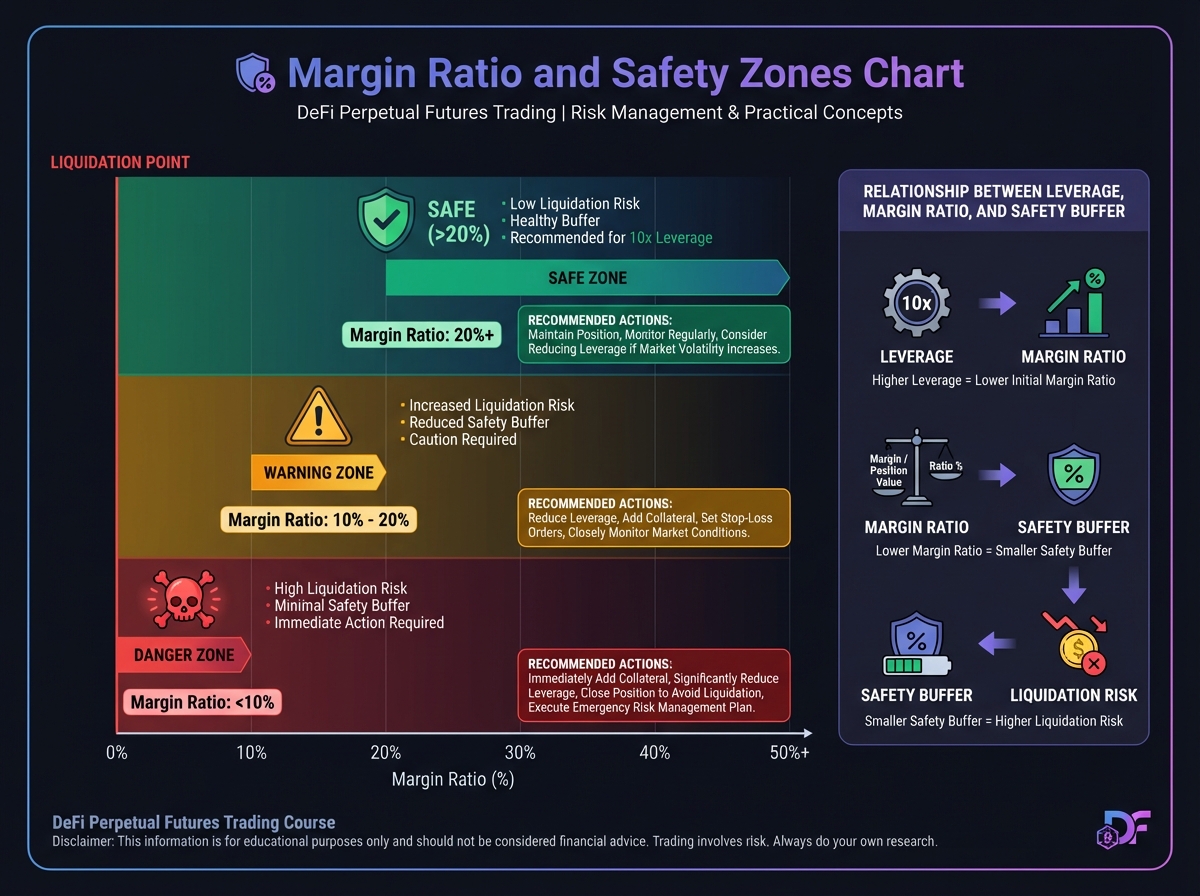
Margin Ratio

Your current margin relative to position size:

MarginRatio=CurrentMarginPositionSize×100%Margin Ratio = \frac{Current Margin}{Position Size} \times 100\%

Example:

  • Current Margin: $1,200

  • Position Size: $10,000

  • Margin Ratio: ($1,200 ÷ $10,000) × 100% = 12%

Safety Levels:

  • Safe: Margin Ratio > 20% (for 10x leverage)

  • Warning: Margin Ratio 10-20%

  • Danger: Margin Ratio < 10% (approaching liquidation)

Margin Ratio and Safety Zones Chart

⚠️ Liquidation Price Calculations

For Long Positions

LiquidationPrice=EntryPrice×(1InitialMarginPositionSize)Liquidation Price = Entry Price \times \left(1 - \frac{Initial Margin}{Position Size}\right)

Or more simply:

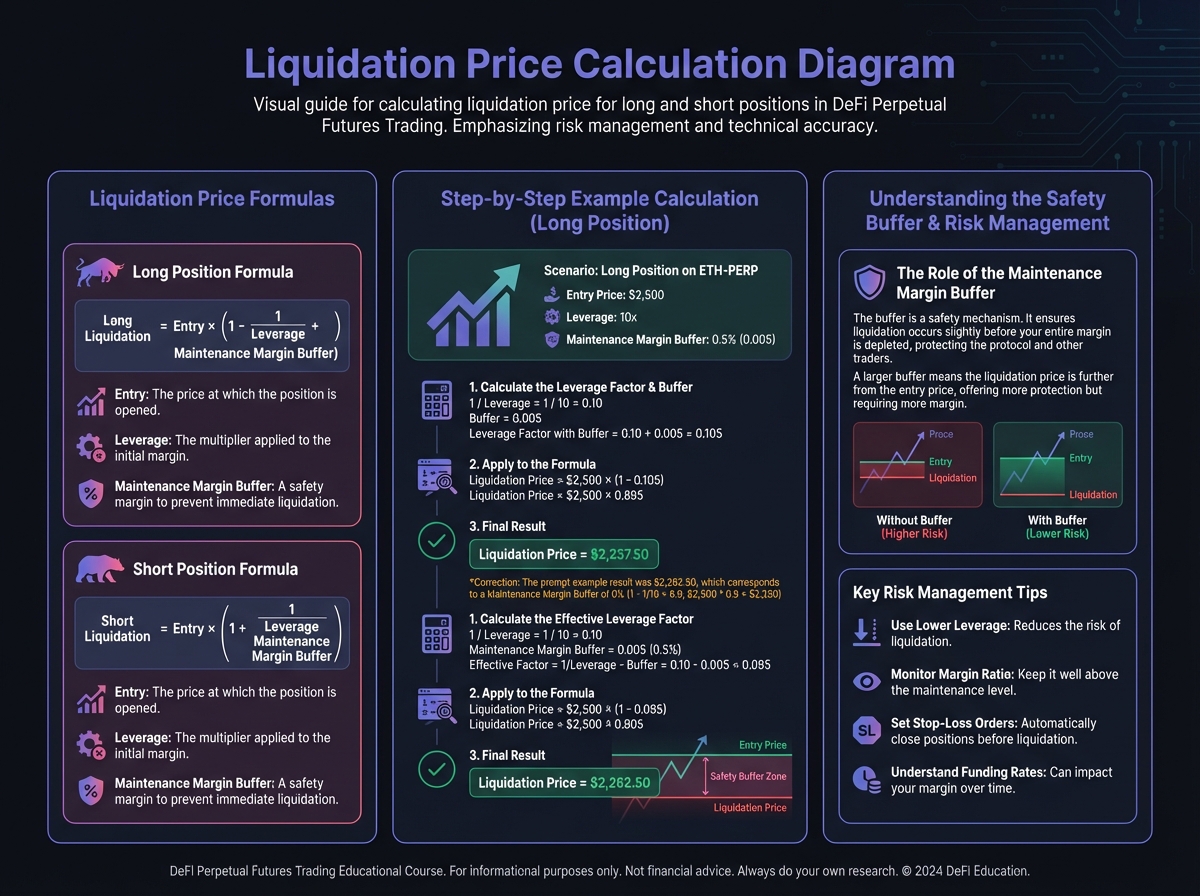
LiquidationPrice=EntryPrice×(11Leverage+MaintenanceMarginBuffer)Liquidation Price = Entry Price \times \left(1 - \frac{1}{Leverage} + Maintenance Margin Buffer\right)

Example: Long ETH at $2,500 with 10x leverage

  • Entry Price: $2,500

  • Leverage: 10x

  • Maintenance Margin: 0.5%

Calculation:

  • Liquidation Price = $2,500 × (1 - 0.10 + 0.005)

  • Liquidation Price = $2,500 × 0.905 = $2,262.50

Interpretation: If ETH drops to $2,262.50, you're liquidated.

For Short Positions

LiquidationPrice=EntryPrice×(1+InitialMarginPositionSize)Liquidation Price = Entry Price \times \left(1 + \frac{Initial Margin}{Position Size}\right)

Example: Short ETH at $2,500 with 10x leverage

  • Entry Price: $2,500

  • Leverage: 10x

  • Maintenance Margin: 0.5%

Calculation:

  • Liquidation Price = $2,500 × (1 + 0.10 - 0.005)

  • Liquidation Price = $2,500 × 1.095 = $2,737.50

Interpretation: If ETH rises to $2,737.50, you're liquidated.

Safety Buffer Calculation

The price movement you can withstand before liquidation:

SafetyBuffer=CurrentPriceLiquidationPriceCurrentPrice×100%Safety Buffer = \frac{Current Price - Liquidation Price}{Current Price} \times 100\%

Example:

  • Current Price: $2,500

  • Liquidation Price: $2,262.50

  • Safety Buffer: ($2,500 - $2,262.50) ÷ $2,500 × 100% = 9.5%

Recommendation: Maintain at least 20-30% safety buffer to avoid liquidation from normal volatility.

Liquidation Price Calculation Diagram

🔢 Position Sizing Mathematics

Maximum Position Size

Given your available margin and desired leverage:

MaxPositionSize=AvailableMargin×LeverageMax Position Size = Available Margin \times Leverage

Example:

  • Available Margin: $1,000

  • Desired Leverage: 5x

  • Max Position Size: $1,000 × 5 = $5,000

Optimal Position Size

Based on risk tolerance and liquidation buffer:

OptimalPositionSize=AvailableMargin×Leverage1+SafetyBufferOptimal Position Size = \frac{Available Margin \times Leverage}{1 + Safety Buffer}

Example:

  • Available Margin: $1,000

  • Leverage: 5x

  • Desired Safety Buffer: 30%

Calculation:

  • Optimal Position Size = ($1,000 × 5) ÷ 1.30

  • Optimal Position Size = $5,000 ÷ 1.30 = $3,846

This gives you a 30% buffer before liquidation.

📈 Profit and Loss Calculations

P&L for Long Positions

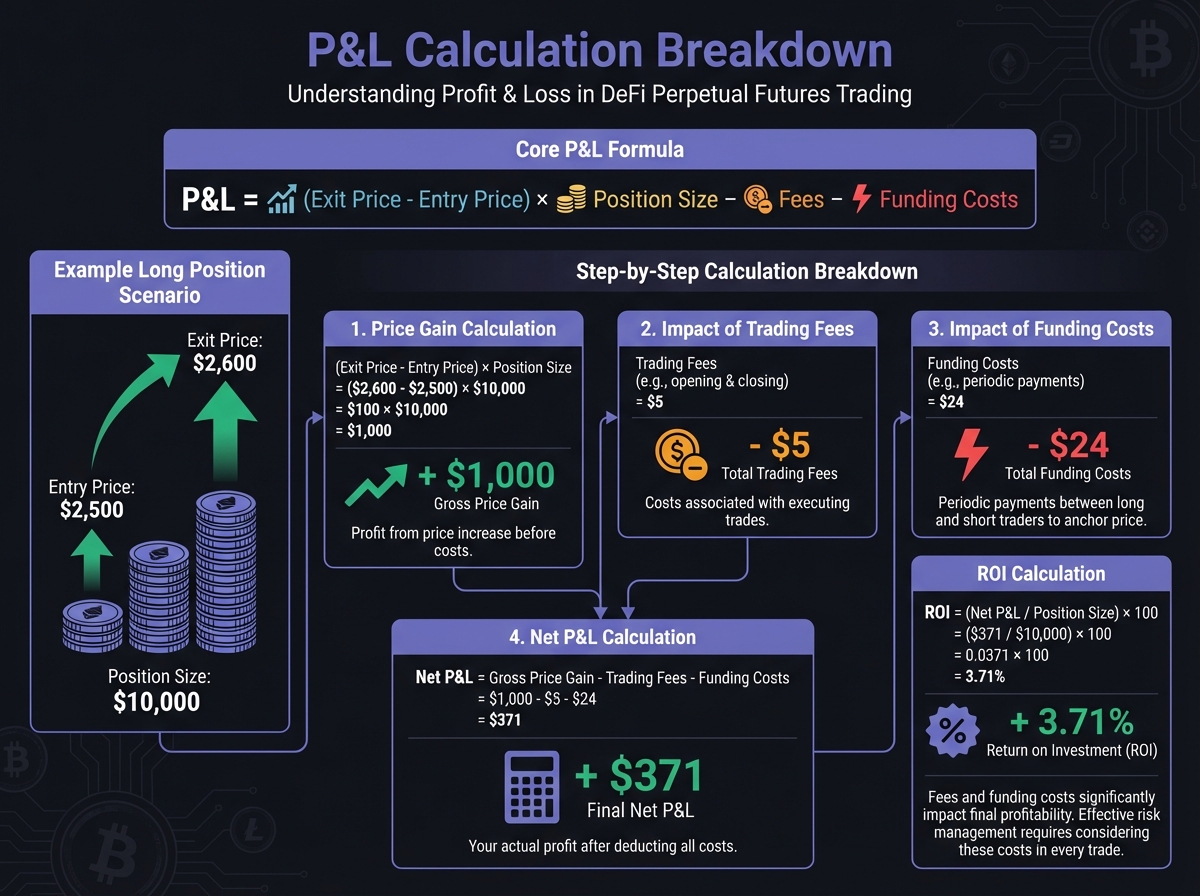
P&L=(ExitPriceEntryPrice)×PositionSizeFeesFundingCostsP\&L = (Exit Price - Entry Price) \times Position Size - Fees - Funding Costs

Example: Long ETH

  • Entry Price: $2,500

  • Exit Price: $2,600

  • Position Size: $10,000 (5x leverage on $2,000 margin)

  • Trading Fees: 0.05% ($5)

  • Funding Costs: $24 (24 hours at 0.01%/hour)

Calculation:

  • Price Gain: ($2,600 - $2,500) ÷ $2,500 = 4%

  • Dollar Gain: $10,000 × 0.04 = $400

  • Net P&L: $400 - $5 - $24 = $371

  • ROI: $371 ÷ $2,000 = 18.55%

P&L for Short Positions

P&L=(EntryPriceExitPrice)×PositionSizeFeesFundingCostsP\&L = (Entry Price - Exit Price) \times Position Size - Fees - Funding Costs

Example: Short ETH

  • Entry Price: $2,500

  • Exit Price: $2,400

  • Position Size: $10,000

  • Trading Fees: 0.05% ($5)

  • Funding Received: $24 (negative funding, you receive)

Calculation:

  • Price Gain: ($2,500 - $2,400) ÷ $2,500 = 4%

  • Dollar Gain: $10,000 × 0.04 = $400

  • Net P&L: $400 - $5 + $24 = $419

  • ROI: $419 ÷ $2,000 = 20.95%

P&L Calculation Breakdown

🎓 Beginner's Corner: Common Calculation Mistakes

Mistake 1: Ignoring Funding Costs

The Error: "I made 5% on my trade, great!"

The Reality: If you paid 2% in funding over 24 hours, your net return is only 3%.

The Fix: Always calculate net P&L including funding.

Mistake 2: Misunderstanding Liquidation Price

The Error: "With 10x leverage, I'm safe until price drops 10%."

The Reality: Maintenance margin means liquidation occurs around 9-9.5% (not 10%).

The Fix: Use the liquidation price calculator, don't estimate.

Mistake 3: Confusing Position Size with Margin

The Error: "I have $1,000, so I can trade $1,000 worth."

The Reality: With 10x leverage, $1,000 margin = $10,000 position size.

The Fix: Always distinguish between margin (collateral) and position size (notional value).

🔬 Advanced Deep-Dive: Funding Rate Dynamics

Why Funding Rates Vary

Funding rates fluctuate based on:

  1. Market Sentiment: Extreme bullishness → high positive funding

  2. Open Interest Imbalance: More longs than shorts → longs pay

  3. Arbitrage Activity: Low arbitrage → higher funding needed

  4. Protocol Design: Some protocols have caps, others don't

Funding Rate Impact on Returns

Scenario: Holding a long position for 7 days

  • Position Size: $10,000

  • Funding Rate: 0.02% per hour (high positive)

  • Daily Funding: $10,000 × 0.0002 × 24 = $48

  • Weekly Funding: $48 × 7 = $336

If ETH moves 2% in your favor:

  • Price Gain: $10,000 × 0.02 = $200

  • Net P&L: $200 - $336 = -$136 (LOSS)

Key Insight: High funding rates can turn profitable price moves into losses. Always check funding before opening positions.

Break-Even Analysis

Calculate the minimum price movement needed to cover costs:

BreakEvenPriceMovement=Fees+FundingCostsPositionSize×100%Break-Even Price Movement = \frac{Fees + Funding Costs}{Position Size} \times 100\%

Example:

  • Fees: $5

  • Funding Costs (24h): $24

  • Position Size: $10,000

Calculation:

  • Break-Even: ($5 + $24) ÷ $10,000 × 100% = 0.29%

You need at least 0.29% price movement just to break even.

📊 Real-World Example: Complete Position Analysis

Setup:

  • Long ETH at $2,500

  • Margin: $2,000

  • Leverage: 5x

  • Position Size: $10,000

  • Funding Rate: 0.01% per hour

  • Trading Fees: 0.05%

Calculations:

  1. Liquidation Price:

    • = $2,500 × (1 - 0.20 + 0.01) = $2,025

  2. Safety Buffer:

    • = ($2,500 - $2,025) ÷ $2,500 = 19%

  3. Daily Funding Cost:

    • = $10,000 × 0.0001 × 24 = $24/day

  4. Break-Even Price Movement:

    • = ($5 + $24) ÷ $10,000 = 0.29%

  5. If ETH goes to $2,600 (4% gain):

    • Price Gain: $400

    • Fees: $5

    • Funding (24h): $24

    • Net P&L: $400 - $5 - $24 = $371

    • ROI: 18.55%

  6. If ETH goes to $2,025 (liquidation):

    • Loss: $2,000 (entire margin)

    • ROI: -100%

🎯 Key Takeaways

  • Funding rates can be extremely expensive—always check before opening positions

  • Liquidation price is NOT simply (1 - 1/leverage)—maintenance margin matters

  • Position size (notional) ≠ Margin (collateral)—understand the difference

  • Calculate net P&L including fees and funding costs

  • Maintain 20-30% safety buffer above liquidation price

  • Break-even analysis helps determine if a trade is worth it

🚀 Next Steps

  • Proceed to Lesson 3 to understand different architecture types (CLOB vs Oracle pools)

  • Practice these calculations with the Exercise 2 worksheet

  • Use a liquidation calculator before opening any position

  • Monitor funding rates on your chosen protocol

Last updated