Lesson 6: GMX V2 - Oracle-Based Liquidity Pools
🎧 Lesson Podcast
🎬 Video Overview
Lesson 6: GMX V2 - Oracle-Based Liquidity Pools
🎯 Core Concept: Zero Slippage Through Oracle Pricing
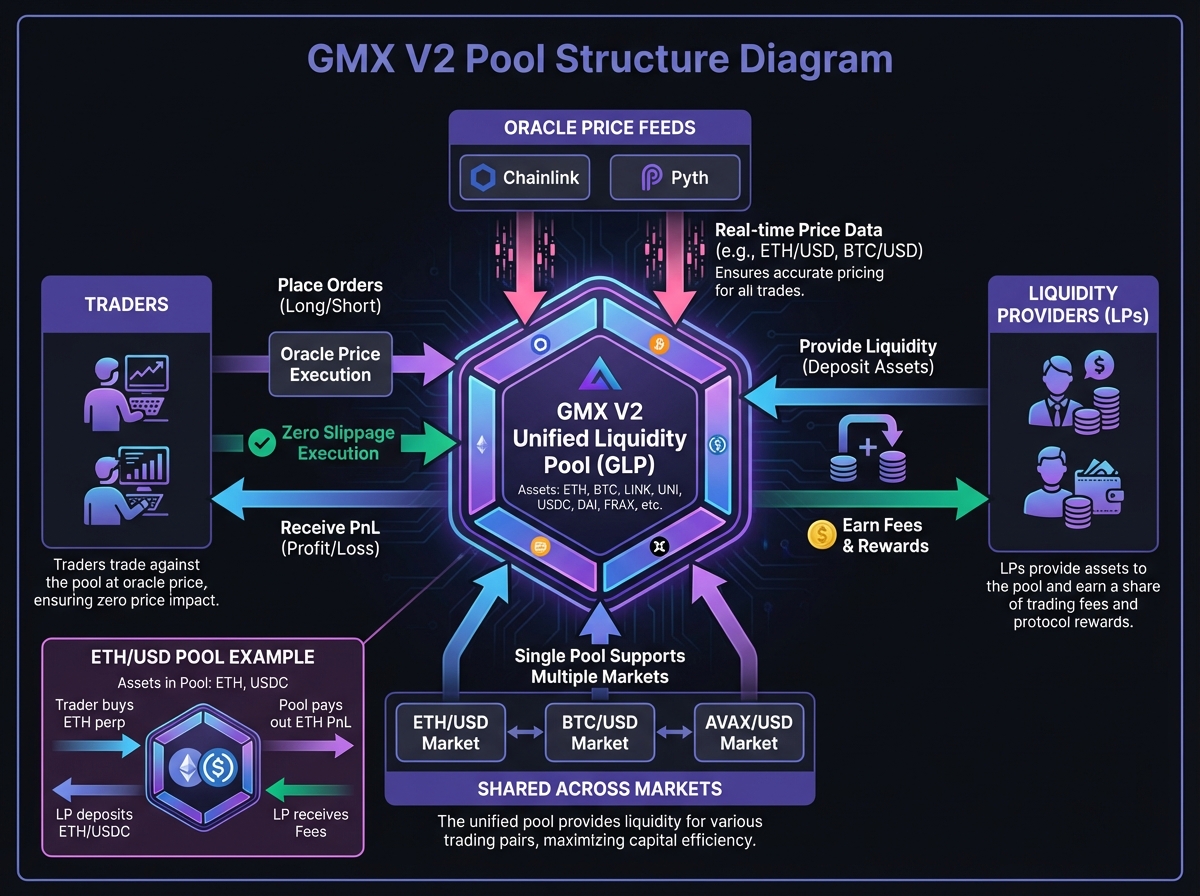
GMX V2 represents the evolution from a unified liquidity pool (GLP) to isolated market pools (GM), while maintaining the core innovation: zero price impact execution at oracle prices. This model eliminates order books entirely, allowing traders to execute any size at the oracle price, provided the pool has sufficient depth.
Why GMX V2 Matters
GMX V2 solved critical limitations of V1:
Risk Isolation: Each market has its own pool (no contagion)
Permissionless Listings: Can list volatile assets without threatening core markets
Dynamic Fees: Price impact fees balance Open Interest
Chainlink Data Streams: Low-latency oracle integration
Capital Efficiency: LPs choose exposure (not forced into all assets)
📚 The Evolution: GLP to GM Pools
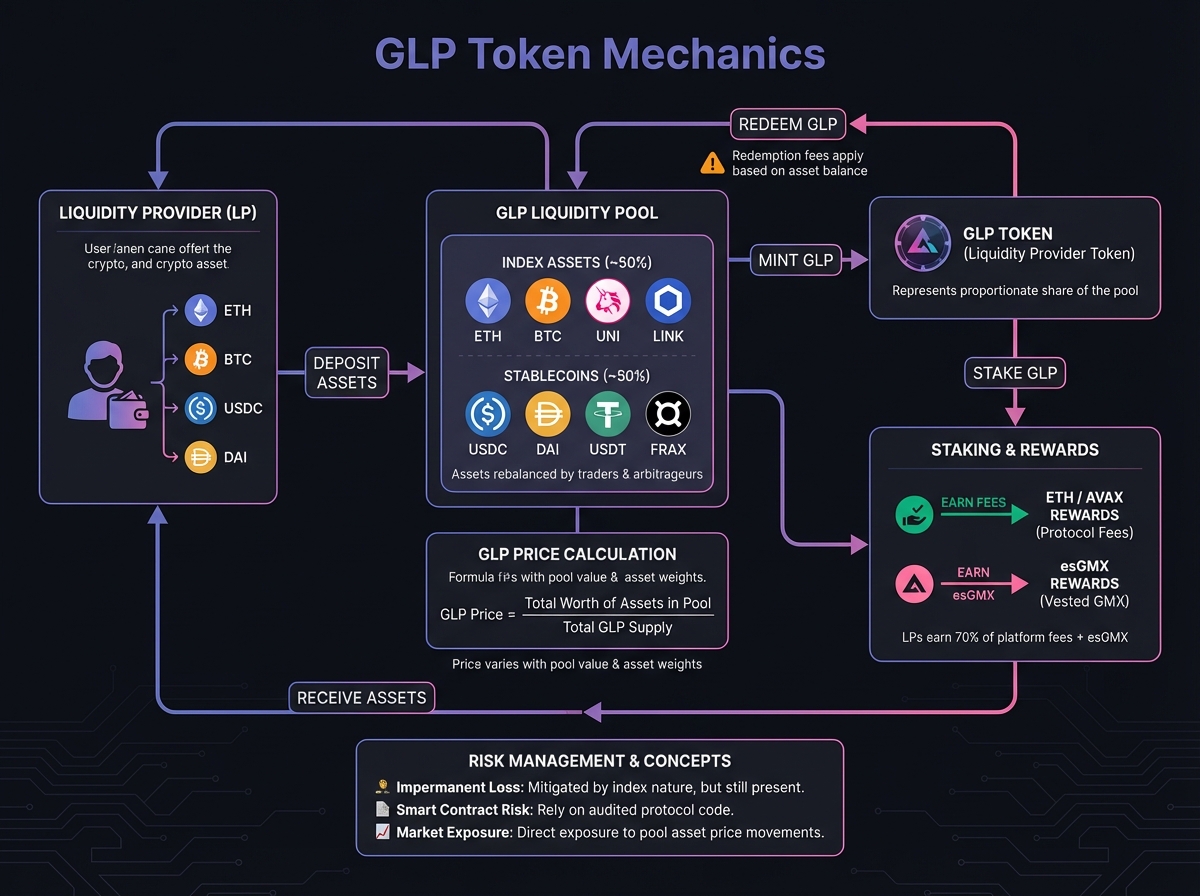
GMX V1: The GLP Model
How It Worked:
Single unified pool (GLP token)
~50% stablecoins, ~50% volatile assets
All markets shared same liquidity
Zero price impact execution
Strengths:
✅ Deep liquidity (all assets pooled)
✅ Simple for LPs (one token: GLP)
✅ Zero slippage execution
Weaknesses:
❌ Risk contagion (one asset failure affects all)
❌ Limited asset listings (couldn't list risky assets)
❌ OI imbalances (no sophisticated rebalancing)
❌ Forced exposure (LPs exposed to all assets)
GMX V2: The GM Pool Model
How It Works:
Each market has dedicated pool (GM-ETH-USDC, GM-BTC-USDC, etc.)
Risk completely isolated
LPs choose which pools to deposit into
Permissionless market creation
Key Innovation: Moving from "communal" to "siloed" liquidity model.
🏗️ GM Pool Architecture
Structural Isolation
Example Markets:
ETH/USD → GM-ETH-USDC pool (ETH + USDC)
BTC/USD → GM-BTC-USDC pool (BTC + USDC)
SOL/USD → GM-SOL-USDC pool (SOL + USDC)
Isolation is Absolute:
Assets in ETH pool cannot settle SOL trades
If SOL pool fails, ETH pool unaffected
Each pool operates independently
Standard vs. Synthetic Markets
Standard Markets (Fully Backed)
How It Works:
Pool holds actual tokens being traded
ETH/USD pool holds ETH (Long Token) + USDC (Short Token)
Trader opens Long ETH = "rents" upside of pool's ETH
Example:
Pool has 1,000 ETH and 2,500,000 USDC
Trader opens $10,000 Long ETH position
If ETH rises 10%, trader profits from pool's ETH reserves
Use Cases: Blue-chip assets (BTC, ETH) with deep on-chain liquidity
Synthetic Markets (Partially Backed)
How It Works:
Pool backing doesn't match index token
DOGE/USD market backed by ETH + USDC (not DOGE)
Oracle tracks DOGE price, but settles using ETH/USDC
Example:
DOGE/USD market backed by ETH and USDC
Trader opens Long DOGE
If DOGE pumps 50% but ETH stays flat, pool faces delta mismatch
Risk Profile:
Higher risk (delta mismatch)
Stricter OI caps
Higher fees to discourage manipulation
Use Cases: Assets not native to chain, low on-chain liquidity
GM Token Valuation
GM Token Components:
Asset Value: Real-time value of Long + Short tokens in pool
Pending PnL: Net profit/loss of all open positions
If traders have $1M unrealized profit → GM token value decreases
If traders have $1M unrealized loss → GM token value increases
Accrued Fees: Auto-compounded trading fees
Key Insight: GM token holders are the "house" for that market—they earn fees but absorb trader PnL volatility.
🔗 The Oracle Engine: Chainlink Data Streams
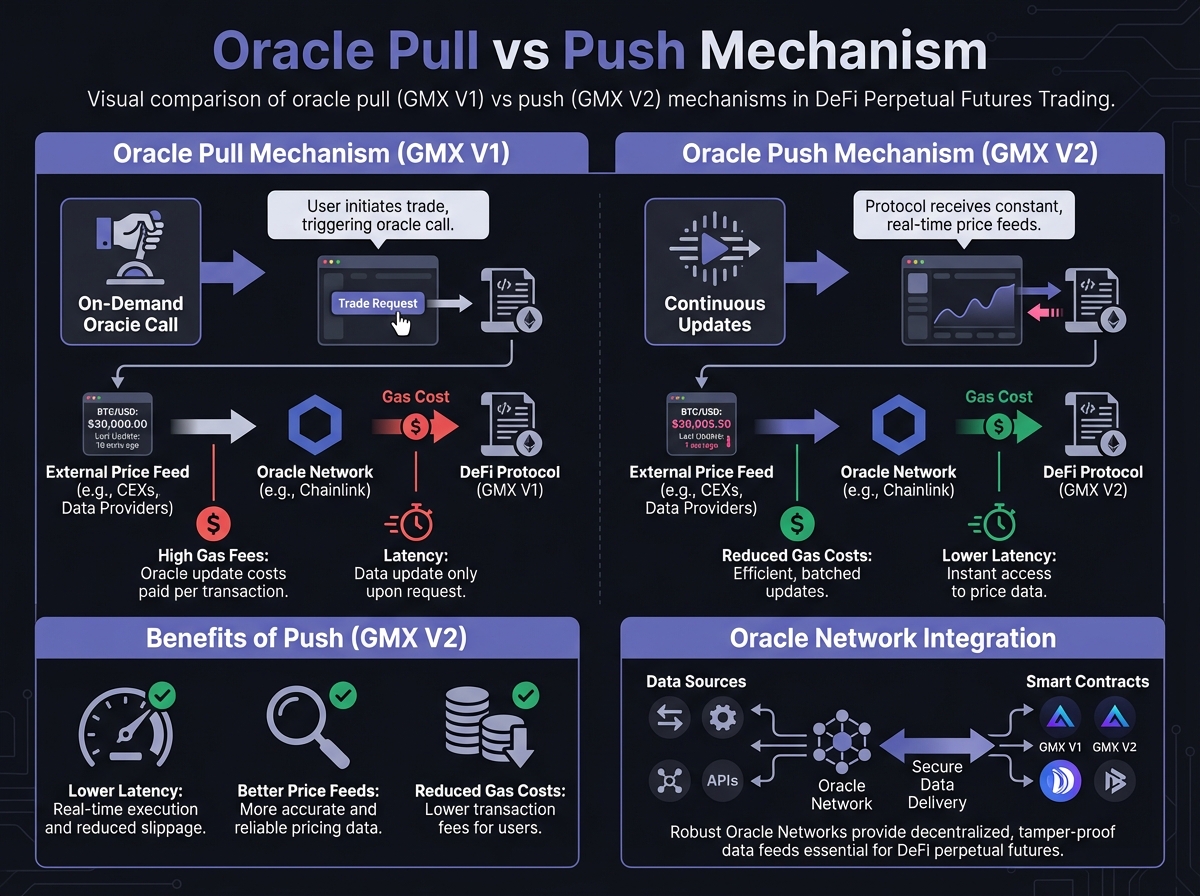
Push vs. Pull Architecture
V1 Push Model:
Chainlink nodes push updates when price deviates 0.1% or heartbeat expires
Creates latency gap (on-chain price can lag CEX)
Toxic arbitrageurs exploit stale prices
V2 Pull Model (Data Streams):
Chainlink aggregates prices off-chain at sub-second intervals
When trade occurs, latest price is "pulled" on-chain
Price data is seconds old (not hours)
Gas efficient (only updates when needed)
Two-Step Execution Process
Step 1: Order Submission
Trader submits transaction to "request" trade
Request queued in smart contract
Step 2: Order Execution
Keeper network monitors request queue
Keeper fetches latest Chainlink price signature
Keeper submits execution transaction
Trader pays execution fee (covers keeper gas)
Verification: Smart contract verifies Chainlink signature and timestamp. If stale or invalid, transaction reverts.
Zero Price Impact: Reality vs. Perception
What "Zero Price Impact" Means:
Trade executes at oracle Index Price
No spread widening due to order book depth
$10M order executes at same base price as $10 order
What It Doesn't Mean:
Total cost is not zero
Price Impact Fees apply (simulated slippage)
Large trades that unbalance pool pay higher fees
Key Distinction: GMX V2 simulates market depth via fees, not price spread.
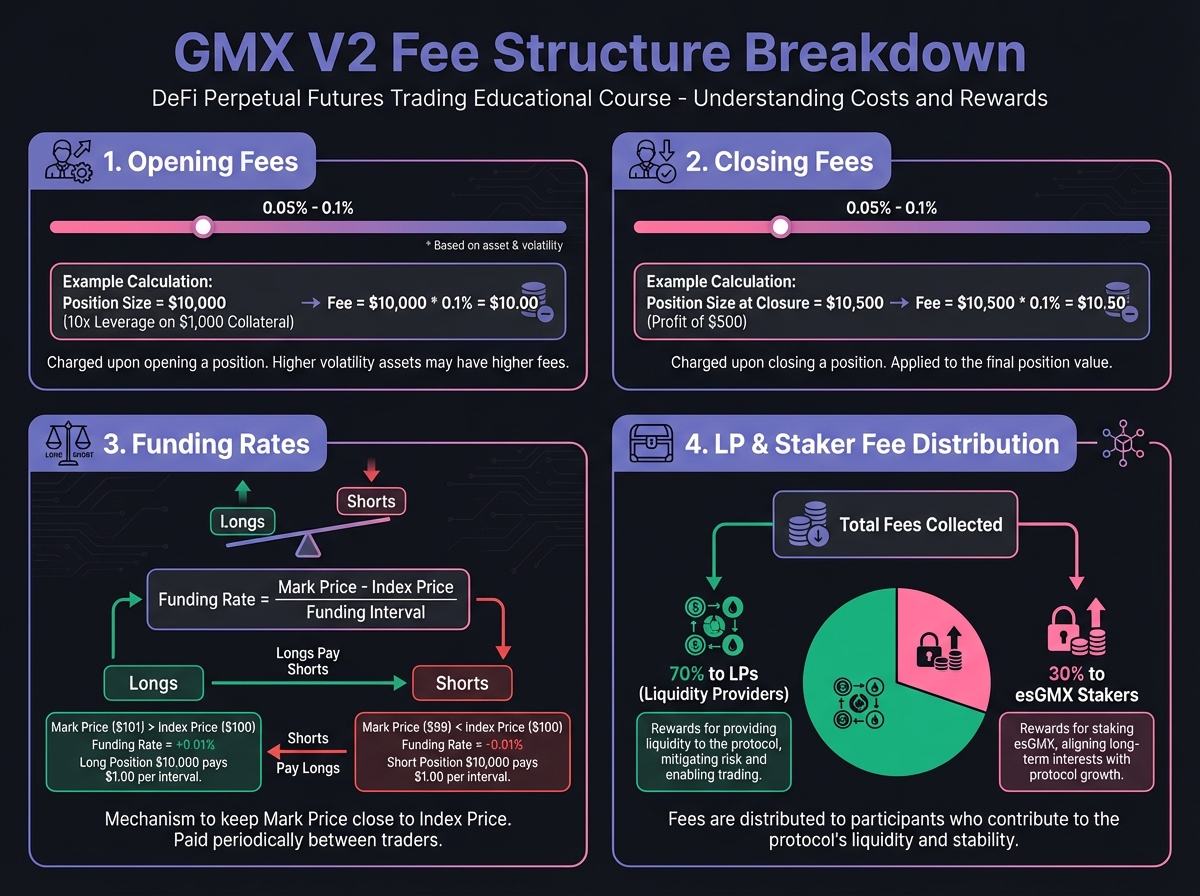
💰 The Multi-Layered Fee Structure
Base Trading Fees
V1: Flat 0.1% (10 bps)
V2: Dynamic 0.05% - 0.07% (5-7 bps)
Rebate Logic: Fee depends on trade's impact on pool balance
If trade increases imbalance (adds Longs to Long-heavy pool): 0.07%
If trade decreases imbalance (adds Shorts to Long-heavy pool): 0.05%
Purpose: Incentivize trades that rebalance the pool.
Price Impact Fee
The Innovation: Simulates market depth without order book.
How It Works:
Function of initial imbalance and target imbalance after trade
Large trades that unbalance pool pay higher fees
Small trades or rebalancing trades pay lower fees
Example:
Pool is 80% Long, 20% Short
Trader opens large Long position → High price impact fee
Trader opens Short position → Low price impact fee (rebalancing)
Purpose: Discourage toxic flow, reward arbitrageurs.
Funding Rate
V1: No funding rate (only borrow fee paid by both sides)
V2: Velocity-based funding rate
Responds to OI imbalance velocity
Fast imbalance growth → Higher funding
Encourages contrarian traders to rebalance
Borrow Fee
How It Works:
Utilization-based fee
High pool utilization → Higher borrow fee
Encourages LPs to deposit more capital
🎓 Beginner's Corner: Using GMX V2
Getting Started
Step 1: Network Configuration
Set MetaMask to Arbitrum One network
Add network if needed (Chainlist.org)
Step 2: Acquire Assets
Buy USDC on CEX or swap on DEX
Bridge to Arbitrum (official bridge or Synapse/Stargate)
Keep some ETH for gas
Step 3: Navigate to GMX
Go to GMX V2 interface
Connect wallet
Select "Trade" tab
Opening a Position
Step-by-Step:
Select Market: Choose ETH/USD (or other)
Check Pool: View pool depth and current OI
Choose Direction: Long or Short
Set Size: Enter collateral amount
Review Fees: See price impact fee estimate
Check Funding: Review current funding rate
Execute: Click "Open Position"
Approve: Sign transaction in wallet
Wait for Keeper: Keeper executes (usually <1 minute)
Key Metrics to Check:
Pool depth (sufficient liquidity?)
Open Interest (balanced or skewed?)
Funding rate (acceptable?)
Price impact fee (reasonable for your size?)
🔬 Advanced Deep-Dive: LP Strategy
Pool Selection
For Conservative LPs:
Standard markets (ETH, BTC)
Large pool depth
Balanced OI
Lower fees but safer
For Aggressive LPs:
Synthetic markets (higher risk/reward)
Smaller pools (higher fee share)
Volatile assets (more trading = more fees)
Delta-Neutral Strategies
The Concept: Eliminate price exposure while earning fees.
How It Works:
Deposit into GM pool (e.g., GM-ETH-USDC)
Hedge ETH exposure on CEX or spot market
Earn GM fees while price-neutral
Example:
Deposit $10,000 into GM-ETH-USDC pool
Short $10,000 ETH on CEX
Net exposure: ~0 (delta neutral)
Earn: GM trading fees + funding (if favorable)
Risk: Basis risk (GM price vs CEX price divergence)
GMX Liquidity Vaults (GLV)
What They Are: Automated vaults that manage GM exposure.
How They Work:
Deposit into GLV
Vault automatically:
Selects pools
Manages delta exposure
Rebalances as needed
Benefits:
Passive management
Professional strategies
Diversification
Risks:
Vault manager risk
Strategy risk
Fees (management + performance)
⚠️ Risks and Considerations
Oracle Risk
Latency Arbitrage:
Even with Data Streams, small latency exists
Sophisticated arbitrageurs can exploit
LPs bear the cost (toxic flow)
Oracle Manipulation:
Rare but possible
Chainlink has safeguards
Monitor for unusual price movements
Pool Insolvency Risk
When It Happens:
Traders win big (pool pays out)
Pool assets insufficient to cover
GM token value decreases
Mitigation:
OI caps prevent excessive exposure
Price impact fees discourage large imbalanced trades
Funding rates incentivize rebalancing
Keeper Centralization
Risk: If keeper network is centralized or colludes:
Could censor transactions
Could delay execution
Could manipulate timing
Mitigation:
Multiple keeper networks
Decentralization efforts
Monitor keeper performance
📊 Real-World Example: Trading on GMX V2
Scenario: Open $10,000 Long ETH position
Setup:
Protocol: GMX V2 (Arbitrum)
Market: ETH/USD
Collateral: $2,000 USDC
Leverage: 5x
Execution:
Navigate to GMX V2, connect wallet
Select ETH/USD market
Check pool depth: $50M (sufficient)
Check OI: 60% Long, 40% Short (slightly imbalanced)
Check funding: 0.01% per hour (acceptable)
Enter $2,000 collateral, 5x leverage
Review price impact fee: 0.02% ($2)
Click "Open Position"
Approve transaction
Keeper executes within 30 seconds
Position opened at oracle price ($2,500)
Advantages:
Zero slippage (executed at oracle price)
Simple execution (no order book)
Large size capability (pool has depth)
Costs:
Trading fee: 0.06% ($6)
Price impact fee: 0.02% ($2)
Funding: 0.01% per hour
Total upfront: $8
⚖️ Compare Protocols
See how GMX V2 compares to other perpetual DEXs:
🔑 Key Takeaways
GMX V2 uses isolated pools (no risk contagion)
Zero price impact execution at oracle prices
Chainlink Data Streams enable low-latency pricing
Dynamic fees (price impact, funding, borrow) balance OI
Standard markets (backed) vs Synthetic markets (delta mismatch)
GM tokens represent pool equity (asset value + PnL + fees)
Best for: Large position traders, LPs seeking yield, simple execution
🚀 Next Steps
Proceed to Lesson 7 to learn about Drift's hybrid architecture
Complete Exercise 6 to practice GMX V2 market analysis
Explore GMX V2 interface to see oracle-based execution
Consider GM pools for liquidity provision strategies
Last updated