Lesson 10: Risk Management and Position Protection
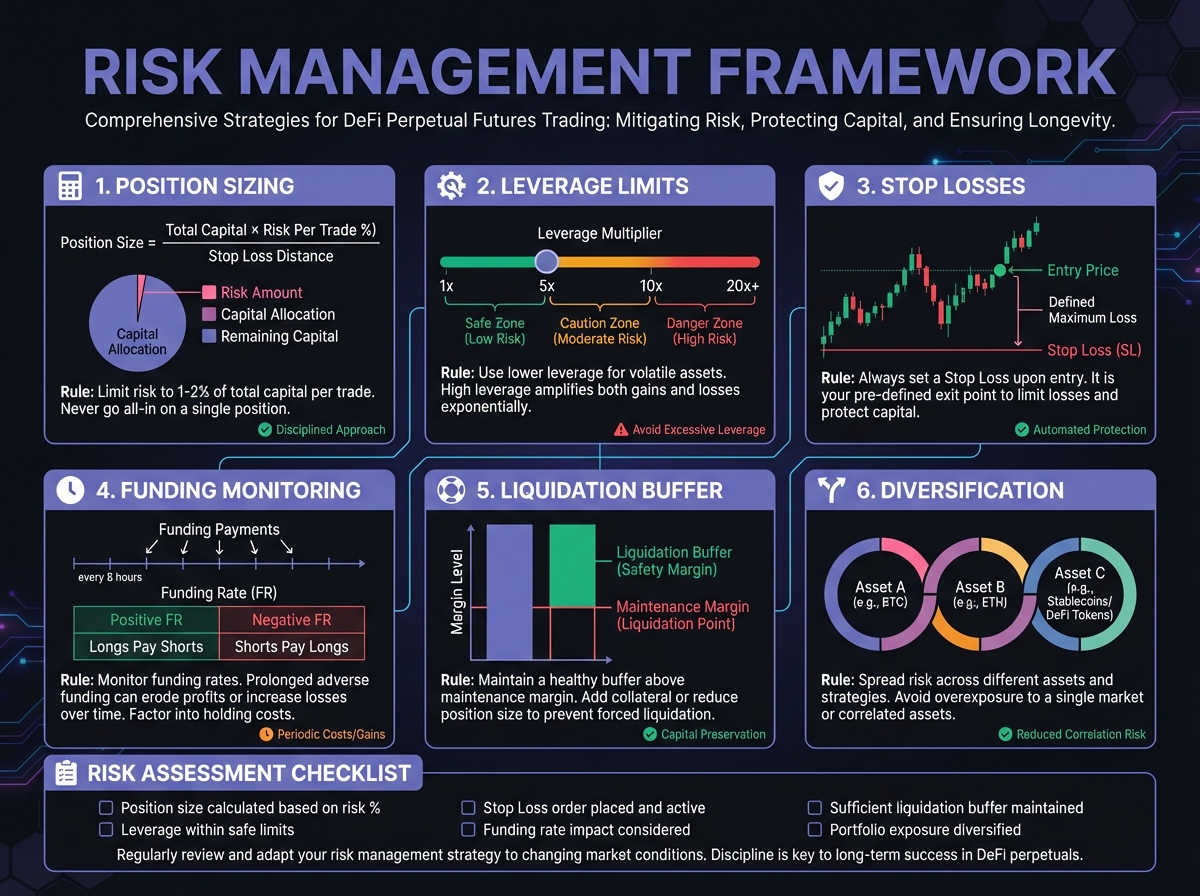
Risk Management Framework

🎯 Core Concept: Risk Management is Non-Negotiable

The freedom of DeFi perpetual trading comes with significant risks. This lesson covers the most common mistakes, systemic risks, and how to protect yourself. Risk management is not optional—it's the difference between sustainable trading and catastrophic losses.

Why Risk Management Matters

Most traders lose money not because of bad trades, but because of:

  • Poor risk management: No stop losses, excessive leverage

  • Ignoring funding rates: High rates erode profits

  • Misunderstanding liquidation: Not accounting for maintenance margin

  • Cross-margin mistakes: One bad trade liquidates entire account

The Statistics: Studies show 70-90% of retail traders lose money. The difference? Professional risk management.

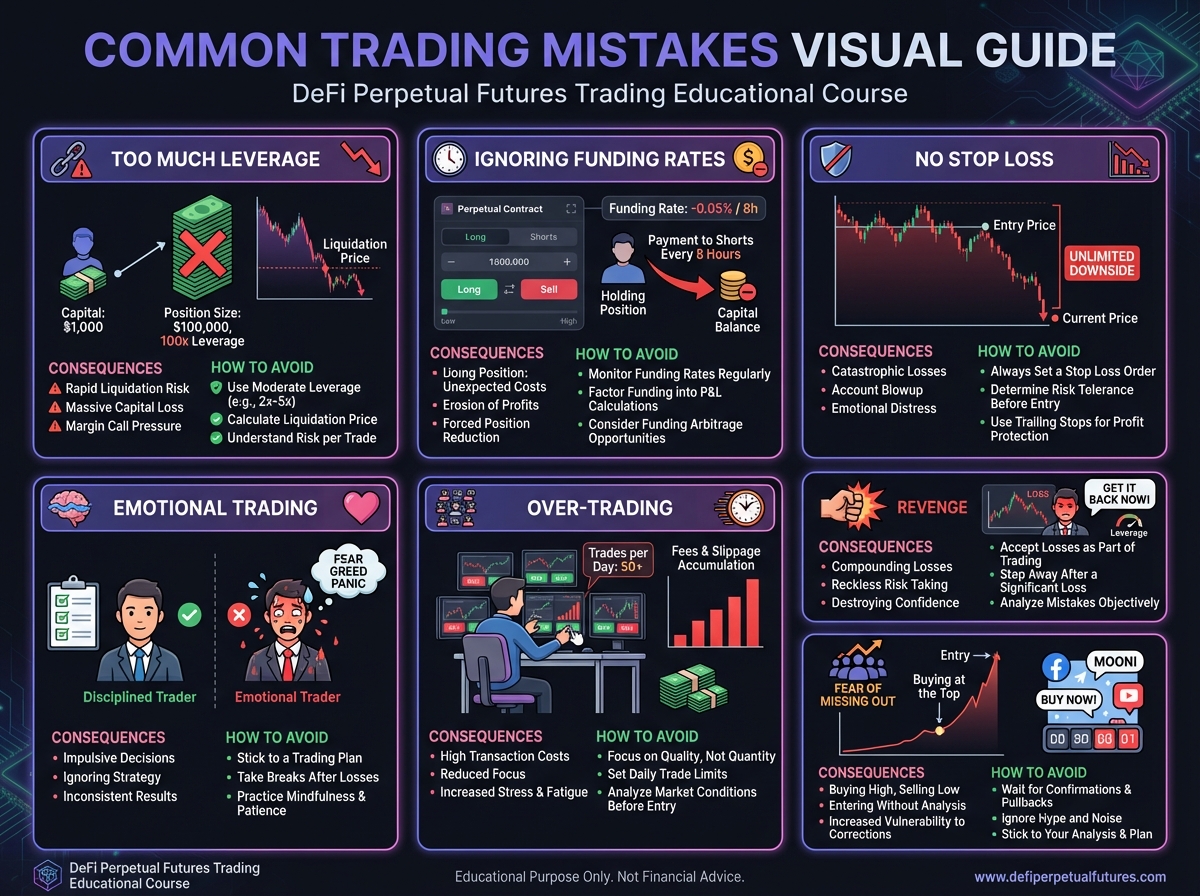
⚠️ Common Mistakes and How to Avoid Them

Mistake 1: Funding Rate Neglect

The Error: "Funding is only 0.01%, that's nothing."

The Reality:

  • 0.01% per hour = 87.6% APR

  • On 10x leverage, calculated on notional size

  • 0.2% per hour = 4.8% per day = 48% of margin per day

Example:

  • Position: $10,000 notional (10x on $1,000 margin)

  • Funding: 0.2% per hour

  • Daily cost: $10,000 × 0.002 × 24 = $480/day

  • On $1,000 margin: 48% loss per day (even if price flat)

The Fix:

  • Always check annualized funding rate

  • If >50% APR, reconsider the trade

  • Use spot position if funding too high

  • Monitor funding rate changes

Mistake 2: Misunderstanding Liquidation Buffers

The Error: "With 10x leverage, I'm safe until price drops 10%."

The Reality:

  • Maintenance margin required (e.g., 5%)

  • Liquidation occurs before 10% drop

  • Usually around 9-9.5% (depends on protocol)

Example:

  • Entry: $100, 10x leverage

  • You think: Safe until $90

  • Reality: Liquidated at ~$90.50-$91.00

The Fix:

  • Use protocol's liquidation calculator

  • Maintain 20-30% buffer above liquidation price

  • Don't estimate—calculate exactly

  • Monitor margin ratio closely

Mistake 3: Cross-Margin Contagion

The Error: Using cross margin for "simplicity" while trading correlated assets.

The Reality:

  • One bad position can drain entire account

  • Correlated assets move together

  • Combined drawdown = account liquidation

Example:

  • Account: $1,000 USDC (cross margin)

  • Long ETH: $5,000 position

  • Long ETH-beta altcoin: $5,000 position

  • Altcoin crashes 20% → Account equity drops

  • ETH also drops (correlated) → Entire account liquidated

The Fix:

  • Use isolated margin for volatile assets

  • Use cross margin only for hedging strategies

  • Never use cross margin for correlated positions

  • Monitor portfolio health factor

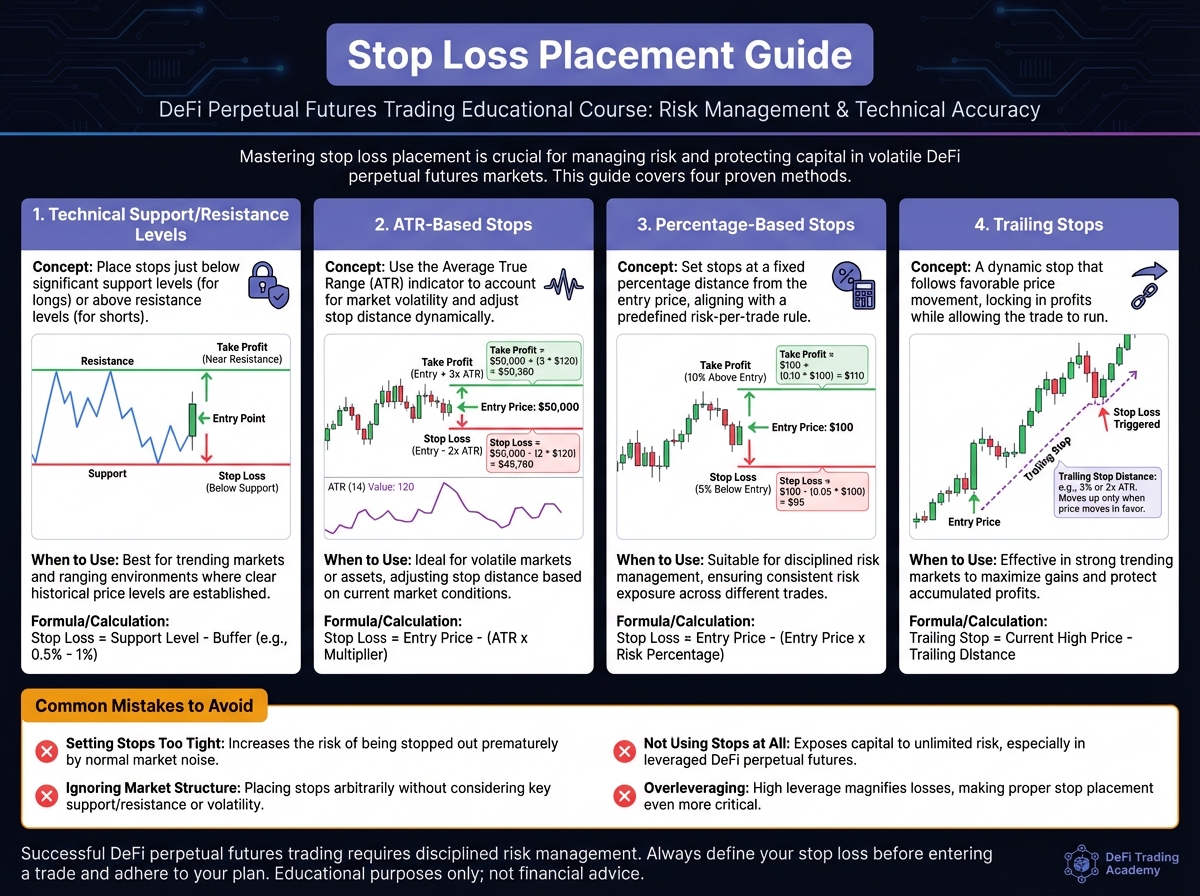
Stop Loss Placement Guide

Mistake 4: Chasing the Liquidity Mirage
The Error: "High volume = deep liquidity, I'm safe."

The Reality:

  • Wash trading inflates volume

  • Real order book depth may be thin

  • Large orders suffer massive slippage

The Fix:

  • Check Open Interest (OI) to Volume ratio

  • Healthy: Balanced OI and volume

  • Red flag: High volume, tiny OI (wash trading)

  • Test liquidity with small orders first

Common Trading Mistakes Visual Guide

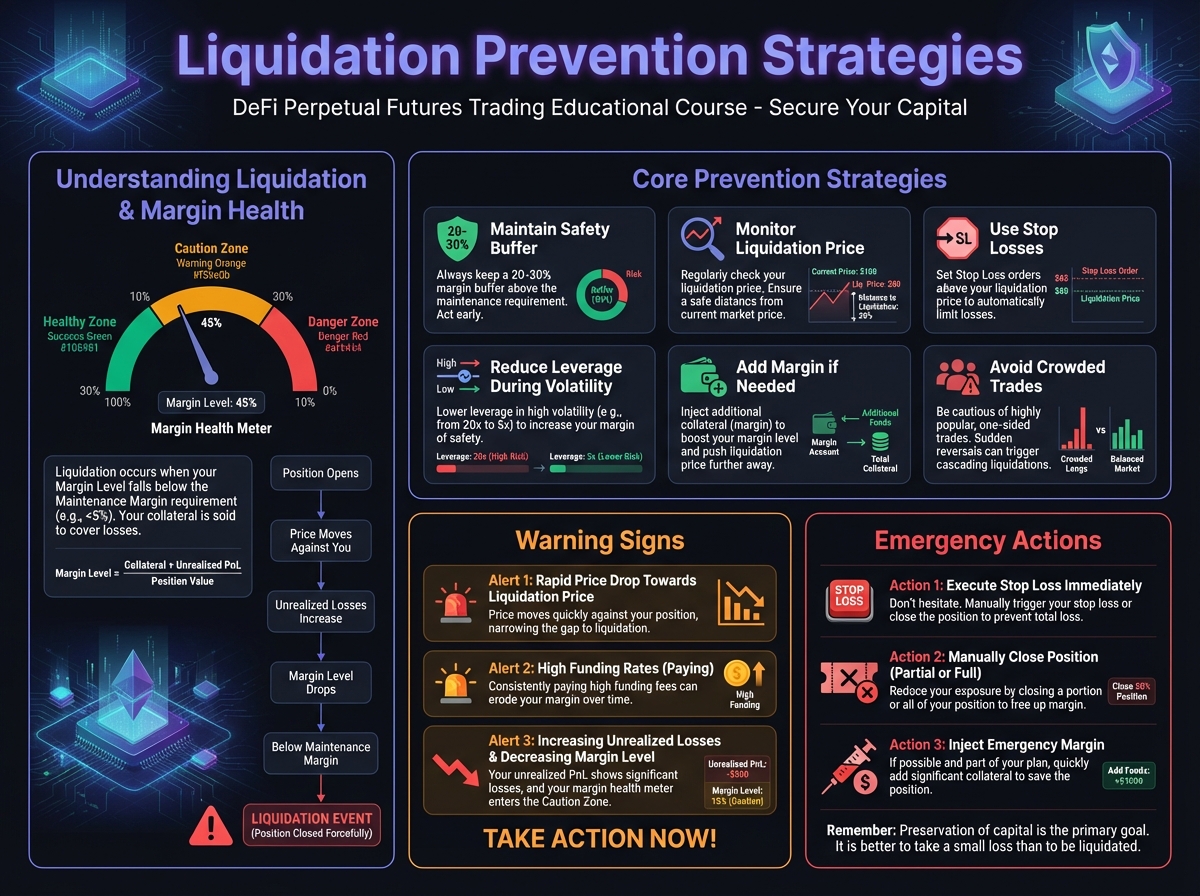
🛡️ Liquidation Prevention Strategies

Strategy 1: Maintain Safety Buffers

The 20-30% Rule:

  • Keep liquidation price 20-30% away from current price

  • For 10x leverage: Maintain margin ratio >15%

  • For 5x leverage: Maintain margin ratio >25%

Calculation:

  • Entry: $2,500

  • Leverage: 5x

  • Liquidation: $2,000

  • Current: $2,400

  • Buffer: ($2,400 - $2,000) ÷ $2,400 = 16.7% (too close!)

Action: Add margin or reduce position size

Strategy 2: Use Stop Losses Religiously

Why Critical:

  • Limits maximum loss

  • Prevents emotional decisions

  • Protects capital

How to Set:

  1. Identify technical support/resistance

  2. Set stop loss below support (long) or above resistance (short)

  3. Ensure stop is 20-30% from entry (for 5x leverage)

  4. Never move stop loss against you

Example:

  • Entry: $2,500

  • Support: $2,400

  • Stop Loss: $2,390

  • Max Loss: $110 (4.4% of position)

Strategy 3: Position Sizing

The 1-5% Rule:

  • Risk only 1-5% of total capital per trade

  • For $10,000 capital: Max risk = $200-500 per trade

  • Prevents single trade from destroying account

Calculation:

  • Total Capital: $10,000

  • Risk Per Trade: 2% = $200

  • Entry: $2,500

  • Stop Loss: $2,400 (4% risk)

  • Position Size: $200 ÷ 0.04 = $5,000

  • Margin Needed: $5,000 ÷ 5x = $1,000

Result: $1,000 margin, $5,000 position, $200 max loss

Strategy 4: Add Margin Proactively

When to Add:

  • Price moving against you but still confident

  • Want to lower liquidation price

  • Want to increase safety buffer

How to Add:

  1. Navigate to position

  2. Click "Add Margin"

  3. Enter additional amount

  4. Verify new liquidation price

Effect: Lowers liquidation price, increases buffer

Liquidation Prevention Strategies

🔒 Systemic Risk Protection

Oracle Risk Mitigation

The Problem: Oracle latency or manipulation

Oracle-Based DEXs (GMX):

  • Risk: Stale prices = arbitrage opportunities

  • Mitigation: Use protocols with low-latency oracles (Pyth, Chainlink Data Streams)

  • Monitor: Check oracle update frequency

CLOB DEXs (Hyperliquid):

  • Risk: On-chain price wicks = liquidations

  • Mitigation: Maintain larger safety buffers

  • Monitor: Check order book depth

Protection:

  • Diversify across protocols

  • Use protocols with multiple oracle sources

  • Monitor for unusual price movements

Bridge Risk Mitigation

The Problem: Bridge hacks or failures

Examples:

  • Hyperliquid bridge (multisig)

  • Cross-chain bridges (various)

Protection:

  • Minimize bridge exposure

  • Use insured bridges when available

  • Don't leave funds in bridges

  • Monitor bridge security

Best Practice: Bridge only what you need, when you need it.

Smart Contract Risk Mitigation

The Problem: Protocol exploits or bugs

Protection Checklist:

Red Flags:

  • Single audit from unknown firm

  • "Audit in progress"

  • No insurance fund

  • Recent exploits

Best Practice: Use only well-audited, established protocols.

📊 Margin Management Best Practices

Isolated vs. Cross Margin Decision Tree

Use Isolated Margin When:

  • Trading volatile assets

  • Testing new strategies

  • First-time trades

  • High leverage (>10x)

  • Uncorrelated positions

Use Cross Margin When:

  • Hedging strategies (Long BTC, Short ETH)

  • Low leverage (<5x)

  • Blue-chip assets only

  • Active portfolio management

  • Understanding correlation risks

Portfolio Health Monitoring

Key Metrics:

  • Portfolio Health Factor: Overall account safety

  • Individual Position Health: Each position's margin ratio

  • Correlation Exposure: How correlated are your positions?

  • Liquidation Distance: How close to liquidation?

Monitoring Schedule:

  • Active Trading: Check every few minutes

  • Swing Trading: Check daily

  • Never: Set and forget

Alert Thresholds:

  • Health factor < 1.5: Warning

  • Health factor < 1.2: Danger

  • Within 5% of liquidation: Critical

🎓 Beginner's Corner: Your Risk Management Checklist

Pre-Trade Checklist

Before Opening Any Position:

During-Trade Checklist

While Position is Open:

Emergency Response Plan

If Approaching Liquidation:

  1. Option 1: Close position (cut losses)

  2. Option 2: Add margin (if still confident)

  3. Option 3: Reduce position size (partial close)

Decision Framework:

  • If stop loss hit: Close immediately

  • If within 5% of liquidation: Add margin or close

  • If funding rate spikes: Reassess or close

🔬 Advanced Deep-Dive: Professional Risk Systems

Multi-Position Risk Management

Portfolio Approach:

  • Total portfolio risk: <10% of capital

  • Individual position risk: 1-5% each

  • Correlation analysis: Don't over-concentrate

  • Diversification: Across assets and protocols

Example Portfolio:

  • Position 1: $5,000 (2% risk)

  • Position 2: $3,000 (1.5% risk)

  • Position 3: $2,000 (1% risk)

  • Total Risk: 4.5% of capital

Automated Risk Management

Bot Features:

  • Monitor all positions

  • Alert on margin ratio thresholds

  • Auto-close if stop loss hit

  • Rebalance if delta drifts

  • Track funding rate changes

Considerations:

  • Development costs

  • Monitoring infrastructure

  • Risk of bugs

  • Gas costs

Insurance and Hedging

Protocol Insurance:

  • Some protocols have insurance funds

  • Check coverage limits

  • Understand what's covered

External Hedging:

  • Hedge perp exposure with spot

  • Use options for protection

  • Cross-protocol hedging

📊 Real-World Example: Complete Risk Management

Setup:

  • Capital: $10,000

  • Risk per trade: 2% ($200)

  • Strategy: Swing trading ETH

Position 1:

  • Entry: $2,500

  • Margin: $1,000 (5x leverage)

  • Position: $5,000

  • Stop Loss: $2,400

  • Liquidation: $2,000

  • Max Loss: $200 (2% of capital) ✓

Risk Management:

  • Safety Buffer: 20% above liquidation ✓

  • Stop Loss: Set and respected ✓

  • Funding Rate: 0.01% per hour (acceptable) ✓

  • Margin Mode: Isolated ✓

  • Monitoring: Daily checks ✓

Result: Even if liquidated, maximum loss is $200 (2% of capital), not entire account.

🎯 Key Takeaways

  • Funding rates can be extremely expensive—always check annualized rates

  • Liquidation occurs before simple leverage math suggests—use calculators

  • Cross margin is dangerous for correlated assets—use isolated margin

  • High volume doesn't mean deep liquidity—check OI to volume ratio

  • Maintain 20-30% safety buffer above liquidation price

  • Always set stop losses before opening positions

  • Risk only 1-5% of capital per trade

  • Monitor positions actively, never set and forget

  • Diversify across protocols to reduce systemic risk

  • Use only well-audited, established protocols

🚀 Next Steps

  • Proceed to Lesson 11 to learn about emerging trends

  • Complete Exercise 10 to design your risk management framework

  • Implement your risk management checklist

  • Start with small positions to practice

Last updated