Lesson 1: Understanding Perpetual Futures Fundamentals
🎧 Lesson Podcast
🎬 Video Overview
Lesson 1: Understanding Perpetual Futures Fundamentals
🎯 Core Concept: What is a Perpetual Future?
A perpetual future (or "perp") is a derivative contract that allows you to speculate on the price of an asset without an expiration date. Unlike traditional futures that settle on a specific date, perpetuals use a "funding rate" mechanism to keep the contract price aligned with the spot price indefinitely.
Why Perpetual Futures Matter
Before perpetual futures, if you wanted to trade with leverage:
You needed centralized exchanges (like Binance or BitMEX)
You had to trust the exchange to hold your funds
You were exposed to counterparty risk (as seen with FTX collapse)
You had limited transparency into order matching
Perpetual futures on decentralized exchanges changed everything by:
Eliminating counterparty risk: Self-custody of funds via smart contracts
Enabling permissionless trading: Trade any asset, anywhere, anytime
Providing transparency: All trades and prices are on-chain, verifiable
Offering leverage: Amplify your position size with borrowed capital
Creating composability: Integrate with other DeFi protocols
📚 The Evolution: From CEX to DEX Perpetuals
Traditional Futures (CEX Model)
Traditional futures contracts have:
Expiration dates: Contracts settle on a specific date (weekly, monthly, quarterly)
Physical or cash settlement: You must close or roll positions before expiry
Centralized matching: Orders matched by exchange servers
Custodial risk: Exchange holds your funds
Example: A BTC futures contract expiring on December 31st must be closed or rolled to the next contract before that date.
The Perpetual Revolution
Perpetual futures eliminate expiration dates by using a funding rate mechanism:
No expiry: Hold positions indefinitely (as long as you maintain margin)
Funding payments: Long and short positions pay/receive funding to keep price aligned
Continuous trading: No need to roll contracts
On-chain settlement: Smart contracts handle everything
Key Innovation: Instead of forcing price convergence through expiration, perpetuals use periodic funding payments to incentivize arbitrage and maintain price parity with spot markets.
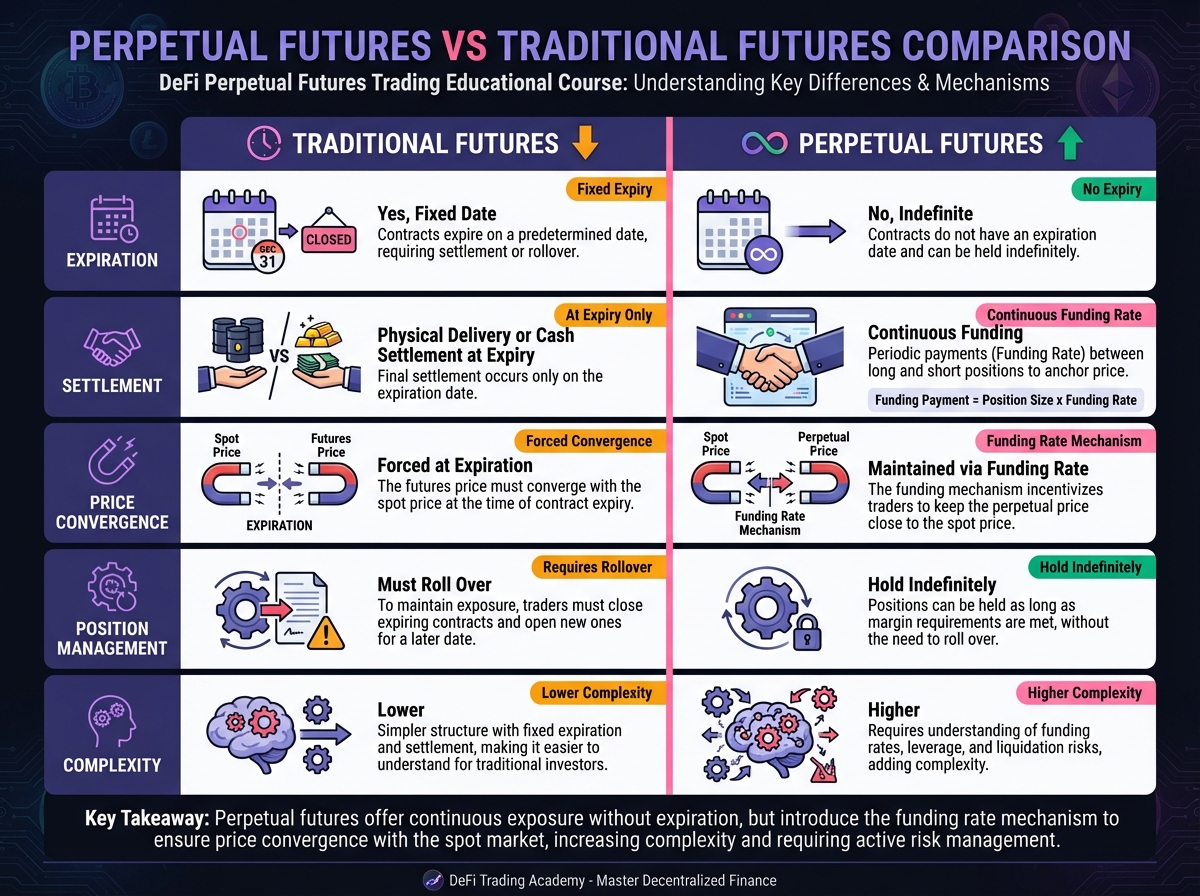
🔄 Perpetual Futures vs Traditional Futures
Expiration
Yes (weekly/monthly)
No (perpetual)
Settlement
Physical or cash on expiry
Continuous funding payments
Price Convergence
Forced at expiration
Maintained via funding rate
Position Management
Must roll before expiry
Hold indefinitely
Complexity
Lower (simple expiry)
Higher (funding mechanics)
💰 Core Concepts: The Foundation
Funding Rates
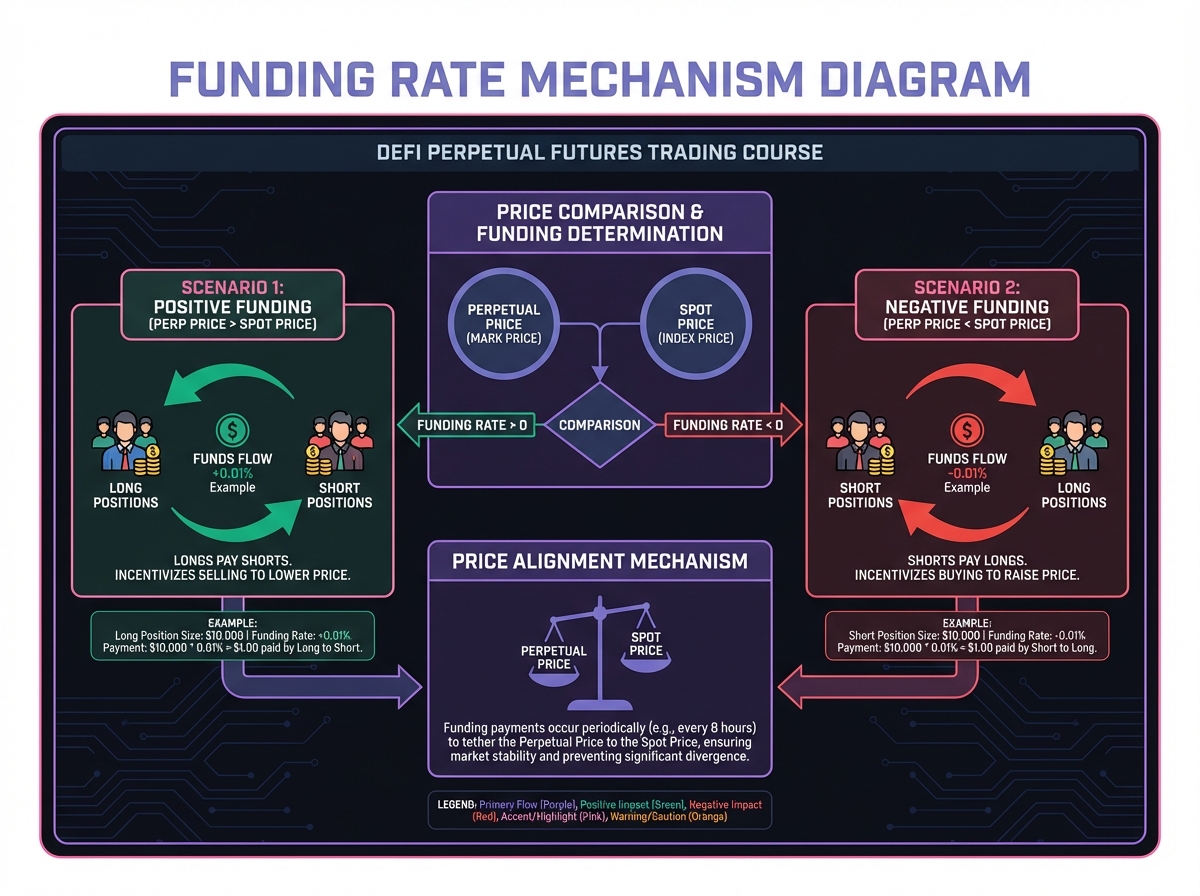
The funding rate is the mechanism that keeps perpetual prices aligned with spot prices:
Positive Funding: When perpetual price > spot price
Long positions pay short positions
Discourages buying, encourages selling
Drives perpetual price down toward spot
Negative Funding: When perpetual price < spot price
Short positions pay long positions
Discourages selling, encourages buying
Drives perpetual price up toward spot
Frequency: Most protocols calculate funding every hour or every 8 hours. High-performance chains like Hyperliquid calculate funding continuously or every block.
Strategic Implication: Funding rates can be significant. In strong trends, annualized funding rates can exceed 100%. Holding a position against the funding rate can erode capital, turning a profitable price move into a net loss.
Leverage
Leverage allows you to control a larger position with less capital:
Example: With 10x leverage, $1,000 controls a $10,000 position
Amplification: Profits and losses are multiplied by the leverage factor
Risk: Higher leverage = higher liquidation risk
Common Leverage Levels:
Conservative: 2-5x (recommended for beginners)
Moderate: 5-10x (intermediate traders)
Aggressive: 10-50x+ (advanced traders, high risk)
Margin
Margin is the collateral you deposit to open and maintain a position:
Initial Margin: Required to open a position (e.g., 10% for 10x leverage)
Maintenance Margin: Minimum required to keep position open (e.g., 5%)
Margin Call: When margin falls below maintenance, position is liquidated
Example:
Open 10x long BTC with $1,000 margin
Position size: $10,000
If BTC drops 10%, you lose $1,000 (100% of margin)
If BTC drops 11%, you're liquidated (below maintenance margin)
🏗️ The Two Main Models: CLOB vs Oracle Pools
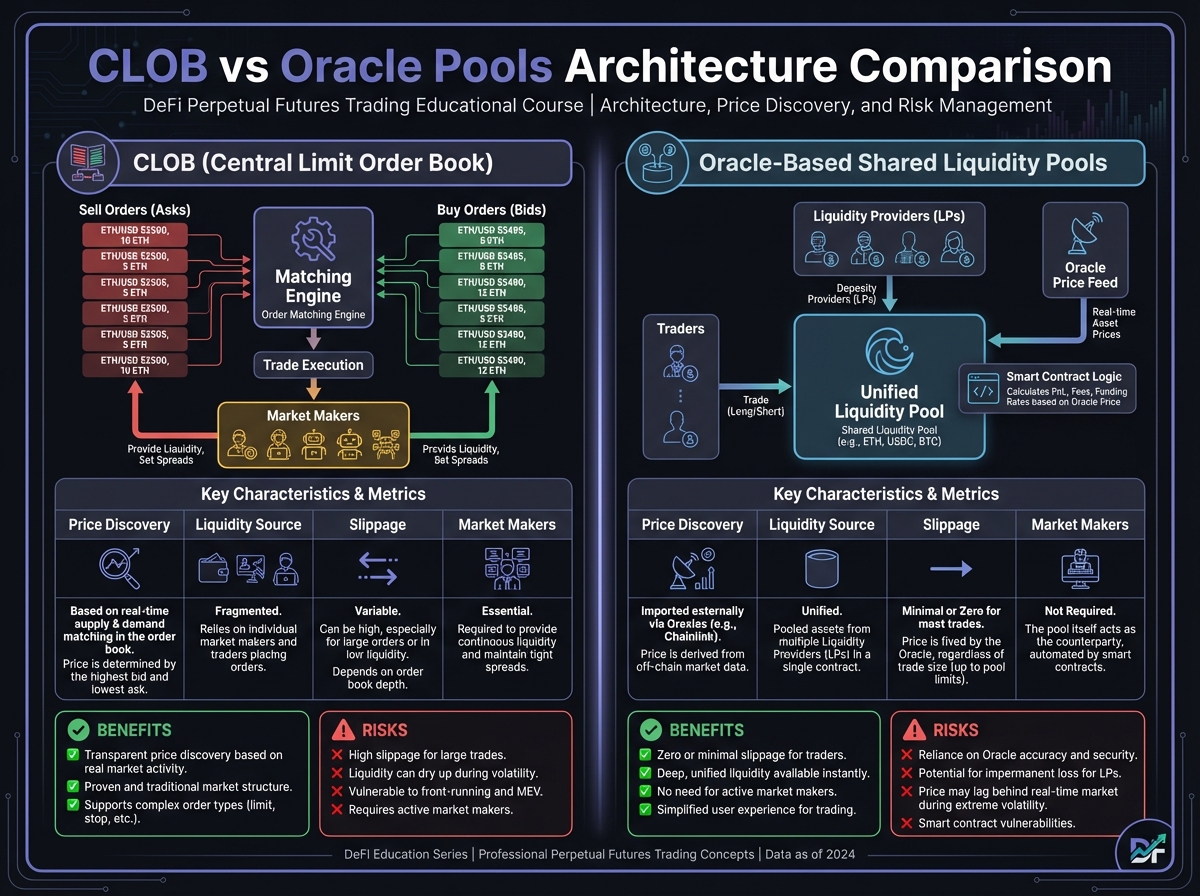
Understanding the architecture of a perpetual DEX is critical for risk assessment and strategy selection.
Central Limit Order Book (CLOB)
How It Works:
Market makers post buy/sell orders at specific prices
Traders execute against the order book
Price discovery happens through supply and demand
Examples: Hyperliquid, dYdX v4, EdgeX
Benefits:
✅ CEX-like experience (limit orders, stop losses)
✅ Transparent price discovery
✅ Deep liquidity (if market makers are active)
Risks:
❌ Slippage on large orders
❌ Front-running risk
❌ Requires active market makers
Oracle-Based Shared Liquidity Pools
How It Works:
Traders trade against a unified liquidity pool (not other traders)
Prices come from external oracles (Chainlink, Pyth)
Zero price impact (executed at oracle price)
Examples: GMX V2, Gains Network, Jupiter
Benefits:
✅ Zero slippage (executed at oracle price)
✅ Simple execution (swap-like interface)
✅ No need for market makers
Risks:
❌ Oracle latency arbitrage
❌ Pool insolvency risk
❌ Limited price discovery
🎓 Beginner's Corner: Common Questions
Q: What's the difference between perpetuals and spot trading? A: Spot trading means you own the asset. Perpetuals let you speculate on price without owning it, using leverage. You can go long (bet price goes up) or short (bet price goes down).
Q: Why do I pay funding rates? A: Funding rates keep the perpetual price aligned with the spot price. If you're long and funding is positive, you pay shorts. This prevents the perpetual from trading too far above spot.
Q: Can I lose more than I deposit? A: With isolated margin, your maximum loss is limited to your margin. With cross margin, one losing position can drain your entire account.
Q: What happens if I get liquidated? A: The protocol automatically closes your position and seizes your remaining collateral. You lose your margin (minus liquidation fees).
Q: Are perpetuals safer than CEX trading? A: Perpetuals on DEXs eliminate counterparty risk (no exchange can steal your funds), but you still face liquidation risk, smart contract risk, and oracle risk.
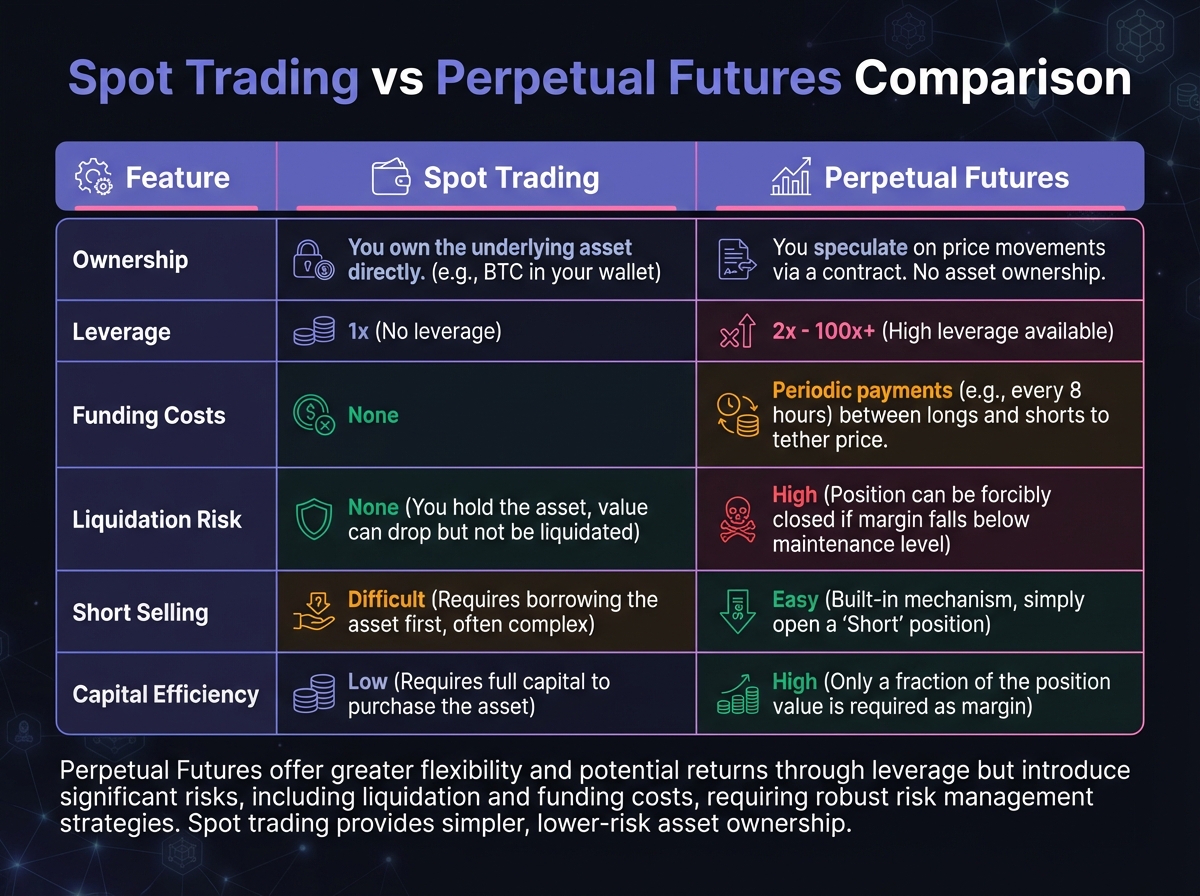
⚠️ Critical Differences from Spot Trading
Ownership
You own the asset
You speculate on price
Leverage
1x (no leverage)
2x-100x+ available
Funding Costs
None
Periodic funding payments
Liquidation Risk
None (you own it)
High (if margin insufficient)
Short Selling
Difficult/expensive
Easy (just open short)
Capital Efficiency
Low (need full value)
High (need only margin)
🔬 Advanced Deep-Dive: The Economics of Perpetuals
Why Perpetuals Exist
Traditional futures require expiration because:
Physical delivery forces price convergence
Cash settlement forces price convergence
Without convergence, arbitrage opportunities emerge
Perpetuals solve this by:
Using funding rates to incentivize arbitrage
Making funding payments continuous (not just at expiry)
Allowing positions to exist indefinitely
The Funding Rate Formula
Most protocols calculate funding as:
Positive: Perp > Spot → Longs pay shorts
Negative: Perp < Spot → Shorts pay longs
The adjustment factor varies by protocol and market conditions.
Market Maker vs Trader Dynamics
In CLOB models:
Market makers provide liquidity (earn spread)
Traders pay spread + funding
Competition tightens spreads
In Oracle pool models:
LPs provide liquidity (earn fees)
Traders pay fees + funding
Pool absorbs all risk
📊 Real-World Example: Opening a Position
Scenario: You want to go long ETH at $2,500 with 5x leverage
Deposit Margin: $1,000 USDC
Position Size: $5,000 (5x leverage)
Entry Price: $2,500
Liquidation Price: ~$2,000 (depends on maintenance margin)
If ETH goes to $3,000:
Profit: ($3,000 - $2,500) × 5 = $2,500
ROI: 250% on your $1,000 margin
If ETH goes to $2,000:
Loss: ($2,500 - $2,000) × 5 = $2,500
But you only have $1,000 margin → LIQUIDATED
Key Takeaway: Leverage amplifies both profits and losses. A 20% price move against you with 5x leverage = 100% loss.
🔑 Key Takeaways
Perpetual futures are derivative contracts without expiration dates
Funding rates keep perpetual prices aligned with spot prices
Leverage amplifies both profits and losses
Two main architectures: CLOB (order book) and Oracle pools
Margin requirements protect the protocol from insolvency
Liquidation risk is real and can result in total loss
🚀 Next Steps
Proceed to Lesson 2 to dive deeper into the mathematics of funding rates, margin, and liquidations
Explore a perpetual DEX interface (Hyperliquid, GMX, or Drift) to see these concepts in action
Start with small positions and low leverage to learn safely
Last updated