Lesson 3: Architecture Types and Market Structure
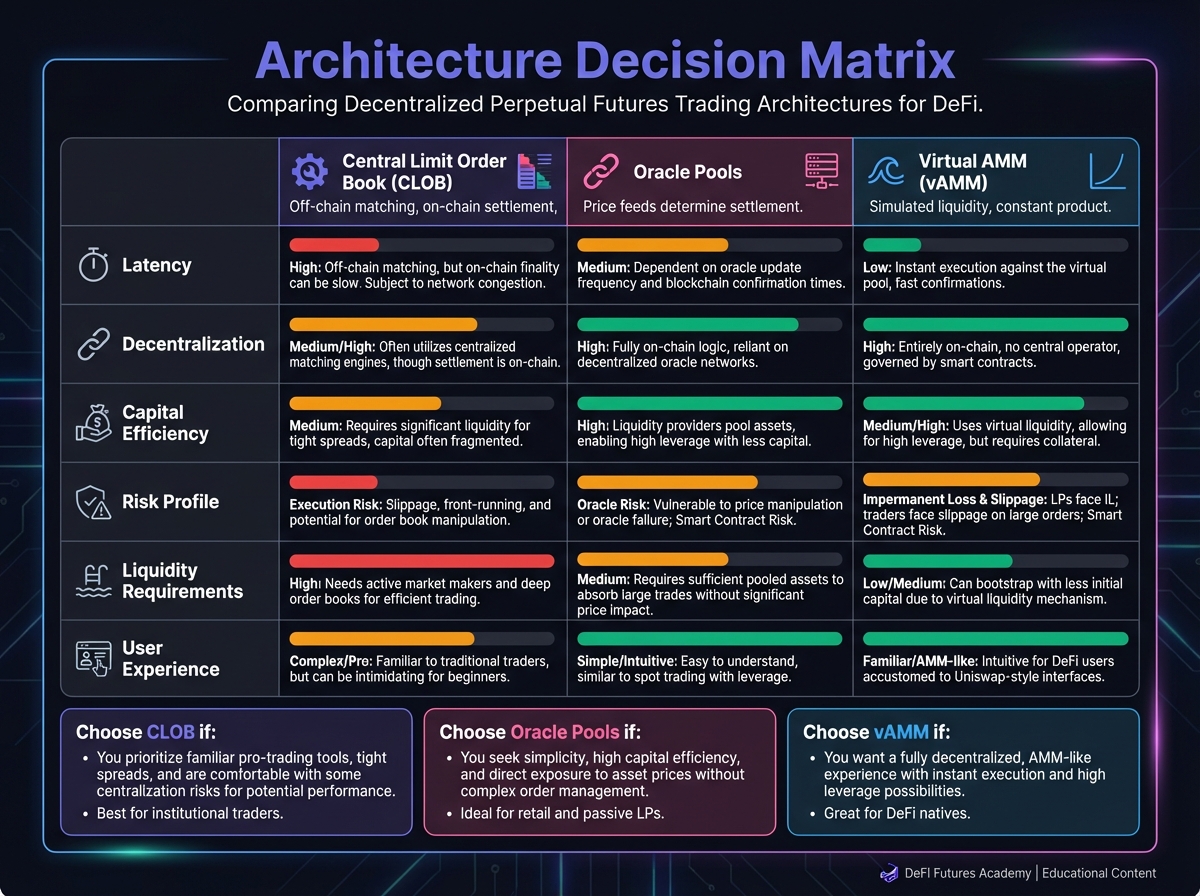
Architecture Decision Matrix

🎯 Core Concept: Architecture Determines Everything

Understanding the architecture of a perpetual DEX is the single most critical factor in assessing risk and choosing the right platform for your strategy. The architecture dictates:

  • How prices are discovered

  • Where liquidity comes from

  • What risks you face

  • What fees you pay

  • How fast trades execute

This lesson is foundational—master it before moving to protocol-specific lessons.

🏗️ The Three Architectural Models

The perpetual DEX market has evolved into three primary architectural categories:

  1. Central Limit Order Book (CLOB)

  2. Oracle-Based Shared Liquidity Pools

  3. Virtual AMM (vAMM)

Each model presents unique trade-offs regarding latency, decentralization, capital efficiency, and risk.

📚 Model 1: Central Limit Order Book (CLOB)

How CLOB Works

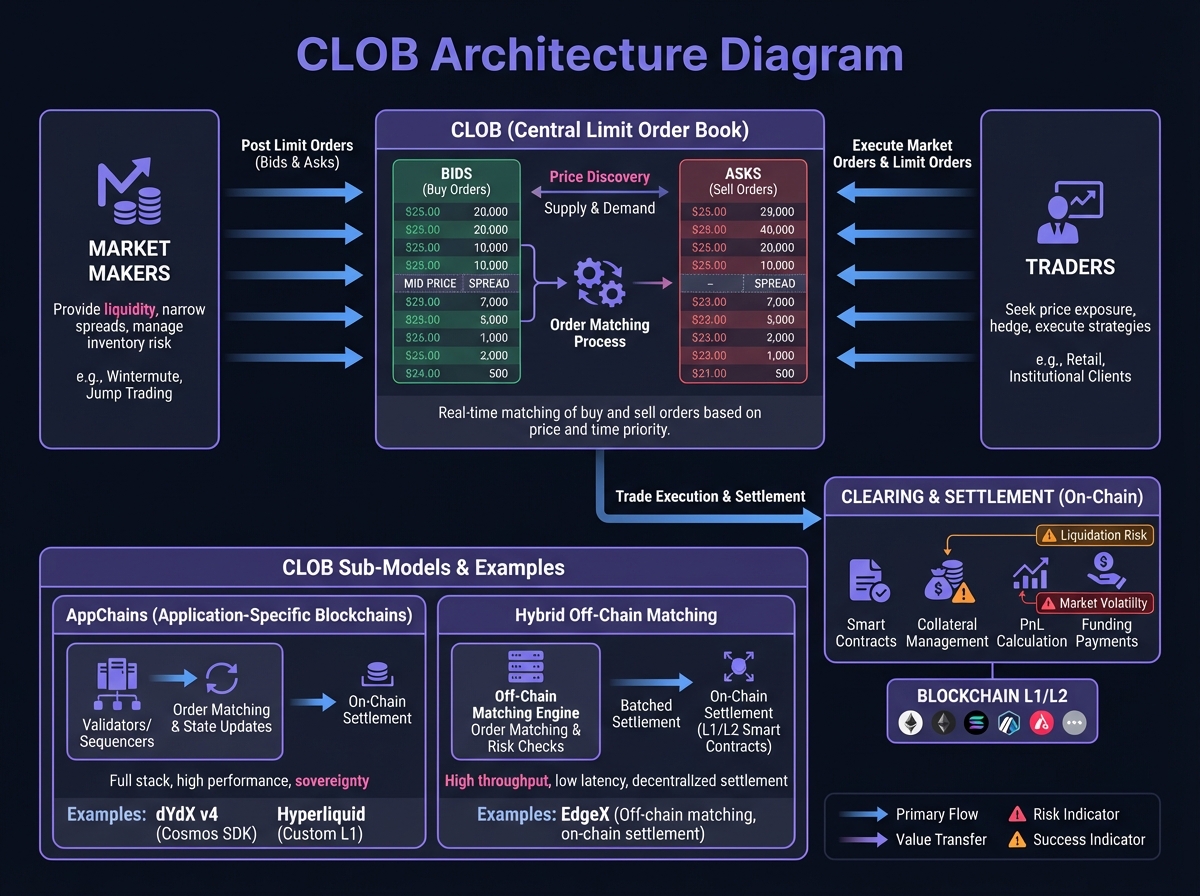
The CLOB model replicates the traditional exchange experience:

  • Market Makers post buy/sell orders at specific prices

  • Traders execute against the order book

  • Price Discovery happens through supply and demand

  • Matching occurs when buy and sell orders cross

Think of it like: A traditional stock exchange (NASDAQ, NYSE) but on-chain.

CLOB Sub-Models

Application-Specific Blockchains (AppChains)

Examples: dYdX v4, Hyperliquid

How It Works:

  • Exchange runs on its own dedicated blockchain

  • Optimized exclusively for trading activity

  • High throughput and low latency

dYdX v4 (Cosmos SDK):

  • In-memory order book maintained by validators off-chain

  • Trades committed on-chain for settlement

  • ~2,000 TPS capacity

  • Decentralized matching engine (validators)

Hyperliquid (HyperEVM):

  • Entire order book fully on-chain

  • Custom consensus (HyperBFT) for low latency

  • ~200,000 orders/second capacity

  • Sub-second latency (0.2s)

Benefits:

  • ✅ CEX-like performance

  • ✅ Transparent order book

  • ✅ Limit orders, stop losses

  • ✅ Deep liquidity (if market makers active)

Risks:

  • ❌ Slippage on large orders

  • ❌ Front-running risk

  • ❌ Requires active market makers

  • ❌ Bridge risk (moving assets to AppChain)

Hybrid Off-Chain Matching

Examples: Vertex (Arbitrum), ApeX (StarkEx), EdgeX (Starknet)

How It Works:

  • Off-chain sequencer matches orders (lightning fast)

  • Trades settled on-chain (L2 rollup)

  • Best of both worlds: CeFi speed + DeFi security

Benefits:

  • ✅ Very low latency (<10ms matching)

  • ✅ On-chain settlement (self-custody)

  • ✅ No MEV (sequencer handles matching)

  • ✅ Works on existing L2s

Risks:

  • ❌ Sequencer centralization

  • ❌ Trust in sequencer not to front-run

  • ❌ Still requires bridging to L2

CLOB Characteristics

Feature
Description
Price Discovery

Internal (supply/demand in order book)

Slippage

Yes (depends on order book depth)

Liquidity Source

Market makers providing quotes

Latency Risk

Front-running order placement

Trader Experience

CEX-like, limit orders, advanced order types

Capital Efficiency

High (market makers provide liquidity)

CLOB Architecture Diagram

💧 Model 2: Oracle-Based Shared Liquidity Pools

How Oracle Pools Work

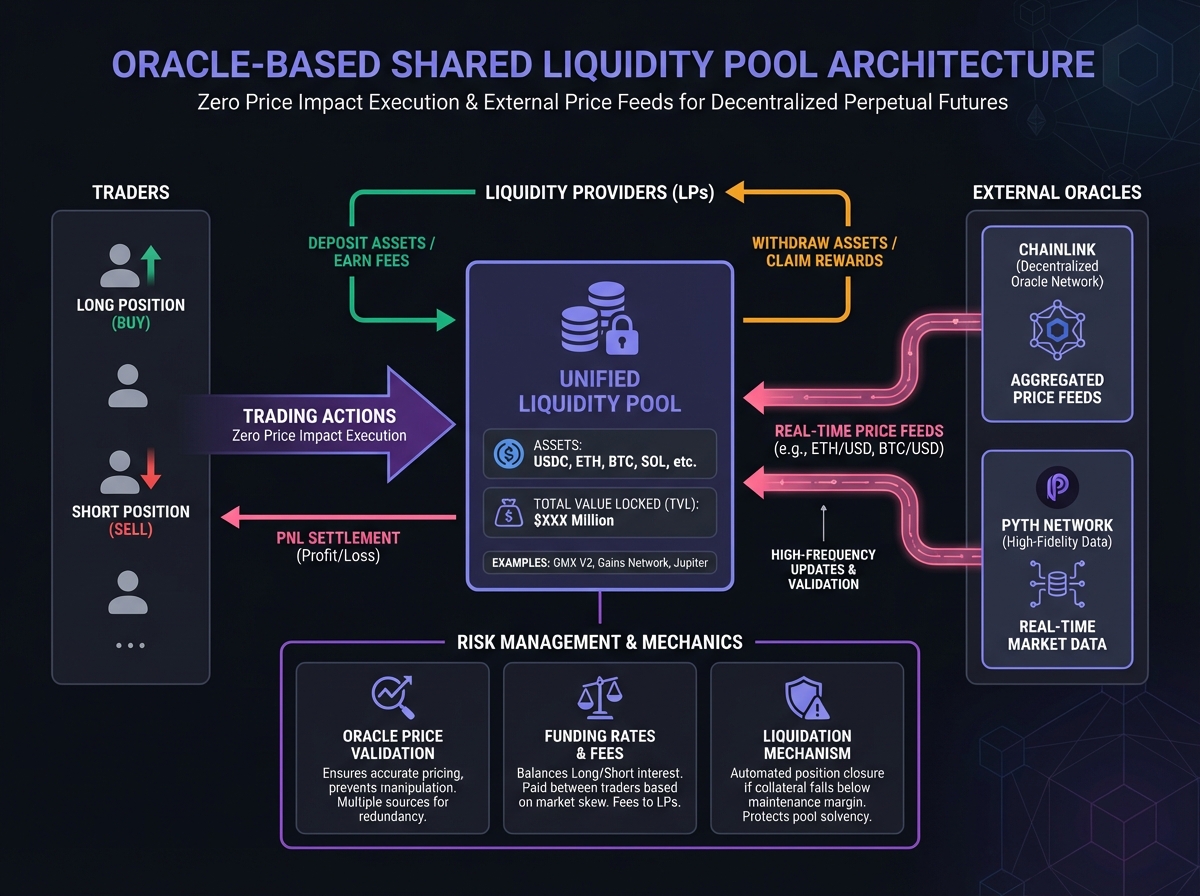
This model eliminates the order book entirely:

  • Liquidity Providers (LPs) deposit assets into a unified pool

  • Traders trade against the pool (not other traders)

  • Prices come from external oracles (Chainlink, Pyth)

  • Zero Price Impact (executed at oracle price)

Think of it like: Trading against a casino—the house (pool) is always the counterparty.

Oracle Pool Mechanism

Examples: GMX V2, Gains Network, Jupiter

How It Works:

  1. LPs deposit assets (ETH, BTC, USDC) into pool

  2. Pool acts as counterparty to all trades

  3. Oracle provides price (from Binance, Coinbase, etc.)

  4. Trades execute at oracle price (zero slippage)

  5. If trader wins → pool pays; if trader loses → pool collects

Key Innovation: No need for market makers or order books. The pool provides infinite liquidity (up to pool size) at the oracle price.

Oracle Pool Characteristics

Feature
Description

Price Discovery

External (oracle feed from CEXs)

Slippage

No (zero price impact at oracle price)

Liquidity Source

LPs depositing into pool

Latency Risk

Oracle latency arbitrage

Trader Experience

Swap-like, simple execution

Capital Efficiency

Very high for LPs (one pool for all trades)

Benefits of Oracle Pools

  • Zero Slippage: Execute any size at oracle price

  • Simple UX: No need to understand order books

  • Deep Liquidity: Pool aggregates all LP capital

  • No Market Makers Needed: Pool provides liquidity

Risks of Oracle Pools

  • Oracle Latency: Price updates lag real market

  • Toxic Flow: Arbitrageurs exploit stale prices

  • Pool Insolvency: If traders win big, pool can drain

  • No Price Discovery: Prices come from external sources

Oracle-Based Shared Liquidity Pool Architecture

🔄 Model 3: Virtual AMM (vAMM)

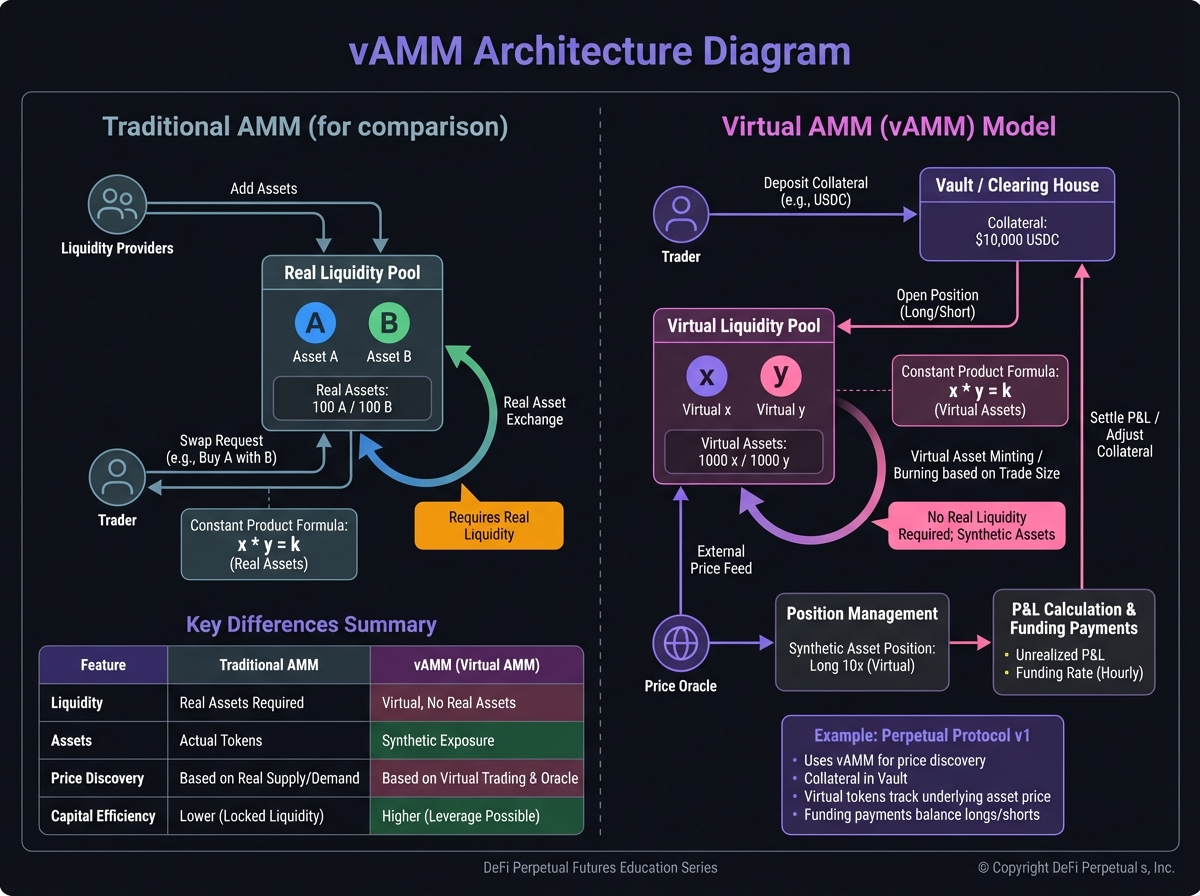
How vAMM Works

The vAMM model adapts the constant product formula for synthetic leverage:

  • No Real Assets: Virtual tokens in the curve

  • Price Discovery: Algorithmic (based on virtual reserves)

  • Real Collateral: Stored in smart contract vault

  • Arbitrage Required: To keep price aligned with spot

Examples: Perpetual Protocol (original), modern iterations with oracle safeguards

How It Works:

  1. Virtual pool uses formula: $x \cdot y = k$

  2. No real assets swapped—just virtual reserves

  3. Real collateral stored in vault

  4. Price calculated from virtual token ratio

  5. Arbitrageurs keep vAMM price aligned with spot

vAMM Characteristics

Feature
Description

Price Discovery

Internal (algorithmic curve)

Slippage

Yes (depends on k-value)

Liquidity Source

LPs providing virtual tokens

Latency Risk

Front-running transactions

Trader Experience

Swap-like

Capital Efficiency

Moderate (requires arbitrage)

Benefits of vAMM

  • Fully On-Chain: No external oracles (initially)

  • Decentralized: Price discovery on-chain

  • Simple Model: Easy to understand

Risks of vAMM

  • High Slippage: Large trades move price significantly

  • Arbitrage Dependency: Needs active arbitrageurs

  • Price Divergence: Can drift from spot if arbitrage insufficient

  • Modern Iterations: Often add oracle safeguards (hybrid model)

vAMM Architecture Diagram

📊 Comparative Analysis Table

Feature
CLOB
Oracle Pools
vAMM

Examples

dYdX, Hyperliquid, Vertex

GMX, Gains, Jupiter

Perpetual Protocol

Price Discovery

Internal (Supply/Demand)

External (Oracle Feed)

Internal (Algorithmic)

Slippage

Yes (depends on depth)

No (Zero slippage)

Yes (depends on k-value)

Liquidity Source

Market Makers

LPs (Public Pool)

LPs (Virtual Tokens)

Latency Risk

Front-running orders

Oracle latency arbitrage

Front-running transactions

Trader Experience

CEX-like, limit orders

Swap-like, simple

Swap-like

Capital Efficiency

High (market makers)

Very High (pooled)

Moderate (arbitrage needed)

Complexity

Medium (understand order book)

Low (simple execution)

Medium (understand curve)

🎓 Beginner's Corner: Which Architecture Should You Choose?

Choose CLOB If:

  • You want CEX-like experience (limit orders, stop losses)

  • You're comfortable with order books

  • You need precise entry/exit prices

  • You're an active trader (scalping, day trading)

Best For: Professional traders, market makers, active day traders

Choose Oracle Pools If:

  • You want simple execution (swap-like)

  • You need zero slippage on large orders

  • You don't want to worry about order book depth

  • You prefer passive liquidity provision

Best For: Casual traders, large position traders, LP providers

Choose vAMM If:

  • You want fully on-chain price discovery

  • You're comfortable with AMM mechanics

  • You understand arbitrage dynamics

  • You prefer decentralized models

Best For: DeFi natives, arbitrageurs, protocol enthusiasts

🔬 Advanced Deep-Dive: Hybrid Architectures

Many modern protocols combine elements of multiple models:

Drift Protocol: The Liquidity Trifecta

Drift uses a three-layer system:

  1. JIT Auction: Market makers compete to fill orders

  2. DLOB: Decentralized limit order book

  3. DAMM: Dynamic AMM as backstop

This hybrid approach:

  • Protects LPs from toxic flow (JIT makers step in first)

  • Provides order book precision (DLOB)

  • Ensures liquidity always exists (DAMM backstop)

GMX V2: Isolated Pools

GMX V2 moved from unified pool (GLP) to isolated pools:

  • Each market has its own pool (ETH pool, BTC pool, etc.)

  • Risk isolation (one market failure doesn't affect others)

  • Still oracle-based (zero slippage)

  • More capital efficient for LPs (choose exposure)

Extended: Unified Margin + CLOB

Extended combines:

  • CLOB for order book trading

  • Unified Margin across all positions

  • Yield-Bearing Collateral (stETH, sDAI)

  • Account Abstraction for EVM compatibility

This creates a "super-app" experience with advanced features.

⚠️ Critical Risk Differences by Architecture

CLOB Risks

  1. Slippage Risk: Large orders move price

  2. Front-Running: MEV bots can front-run your orders

  3. Liquidity Risk: Thin order books = high slippage

  4. Market Maker Dependency: Need active makers for liquidity

Oracle Pool Risks

  1. Oracle Latency: Stale prices = arbitrage opportunities

  2. Toxic Flow: Informed traders exploit pool

  3. Pool Insolvency: If traders win big, pool can drain

  4. Oracle Manipulation: Rare but possible

vAMM Risks

  1. High Slippage: Large trades move price significantly

  2. Arbitrage Dependency: Needs active arbitrageurs

  3. Price Divergence: Can drift from spot

  4. Capital Inefficiency: Requires large k-value for depth

📈 Real-World Examples

Example 1: Large Order on CLOB

Scenario: Want to buy $100,000 worth of ETH perp on Hyperliquid

  • Order Book Depth: $50,000 at best bid

  • Result: Your order will move price (slippage)

  • Solution: Split into smaller orders or use limit orders over time

Example 2: Large Order on Oracle Pool

Scenario: Want to buy $100,000 worth of ETH perp on GMX

  • Oracle Price: $2,500

  • Pool Depth: $50M

  • Result: Execute at $2,500 (zero slippage)

  • Solution: No solution needed—just execute

Example 3: Funding Rate Arbitrage

Scenario: ETH perp funding rate is 0.1% per hour (very high)

  • CLOB: Can't easily arbitrage (slippage costs)

  • Oracle Pool: Can arbitrage (zero slippage)

  • Result: Oracle pools better for arbitrage strategies

🎯 Key Takeaways

  • Architecture determines risk profile: CLOB = slippage risk, Oracle = oracle risk

  • CLOB offers CEX-like experience: Limit orders, stop losses, order book depth

  • Oracle pools offer zero slippage: But face oracle latency and toxic flow risks

  • vAMM offers on-chain price discovery: But requires arbitrage and has slippage

  • Hybrid models combine benefits: Modern protocols use multiple layers

  • Choose based on strategy: Active trading = CLOB, Large orders = Oracle pools

🚀 Next Steps

  • Proceed to Lesson 4 to learn how to open your first position

  • Explore different protocols to see architectures in action

  • Consider which architecture fits your trading style

  • Complete Exercise 3 to practice architecture analysis

Last updated