Lesson 8: Alternative Chain Protocols


🎯 Core Concept: The Multi-Chain Perpetual Landscape
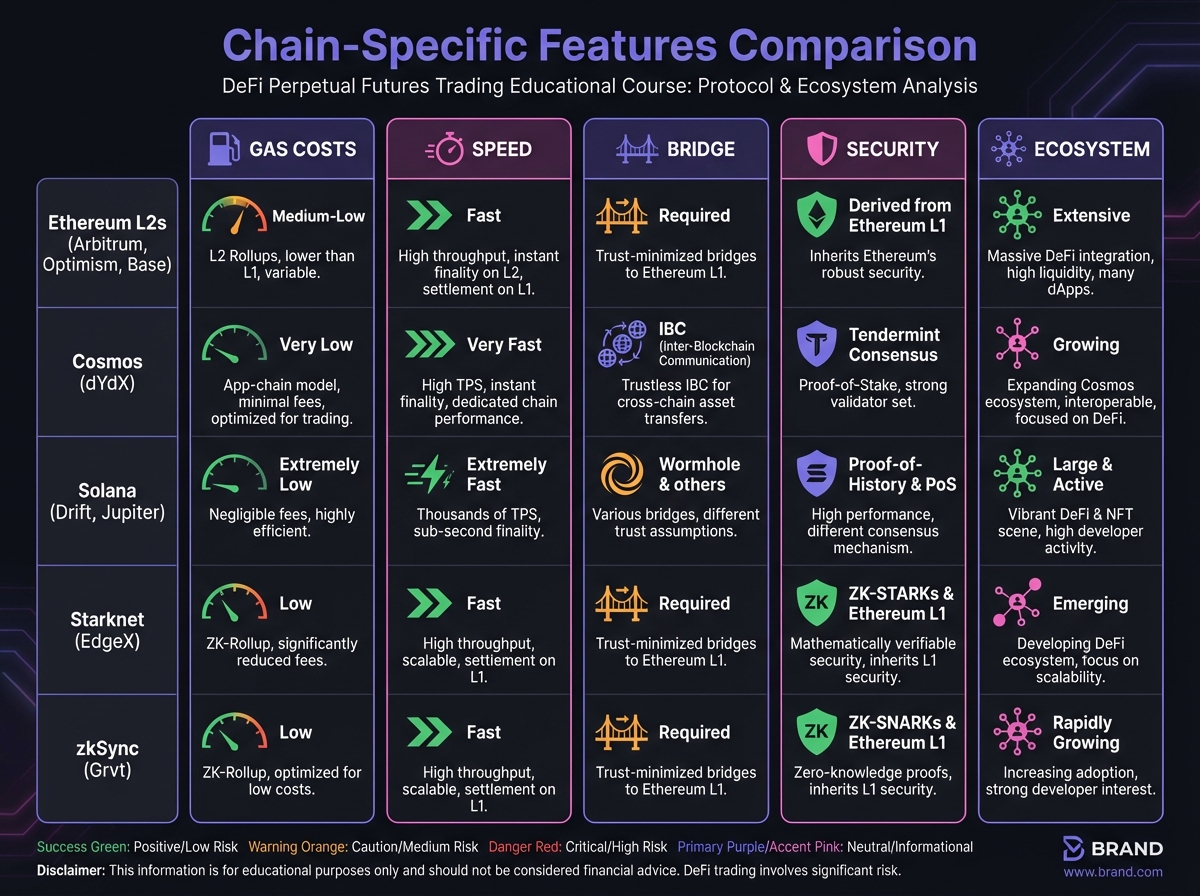
The perpetual DEX ecosystem extends far beyond the major players. This lesson explores alternative protocols across different chains, each offering unique architectures, features, and trade-offs. Understanding these alternatives helps you choose the right protocol for your specific needs, chain preferences, and trading strategies.

Why Alternative Protocols Matter
Different protocols excel in different areas:
Chain-specific: Optimized for particular ecosystems
Feature differentiation: Unique capabilities (mobile apps, privacy, yield-bearing collateral)
Competitive fees: Lower costs for specific use cases
Niche markets: Specialized assets or trading pairs
🌐 Cosmos Ecosystem: dYdX v4
Architecture Overview
dYdX v4 transitioned from Ethereum L2 to its own sovereign Cosmos SDK blockchain.
Key Features:
In-Memory Order Book: Maintained by validators off-chain
On-Chain Settlement: Trades committed on-chain
Decentralized Matching: Validators run matching engine (upgrade from v3)
IBC Integration: Inter-Blockchain Communication for Cosmos ecosystem
Throughput: ~2,000 TPS
How It Works
Order Flow:
User submits order
Validators match orders in-memory (off-chain)
Matched trades committed on-chain
Settlement via smart contracts
Collateral: Primarily USDC bridged from other networks
Wallet Support: Keplr (recommended), MetaMask (with Cosmos support)
Use Cases
Best For:
Cosmos ecosystem users
Traders wanting decentralized matching
Users comfortable with Cosmos wallets
Considerations:
Requires bridging to Cosmos chain
Lower throughput than Hyperliquid
Off-chain matching (less transparent than fully on-chain)
📱 Arbitrum Ecosystem: EdgeX
Architecture Overview
EdgeX uses StarkEx on Arbitrum - hybrid off-chain matching with L2 settlement.
Key Differentiator: Native mobile apps (iOS and Android)
Mobile-First Advantage
Native App Benefits:
Persistent Connections: WebSocket stays active in background
Hardware Acceleration: GPU-accelerated charting
Biometric Security: FaceID/TouchID for transaction signing
Push Notifications: Real-time alerts (sub-100ms)
Drag-to-Set Orders: TP/SL directly on chart
vs. Mobile Web:
Mobile web: Browser throttling, reconnection lag, higher latency
Native app: Always-on connectivity, instant execution
Fee Structure and VIP System
Base Fees:
Maker: 0.012%
Taker: 0.038%
VIP 1 "Hack":
Referral code grants permanent VIP 1 status
Taker fee: 0.036% (20% discount vs Hyperliquid)
No volume requirements
Rewards Ecosystem:
Aggressive fee subsidies
Points programs
Cash rebates (not just discounts)
Use Cases
Best For:
Mobile-first traders
High-frequency scalpers (lower fees)
Users wanting native app experience
Considerations:
StarkEx sequencer centralization
Requires Arbitrum network
Mobile app availability (iOS/Android)
🔷 Starknet Ecosystem: Extended
Architecture Overview
Extended (formerly X10) operates on Starknet L2 with a "fintech-first" approach.
Key Innovation: Account Abstraction for EVM compatibility
The "No-Bridge" Solution
How Account Abstraction Works:
User signs with Ethereum wallet (MetaMask)
Extended deploys Starknet smart contract wallet
Contract accepts Ethereum signatures
User trades on Starknet using MetaMask
No explicit bridging or STRK tokens needed
Result: EVM users can trade on Starknet without learning new infrastructure.
Unified Margin and Yield-Bearing Collateral
Supported Collateral:
USDC (base)
BTC/ETH (volatile, with haircuts)
stETH (Lido liquid staking)
sDAI (Maker yield-bearing stablecoin)
Benefits:
Earn yield on collateral while trading
Cross-margin across all positions
Lower net funding cost (yield offsets funding)
Example:
Funding rate: 10% APR (long position)
Collateral yield: 4% APR (stETH)
Net cost: 6% APR (not 10%)
Use Cases
Best For:
EVM-native users wanting Starknet access
Traders with yield-bearing assets
Users wanting unified margin across products
Considerations:
Starknet ecosystem (less mature)
Account abstraction complexity
Lower liquidity than major chains
🪐 Solana Ecosystem: Jupiter
Architecture Overview
Jupiter Perpetual Exchange uses Peer-to-Pool model with JLP (Jupiter Liquidity Provider) index.
Key Feature: Integration with Jupiter Spot Aggregator for atomic composability.
JLP Pool Mechanics
Pool Composition (Target Weights):
SOL: ~44% (primary trading pair)
ETH: ~10% (diversification)
WBTC: ~10% (diversification)
USDC/USDT: ~36% (stablecoin ballast)
How It Works:
Unified pool serves as counterparty to all trades
Algorithmic rebalancing maintains target weights
Traders trade against pool (not other traders)
Atomic Composability
Jupiter Spot Integration:
Trade spot and perps in same transaction
Use spot profits to fund perp positions
Hedge perp exposure with spot trades
All atomic (one transaction)
Example:
Buy SOL spot
Open SOL-PERP short (hedge)
Both execute atomically
No intermediate steps
Use Cases
Best For:
Solana ecosystem natives
Traders wanting spot/perp integration
Users comfortable with pool-based model
Considerations:
Solana network risks (congestion, validator centralization)
Pool exposure (all assets in one pool)
Less control than isolated pools
🔶 BNB Chain: Aster Protocol
Architecture Overview
Aster operates on BNB Chain with dual-mode execution.
Key Innovation: 1001x leverage in Simple Mode, ZK privacy in Pro Mode
Simple Mode vs. Pro Mode
Simple Mode:
Streamlined "dumb mode" interface
Up to 1001x leverage
Binary options-like experience
High-risk, high-reward
Pro Mode:
Full order book (CLOB)
Hidden orders (ZK proofs)
Professional trading features
Privacy-focused execution
Trade & Earn Economy
Liquidity Absorption:
asBNB (liquid staking derivative)
USDF (delta-neutral stablecoin)
Incentivizes capital migration to BNB Chain
Yield Integration: Collateral earns yield while trading
Use Cases
Best For:
BNB Chain ecosystem users
High-leverage speculators (Simple Mode)
Privacy-focused traders (Pro Mode)
Considerations:
Extreme leverage risks (1001x)
BNB Chain ecosystem
Centralization concerns (96% token supply concentration)
🔷 StarkEx Ecosystem: ApeX Protocol
Architecture Overview
ApeX uses StarkEx Validium for high-performance trading.
Key Feature: Multi-chain architecture via zkLink X
Validium vs. ZK-Rollup
Validium:
Data availability off-chain
Lower costs
Higher throughput
Data withholding risk (mitigated by DAC)
Data Availability Committee (DAC):
Reputable entities hold data copies
Quorum signatures required
Balances security and performance
ApeX Omni Evolution
Migration: From StarkEx to modular, intent-centric infrastructure
Multi-Chain:
True chain-agnostic liquidity
No traditional bridging
zkLink X integration
Solver networks
Use Cases
Best For:
Multi-chain traders
Users wanting StarkEx performance
Traders comfortable with Validium model
Considerations:
Validium data availability risk
Multi-chain complexity
Less mature than major protocols
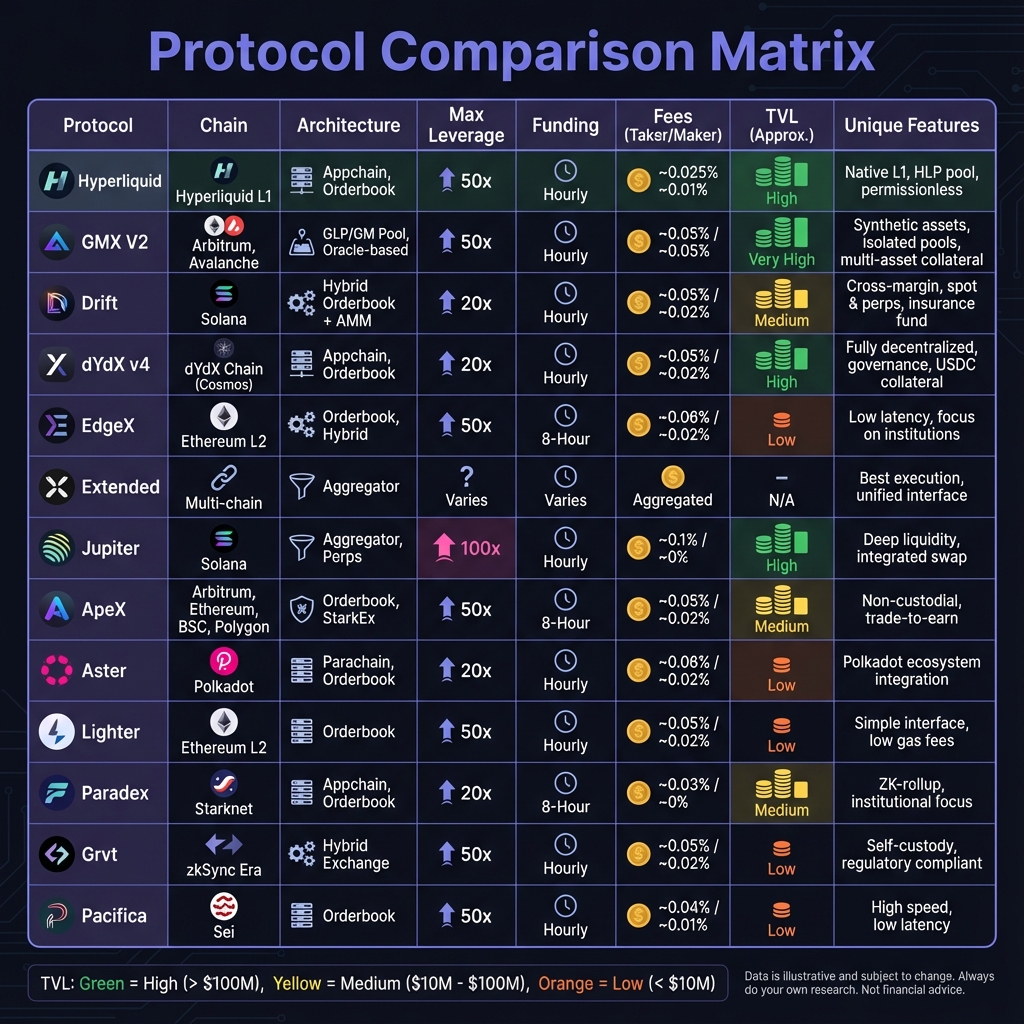
📊 Protocol Comparison Matrix
dYdX v4
Cosmos
CLOB (AppChain)
Decentralized matching
Cosmos users
EdgeX
Arbitrum
CLOB (StarkEx)
Native mobile apps
Mobile traders
Extended
Starknet
CLOB (Hybrid)
Account abstraction, yield collateral
EVM→Starknet users
Jupiter
Solana
Oracle Pool (JLP)
Spot/perp integration
Solana natives
Aster
BNB Chain
Hybrid (Dual-mode)
1001x leverage, privacy
BNB users, degens
ApeX
Multi-chain
CLOB (Validium)
Multi-chain liquidity
Multi-chain traders
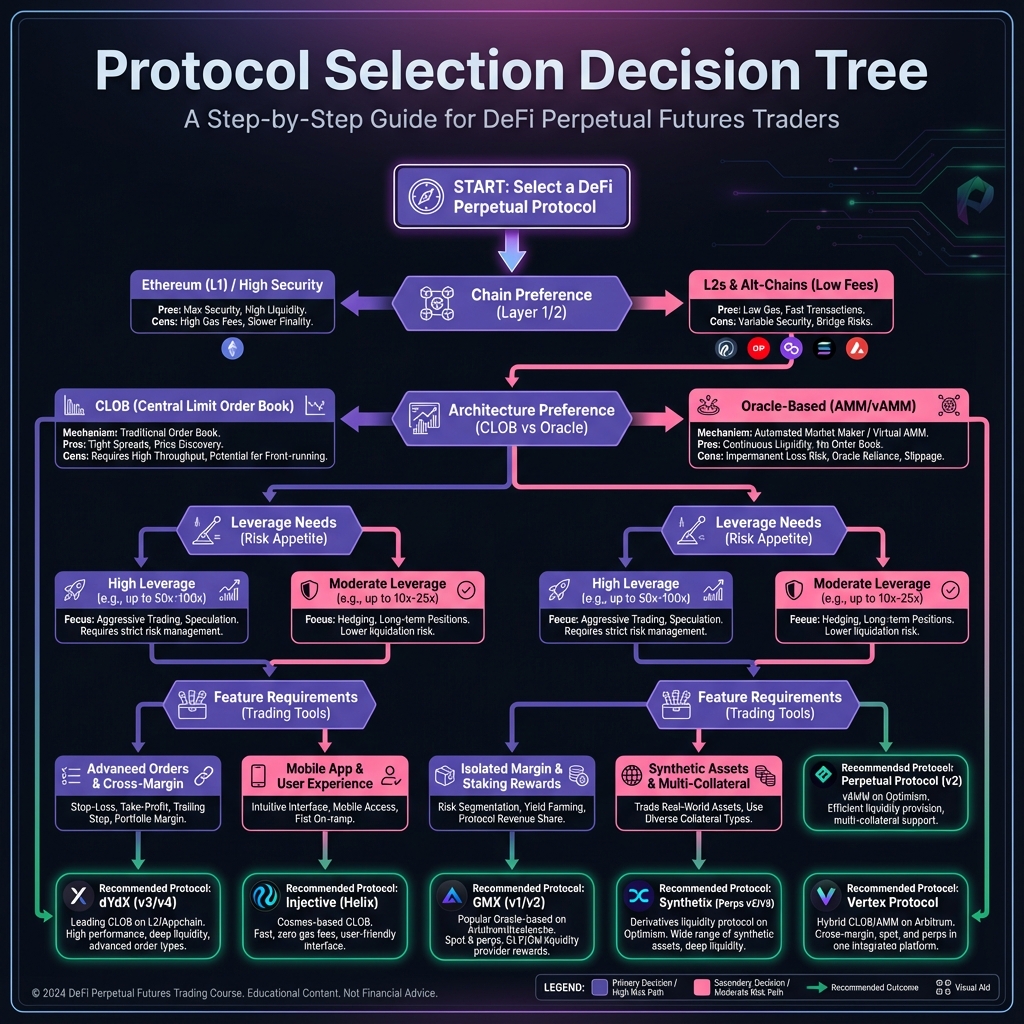
🎓 Beginner's Corner: Choosing an Alternative Protocol
Decision Framework
1. Chain Preference:
Already on Cosmos? → dYdX v4
Prefer Solana? → Jupiter, Drift
Want BNB Chain? → Aster
Need multi-chain? → ApeX
2. Trading Style:
Mobile-first? → EdgeX
High leverage? → Aster (Simple Mode)
Privacy-focused? → Aster (Pro Mode)
Yield optimization? → Extended
3. Technical Comfort:
Simple interface? → Jupiter, Aster (Simple Mode)
Advanced features? → dYdX v4, Aster (Pro Mode)
EVM-native? → Extended (easiest Starknet access)
Risk Considerations
Chain-Specific Risks:
Cosmos: IBC bridge risks, validator centralization
Starknet: Ecosystem maturity, account abstraction complexity
Solana: Network congestion, validator centralization
BNB Chain: Centralization, regulatory concerns
Protocol-Specific Risks:
dYdX v4: Off-chain matching opacity
EdgeX: Sequencer centralization
Extended: Starknet ecosystem risks
Jupiter: Pool insolvency risk
Aster: Extreme leverage, token concentration
ApeX: Validium data availability
🔬 Advanced Deep-Dive: Emerging Protocols
Lighter.xyz
Architecture: CLOB on multiple chains Key Feature: Cross-chain order routing Use Case: Multi-chain market making
Paradex
Architecture: StarkEx on various chains Key Feature: Institutional-grade infrastructure Use Case: Professional traders, institutions
Grvt (ZKsync)
Architecture: CLOB on ZKsync Key Feature: ZK-rollup performance Use Case: ZKsync ecosystem users
Pacifica Finance
Architecture: Oracle-based pools Key Feature: Focus on emerging markets Use Case: Niche asset trading
⚠️ Critical Considerations
Liquidity Fragmentation
The Problem: Many protocols = fragmented liquidity
Impact:
Lower depth per protocol
Higher slippage
Harder to find best price
Solution: Use aggregators or stick to major protocols
Chain-Specific Risks
Bridge Risks: Moving assets between chains introduces custody risk
Network Risks: Each chain has unique failure modes
Ecosystem Risks: Less mature ecosystems = higher risk
Feature Differentiation
Not All Features Are Equal:
Mobile apps: Nice-to-have, not essential
Extreme leverage: High risk, use carefully
Privacy: May have trade-offs (centralization)
Focus on Core Value: Execution quality, liquidity, fees
📊 Real-World Example: Multi-Protocol Strategy
Scenario: You want to trade ETH perps across multiple chains
Strategy:
Primary: Hyperliquid (best liquidity, zero gas)
Mobile: EdgeX (when on mobile)
Yield: Extended (if holding stETH)
Solana: Jupiter (if already on Solana)
Considerations:
Bridge costs between chains
Liquidity depth on each
Fee differences
Funding rate variations
🎯 Key Takeaways
Alternative protocols offer unique features and chain-specific optimizations
dYdX v4: Cosmos ecosystem, decentralized matching
EdgeX: Native mobile apps, lower fees with VIP
Extended: EVM→Starknet bridge, yield-bearing collateral
Jupiter: Solana integration, spot/perp composability
Aster: Extreme leverage, privacy features
ApeX: Multi-chain, Validium performance
Choose based on chain preference, trading style, and risk tolerance
🚀 Next Steps
Proceed to Module 3 to learn advanced strategies
Complete Exercise 8 to practice protocol comparison
Explore alternative protocols that match your needs
Consider multi-protocol strategies for diversification
Last updated