Lesson 4: Fake Support Scams
🎧 Lesson Podcast
🎬 Video Overview
Lesson 4: Fake Support Scams
Core concept: Scammers impersonate customer support from exchanges, wallet providers, and projects to trick you into revealing credentials or approving malicious transactions.
The Imposter Tech Support Call
You've probably heard of this scam: phone rings, "This is Microsoft. We've detected a virus on your computer. Let me help you fix it." They're not from Microsoft—they want remote access to steal from you.
Crypto has the same scam, updated for the digital age:
"Hi! I'm from MetaMask support. I see you're having trouble. Let me help you verify your wallet."
They're not from MetaMask. They want your seed phrase or wallet access.
How Fake Support Scams Work
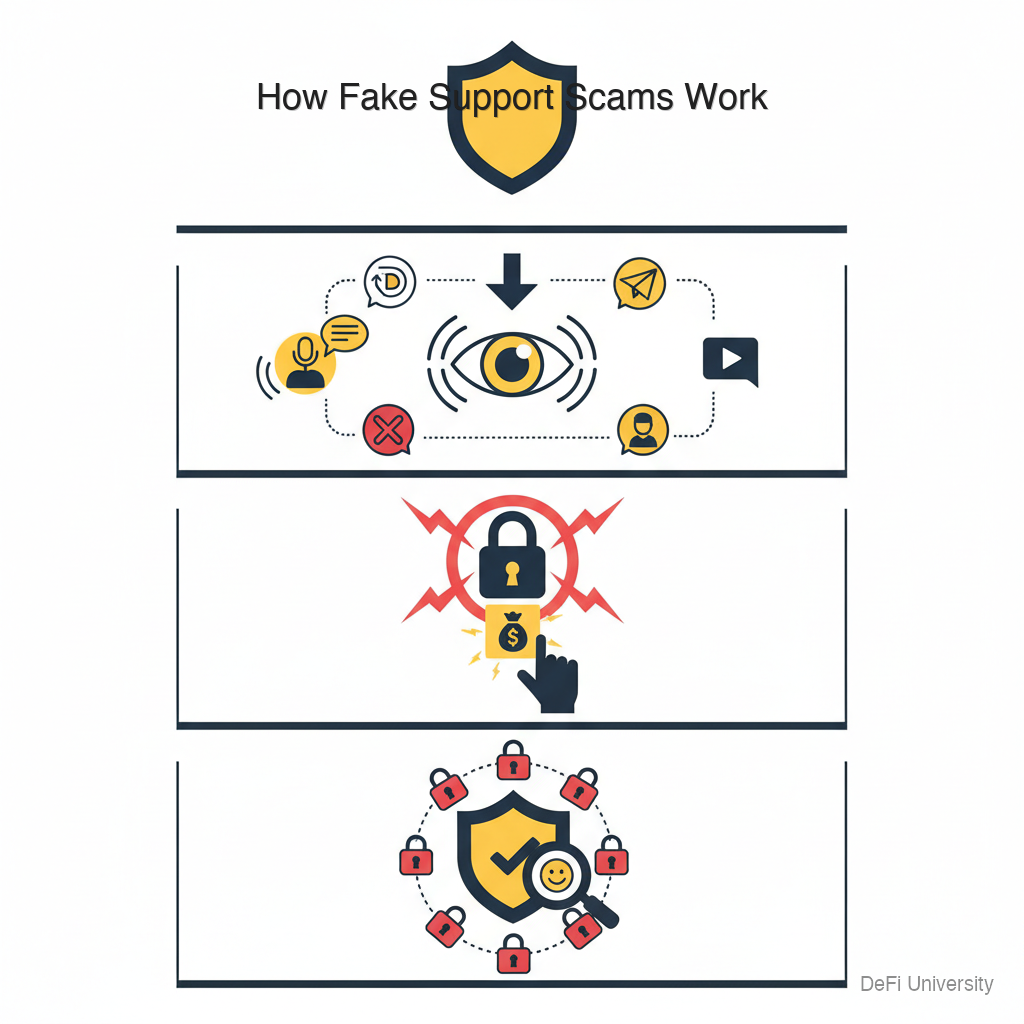
Step 1: Find a Target Scammers monitor:
Project Discord servers for users asking questions
Twitter/X for people complaining about issues
Telegram groups for confused newcomers
Comment sections of crypto content
Step 2: Make Contact They reach out via:
Direct message pretending to be support
Reply pretending to be the official account
Fake support ticket systems
Sometimes even fake phone numbers
Step 3: Gain Trust They use:
Official-looking profile pictures and names
Professional language
Links to fake but convincing support sites
Knowledge about common issues (making them seem legitimate)
Step 4: Extract Value They ask for:
Seed phrase "to verify your wallet"
Screen share access
Approval of a "security transaction"
Remote desktop access
Then they steal everything.
Red Flags of Fake Support
They contacted you first: Real support responds to your tickets—they don't DM you randomly.
They want your seed phrase: No legitimate support EVER needs your seed phrase. Period.
Urgency: "Act now or your funds will be locked!" Legitimate support doesn't threaten.
Unusual contact methods: Real support uses official channels, not random DMs.
Requests for remote access: No legitimate crypto company needs to control your computer.
Asking you to approve transactions: Support doesn't require you to sign or approve anything to help you.
How Real Support Works
Real customer support:
Responds through official ticket systems
Never asks for seed phrase or private keys
Never DMs you first on social media
Uses official support emails (from real domains)
Helps without requiring you to approve transactions
Takes time to verify your identity through proper channels
You initiate contact:
Go to the official website
Find the support section
Submit a ticket or use official chat
Wait for response through that system
If someone contacts you about crypto support that you didn't request, it's almost certainly a scam.
Common Fake Support Scenarios
"Wallet compromised" DM: "We've detected unauthorized access to your wallet. Verify your seed phrase immediately to secure funds." → Scam.
"Failed transaction" help: "I see your transaction failed. Send me the transaction details and seed phrase to help." → Scam.
"Verification required" email: "Your exchange account requires re-verification. Click here and enter your credentials." → Phishing scam.
"Airdrop claim" assistance: "You have unclaimed tokens! I'll help you claim them. First, approve this transaction." → Drainer scam.
Discord "admin" DM: "Hi, I'm an admin. I noticed your issue. Let me help via DM." → Real admins help in public channels.
Protection Strategies
Never share seed phrase: This rule has no exceptions. Ever.
Verify support channels: Only use support links from official websites.
Be suspicious of DMs: Legitimate support doesn't hunt for customers in DMs.
Check account details: Verify usernames carefully. Scammers use similar names with subtle differences.
Ask publicly first: If you're unsure, ask in the public channel if this person is real.
Take your time: Scammers create urgency. Real support doesn't pressure you.
Key Takeaways
Scammers impersonate support to gain trust and steal credentials
Real support never contacts you first via DM—you initiate through official channels
No legitimate support asks for seed phrases—this is always a scam
Urgency is a scam tactic—real support doesn't threaten or pressure
Verify through official websites—don't trust links sent to you
When in doubt, stop and verify through separate official channels
Last updated