Lesson 8: Alternative Chain Protocols

Lesson 8: Alternative Chain Protocols

🎯 Core Concept: High-Performance Chain Money Markets

While Ethereum-based protocols focus on modularity and L2 scaling, high-performance chains (Solana, Sui, Tron) prioritize speed, capital efficiency, and user experience. This lesson explores Kamino (Solana), Suilend (Sui), and JustLend (Tron)—each optimized for their network's unique capabilities.

🪐 Kamino Finance (Solana)

The Hybrid Primitive

Key Innovation: Unifies lending markets with automated liquidity vaults into a single hybrid primitive. Users earn both trading fees (as LPs) and interest (as lenders) simultaneously.

Architecture:

  • Vault Layer: Automated CLMM (Concentrated Liquidity Market Maker) positions

  • Lending Layer (K-Lend): Accepts LP tokens (kTokens) as collateral

  • Result: Capital efficiency—deposit into LP, use LP tokens as collateral to borrow

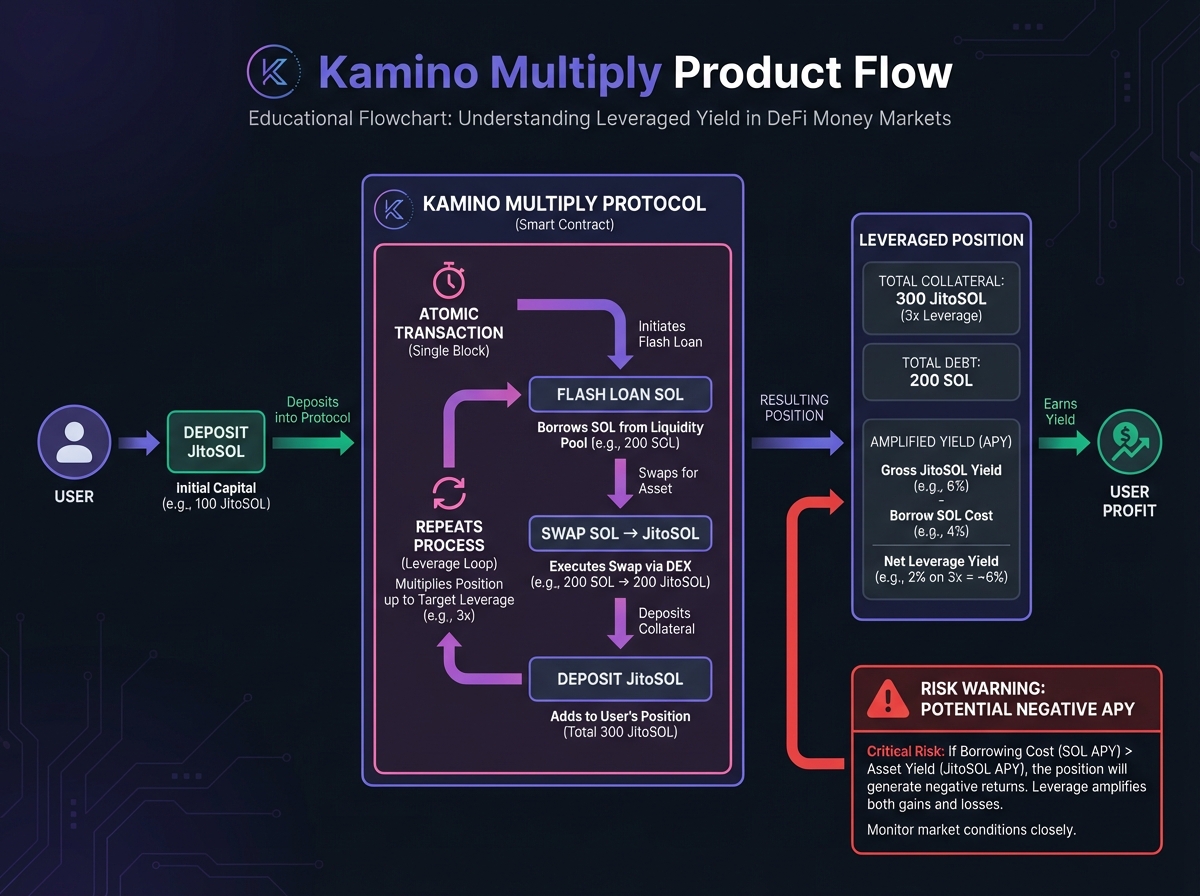
The Multiply Product

What It Is: One-click leverage engine automating looping strategies

How It Works (Atomic Transaction):

  1. Flash loan initiation

  2. Asset swap via Jupiter aggregator

  3. Collateral deposit

  4. Debt creation

  5. Flash loan repayment

Example: JitoSOL Multiply vault

  • User deposits JitoSOL

  • Protocol borrows SOL → swaps for JitoSOL → deposits → repeats

  • Amplifies staking yield (7% base → ~13% with 3x leverage)

The Risk: Negative Net APY—if borrow rate exceeds staking yield, position costs money. Monitor constantly.

Kamino Multiply Product Flow

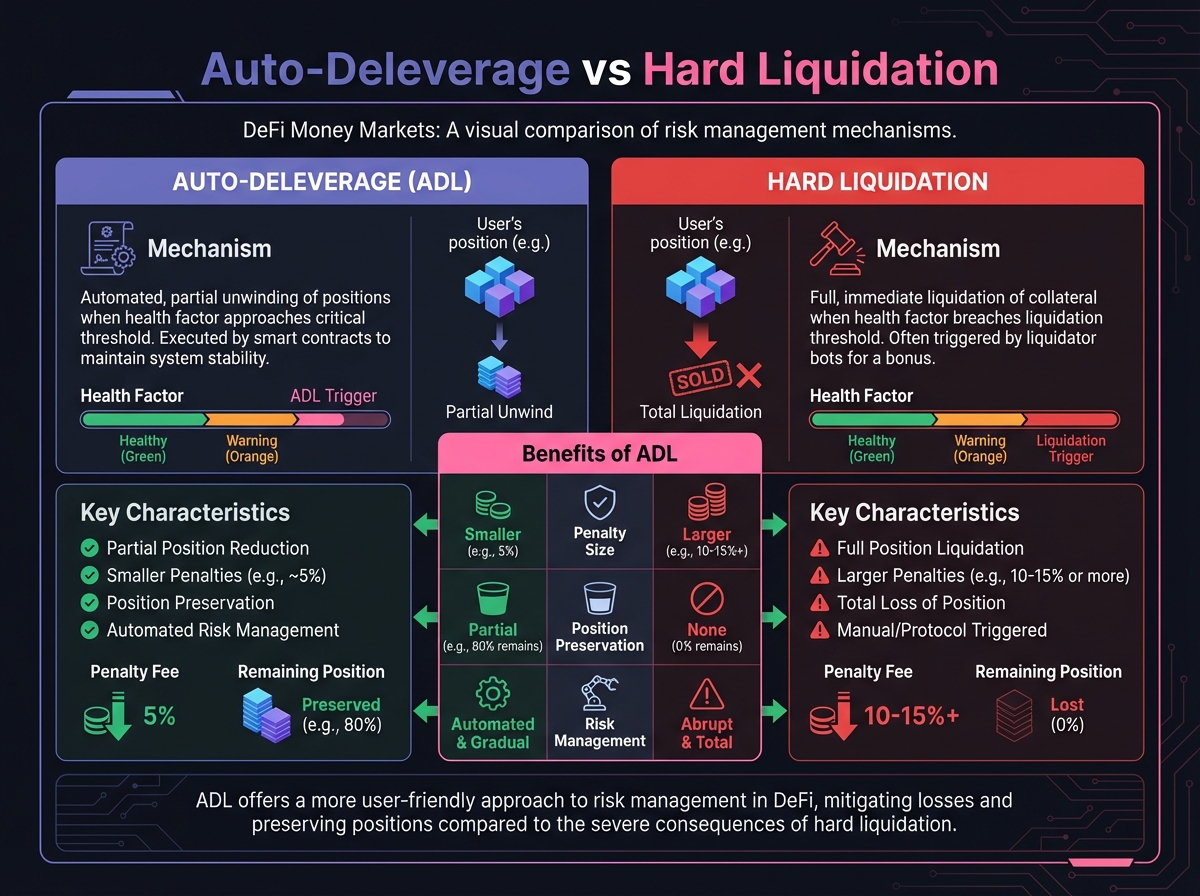
Auto-Deleverage (ADL)

Innovation: Prevents catastrophic liquidations

How It Works:

  • Monitors position health

  • As it approaches danger, partially unwinds

  • Sells just enough collateral to restore health

  • Avoids total loss scenario

Benefit: Automated risk manager—superior to hard liquidations

Auto-Deleverage vs Hard Liquidation

V2 Modular Design

Market Factory Model:

  • Permissionless market creation

  • Isolated markets (like Morpho)

  • Risk isolation at market level

  • Custom oracle configurations

Result: Can list any SPL token, including meme coins, with isolated risk.

🌊 Suilend (Sui)

The Move-Based Architecture

Built By: Team behind Solend (Solana's first money market)

Language: Move (asset-safe programming language)

  • Treats tokens as objects (not mutable ledger entries)

  • Built-in security for asset transfers

  • Designed for high-performance DeFi

Operational Considerations

Bridging:

  • Use Sui Bridge (native) or Portal (Wormhole)

  • Critical: Bridge canonical assets (native USDC, not wUSDC)

  • Verify asset version before depositing

Strategies:

  • Similar to Kamino—automated rebalancing

  • Sui-specific optimizations

  • Move language security benefits

Security History

May 2025 Incident:

  • $10M exploit in isolated asset pools

  • Main pools remained safe

  • Lesson: Avoid isolated/experimental pools until ecosystem matures

Recommendation: Stick to Main Pool assets (SUI, USDC, USDT) for safety.

🌐 JustLend (Tron)

The Tron Ecosystem Leader

TVL: Often exceeds $6-8 billion

  • Massive financial engine

  • Unique risk profile (centralization + algorithmic stablecoins)

The USDD Factor

Core Asset: USDD stablecoin

  • Algorithmic stablecoin (claims over-collateralization)

  • Rating: "F" (Failing) by Bluechip stablecoin rating agency

  • Concerns: Governance and reserve composition transparency

The Yield Trap:

  • High APYs (10-30% via mining rewards)

  • Risk premium—you're paid to take USDD depeg risk

  • Warning: Avoid significant holdings in USDD or using as collateral

Why: If USDD depegs, liquidation engine could trigger spiral affecting entire system.

Energy and Bandwidth Model

Unique Fee Structure:

  • Tron uses "Energy" and "Bandwidth" (not just gas)

  • Executing smart contracts requires Energy

  • Cost: 10-20 TRX ($2-4) per interaction if Energy not frozen (staked)

For Beginners: Freeze TRX to generate Energy, or costs will drain wallet unexpectedly.

📊 Cross-Chain Comparison

Feature
Kamino (Solana)
Suilend (Sui)
JustLend (Tron)
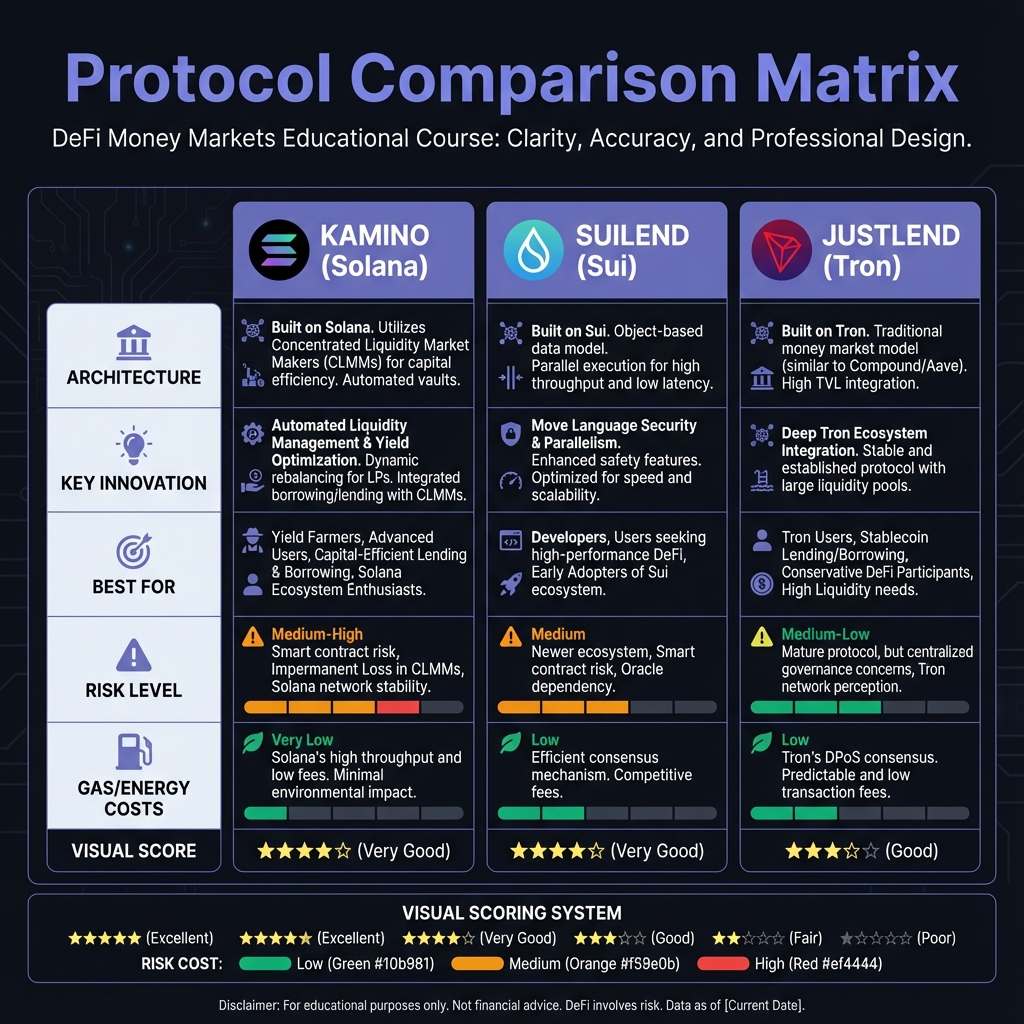
Architecture

Hybrid (Lending + LP)

Monolithic

Monolithic

Key Innovation

Multiply + ADL

Move security

High yields

Best For

Leverage strategies

Move-native assets

Tron ecosystem

Risk Level

Medium

Medium

High (USDD)

Gas Costs

Very low

Very low

Energy model

Protocol Comparison Matrix

⚠️ Cross-Chain Considerations

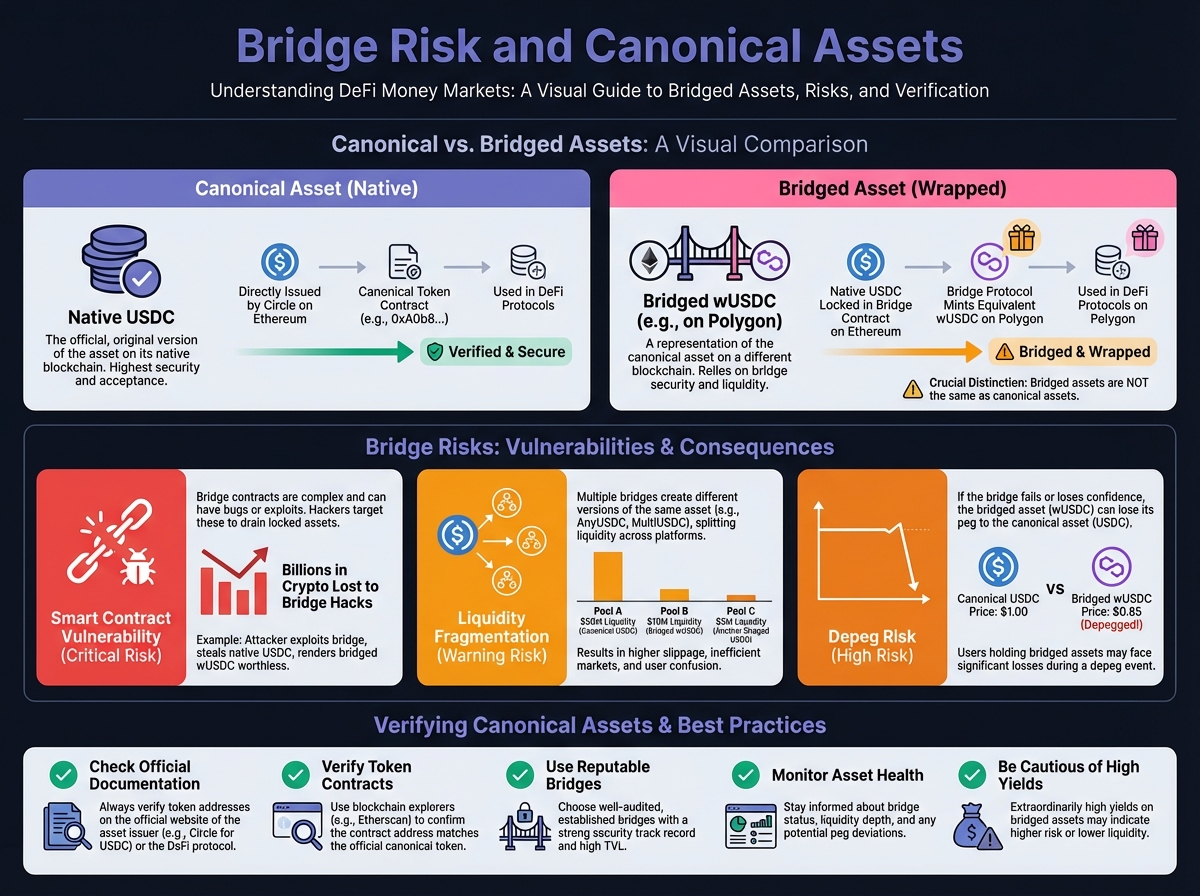
Bridge Risk

The Problem: Moving assets between chains introduces new risks

Risks:

  • Bridge hacks

  • Asset wrapping (canonical vs bridged)

  • Liquidity fragmentation

Best Practices:

  1. Use official/canonical bridges

  2. Verify asset version (native vs wrapped)

  3. Bridge small amounts first to test

  4. Keep native gas tokens for destination chain

Canonical Assets

Critical: Verify you're using canonical (official) versions

Example:

  • Sui: Native USDC (Circle-issued) vs wUSDC (Wormhole-wrapped)

  • Suilend prioritizes native USDC

  • Using wrong version = fragmented liquidity + depeg risk

Always Check: Protocol documentation for supported asset versions

Bridge Risk and Canonical Assets

🎯 When to Use Alternative Chains

Use Solana (Kamino) For:

  • ✅ High-speed transactions

  • ✅ Leverage strategies (Multiply)

  • ✅ Capital efficiency (LP + lending combo)

  • ✅ Low fees

Use Sui (Suilend) For:

  • ✅ Move-native assets

  • ✅ Move language security benefits

  • ✅ Sui ecosystem integration

  • ✅ Main pool assets (SUI, USDC, USDT)

Use Tron (JustLend) For:

  • ✅ Tron ecosystem native

  • ⚠️ High yields (but understand USDD risks)

  • ⚠️ Accept centralization risk

🚀 Getting Started on Alternative Chains

Step 1: Network Setup

  1. Install wallet (Phantom for Solana, Sui Wallet, TronLink)

  2. Fund wallet with native token (SOL, SUI, TRX)

  3. Bridge assets if coming from another chain

  4. Verify canonical assets

Step 2: Choose Protocol

  • Solana: Kamino (dominant money market)

  • Sui: Suilend (established, secure)

  • Tron: JustLend (only major option)

Step 3: Start Conservative

  • Avoid isolated/experimental pools initially

  • Stick to main pool assets

  • Understand gas/energy model

  • Monitor positions actively

Step 4: Understand Risks

  • Bridge risks (canonical assets)

  • Network-specific risks (USDD on Tron)

  • Auto-deleverage benefits (Kamino)

  • Move security model (Sui)

🎓 Beginner's Corner

Q: Should I use alternative chains? A: Start on Ethereum L2s (Aave on Arbitrum). Explore alt chains after mastering basics.

Q: Is USDD safe? A: No. It has an "F" rating. Avoid significant exposure.

Q: Why use Solana/Sui over Ethereum? A: Speed and low fees are advantages, but Ethereum L2s offer similar benefits with more liquidity.

Q: What about bridge risks? A: Always use official bridges. Verify canonical assets. Start small to test.

🔬 Advanced Deep-Dive: Kamino's Efficiency

Why Hybrid Primitive Matters

Traditional DeFi:

  • Choose: LP fees OR lending interest

  • Capital siloed

Kamino:

  • LP tokens as collateral

  • Earn fees + interest simultaneously

  • Double capital utility

Example:

  • Deposit $100k into SOL/USDC LP

  • Earn trading fees: 10% APY

  • Use kToken as collateral, borrow $50k USDC

  • Deploy $50k in another strategy

  • Total utility: 1.5x capital efficiency

📈 Real-World Example: Kamino Multiply

Setup:

  • Deposit: 10 JitoSOL (worth $2,000)

  • Target: 3x leverage

  • Base yield: 7% APY

  • Borrow cost: 4% APY

Calculation:

  • Effective yield: (7% × 3) - (4% × 2) = 13% APY

  • If borrow cost spikes to 8%: (7% × 3) - (8% × 2) = 5% APY

  • If borrow cost exceeds staking yield: Negative APY

Monitor: Net APY constantly to avoid losses.

🎯 Key Takeaways

  1. Kamino offers hybrid primitive (LP + lending) with Multiply leverage

  2. Suilend leverages Move language security

  3. JustLend dominates Tron but carries USDD risk

  4. Bridge risks are real—use canonical assets

  5. Auto-Deleverage (Kamino) prevents catastrophic liquidations

  6. Start on Ethereum L2s before exploring alternative chains

🚀 Next Steps

Lesson 9 explores yield optimization strategies—maximizing returns while managing risk through looping, cross-protocol arbitrage, and strategic position sizing.

Complete Exercise 8 to practice multi-protocol comparison and selection.


Remember: Alternative chains offer speed and efficiency but require understanding network-specific risks. Master Ethereum-based protocols first, then explore with small positions.

← Back to Summary | Next: Exercise 8 → | Previous: Lesson 7 ←

Last updated