Lesson 10: Risk Management and Hedging
🎯 Core Concept: Professional Risk Management
Advanced risk management goes beyond monitoring Health Factor. This lesson teaches portfolio diversification, liquidation protection systems, hedging strategies, and building comprehensive risk frameworks for multi-protocol operations.
📊 Portfolio Diversification
Multi-Protocol Strategy
Why Diversify:
Protocol-specific risks (bugs, governance attacks)
Liquidity fragmentation
Rate volatility differences
Insurance coverage variations
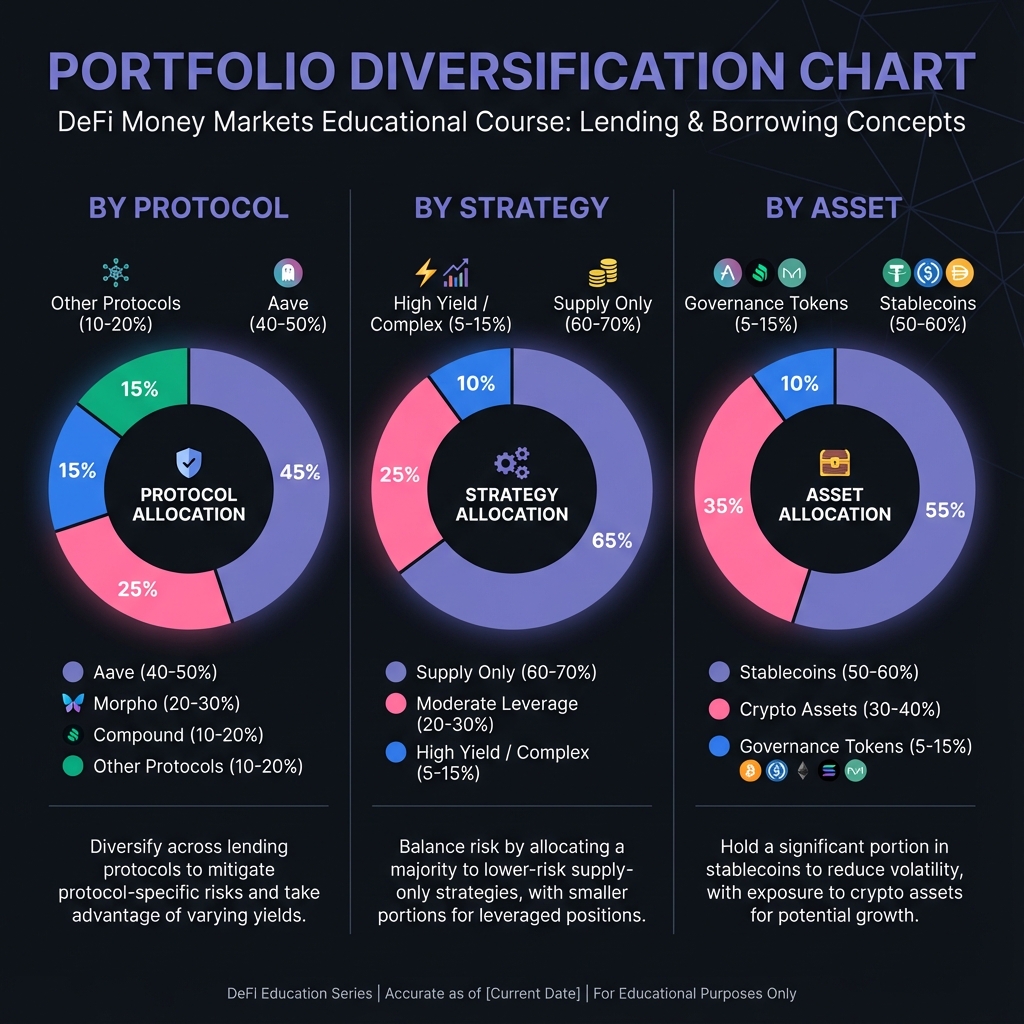
Diversification Framework:
By Protocol:
40-50% Aave (safety, insurance)
20-30% Morpho (efficiency)
10-20% Euler (customization)
10-20% Alternative chains (yield)
By Asset:
Stablecoins: 50-60% (base yield)
Blue-chip crypto: 30-40% (growth + yield)
Yield-bearing tokens: 10-20% (optimization)
By Strategy:
Supply only: 60-70% (low risk)
Moderate leverage: 20-30% (optimization)
Aggressive strategies: 10-20% (maximum yield)
Correlation Analysis
Understanding Correlation:
Assets that move together amplify risk
Diversification reduces impact of single asset failure
Example Portfolio:
USDC (stable)
ETH (volatile, uncorrelated with stablecoins)
BTC (volatile, correlated with ETH but different magnitude)
LSTs (correlated with ETH but with staking yield)
Risk: If crypto crashes together, crypto-collateralized positions all at risk.

🛡️ Liquidation Protection Strategies
Health Factor Monitoring Systems
Automated Alerts:
Set HF threshold alerts (e.g., alert if HF < 1.8)
Price movement alerts for collateral
Utilization spike alerts (affects rates)
Protocol pause/incident alerts
Tools:
DeFi portfolio trackers (Zapper, DeBank)
Custom scripts (webhooks + Discord/Telegram)
Protocol-specific dashboards
Price alert services (CoinGecko, etc.)
Dynamic Collateral Management
Strategy 1: Maintain Reserve Fund
Keep 20-30% of capital in stablecoins outside positions
Use to add collateral if HF drops
Provides buffer during volatility
Strategy 2: Multiple Collateral Types
Don't rely on single collateral
Diversify across asset classes
If one crashes, others may hold
Strategy 3: Conservative LTV
Borrow only 40-50% of max LTV
Maintain larger safety buffer
Reduces need for constant monitoring
Automated Protection Mechanisms
1. Keep3r/Chainlink Automation:
Automatically add collateral if HF drops
Requires gas funds in reserve
Set threshold triggers
2. Protocol-Specific Features:
Aave: Safety module insurance
Kamino: Auto-Deleverage
Some protocols: Partial liquidation protection
3. Smart Contract Safeguards:
Set max borrow limits
Automatic position reduction at thresholds
Flash loan protection
🔄 Hedging Strategies
Understanding Hedging
Definition: Taking offsetting positions to reduce risk
Goal: Limit downside while maintaining upside potential
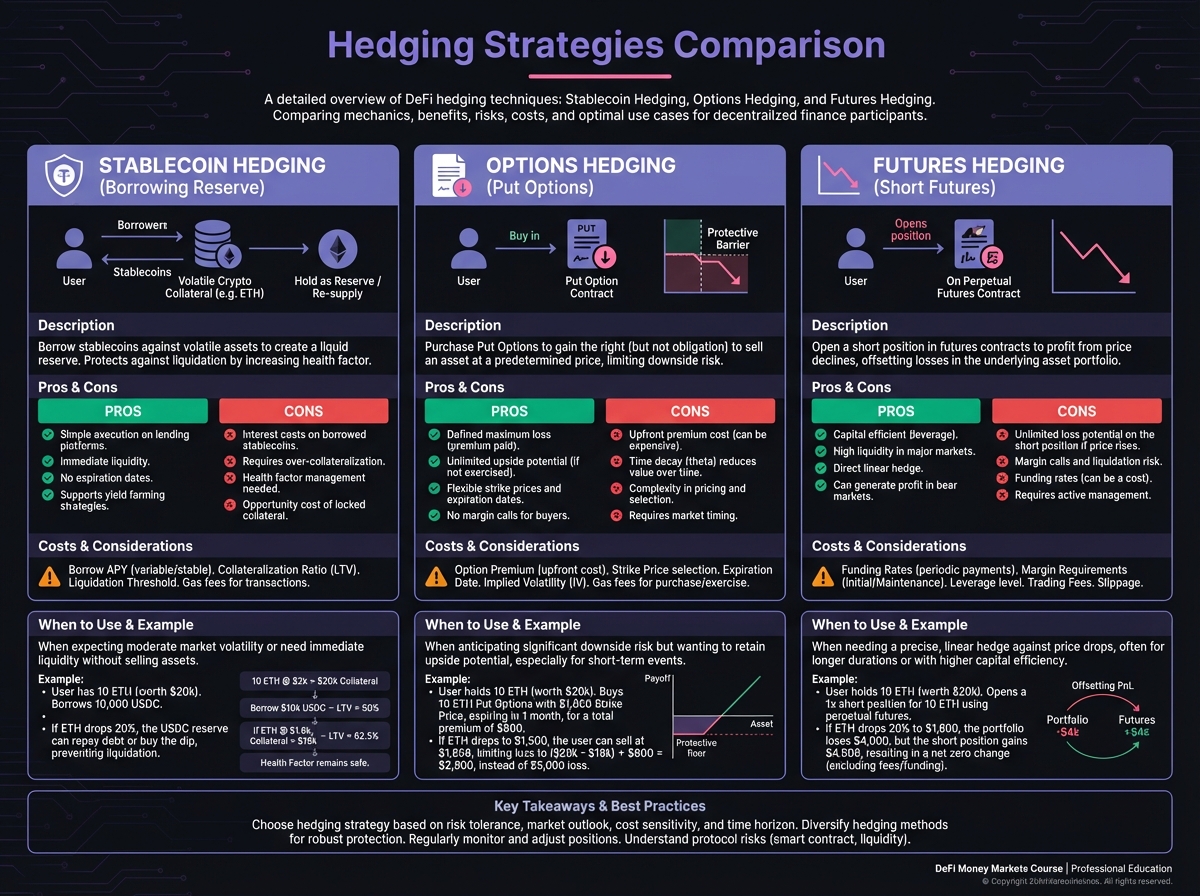
Common Hedging Techniques
1. Stablecoin Hedging
Borrow against volatile collateral
Hold borrowed stablecoins as hedge
If collateral crashes, stablecoins preserve value
Example:
Collateral: 10 ETH @ $2,000 = $20,000
Borrow: $10,000 USDC (hold as reserve)
If ETH drops 50%: Collateral = $10,000, debt = $10,000
Net position: $0 loss (instead of -$10,000)
2. Options Hedging (Advanced)
Buy put options on collateral
Limits downside exposure
Cost: Premium payments
3. Futures Hedging
Short futures against collateral
Offsets price movements
Requires active management

Partial Hedging
Strategy: Hedge portion of position
Example:
Position: $20,000 ETH collateral, $10,000 debt
Hedge: Short $5,000 ETH futures
Result: 50% hedged, 50% exposed
Balance: Maintains upside potential while limiting downside.
🏗️ Risk Management Framework
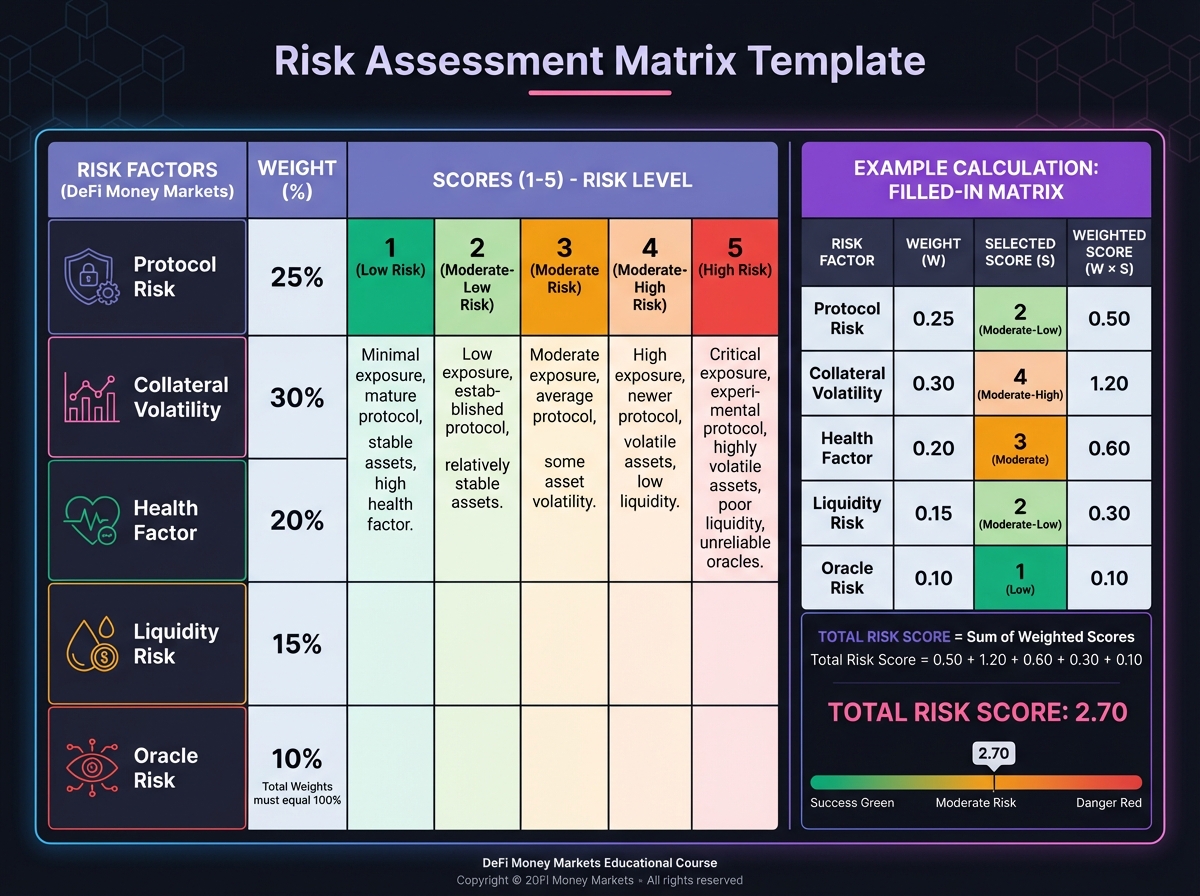
Risk Assessment Matrix
Evaluate Each Position:
Protocol Risk
___
30%
___
Collateral Volatility
___
25%
___
Health Factor
___
20%
___
Liquidity Risk
___
15%
___
Oracle Risk
___
10%
___
Total Risk Score
___
Risk Thresholds:
< 2.0: Low risk (acceptable)
2.0-3.0: Moderate risk (monitor closely)
3.0: High risk (reduce or exit)
Position Sizing Framework
Kelly Criterion (Simplified):
For Money Markets:
Edge = Expected yield advantage
Odds = Risk of loss
Conservative Approach: Use fractional Kelly (50% of calculated size)
Example:
Expected edge: 2% APY advantage
Risk of loss: 5% (liquidation + protocol risk)
Position size: (0.02 / 0.05) × 0.5 = 20% of capital
Stress Testing
Scenario Analysis:
Base Case: Expected outcomes
Stress Case: 30% collateral drop
Extreme Case: 50% drop + protocol pause
For Each Scenario:
Calculate new Health Factor
Assess liquidity availability
Evaluate exit options
Calculate potential losses
Action Plan: Define responses for each scenario before they occur.

🚨 Emergency Exit Procedures
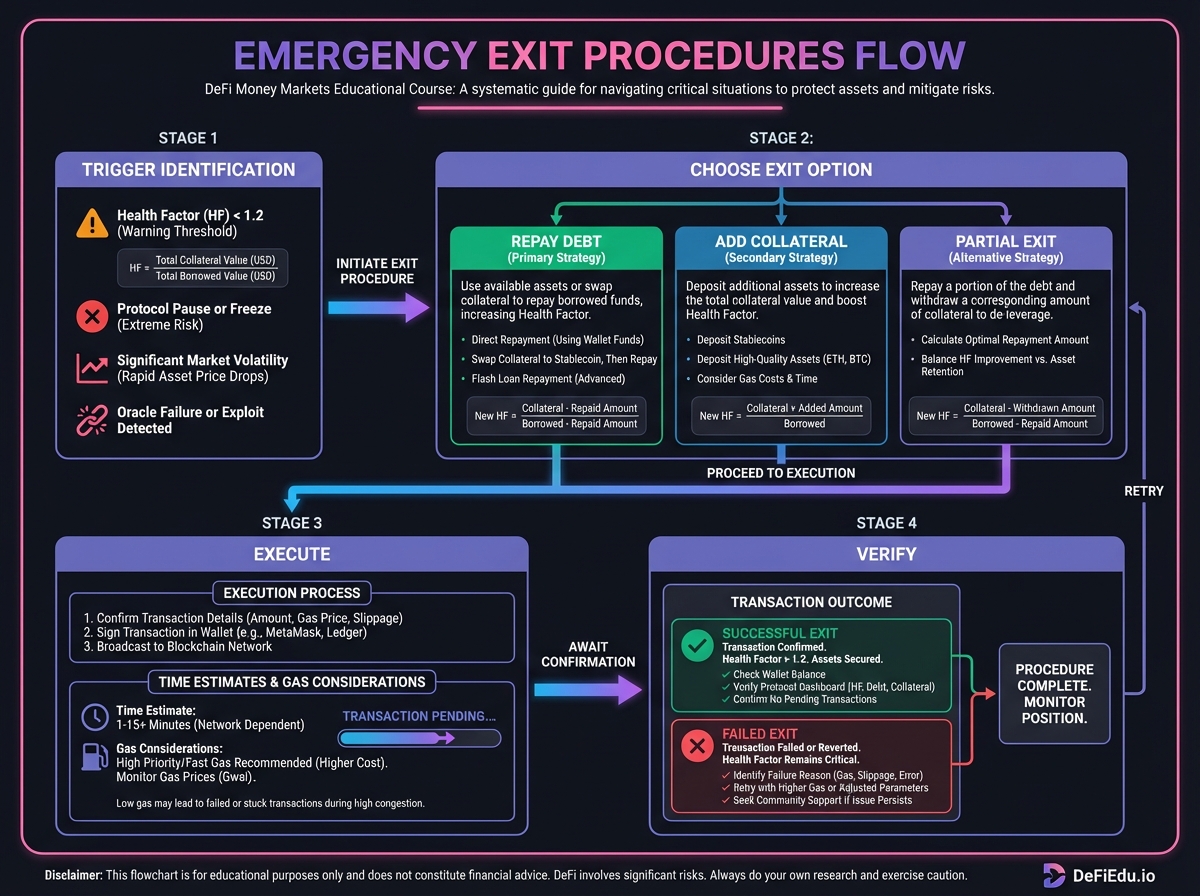
When to Exit
Triggers:
HF < 1.2 (critical)
Protocol pause/exploit announced
Oracle failure detected
Critical collateral depeg
Major market crash (>30% in 24h)
Exit Execution
Option 1: Repay Debt
Calculate total debt (principal + interest)
Ensure funds available (reserve fund)
Repay via protocol interface
Withdraw collateral
Time: Minutes (depends on network)
Option 2: Add Collateral
Calculate required collateral
Transfer additional assets
Deposit to increase HF
Time: Fastest option if reserves available
Option 3: Partial Exit
Repay portion of debt
Withdraw some collateral
Maintain smaller position
Time: Intermediate strategy
Exit Timing
Consider:
Gas costs vs position value
Network congestion (delays during volatility)
Price slippage if swapping
Time to execute full exit
Preparation: Keep gas tokens ready, have exit plan documented.

📈 Risk-Adjusted Returns
Sharpe Ratio (Simplified)
Formula:
For Money Markets:
Return = Net APY earned
Risk-free rate = Stable supply rate (e.g., 4%)
Volatility = Standard deviation of returns
Interpretation:
1.0: Good risk-adjusted returns
1.0-2.0: Very good
2.0: Excellent
Sortino Ratio
Focus: Downside volatility only (more relevant for lending)
Formula:
Benefit: Doesn't penalize positive volatility (upside gains).
🎯 Risk Management Best Practices
Daily Practices
Check Health Factors on all positions
Review collateral prices (any significant moves?)
Monitor protocol news/updates
Check utilization rates (affects yields)
Review any alerts/notifications
Weekly Practices
Calculate risk scores for all positions
Review portfolio allocation
Assess any new opportunities
Update exit plans if needed
Review performance vs targets
Monthly Practices
Comprehensive portfolio review
Stress test all positions
Rebalance if needed
Update risk framework
Document lessons learned
🎓 Beginner's Corner
Q: How much should I hedge? A: Start with 0% hedging. As you scale, consider 20-30% partial hedging on large positions.
Q: What's the minimum HF to maintain? A: 2.0 absolute minimum. Consider 2.5+ for peace of mind.
Q: Should I diversify across many protocols? A: Start with 2-3 reputable protocols. Too many = harder to monitor.
Q: How often should I check positions? A: Daily during active positions. Weekly if supply-only conservative strategies.
🔬 Advanced Deep-Dive: Correlation Hedging
Portfolio Correlation Matrix
Calculate correlations:
ETH vs BTC: High (0.7-0.9)
ETH vs Stablecoins: Low (0.1-0.3)
BTC vs Stablecoins: Low (0.1-0.3)
Hedging Strategy:
If holding ETH collateral, diversify with stablecoin positions
Avoid over-concentration in correlated assets
Use uncorrelated assets to reduce portfolio risk
📊 Real-World Example: Risk Management
Portfolio:
$50k total capital
Allocation:
$25k Aave: USDC supply (HF: N/A, risk: low)
$15k Morpho: ETH collateral, $7.5k USDC borrowed (HF: 2.5, risk: moderate)
$10k reserve: USDC (emergency fund)
Risk Assessment:
Protocol risk: Diversified (low)
Collateral risk: ETH only (moderate)
Health Factor: 2.5 (safe)
Liquidity: Reserve fund available (low risk)
Action Plan:
Daily: Check Morpho HF
If HF < 2.0: Add collateral from reserve
If HF < 1.5: Repay $2.5k debt
If protocol issues: Exit immediately
🎯 Key Takeaways
Diversify across protocols, assets, and strategies
Monitor Health Factors daily with automated alerts
Maintain reserves for emergency collateral additions
Hedge selectively to limit downside while maintaining upside
Stress test positions regularly
Have exit plans documented before emergencies
🚀 Next Steps
Lesson 11 explores advanced topics and emerging trends—RWAs, institutional adoption, governance participation, and the future of money markets.
Complete Exercise 10 to design your risk management framework.
Remember: Risk management is about protecting capital first, optimizing returns second. Better to earn 4% safely than 8% with high liquidation risk.
← Back to Summary | Next: Exercise 10 → | Previous: Lesson 9 ←
Last updated