Lesson 12: Building Your Professional Money Market System

Lesson 12: Building Your Professional Money Market System

🎯 Core Concept: Operational Excellence

Building a professional money market system requires integrating all concepts from previous lessons: portfolio management, automation, monitoring, risk frameworks, and operational workflows. This final lesson synthesizes everything into a comprehensive system.

🏗️ System Architecture

Core Components
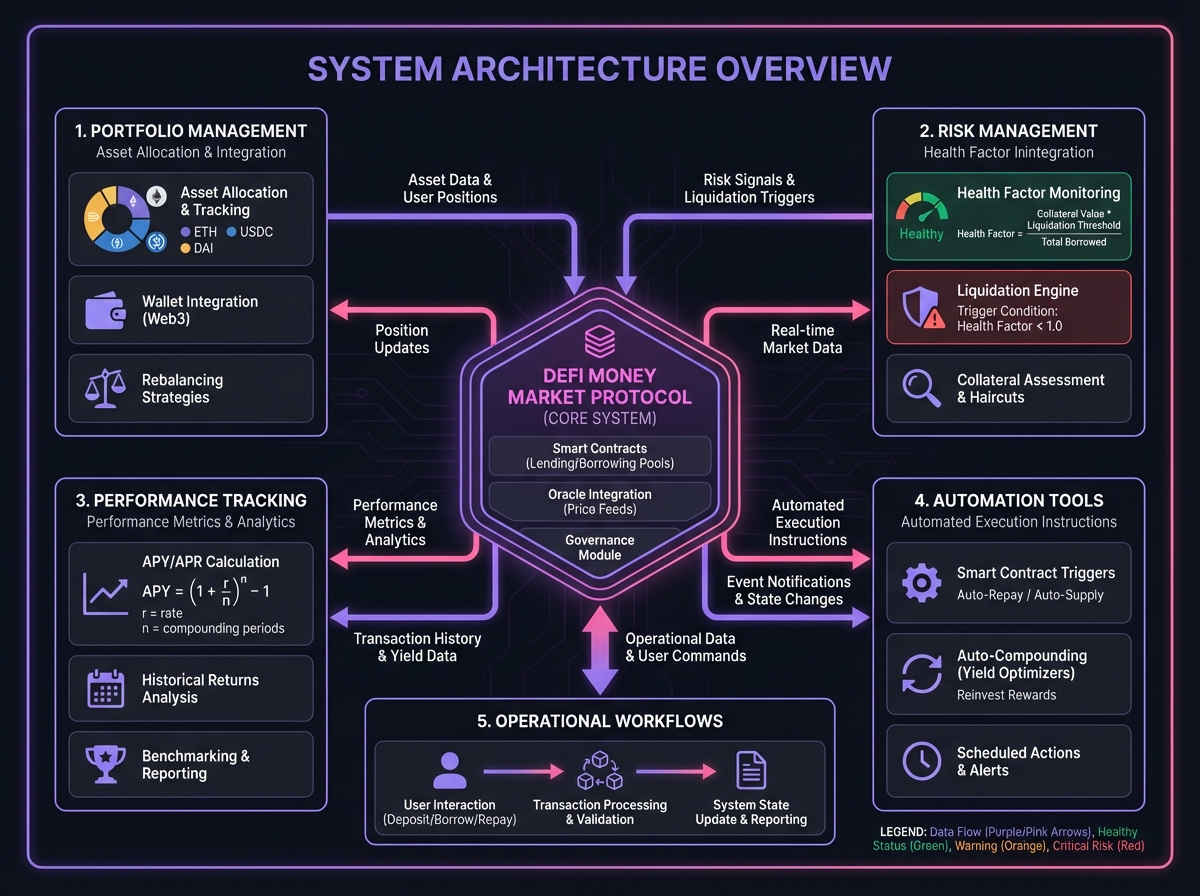
1. Portfolio Management

  • Multi-protocol allocation

  • Asset diversification

  • Strategy segmentation

  • Rebalancing mechanisms

2. Risk Management

  • Health Factor monitoring

  • Automated alerts

  • Emergency protocols

  • Stress testing framework

3. Performance Tracking

  • Yield measurement

  • Risk-adjusted returns

  • Gas cost analysis

  • Benchmark comparison

4. Automation Tools

  • Alert systems

  • Rebalancing scripts

  • Monitoring dashboards

  • Emergency responses

5. Operational Workflows

  • Daily/weekly/monthly routines

  • Documentation standards

  • Decision frameworks

  • Continuous improvement

System Architecture Overview

📊 Multi-Protocol Portfolio Management

Portfolio Structure

Recommended Allocation (Starting Point):

By Protocol:

  • 40-50% Aave (foundation, safety)

  • 20-30% Morpho (efficiency)

  • 10-20% Euler (customization)

  • 10-20% Alternative chains (optional)

By Strategy:

  • 60-70% Supply only (low risk base)

  • 20-30% Moderate leverage (optimization)

  • 10-20% Aggressive strategies (max yield)

By Asset:

  • 50-60% Stablecoins (base yield)

  • 30-40% Blue-chip crypto (growth)

  • 10-20% Yield-bearing tokens (optimization)

Rebalancing Framework

Triggers for Rebalancing:

  1. Significant rate spreads (>1% APY difference)

  2. Risk threshold breaches

  3. Utilization changes

  4. Protocol updates/changes

  5. Portfolio drift (>10% from target)

Rebalancing Process:

  1. Assess current allocation

  2. Identify opportunities

  3. Calculate gas costs

  4. Execute rebalancing

  5. Update documentation

Frequency: Monthly review, quarterly rebalancing (unless major opportunities arise)

🔧 Automation Tools

Health Factor Monitoring

Setup Requirements:

  1. Data Sources: Protocol APIs, price feeds

  2. Alert Thresholds: HF < 2.0 (warning), < 1.5 (critical)

  3. Notification Channels: Email, Discord, Telegram, SMS

  4. Response Actions: Auto-document, trigger alerts

Tools:

  • Custom scripts (Python/JavaScript)

  • DeFi portfolio trackers (Zapper, DeBank)

  • Protocol-specific dashboards

  • Webhook integrations

Example Alert Configuration:

Health Factor Alerts:
- Warning: HF < 2.0 (daily check)
- Critical: HF < 1.5 (immediate notification)
- Emergency: HF < 1.2 (SMS + all channels)

Price Alerts:
- Collateral: -10% in 24h
- Protocol: Pause/exploit announcements

Automated Reporting

Daily Report (Automated):

  • Current positions

  • Health Factors

  • Yields earned

  • Notable changes

Weekly Report:

  • Performance summary

  • Risk assessment

  • Opportunities identified

  • Actions taken

Monthly Report:

  • Comprehensive review

  • Stress test results

  • Rebalancing decisions

  • Strategy adjustments

Rebalancing Automation

Conditions:

  • Rate spread > 1% APY for > 24 hours

  • Risk score change > 20%

  • Utilization shift > 10%

Process (Semi-Automated):

  1. Detect condition

  2. Calculate optimal rebalancing

  3. Request approval (human-in-loop)

  4. Execute if approved

  5. Document action

Safety: Always require human approval for large moves.

📈 Performance Tracking

Key Metrics

1. Yield Metrics:

  • Gross APY (before costs)

  • Net APY (after gas)

  • Risk-adjusted return (Sharpe ratio)

  • Comparison to benchmarks

2. Risk Metrics:

  • Average Health Factor

  • Maximum drawdown risk

  • Liquidation probability

  • Correlation exposure

3. Cost Metrics:

  • Total gas spent

  • Gas as % of yield

  • Transaction frequency

  • Cost per position

4. Operational Metrics:

  • Time spent managing

  • Alert frequency

  • Rebalancing frequency

  • System uptime

Benchmarking

Benchmarks to Track:

  1. Risk-free rate: USDC supply on Aave

  2. Market average: DeFiLlama money market index

  3. Your target: Based on risk tolerance

  4. Best-in-class: Top performers (risk-adjusted)

Tracking Dashboard:

Current Performance:
- Your Net APY: 5.2%
- Risk-free: 4.0%
- Market avg: 4.5%
- Target: 5.0%
- Status: ✅ Exceeding target

Risk Metrics:
- Avg HF: 2.3
- Max drawdown risk: -15%
- Sharpe ratio: 1.8
- Status: ✅ Healthy

🔄 Operational Workflows

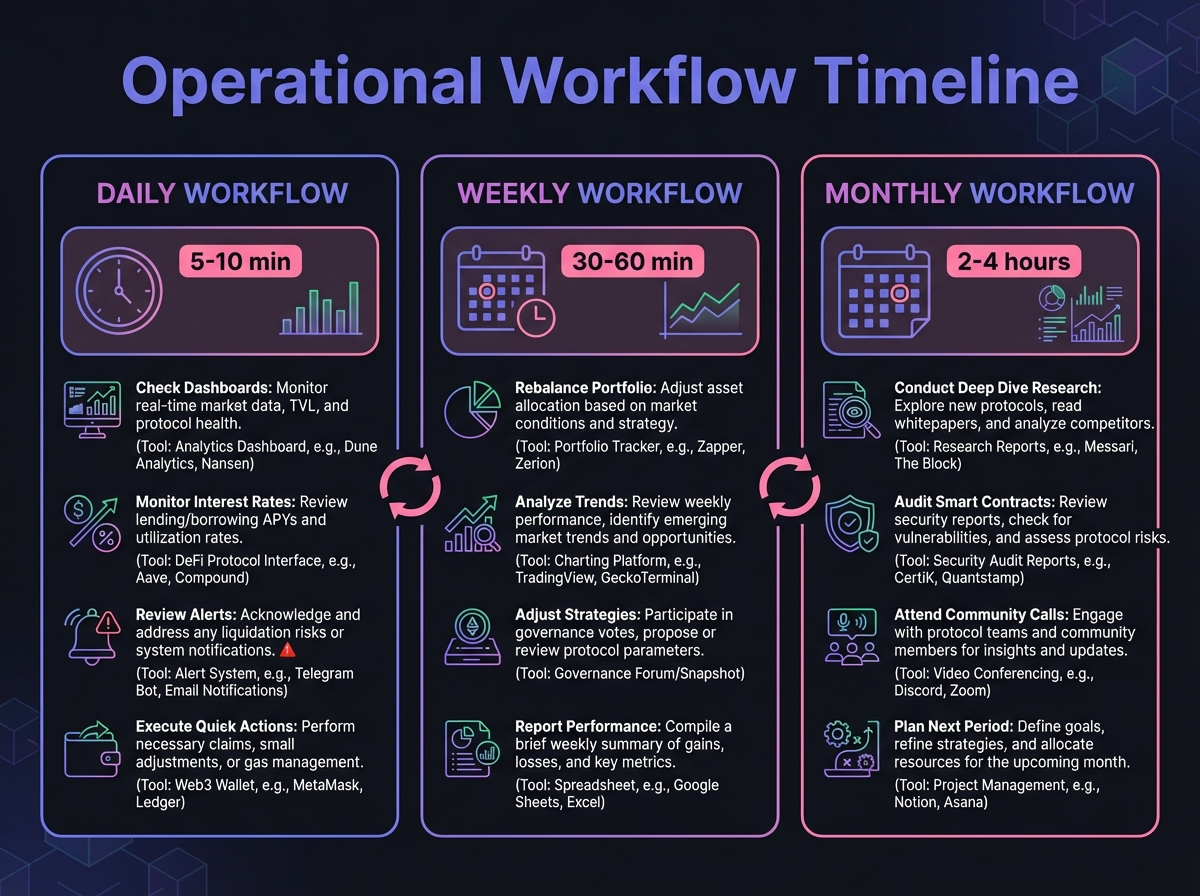
Daily Workflow (5-10 minutes)

Morning Routine:

  1. Check overnight alerts

  2. Review Health Factors

  3. Scan protocol news

  4. Note any issues

Evening Routine:

  1. Quick position check

  2. Review any changes

  3. Update notes if needed

Weekly Workflow (30-60 minutes)

Monday:

  • Comprehensive position review

  • Check all Health Factors

  • Review protocol updates

  • Assess week's opportunities

Mid-Week:

  • Monitor for rebalancing triggers

  • Review performance trends

  • Check utilization changes

Friday:

  • Weekly report generation

  • Plan next week's actions

  • Update documentation

Monthly Workflow (2-4 hours)

Month Start:

  1. Full portfolio review

  2. Calculate all metrics

  3. Stress test all positions

  4. Identify optimization opportunities

  5. Plan rebalancing if needed

Month End:

  1. Generate monthly report

  2. Review performance vs targets

  3. Update risk framework

  4. Document lessons learned

  5. Plan next month's strategy

Operational Workflow Timeline

📋 Documentation System

Essential Documents

1. Portfolio Overview:

  • Current allocations

  • Target allocations

  • Strategy descriptions

  • Performance targets

2. Position Log:

  • All active positions

  • Entry dates and amounts

  • Current status

  • Exit criteria

3. Risk Framework:

  • Risk assessment matrix

  • Stress test scenarios

  • Emergency procedures

  • Decision frameworks

4. Performance Tracking:

  • Historical metrics

  • Benchmark comparisons

  • Lessons learned

  • Strategy evolution

5. Emergency Procedures:

  • Exit protocols

  • Contact information

  • Backup plans

  • Recovery procedures

Documentation Best Practices

Format: Simple, accessible (spreadsheet, Notion, etc.)

Updates: After every significant action

Backup: Store securely (encrypted cloud, multiple locations)

Review: Monthly comprehensive review

🎯 The Professional System Checklist

Setup Phase

Operation Phase

Optimization Phase

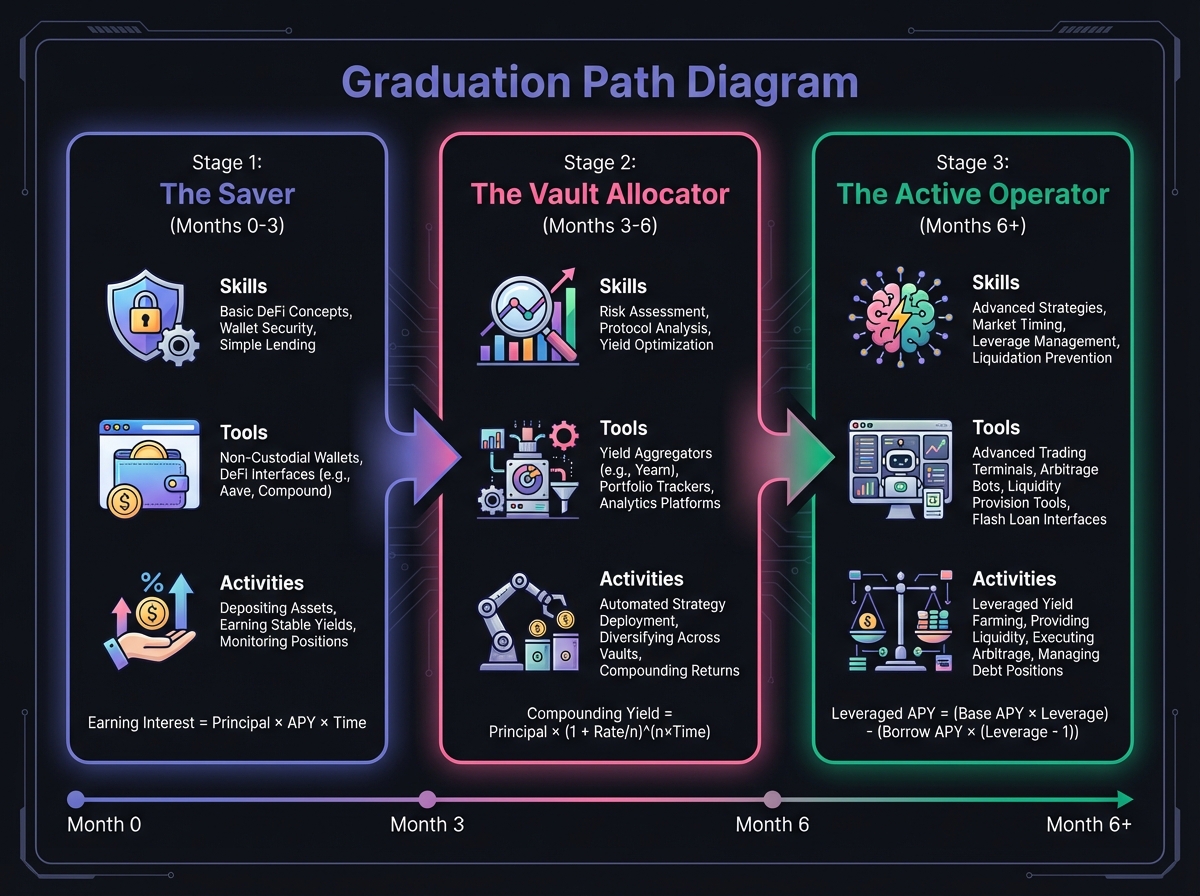
🚀 The Graduation Path

Stage 1: The Saver (Months 0-3)

Focus: Understanding and safety

Activities:

  • Use Aave App or Aave V3 on Arbitrum

  • Supply stablecoins only (collateral OFF)

  • Learn wallet security and gas management

  • Understand yield generation basics

Goal: Build confidence, learn fundamentals

Stage 2: The Vault Allocator (Months 3-6)

Focus: Efficiency and optimization

Activities:

  • Graduate to Morpho vaults

  • Choose reputable curators (Gauntlet, Steakhouse)

  • Understand risk curation

  • Explore isolated markets

Goal: Optimize yields while maintaining safety

Stage 3: The Active Operator (Months 6+)
Focus: Advanced strategies

Activities:

  • Explore multiple protocols

  • Use leverage strategically (conservatively)

  • Implement automation

  • Build professional system

Goal: Professional-level operations with optimized risk-adjusted returns

Graduation Path Diagram

🎓 Final Best Practices

Do's

✅ Start small and scale gradually ✅ Diversify across protocols and assets ✅ Monitor positions actively ✅ Maintain emergency reserves ✅ Document everything ✅ Learn continuously ✅ Stay informed on developments ✅ Test new strategies with small amounts

Don'ts

❌ Don't chase highest yields blindly ❌ Don't ignore Health Factors ❌ Don't over-leverage ❌ Don't skip due diligence ❌ Don't ignore gas costs ❌ Don't forget about taxes ❌ Don't skip backups/documentation ❌ Don't panic during volatility

🔬 Advanced: Custom Automation Example

Python Monitoring Script (Concept)

# Simplified example structure
import time
from defi_apis import get_aave_position, get_morpho_position

def monitor_positions():
    positions = [
        get_aave_position(),
        get_morpho_position()
    ]
    
    for position in positions:
        hf = position['health_factor']
        
        if hf < 1.5:
            send_critical_alert(position)
        elif hf < 2.0:
            send_warning_alert(position)
            
        log_position_data(position)

# Run every hour
while True:
    monitor_positions()
    time.sleep(3600)

Production Considerations:

  • Error handling

  • Rate limiting

  • Secure API keys

  • Multiple notification channels

  • Logging and alerting

📊 Real-World System Example

Portfolio: $100,000 total

Allocation:

  • $40k Aave: USDC supply (4% APY, zero risk)

  • $30k Morpho: ETH collateral, $15k USDC borrowed (HF: 2.2, 5.5% net APY)

  • $20k Euler: Diversified strategies (6% APY)

  • $10k Reserve: Emergency fund

System:

  • Daily: Automated HF checks, alerts configured

  • Weekly: Manual review, performance tracking

  • Monthly: Full rebalancing, stress testing

  • Tools: DeBank dashboard, custom alerts, spreadsheet tracking

Performance:

  • Net APY: 4.8% (risk-adjusted)

  • Sharpe ratio: 1.6

  • Time spent: 2 hours/week

  • Status: ✅ Professional operation

🎯 Key Takeaways

  1. System thinking—integrate all components into cohesive operation

  2. Automation—reduce manual work, increase reliability

  3. Documentation—maintain clear records of all decisions

  4. Continuous improvement—refine system based on experience

  5. Graduation path—progress from simple to advanced gradually

  6. Risk-first mindset—protect capital, optimize second

🎓 Course Completion

Congratulations! You've completed the comprehensive Money Markets Mastery course. You now understand:

  • ✅ Fundamental mechanics and mathematics

  • ✅ Risk management frameworks

  • ✅ Major protocols (Aave, Morpho, Euler)

  • ✅ Alternative chains (Kamino, Suilend, JustLend)

  • ✅ Yield optimization strategies

  • ✅ Professional system building

Next Steps:

  1. Start with small positions

  2. Build your system gradually

  3. Monitor and learn

  4. Scale as you gain experience

  5. Stay informed on developments

Remember: Mastery comes from practice. Start conservatively, learn continuously, and scale responsibly.

🚀 Final Exercise

Complete Exercise 12 to build your complete professional money market system—integrating all lessons into a comprehensive operational framework.


Thank you for completing this course! You're now equipped with the knowledge to participate safely and effectively in decentralized money markets. Use this knowledge wisely, manage risk carefully, and continue learning as the space evolves.

← Back to Summary | Next: Exercise 12 → | Previous: Lesson 11 ←

Last updated