Lesson 5: Aave - The Monolithic Standard
🎧 Lesson Podcast
🎬 Video Overview
Lesson 5: Aave - The Monolithic Standard
🎯 Core Concept: The DeFi Lending Hegemon
Aave stands as the undisputed leader in decentralized lending, managing over $70 billion in total value locked (TVL) and commanding approximately 60% market share. Its dominance stems from a "safety-first" approach, extensive auditing, and strategic evolution from V3's fragmented pools to V4's unified Hub and Spoke architecture.
Why Aave Matters: For beginners, Aave offers the lowest-risk entry point into DeFi lending, with insurance options, consumer-friendly interfaces, and the largest liquidity pools in the industry.
🏗️ Aave V3: The Legacy Standard
Core Architecture
The Monolithic Pool Model:
All assets pooled together into shared liquidity reserves
Simple UX: Deposit Asset A, Borrow Asset B
Cross-collateralization enabled (use multiple assets as collateral)
Unified risk management via governance
Key Features:
1. High Efficiency Mode (eMode)
Allows extremely high LTVs (up to 97%) for correlated assets
Example: USDC/USDT pairs can leverage at 97% LTV
Designed for forex-style arbitrage and yield farming
Risk: Small depegs (like USDC's $0.87 in March 2023) can trigger instant liquidations
2. Isolation Mode
Allows listing newer, volatile assets safely
Restrictions:
Can only borrow stablecoins (USDC, USDT, DAI)
Cannot use other assets as collateral simultaneously
Debt ceiling caps total borrowing
Purpose: Firewall to prevent contagion from risky assets
3. The Fragmentation Problem
Each network deployment (Ethereum, Arbitrum, Optimism) is independent
Liquidity cannot flow between pools
Forces bootstrap costs for new deployments
Creates inconsistent interest rates across chains
🚀 Aave V4: The Hub and Spoke Revolution
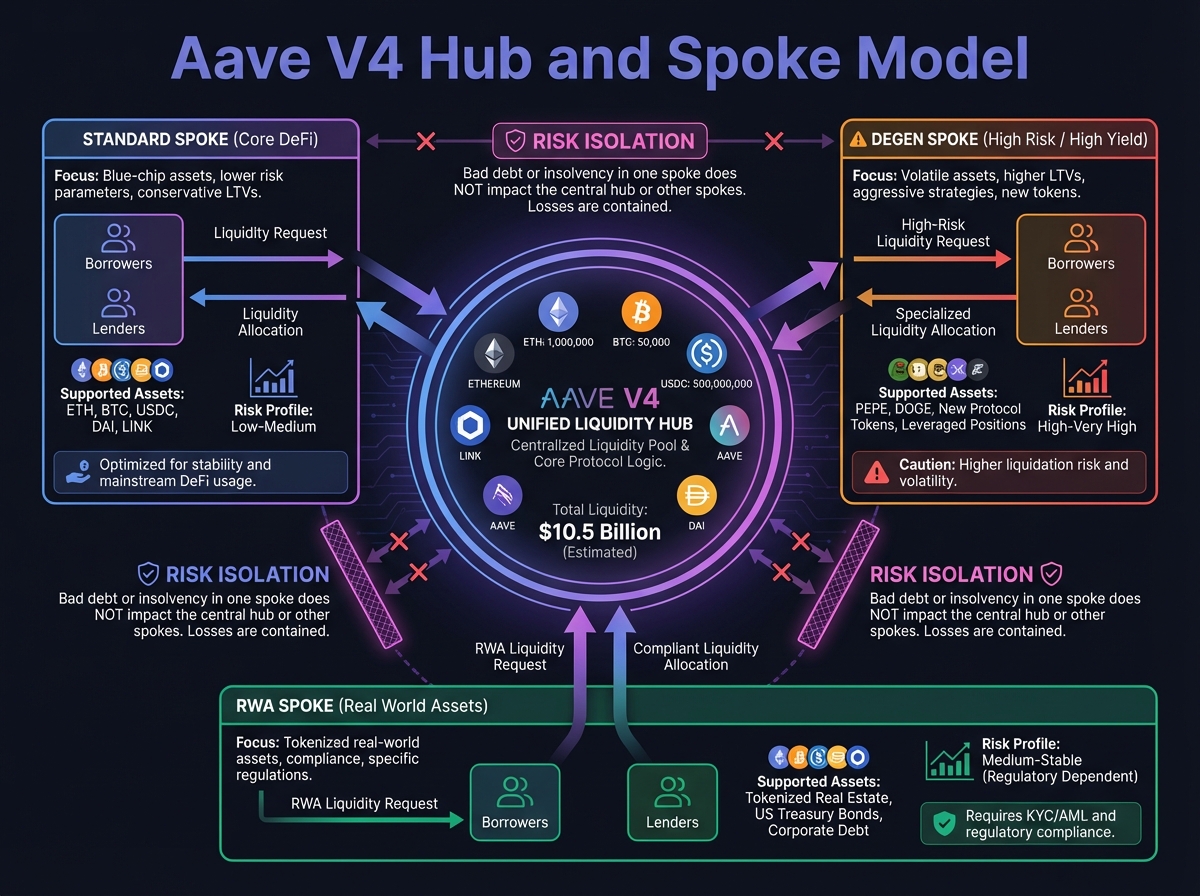
The Unified Liquidity Layer
The Hub:
Central settlement layer for all assets on a network
Consolidates all protocol-wide liquidity
Manages core accounting and solvency
Does not interact directly with users
The Spokes:
User-facing modules with specific lending logic
Customizable risk parameters per Spoke
Examples:
Standard Spoke (like V3)
Degen Spoke (high-risk meme coins)
RWA Spoke (Horizon, institutional)
Risk isolation at the Spoke level
Benefits of V4:
100% Capital Reuse: Deposits in Hub serve all Spokes simultaneously
Fast Innovation: Add new Spokes without liquidity migration
Dynamic Risk: Adjust LTV/rates based on volatility in real-time
Soft Liquidations: Partial liquidations preserve user positions
ERC-4626 Standard: Vault shares compatible with all DeFi
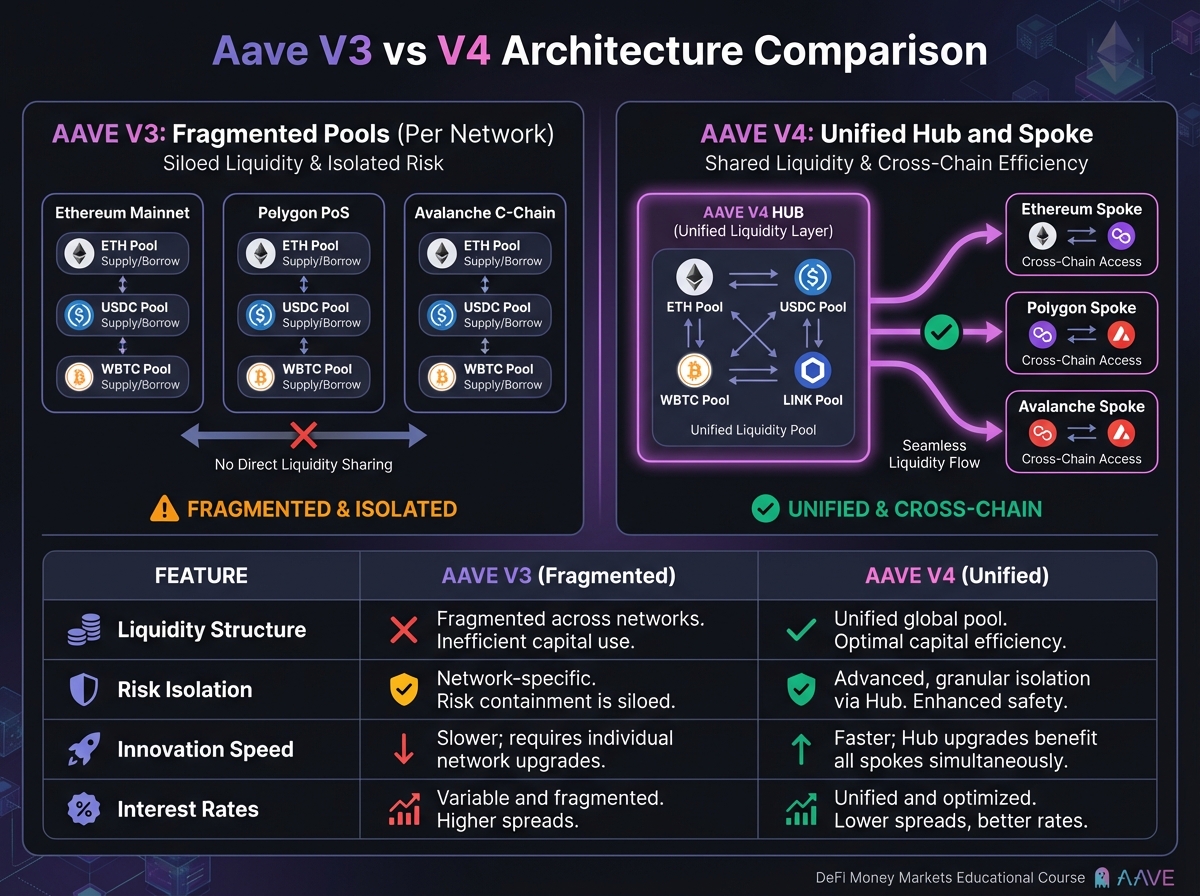
Architecture Comparison
Liquidity
Fragmented pools
Unified Hub
Risk Isolation
Asset-level (Isolation Mode)
Spoke-level (module isolation)
Innovation Speed
Slow (requires migration)
Fast (add Spoke, tap existing liquidity)
Interest Rates
Static curves
Dynamic/fuzzy logic
Accounting
aTokens (rebasing)
Vault shares (ERC-4626)
📱 The Two Paths to Aave
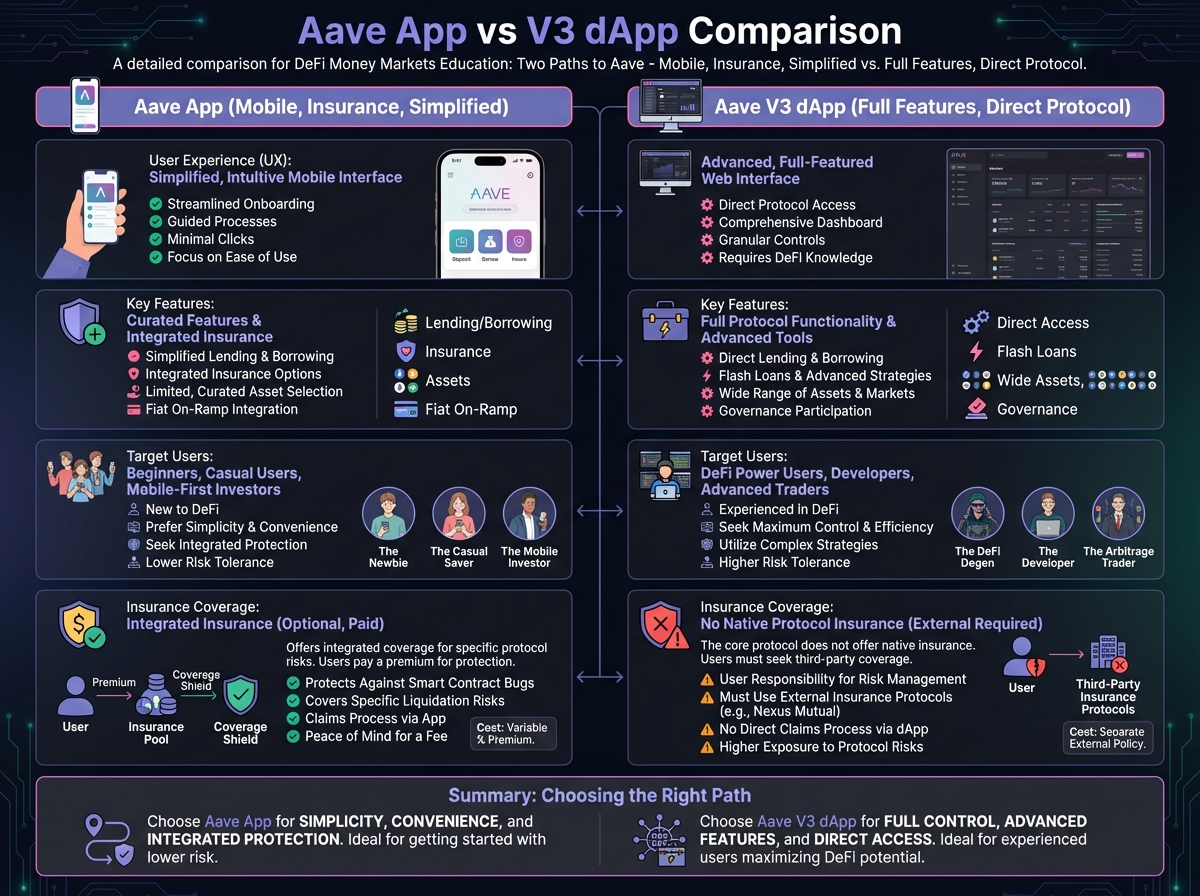
Path A: The Aave App (Recommended for Beginners)
The "DeFi Mullet" Strategy: Fintech in the front, DeFi in the back.
Features:
Mobile app (iOS, Android)
Clean, bank-like interface
Abstracts gas fees and complex signing
Critical: $1M insurance coverage per account
Yields: 5-9% APY on stablecoins
Best For:
Retail savers
Capital preservation focus
Users wanting insurance protection
Simplified yield earning
The Insurance Layer:
Coverage for smart contract failures
Coverage for technical exploits
Combines Umbrella Safety Module + external coverage
First-of-its-kind protection in DeFi
Path B: Aave V3 dApp (Direct Protocol)
Full Protocol Access:
Web interface at app.aave.com
Direct smart contract interaction
Can use crypto as collateral
Full feature access
Network Selection:
Recommended for beginners: Arbitrum or Base (low gas)
Advanced users: Ethereum Mainnet (maximum liquidity)
Available on: Ethereum, Arbitrum, Optimism, Base, Polygon, Avalanche, Scroll
Operational Guide:
Connect wallet
Switch to L2 (Arbitrum/Base)
Supply assets (toggle collateral OFF for supply-only)
Borrow (if desired, monitor Health Factor)
🛡️ Risk Management: Umbrella Safety Module
Automated Solvency Protection
Legacy Safety Module:
Users staked AAVE tokens
Slashing required governance vote (slow, political)
Risked tokens for assets they didn't use
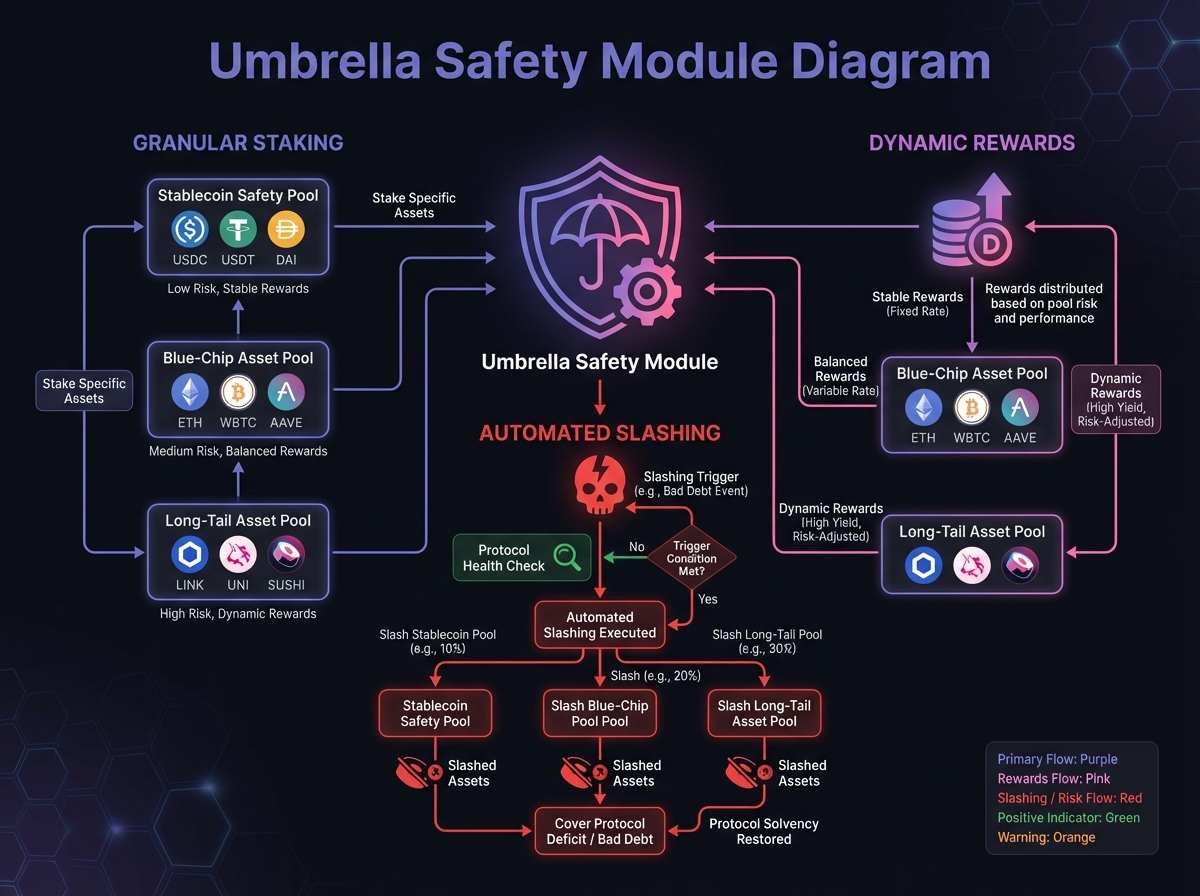
Umbrella Upgrade:
Automated slashing: Smart contracts detect deficits, slash immediately
Granular staking: Stake specific assets (aUSDC) to insure specific markets
Incentive alignment: Stakers protect what they understand
Dynamic rewards: Higher rewards for under-insured markets
How It Works:
Stake yield-bearing assets (aUSDC, aETH) into Safety Pools
Each pool covers specific asset classes
If bad debt occurs, relevant pool is slashed automatically
Creates internal insurance market
Risk Stewards: Real-Time Protection
The Problem: DAO governance takes 3-5 days; markets move in seconds.
The Solution: Risk Stewards (Chaos Labs) with automated oracles.
Capabilities:
Monitor liquidity depth on CEXs
Track on-chain volatility
Automatically adjust Supply/Borrow caps
Adjust interest rate curves based on utilization duration
Example: If CRV liquidity dries up on Binance, Risk Oracle lowers caps immediately to prevent manipulation attacks.
🏛️ Aave Horizon: The Institutional Bridge
The RWA Integration
Horizon Overview:
Permissioned deployment for Real-World Assets
Hybrid model: permissioned collateral, permissionless borrowing
$600M+ TVL by late 2025
How It Works:
Institutions tokenize U.S. Treasuries (e.g., BlackRock's BUIDL)
Use as collateral to borrow USDC/GHO
Permissionless side lends stablecoins to institutions
Brings "repo market" on-chain
Strategic Positioning:
Aave as settlement layer for tokenized economy
Major partnerships with tokenization firms
Expected exponential growth with regulatory clarity
💰 The GHO Ecosystem
The Native Stablecoin
GHO Features:
Native Aave stablecoin
Backed by collateral on Aave
Cross-chain via CCIP
Revenue engine for DAO
The Merit Program:
Incentivizes GHO usage
Expansion across chains
Integration with DeFi ecosystem
The "Chainsaw Arc": Financial Optimization
What Happened:
Aave DAO shut down 50%+ of underperforming L2 instances
Focused liquidity on high-revenue chains (Ethereum, Arbitrum, Base)
Dramatically improved profitability
Results:
Annualized revenue: ~$130M
Exceeds cash reserves of many competitors
Funds AAVE buybacks
Bolsters GHO stability
⚙️ Advanced Features and Modes
Isolation Mode Deep-Dive
When Assets Are Isolated:
Newer, volatile tokens
Lower liquidity assets
Experimental listings
Restrictions:
Can only borrow stablecoins
Cannot combine with other collateral
Limited flexibility during downturns
Why Avoid as Beginner:
If isolated asset crashes, you can't add ETH to shore up HF
Must repay debt or deposit more of falling asset
Higher risk concentration
E-Mode Deep-Dive
High Leverage, High Risk:
Up to 97% LTV for correlated assets
Designed for looping strategies
Example: Supply USDC → Borrow USDT → Swap → Repeat
The Danger:
USDC/USDT correlation is high but not 100%
Depeg events can trigger instant liquidations
Small 2-3% deviation = total loss at 97% LTV
For Beginners: Avoid E-Mode until you understand correlation risk and depeg scenarios.
📊 Operational Best Practices
For Supply-Only Positions
Choose stablecoins (USDC, USDT, DAI)
Toggle collateral OFF (zero liquidation risk)
Monitor APY (it fluctuates with utilization)
Use L2 (Arbitrum/Base for lower gas)
Start with Aave App (insurance coverage)
For Borrowing Positions
Maintain HF > 2.0 (absolute minimum: 1.5)
Use blue-chip collateral (ETH, WBTC, stablecoins)
Avoid Isolation Mode (unless you understand risks)
Monitor daily (prices and interest change)
Have exit plan (know how to add collateral/repay)
Network Selection
Beginners: Arbitrum or Base
Low gas costs ($0.20-1.00)
High liquidity
Same security as mainnet
Better for learning
Advanced: Ethereum Mainnet
Maximum liquidity
Highest security
Best for large positions ($50k+)
Higher gas costs ($20-100+)
🎓 Beginner's Corner: Getting Started with Aave
Step 1: Choose Your Path
Simple savings: Use Aave App (insurance, simple)
Full features: Use Aave V3 dApp (borrowing, advanced)
Step 2: Network Selection
Start on Arbitrum or Base (low gas)
Bridge funds from mainnet or withdraw from CEX
Step 3: First Position
Supply USDC only (stable, no volatility risk)
Toggle collateral OFF (zero liquidation risk)
Monitor for a week to understand system
Step 4: Graduation
Once comfortable, explore borrowing
Start with conservative HF (>2.0)
Use blue-chip collateral only
🔬 Advanced Deep-Dive: V4 Architecture Details
Dynamic Risk Configuration
Real-Time Adjustments:
LTV ratios adjust based on volatility
Liquidation thresholds adjust automatically
No governance vote needed
Responds to market conditions instantly
Example: If ETH volatility spikes, LTV automatically decreases to protect protocol and users.
Soft Liquidations
Traditional (Hard):
Liquidate entire position
Sell all collateral
Large penalty
V4 (Soft):
Liquidate only minimum needed
Partial collateral sale
Smaller penalty
User keeps remaining position
Benefit: Reduces punitive losses and improves user experience.
📈 Real-World Example: Aave Supply Position
Setup:
Supply: $10,000 USDC
Network: Arbitrum
APY: 5%
Collateral: OFF
After 1 Year:
aUSDC balance: ~10,500
Value: $10,500
Earnings: $500
Gas costs: ~$0.50 (on Arbitrum)
If APY Changes to 7%:
Your position automatically earns new rate
No action needed
Compound effect continues
Withdrawal:
Burn 10,500 aUSDC
Receive 10,500 USDC
Total cost: ~$0.50 gas
Net profit: ~$499.50
Interactive Protocol Comparison Tool
Compare Aave, Morpho, and Euler features side by side:
Launch Protocol Comparison Tool →
🔑 Key Takeaways
Aave is the market leader with $70B+ TVL and 60% market share
Two entry paths: Aave App (insurance, simple) or V3 dApp (full features)
V4 introduces Hub/Spoke architecture solving fragmentation
Umbrella Safety Module provides automated, granular protection
Start on L2 (Arbitrum/Base) for low gas costs
Supply stablecoins first with collateral OFF for zero risk
Horizon bridges RWA opening institutional access
Avoid E-Mode/Isolation until you understand risks
🚀 Next Steps
Lesson 6 explores Morpho's modular infrastructure—the efficient challenger to Aave's monolithic model. You'll learn about Morpho Blue, MetaMorpho vaults, and the curator economy.
Complete Exercise 5 to practice Aave position setup and optimization strategies.
Remember: Aave represents the safest, most established entry point. Master its interface and features before exploring more complex protocols.
← Back to Summary | Next: Exercise 5 → | Previous: Lesson 4 ←
Last updated