Lesson 6: Morpho - Modular Lending Infrastructure
🎯 Core Concept: From Optimizer to Infrastructure
Morpho represents the evolution from parasitic optimization to foundational infrastructure. Originally an optimizer layered on Aave/Compound, Morpho Blue transformed into an immutable, permissionless lending primitive that rivals Aave's efficiency while offering superior capital utilization and risk isolation.
Key Innovation: Decouples risk management from lending execution—functions less like a bank, more like an operating system for credit.
📈 Evolution: Optimizer to Blue
Phase I: The Morpho Optimizer
What It Was:
Peer-to-peer matching engine on top of Aave/Compound
Matched lenders directly with borrowers
Set rates at midpoint of pool rates
Fallback to underlying pools when no match
Success & Limitations:
✅ Achieved $2B+ in deposits
✅ Proved efficiency demand exists
❌ Growth ceiling (never exceed base protocols)
❌ Inherited systemic risks of base layers
Phase II: Morpho Blue (V2)
The Paradigm Shift:
Permissionless, immutable primitive
Non-upgradeable singleton contract (~650 lines)
No DAO bottleneck for listings
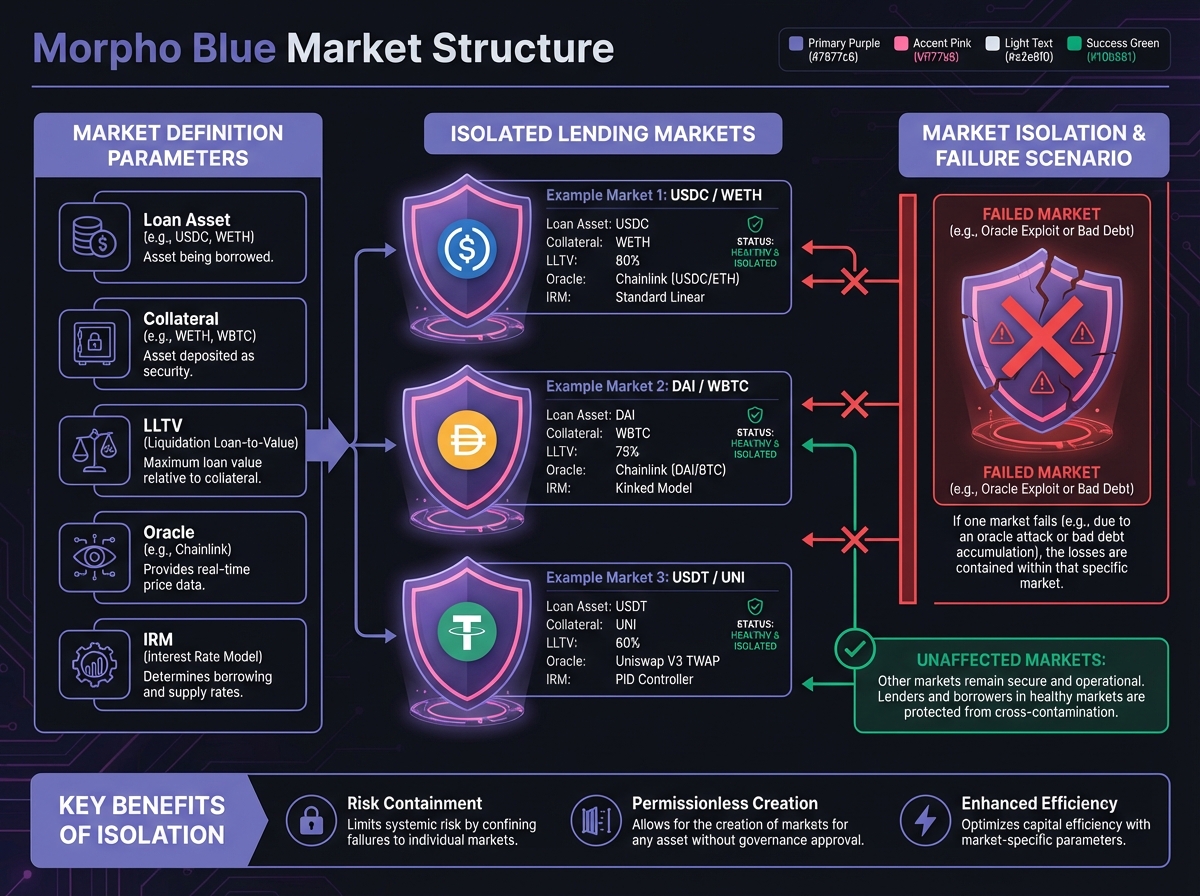
Markets isolated by design
🏗️ Morpho Blue Architecture
The Singleton Contract
Design Philosophy: "Uniswap V2 of Lending"
Single contract for all markets
~70% gas savings vs multi-contract systems
Free flashloans across all markets
Internal accounting reduces state updates
Isolated Lending Markets
Market Definition (5 immutable parameters):
Loan Asset (e.g., USDC)
Collateral Asset (e.g., WETH)
Liquidation LTV (LLTV)
Oracle address
Interest Rate Model (IRM)
Key Point: Once created, parameters cannot be changed. Provides "hard-coded trust" for developers.
Oracle Agnosticism
Flexibility:
Any contract implementing IOracle interface
Hardcoded prices for stablecoin pairs (eliminates manipulation risk)
TWAPs for RWAs
Specialized feeds for long-tail assets
Responsibility: Market creator/curator must verify oracle security (not protocol-enforced).
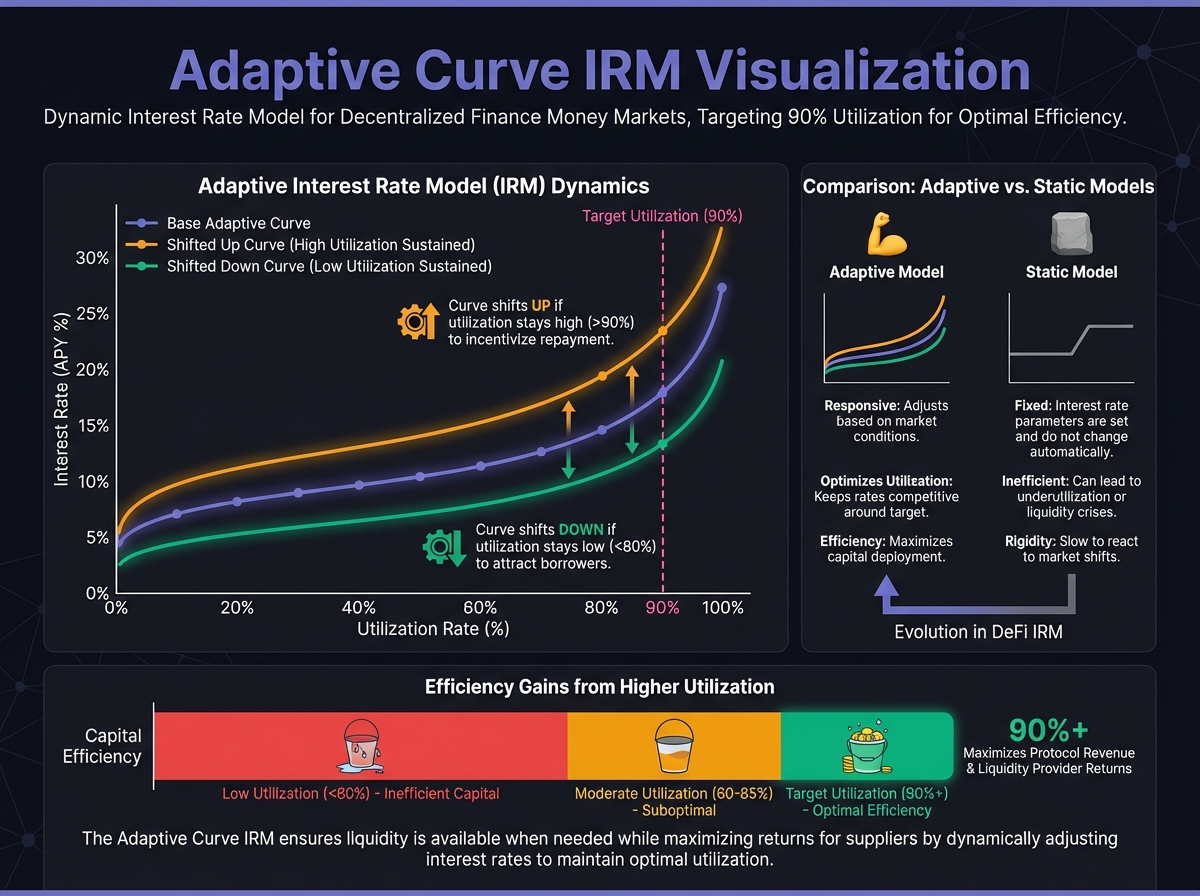
Adaptive Curve IRM
Innovation: Curve adjusts to target utilization (typically 90%)
How It Works:
If utilization > 90%: Curve shifts up (higher rates)
If utilization < 90%: Curve shifts down (lower rates)
Maintains high utilization without liquidity crisis
Result:
90% utilization vs Aave's 45-60%
Narrower spread (less idle capital)
Higher capital efficiency


📦 MetaMorpho Vaults: The Curation Layer
The User Experience Problem
The Challenge: With thousands of isolated markets, how does a retail user choose?
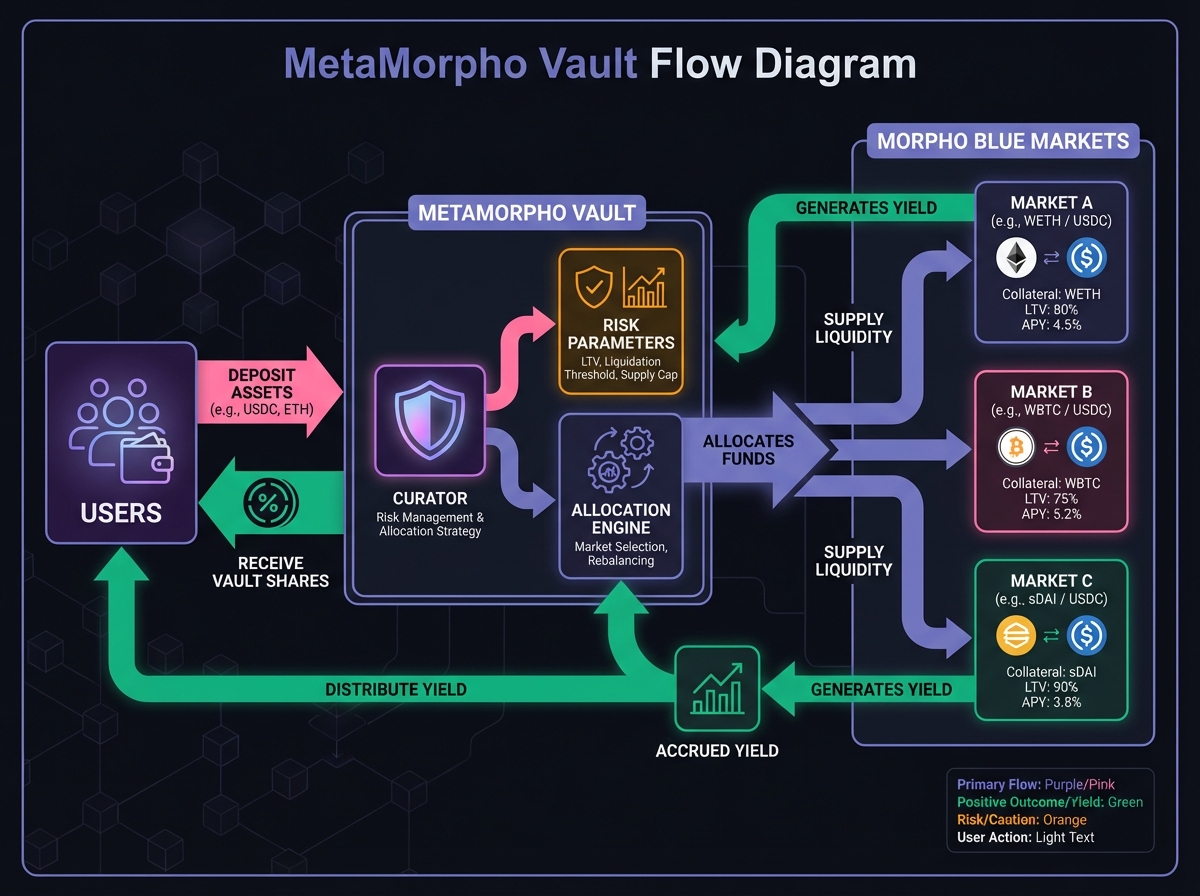
The Solution: MetaMorpho Vaults—ERC-4626 compliant vaults managed by Curators.
How Vaults Work
Mechanism:
Curator (e.g., Gauntlet, Steakhouse) creates vault
Sets risk policy and allocation logic
Users deposit USDC into vault
Curator allocates across Morpho Blue markets
Users receive vault shares (receipt tokens)
Example: "Gauntlet USDC Prime" vault deposits funds across multiple blue-chip Morpho markets.
The Curator Economy
Risk-as-a-Service (RaaS):
Professional risk managers compete
Users choose curators based on track record
Marketplace for risk management
Major Curators:
Gauntlet: Blue-chip focus, conservative LTVs
Steakhouse Financial: Transparent reporting, RWA integration
RE7 Capital: Specialized strategies
Centralization Concern: Top 10 curators control 65%+ of liquidity. Protocol decentralized, but aggregation layer becoming oligopoly.
Vault Selection Criteria
What to Check:
Guardian Address: Can veto curator updates or pause vault
Timelock: 24-48 hour delay on parameter changes
Curator Track Record: Historical performance, transparency
Idle Liquidity: >10% for instant withdrawals
Risk Reports: Public analysis of allocations

💧 Risk Isolation & Bad Debt
Market-Level Isolation
How It Works:
Each market operates independently
Bad debt in one market doesn't affect others
Lenders in failing market take losses, others unaffected
Example: If a niche memecoin market fails:
Only lenders in that specific market lose funds
USDC/ETH markets remain completely safe
Protocol continues operating
Unrealized Bad Debt Tracking
Protection Mechanism:
Protocol tracks unrealized bad debt
Curators can proactively withdraw from stressed markets
Prevents crystallization of losses
Primary defense line against insolvency
⚠️ Operational Considerations
Idle Liquidity Risk
The Problem:
Vault has 0% idle liquidity (all lent out)
You try to withdraw
Transaction fails—no liquidity available
The Solution: Only deposit in vaults maintaining >10% idle liquidity for instant withdrawals.
Curator Risk
What to Monitor:
Curator allocation changes
Parameter updates (check timelock)
Performance metrics
Community discussions
Red Flags:
No guardian address
No timelock on changes
Opaque risk reporting
Sudden allocation shifts to high-risk markets
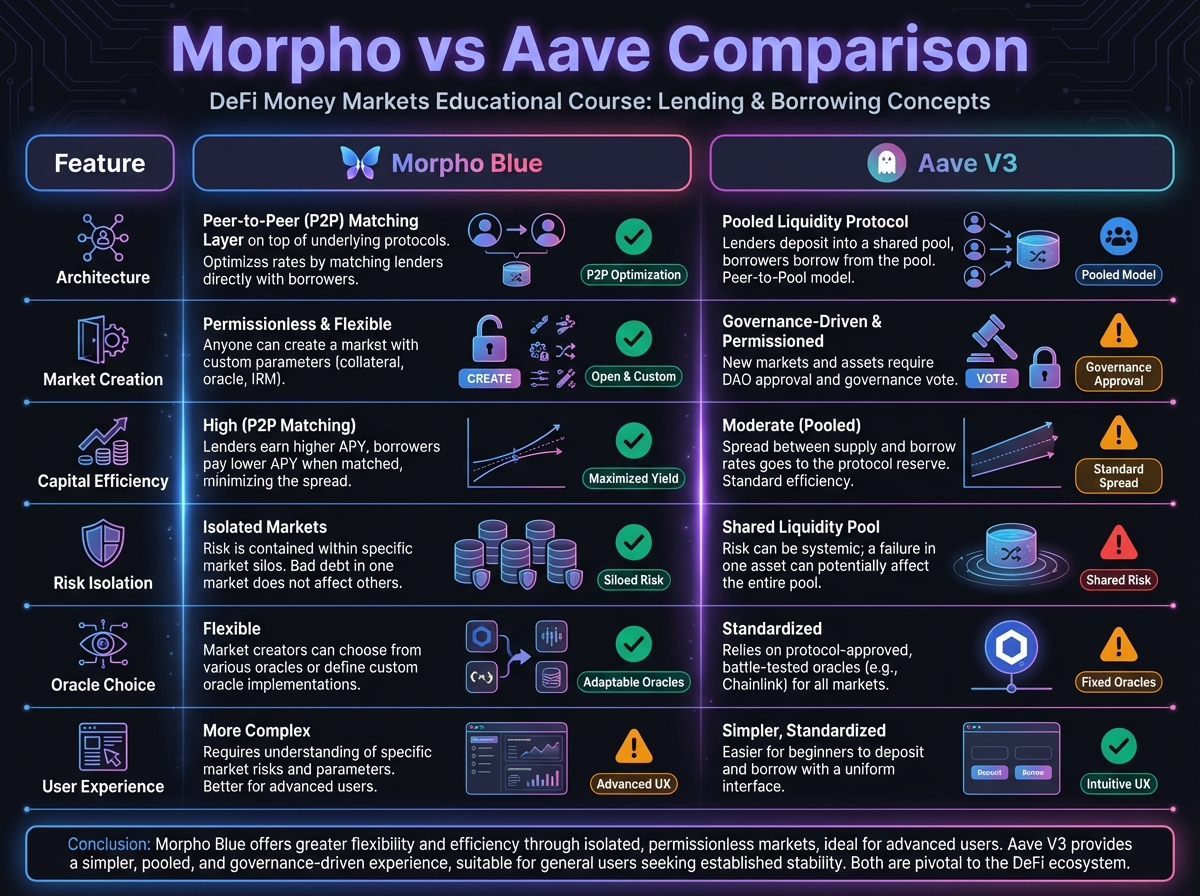
📊 Comparing Morpho vs Aave
Architecture
Monolithic pools
Isolated markets
Market Creation
DAO governance
Permissionless
Capital Efficiency
45-60% utilization
90%+ utilization
Risk Isolation
Asset-level (Isolation Mode)
Market-level (complete)
Oracle Choice
Primarily Chainlink
Oracle agnostic
User Experience
Direct protocol
Vault-based (curated)
Gas Efficiency
Higher
~70% lower

🎯 When to Use Morpho
Best For:
✅ Higher yield seekers
✅ Users comfortable with curator selection
✅ Advanced users wanting capital efficiency
✅ Long-tail asset lending
Not Ideal For:
❌ Absolute beginners (start with Aave)
❌ Users wanting simplicity
❌ Those uncomfortable with curator risk
🚀 Getting Started with Morpho
Step 1: Choose a Vault
Recommended for Beginners:
Gauntlet Prime vaults (blue-chip focus)
High idle liquidity (>15%)
Established curator track record
Step 2: Due Diligence
Check vault documentation
Review curator's risk reports
Verify guardian address exists
Check timelock duration
Review historical performance
Step 3: Deposit
Navigate to Morpho interface
Select vault
Review parameters
Deposit assets
Receive vault shares
Step 4: Monitor
Check idle liquidity regularly
Monitor curator updates
Review performance vs expectations
🎓 Beginner's Corner
Q: Do I need to understand all Morpho Blue markets? A: No. Vaults abstract this complexity. Choose a reputable curator vault.
Q: Is Morpho riskier than Aave? A: Market-level isolation means individual market failures are contained. However, curator selection requires due diligence.
Q: What if my curator makes a bad decision? A: Guardian addresses can veto, timelocks allow withdrawal windows. Always check these exist.
🔬 Advanced Deep-Dive: Efficiency Gains
Why Morpho Achieves Higher Utilization
Traditional Pools (Aave):
Need reserves for withdrawals
Average utilization: 50%
Half capital idle
Morpho Markets:
Peer-to-peer matching where possible
Targets 90% utilization
Only 10% idle
Mathematical Result: Narrower spread = higher supply rates for same borrow demand.
📈 Real-World Example
Scenario: Lending USDC on Aave vs Morpho
Aave:
Utilization: 60%
Supply APY: 4%
Borrow APY: 6%
Morpho (via Gauntlet vault):
Utilization: 90%
Supply APY: 5.5%
Borrow APY: 6.2%
Difference: 1.5% extra yield for lenders with same borrow demand.
🎯 Key Takeaways
Morpho Blue is an immutable, permissionless primitive
MetaMorpho vaults simplify user experience via curation
Risk isolation occurs at market level, not protocol level
Higher utilization (90%+) means better yields
Curator selection is critical—do due diligence
Check idle liquidity before depositing (>10% target)
🚀 Next Steps
Lesson 7 explores Euler v2—another modular protocol with unique customization capabilities, including sub-accounts and advanced risk configurations.
Complete Exercise 6 to practice Morpho market analysis and vault selection.
Remember: Morpho offers efficiency but requires understanding curators and vault selection. Master these concepts to optimize yields safely.
← Back to Summary | Next: Exercise 6 → | Previous: Lesson 5 ←
Last updated