Exercise 1: Perpetual Futures Knowledge Assessment
⏰ Time Investment: 30-45 minutes 🎯 Goal: Test your understanding of perpetual futures fundamentals and identify knowledge gaps
📚 Required Reading Integration 📖 Primary: Lesson 1: Understanding Perpetual Futures Fundamentals 📖 Supporting: Lesson 2: The Mathematics of Perpetual Trading
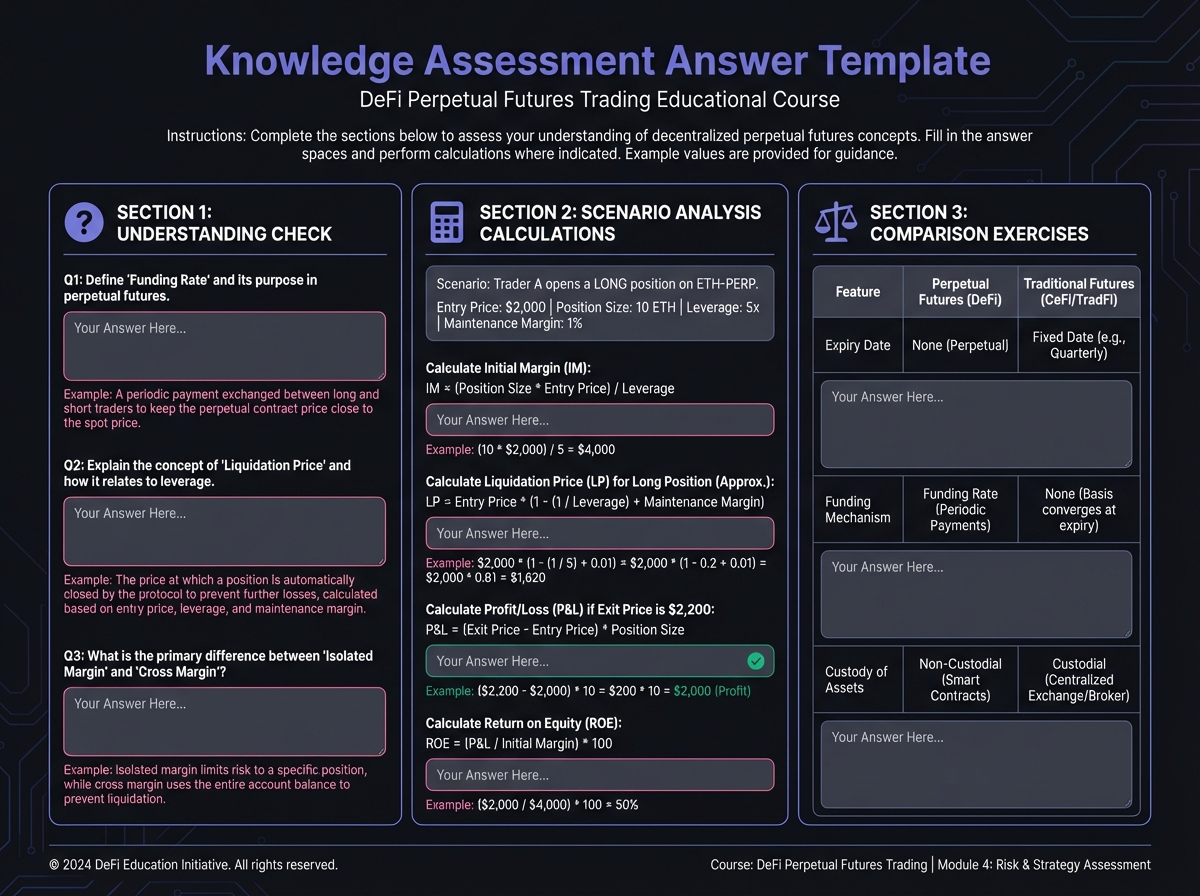
🔍 Phase 1: Knowledge Check (10 minutes)
Understanding Check
Answer these questions to assess your comprehension:
1. What is the fundamental difference between perpetual futures and traditional futures?
Your answer: _________________________________
2. How do funding rates keep perpetual prices aligned with spot prices?
Your answer: _________________________________
3. What happens when funding rate is positive and you're holding a long position?
Your answer: _________________________________
4. What is the difference between isolated margin and cross margin?
Your answer: _________________________________
5. Why can perpetual futures exist without expiration dates?
Your answer: _________________________________
📊 Phase 2: Scenario Analysis (15 minutes)
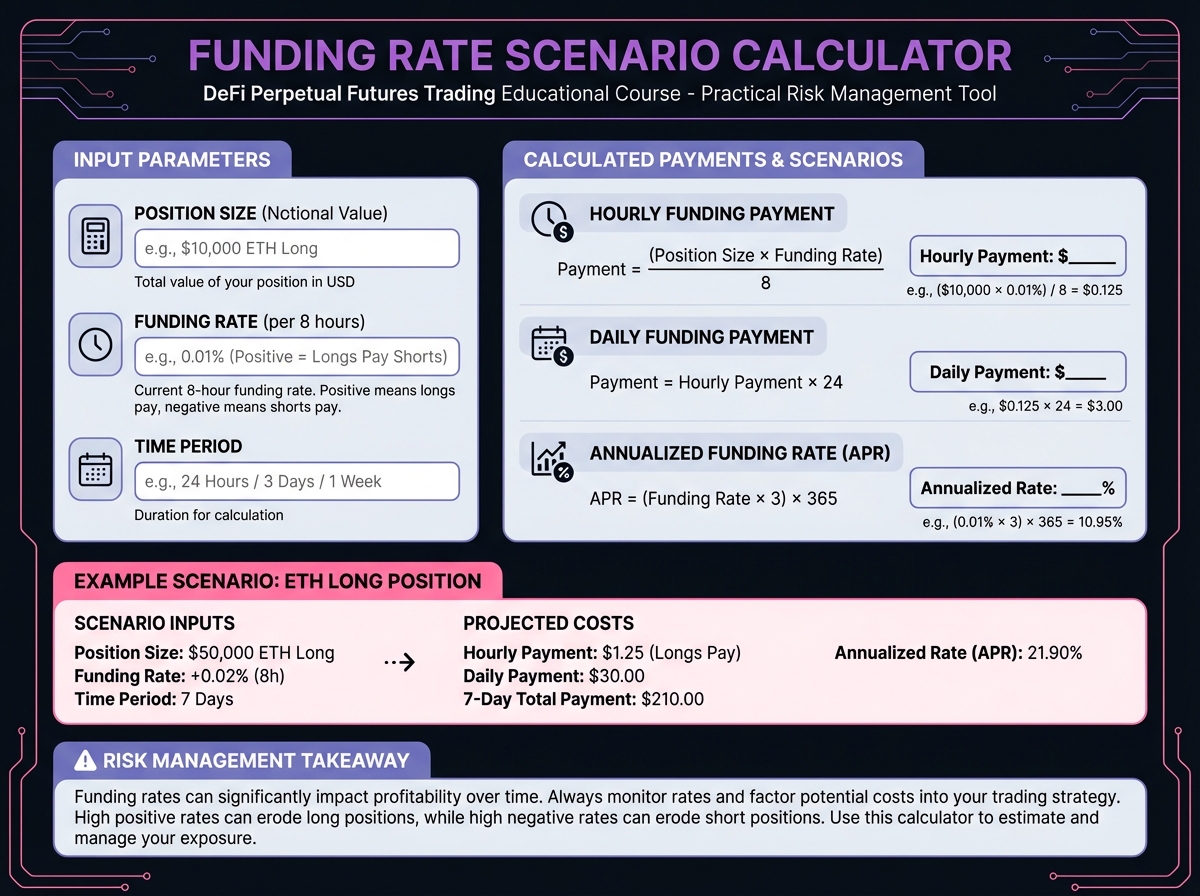
Funding Rate Scenario
Scenario: You're considering a long ETH perpetual position.
Market Conditions:
ETH Spot Price: $2,500
ETH Perpetual Price: $2,550
Funding Rate: 0.02% per hour (positive)
Your Position: $10,000 notional (5x leverage on $2,000 margin)
Exercise 1: Calculate the funding cost:
Hourly payment: $_______
Daily payment (24 hours): $_______
Annualized rate: _______%
Exercise 2: If ETH price stays flat at $2,500 for 7 days, what is your net P&L?
Funding paid over 7 days: $_______
Price movement: $_______
Net P&L: $_______
ROI: _______%
Exercise 3: What does this tell you about the importance of funding rates?
Your answer: _________________________________
Leverage Scenario
Scenario: You want to open a position with different leverage levels.
Setup:
Available Margin: $1,000
Entry Price: $2,500
Maintenance Margin: 0.5%
Exercise 4: Calculate position size and liquidation price for each leverage:
2x
$_______
$_______
_______%
5x
$_______
$_______
_______%
10x
$_______
$_______
_______%
Exercise 5: Which leverage would you choose for your first trade and why?
Your choice: _______
Reasoning: _________________________________
💡 Phase 3: Risk Identification (10 minutes)
Common Mistakes Exercise
Identify the mistake in each scenario:
Scenario 1: Trader opens 20x long position on ETH, thinking "I'm safe until price drops 5%."
The Mistake: _________________________________
Why It's Wrong: _________________________________
Scenario 2: Trader holds long position for 30 days, pays 0.01% per hour funding, says "funding is negligible."
The Mistake: _________________________________
Why It's Wrong: _________________________________
Scenario 3: Trader uses cross margin for first trade, opens long BTC and long ETH, both get liquidated when market crashes.
The Mistake: _________________________________
Why It's Wrong: _________________________________
📝 Phase 4: Key Concepts Review (10 minutes)
Fill in the Blanks
1. Perpetual futures use _______________ to keep prices aligned with spot, instead of expiration dates.
2. When perpetual price is above spot price, _______________ positions pay _______________ positions.
3. With _______________ margin, your maximum loss is limited to the margin you allocate to that position.
4. _______________ amplifies both profits and losses, making liquidation risk higher.
5. The _______________ is the price at which your position will be automatically closed by the protocol.
True or False
1. Perpetual futures never expire. (True / False)
2. Funding rates are always paid by long positions. (True / False)
3. Higher leverage always means higher profits. (True / False)
4. Isolated margin is safer than cross margin for beginners. (True / False)
5. You can lose more than your margin with isolated margin. (True / False)
✅ Self-Assessment
Rate your understanding (1 = Need more review, 5 = Fully understand):
Areas needing more review: _________________________________
🎯 Next Steps
If you scored < 4 on any topic:
Review Lesson 1 material on that topic
Re-read the Beginner's Corner sections
Practice calculations from Lesson 2
Look up additional resources on unclear concepts
If all topics ≥ 4:
Proceed to Exercise 2 (Calculation Practice)
Move forward with confidence!
Last updated