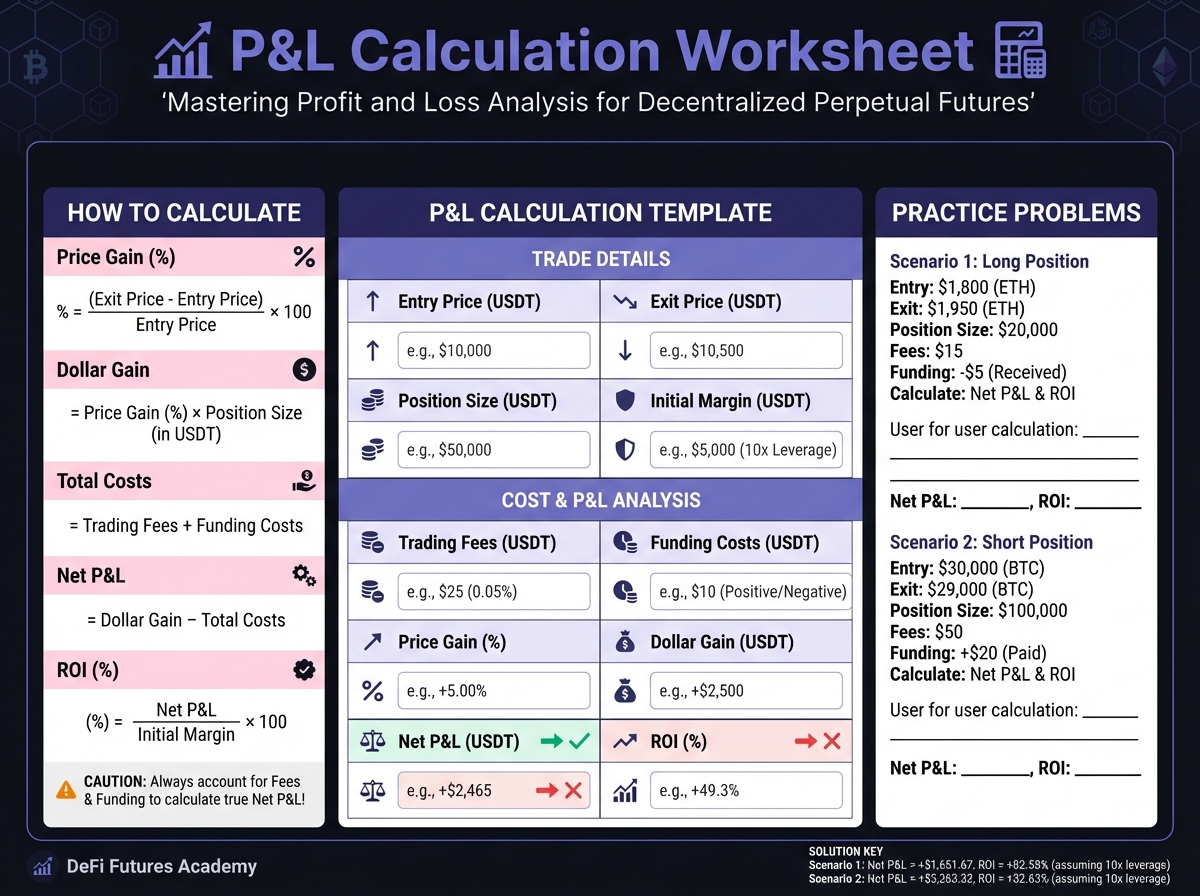
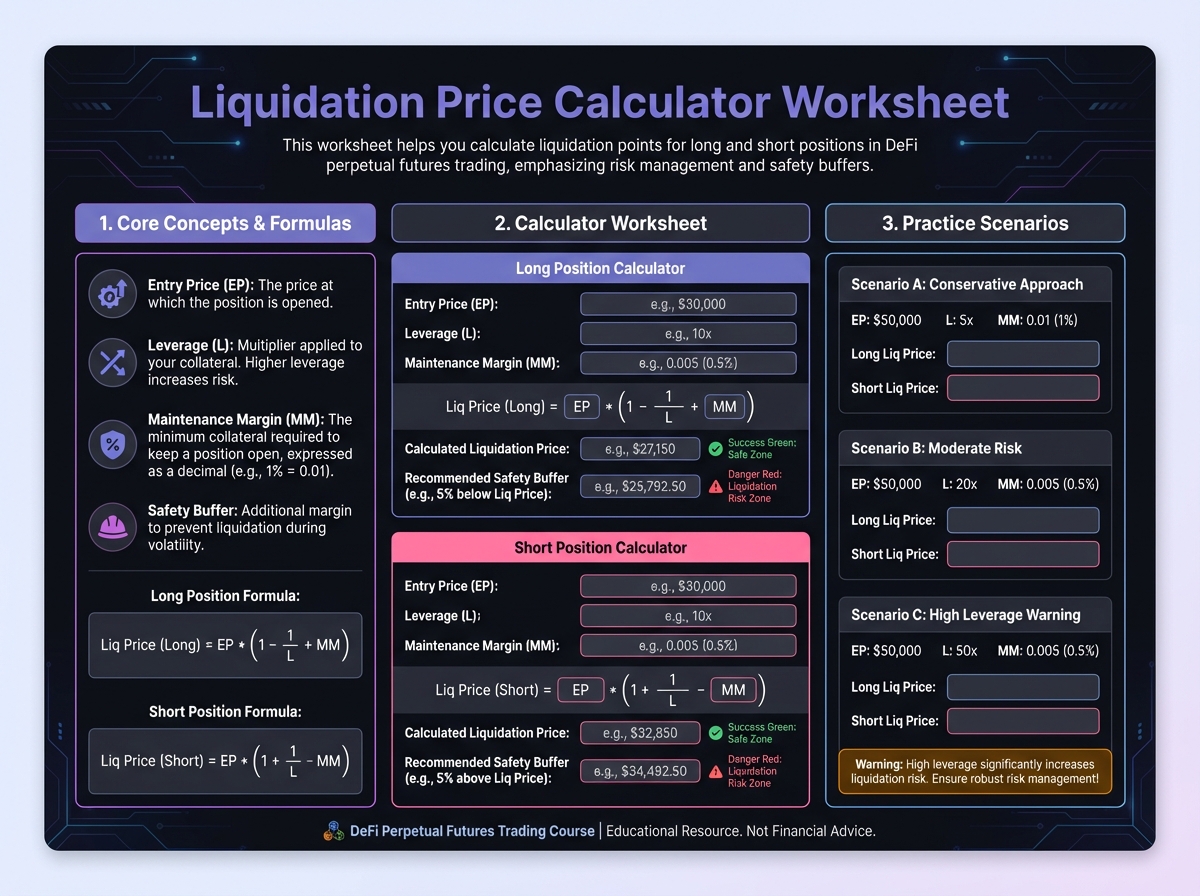
Exercise 2: Calculation Practice and Risk Metrics
⏰ Time Investment: 45-60 minutes 🎯 Goal: Master the mathematical calculations needed for safe perpetual trading
📚 Required Reading Integration 📖 Primary: Lesson 2: The Mathematics of Perpetual Trading 📖 Supporting: Lesson 1: Understanding Perpetual Futures Fundamentals
🔢 Phase 1: Funding Rate Calculations (15 minutes)
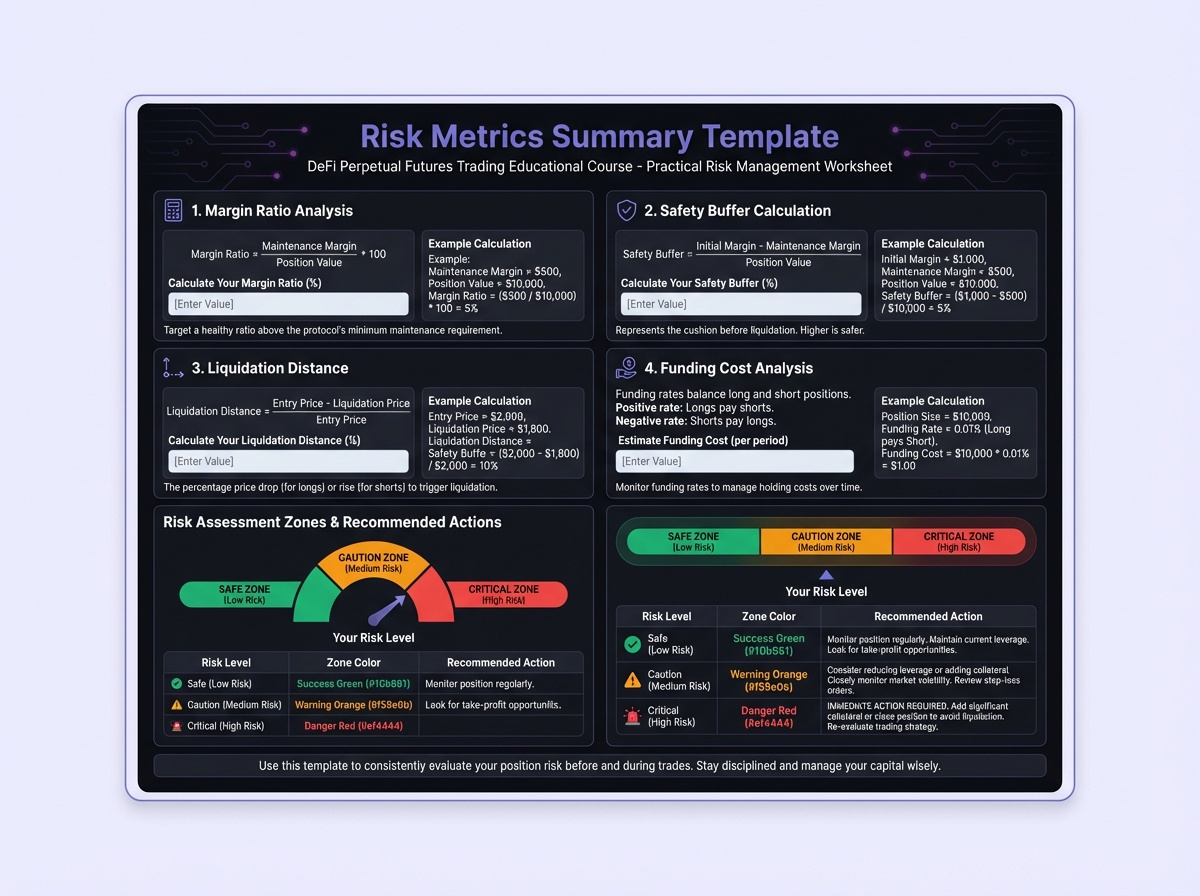


Exercise 1: Basic Funding Payment
Scenario: Long ETH perpetual position
Position Size: $5,000
Funding Rate: 0.01% per hour
Holding Period: 12 hours
Calculate:
Hourly payment: $_______
Total payment (12 hours): $_______
Annualized rate: _______%
Exercise 2: Funding Cost Comparison
Compare funding costs across different rates:
0.005%
$_______
$_______
$_______
_______%
0.01%
$_______
$_______
$_______
_______%
0.02%
$_______
$_______
$_______
_______%
Position: $10,000 notional size
Question: Which funding rate would make a trade unprofitable if price only moves 1% in your favor over 7 days?
Your answer: _________________________________
Exercise 3: Break-Even Analysis
Setup:
Position Size: $8,000
Trading Fees: 0.05% ($4)
Funding Rate: 0.015% per hour
Holding Period: 48 hours
Calculate:
Total fees: $_______
Total funding: $_______
Total costs: $_______
Break-even price movement: _______%
Interpretation: You need at least _______% price movement just to break even.
📊 Phase 2: Margin and Leverage Calculations (15 minutes)
Exercise 4: Position Sizing
Scenario: You have $2,000 available for trading
Calculate position size for each leverage:
2x
$_______
$_______
5x
$_______
$_______
10x
$_______
$_______
Question: If you want to risk only $500, what leverage should you use for a $2,000 position?
Your answer: _______
Exercise 5: Liquidation Price Calculations
Scenario: Long ETH position
Entry Price: $2,500
Margin: $1,000
Leverage: 10x
Maintenance Margin: 0.5%
Calculate:
Position Size: $_______
Liquidation Price: $_______
Safety Buffer: _______%
Scenario: Short ETH position
Entry Price: $2,500
Margin: $1,000
Leverage: 10x
Maintenance Margin: 0.5%
Calculate:
Position Size: $_______
Liquidation Price: $_______
Safety Buffer: _______%
Exercise 6: Margin Ratio Analysis
Current Position:
Position Size: $10,000
Current Margin: $1,500
Entry Price: $2,500
Current Price: $2,400
Calculate:
Current Margin Ratio: _______%
Unrealized P&L: $_______
Remaining Margin: $_______
New Margin Ratio: _______%
Distance to Liquidation: _______%
⚠️ Phase 3: Risk Assessment (15 minutes)
Exercise 7: Liquidation Risk Analysis
Position Details:
Long BTC at $50,000
Margin: $5,000
Leverage: 10x
Maintenance Margin: 0.5%
Calculate:
Position Size: $_______
Liquidation Price: $_______
Maximum Drawdown Before Liquidation: _______%
Risk Scenarios:
-5%
$_______
$_______
_______%
_______
-8%
$_______
$_______
_______%
_______
-9%
$_______
$_______
_______%
_______
-10%
$_______
$_______
_______%
_______
Exercise 8: Funding Rate Impact
Scenario: Holding long position during high funding period
Setup:
Position Size: $20,000
Funding Rate: 0.02% per hour (very high)
Holding Period: 30 days
Calculate:
Daily funding cost: $_______
30-day funding cost: $_______
Annualized rate: _______%
Question: If ETH only moves 2% in your favor over 30 days, what is your net P&L?
Price gain: $_______
Funding cost: $_______
Net P&L: $_______
ROI: _______%
Interpretation: Is this trade profitable? (Yes / No)
Reasoning: _________________________________
💰 Phase 4: Profit and Loss Calculations (15 minutes)
Exercise 9: Complete P&L Analysis
Long Position:
Entry: $2,500
Exit: $2,600
Position Size: $10,000 (5x leverage on $2,000 margin)
Trading Fees: 0.05% (entry + exit = $10)
Funding: 0.01% per hour for 48 hours
Calculate:
Price gain: $_______
Trading fees: $_______
Funding costs: $_______
Net P&L: $_______
ROI on margin: _______%
Exercise 10: Short Position P&L
Short Position:
Entry: $2,500
Exit: $2,400
Position Size: $8,000 (4x leverage on $2,000 margin)
Trading Fees: 0.05% (entry + exit = $8)
Funding: -0.005% per hour (you receive) for 72 hours
Calculate:
Price gain: $_______
Trading fees: $_______
Funding received: $_______
Net P&L: $_______
ROI on margin: _______%
Exercise 11: Break-Even Price
Setup:
Long ETH at $2,500
Position Size: $10,000
Margin: $2,000
Trading Fees: 0.05% ($10 total)
Funding: 0.01% per hour
Target Holding: 7 days
Calculate:
Total funding (7 days): $_______
Total costs: $_______
Break-even price: $_______
Break-even price movement: _______%
Question: If you exit at $2,550, what is your net profit?
Your calculation: _________________________________
Net profit: $_______
📈 Phase 5: Position Management Scenarios (15 minutes)
Exercise 12: Adding Margin
Current Position:
Entry: $2,500
Current Price: $2,450
Position Size: $10,000
Current Margin: $1,000
Leverage: 10x
Liquidation Price: $2,250
You add $500 margin:
Calculate:
New Total Margin: $_______
New Position Size: $_______ (unchanged)
New Leverage: _______x
New Liquidation Price: $_______
New Safety Buffer: _______%
Question: How much did the safety buffer improve?
Improvement: _______%
Exercise 13: Partial Close
Current Position:
Entry: $2,500
Current Price: $2,600
Position Size: $10,000
Margin: $2,000
Unrealized P&L: +$400
You close 50% of position:
Calculate:
Amount closed: $_______
Realized P&L: $_______
Remaining Position Size: $_______
Remaining Margin: $_______
Remaining Unrealized P&L: $_______
✅ Self-Assessment
Rate your calculation skills (1 = Need more practice, 5 = Fully confident):
Areas needing more practice: _________________________________
🎯 Next Steps
If you struggled with any calculations:
Review Lesson 2 formulas
Practice with different scenarios
Use a spreadsheet to verify answers
Re-calculate until confident
If all calculations correct:
Proceed to Exercise 3 (Architecture Analysis)
You're ready for practical trading!
Last updated