Exercise 3: Architecture Analysis and Selection
⏰ Time Investment: 30-45 minutes 🎯 Goal: Learn to identify protocol architectures and select the right one for your strategy
📚 Required Reading Integration 📖 Primary: Lesson 3: Architecture Types and Market Structure 📖 Supporting: Lesson 1: Understanding Perpetual Futures Fundamentals
🔍 Phase 1: Architecture Identification (10 minutes)

Exercise 1: Protocol Classification
Classify each protocol by architecture type:
Hyperliquid
_______
_______
GMX V2
_______
_______
dYdX v4
_______
_______
Drift Protocol
_______
_______
Perpetual Protocol
_______
_______
Vertex
_______
_______
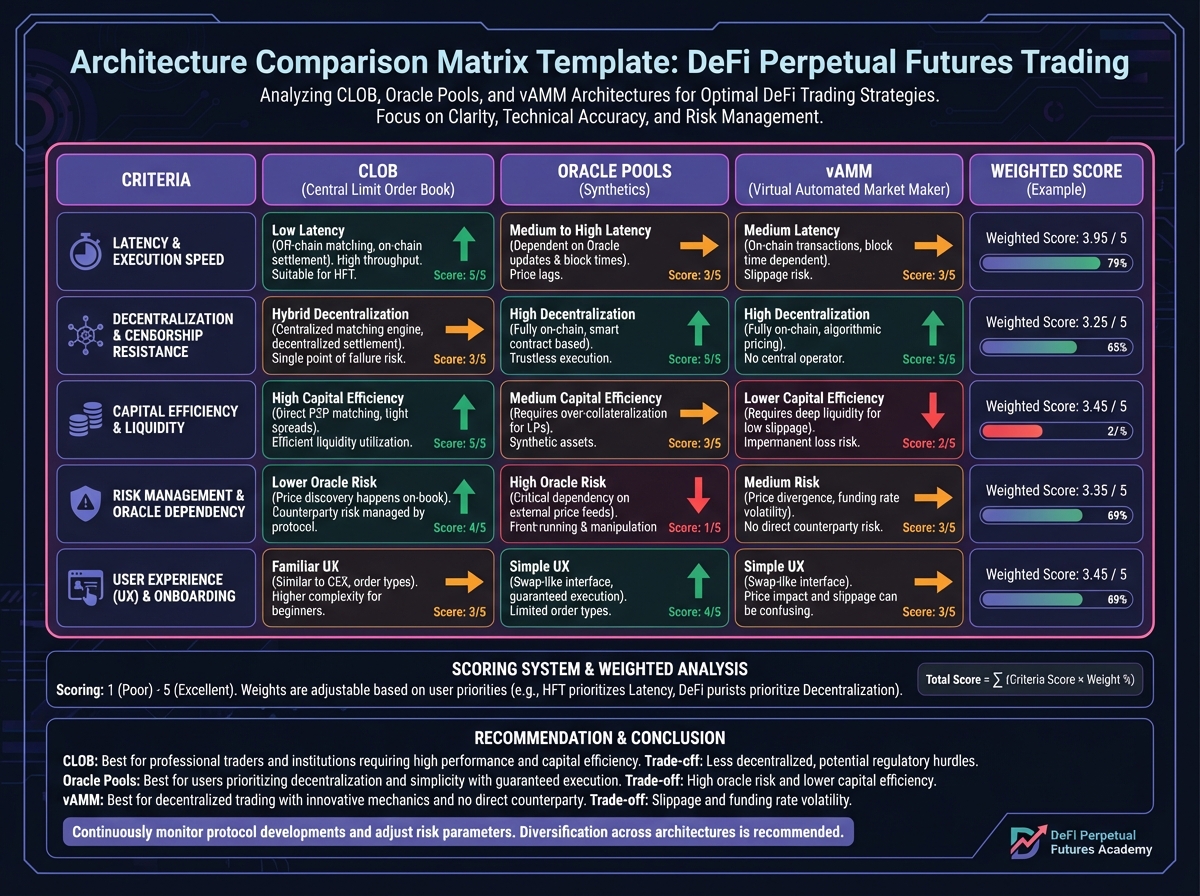
Exercise 2: Architecture Characteristics
Fill in the table comparing architectures:
Price Discovery
_______
_______
_______
Slippage
_______
_______
_______
Liquidity Source
_______
_______
_______
Trader Experience
_______
_______
_______
Main Risk
_______
_______
_______
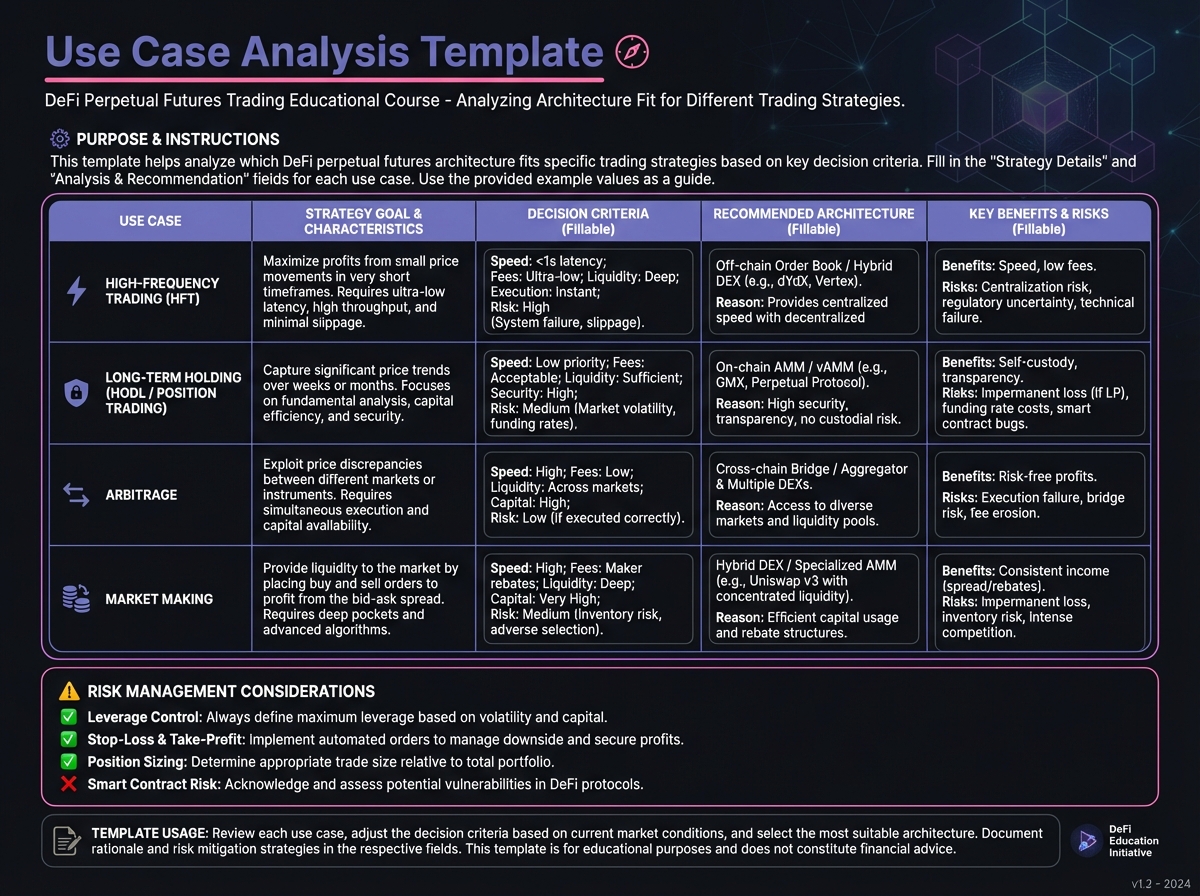
📊 Phase 2: Use Case Matching (15 minutes)
Exercise 3: Strategy to Architecture Matching
Match each trading strategy to the best architecture:
Strategies:
Large position trading ($100k+)
Scalping (many small trades)
Funding rate arbitrage
Limit order trading
Simple swap-like execution
Architectures:
A. CLOB
B. Oracle Pools
C. vAMM
Large position trading
_______
_______
Scalping
_______
_______
Funding rate arbitrage
_______
_______
Limit order trading
_______
_______
Simple execution
_______
_______
Exercise 4: Risk Assessment by Architecture
Scenario: You want to open a $50,000 long ETH position
Analyze risks for each architecture:
CLOB (Hyperliquid):
Primary Risk: _________________________________
How to Mitigate: _________________________________
Oracle Pool (GMX):
Primary Risk: _________________________________
How to Mitigate: _________________________________
vAMM (Perpetual Protocol):
Primary Risk: _________________________________
How to Mitigate: _________________________________
Question: Which architecture would you choose and why?
Your choice: _______
Reasoning: _________________________________
💡 Phase 3: Real-World Scenario Analysis (15 minutes)
Exercise 5: Protocol Selection Scenario
Your Situation:
Trading Experience: Beginner (first 10 trades)
Capital: $5,000
Strategy: Swing trading (hold 3-7 days)
Priority: Safety and simplicity
Options:
Option A: GMX V2 (Oracle Pool)
Zero slippage
Simple interface
Oracle risk
Good liquidity
Option B: Hyperliquid (CLOB)
Limit orders
CEX-like experience
Slippage on large orders
Very fast execution
Option C: Drift (Hybrid)
Multiple liquidity sources
More complex
Solana ecosystem
Good for active trading
Exercise: Rank these options (1 = Best, 3 = Least suitable):
Option A: ___
Option B: ___
Option C: ___
Reasoning for #1: _________________________________
Exercise 6: Architecture Comparison Matrix
Create a comparison for your use case:
Your Use Case: [Fill in your trading style]
Execution Speed
High/Med/Low
Slippage
High/Med/Low
Complexity
High/Med/Low
Risk Profile
High/Med/Low
Capital Efficiency
High/Med/Low
Best Match: _______
Why: _________________________________
📝 Phase 4: Hybrid Architecture Understanding (10 minutes)
Exercise 7: Drift's Liquidity Trifecta
Question: How does Drift's three-layer system protect LPs?
JIT Auction: _________________________________
DLOB: _________________________________
DAMM: _________________________________
Question: Why is this better than a simple AMM?
Your answer: _________________________________
Exercise 8: GMX V2 Evolution
Question: Why did GMX move from unified pool (GLP) to isolated pools (GM)?
Your answer: _________________________________
Question: What are the benefits and drawbacks?
_______
_______
_______
_______
✅ Self-Assessment
Rate your understanding (1 = Need more review, 5 = Fully understand):
Areas needing more review: _________________________________
🎯 Next Steps
If you scored < 4 on any topic:
Review Lesson 3 architecture sections
Study the comparison table
Research specific protocols
Practice identifying architectures
If all topics ≥ 4:
Proceed to Exercise 4 (First Position Setup)
You're ready to open your first position!
Last updated