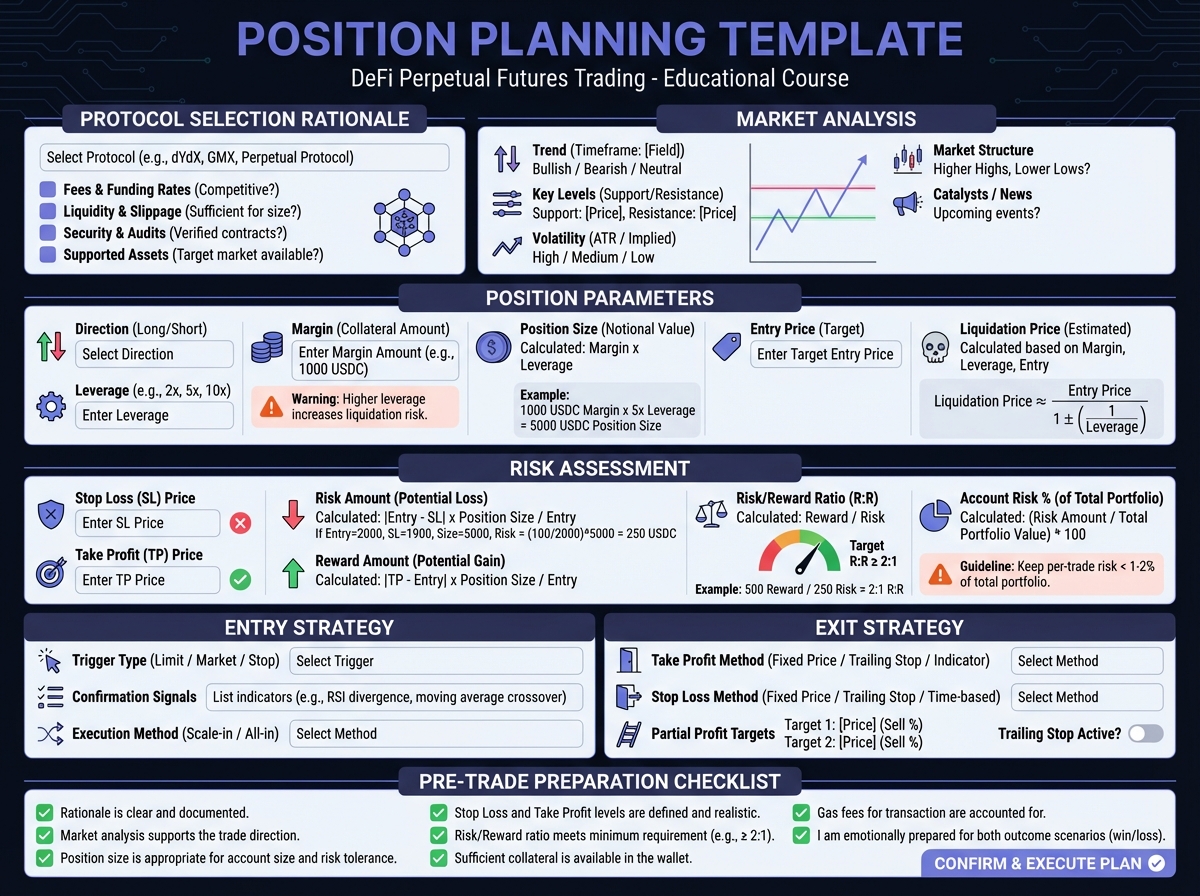
Exercise 4: First Position Setup and Management

⏰ Time Investment: 45-60 minutes 🎯 Goal: Create a complete plan for your first perpetual position with proper risk management

📚 Required Reading Integration 📖 Primary: Lesson 4: Your First Perpetual Position 📖 Supporting: Lesson 2: The Mathematics of Perpetual Trading, Lesson 3: Architecture Types

📋 Phase 1: Pre-Trade Planning (15 minutes)

Exercise 1: Position Planning Worksheet

Fill out this worksheet before opening any position:

Protocol Selection:

  • Chosen Protocol: _______

  • Architecture Type: _______

  • Why this protocol: _________________________________

Market Selection:

  • Trading Pair: _______

  • Current Spot Price: $_______

  • Current Perpetual Price: $_______

  • Funding Rate: _______% per hour

  • Annualized Funding: _______%

Position Configuration:

  • Direction: Long / Short

  • Available Capital: $_______

  • Risk Per Trade: _______% (recommended: 1-5%)

  • Margin to Use: $_______

  • Leverage: _______x

  • Position Size: $_______

Risk Parameters:

  • Entry Price: $_______

  • Liquidation Price: $_______

  • Safety Buffer: _______%

  • Stop Loss: $_______

  • Take Profit: $_______

Exercise 2: Pre-Trade Checklist

Complete this checklist before executing:

Any unchecked items? List them and address before trading:

📊 Phase 2: Position Setup Calculations (15 minutes)

Exercise 3: Complete Position Math

Your Plan:

  • Protocol: GMX V2

  • Market: ETH/USD

  • Direction: Long

  • Available Capital: $10,000

  • Risk Per Trade: 2%

Calculate:

  • Maximum Risk: $_______

  • Margin to Use: $_______

  • Leverage: 5x

  • Position Size: $_______

  • Entry Price: $2,500 (current)

  • Liquidation Price: $_______

  • Safety Buffer: _______%

Funding Analysis:

  • Current Funding Rate: 0.01% per hour

  • Daily Funding Cost: $_______

  • Weekly Funding Cost: $_______

Break-Even Analysis:

  • Trading Fees (0.05%): $_______

  • Weekly Funding: $_______

  • Total Costs: $_______

  • Break-Even Price Movement: _______%

Exercise 4: Risk Scenario Planning

Plan for different outcomes:

Price Movement
Unrealized P&L
Funding Cost (7 days)
Net P&L
Action Plan

+5%

$_______

$_______

$_______

_______

+2%

$_______

$_______

$_______

_______

0%

$_______

$_______

$_______

_______

-2%

$_______

$_______

$_______

_______

-5%

$_______

$_______

$_______

_______

-10% (liquidation)

$_______

$_______

$_______

_______

Question: At what price would you add margin? Why?

  • Price: $_______

  • Reasoning: _________________________________

💡 Phase 3: Execution Plan (10 minutes)

Exercise 5: Step-by-Step Execution

Write out your exact execution steps:

  1. Wallet Setup:

    • Wallet: _______

    • Network: _______

    • Status: [ ] Connected

  2. Deposit:

    • Amount: $_______

    • Asset: _______

    • Status: [ ] Deposited

  3. Market Analysis:

    • Funding Rate: _______% (acceptable? Yes/No)

    • Open Interest: $_______ (healthy? Yes/No)

    • Current Price: $_______

  4. Order Configuration:

    • Type: Market / Limit

    • Price: $_______

    • Size: $_______

    • Leverage: _______x

    • Margin Mode: Isolated / Cross

  5. Risk Controls:

    • Stop Loss: $_______

    • Take Profit: $_______

  6. Execution:

Exercise 6: Monitoring Plan

Create your monitoring schedule:

Immediate (First Hour):

  • Check: [ ] Position opened correctly

  • Check: [ ] Liquidation price correct

  • Check: [ ] Funding rate hasn't changed

Daily Checks:

Weekly Review:

Alert Thresholds:

  • Price within 5% of liquidation: [ ] Alert set

  • Funding rate > 0.05%/hour: [ ] Alert set

  • Unrealized loss > 50% of margin: [ ] Alert set

🎯 Phase 4: Position Management Scenarios (15 minutes)

Exercise 7: Scenario Response Planning

Scenario 1: Price Moves Against You

  • Entry: $2,500

  • Current: $2,450 (-2%)

  • Liquidation: $2,000

  • Unrealized Loss: $_______

Your Response:

Reasoning: _________________________________

Scenario 2: Price Moves in Your Favor

  • Entry: $2,500

  • Current: $2,600 (+4%)

  • Unrealized Profit: $_______

Your Response:

Reasoning: _________________________________

Scenario 3: Funding Rate Spikes

  • Original: 0.01% per hour

  • Current: 0.05% per hour (5x increase)

  • Daily cost now: $_______

Your Response:

Reasoning: _________________________________

Exercise 8: Exit Strategy Planning

Define your exit conditions:

Take Profit Exits:

  • Target 1 (partial): $_______ (close 50%)

  • Target 2 (full): $_______ (close remaining)

Stop Loss Exits:

  • Hard Stop: $_______

  • Trailing Stop: Yes / No (if yes, explain: _______)

Time-Based Exits:

  • Maximum Hold Time: _______ days

  • Reason: _________________________________

Condition-Based Exits:

  • Close if funding > _______% per hour

  • Close if liquidation within _______%

  • Close if fundamental change: _______

✅ Phase 5: Post-Trade Reflection (10 minutes)

Exercise 9: Trade Journal Entry
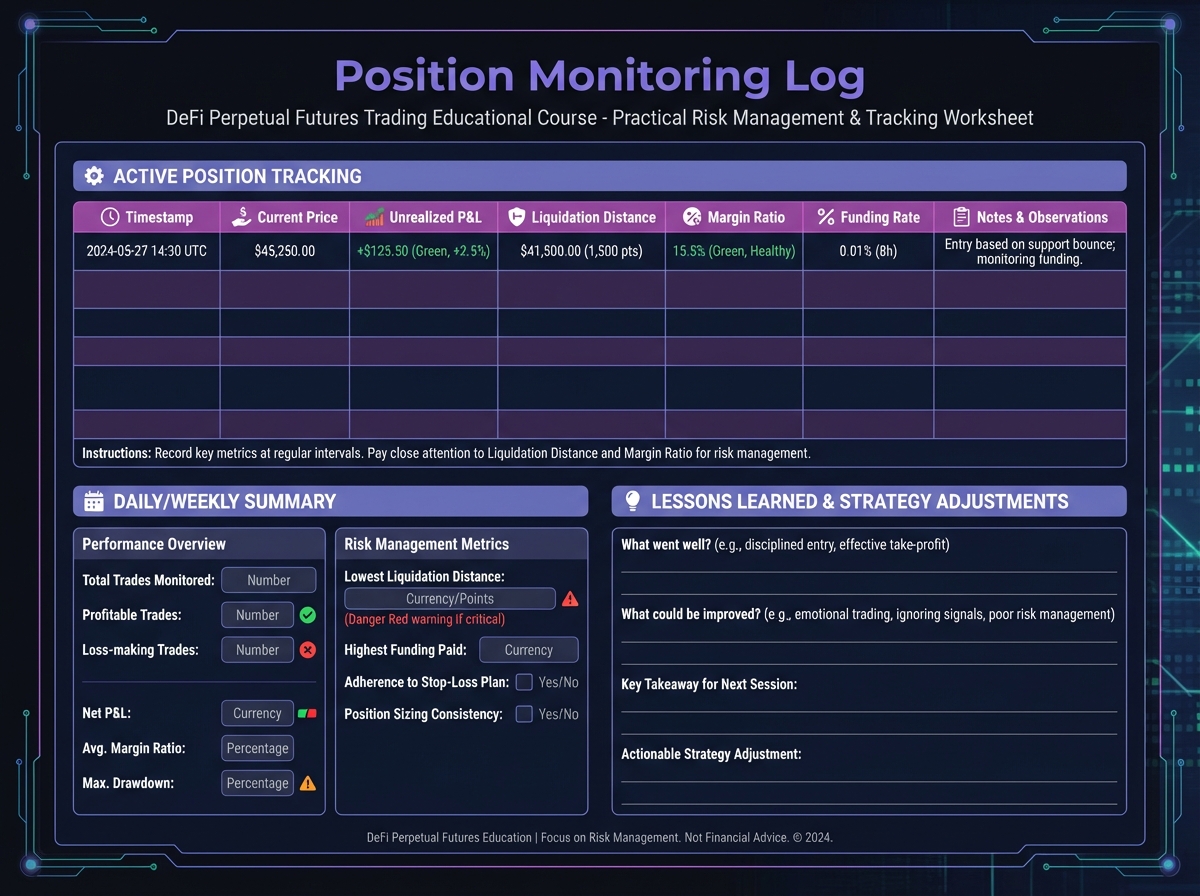
After closing your position, complete this:

Position Monitoring Log
Position Planning Template

Trade Summary:

  • Entry: $_______

  • Exit: $_______

  • Duration: _______ days

  • Final P&L: $_______

  • ROI: _______%

What Went Well:

What Could Improve:

Lessons Learned:

Would You Trade This Again? Yes / No

  • Why: _________________________________

Exercise 10: Risk Management Review

Assess your risk management:

Areas for Improvement:

🎯 Self-Assessment

Rate your readiness (1 = Not ready, 5 = Fully ready):

Ready to open first position? Yes / No

  • If no, what do you need to review? _________________________________

🚀 Next Steps

Before Opening Position:

  1. Complete all exercises above

  2. Review any areas scoring < 4

  3. Practice on testnet if available

  4. Start with smallest position possible

  5. Monitor closely for first few trades

After First Position:

  1. Complete trade journal

  2. Review what you learned

  3. Adjust plan for next trade

  4. Proceed to Module 2 (Protocol Mastery)


← Back to Summary | Next: Module 2 →

Last updated