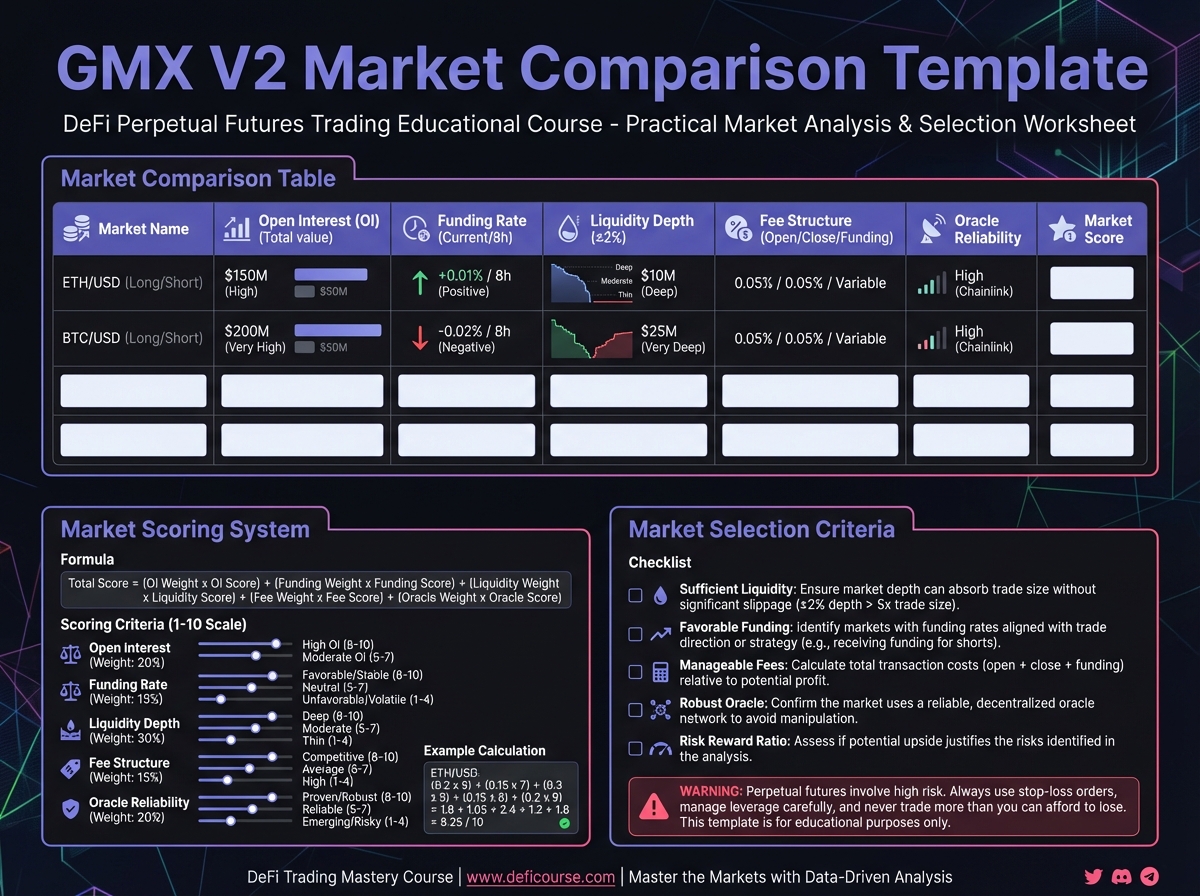
Exercise 6: GMX V2 Market Analysis and Selection
⏰ Time Investment: 45-60 minutes 🎯 Goal: Learn to analyze GM pools and select optimal markets for trading and LP provision
📚 Required Reading Integration 📖 Primary: Lesson 6: GMX V2 - Oracle-Based Liquidity Pools 📖 Supporting: Lesson 3: Architecture Types and Market Structure
🔍 Phase 1: Pool Analysis (20 minutes)
Exercise 1: Standard vs. Synthetic Market Identification
Analyze These Markets:
ETH/USD
ETH + USDC
_______
_______
BTC/USD
BTC + USDC
_______
_______
DOGE/USD
ETH + USDC
_______
_______
SOL/USD
SOL + USDC
_______
_______
Question: Why are synthetic markets riskier?
Your answer: _________________________________
Exercise 2: Pool Health Assessment
Select a GM Pool (e.g., GM-ETH-USDC):
Pool Metrics:
Total TVL: $_______
Current OI: $_______
Long/Short Ratio: _______% / _______%
Utilization: _______%
Health Indicators:
Assessment: Healthy / Moderate Risk / High Risk
Reasoning: _________________________________
Exercise 3: GM Token Valuation
Current GM Token Price: $_______
Components:
Asset Value: $_______
Pending PnL (trader losses = positive): $_______
Accrued Fees: $_______
Question: If traders have $1M unrealized profits, what happens to GM token value?
Your answer: _________________________________
📊 Phase 2: Fee Structure Analysis (15 minutes)
Exercise 4: Trading Fee Calculation
Scenario: Open $10,000 Long ETH position
Pool State:
Current OI: 70% Long, 30% Short
Your trade: Adds to Long side
Calculate:
Base trading fee: _______% (0.05% or 0.07%?)
Fee amount: $_______
Reasoning: _________________________________
Exercise 5: Price Impact Fee Estimation
Pool Imbalance:
Before trade: 70% Long, 30% Short
Your trade: $10,000 Long
After trade: 75% Long, 25% Short


Price Impact Fee:
Estimated fee: _______%
Fee amount: $_______
Question: How can you reduce price impact fees?
Your answer: _________________________________
Exercise 6: Funding Rate Analysis
Current Funding Rate: _______% per hour
Calculate:
Daily funding: _______%
Annualized: _______%
Cost for $10,000 position (24h): $_______
OI Imbalance Impact:
If OI becomes 80% Long, funding rate will: Increase / Decrease
Reasoning: _________________________________
💰 Phase 3: LP Strategy Development (15 minutes)
Exercise 7: Pool Selection for LP
Your LP Goals: [Fill in]
Risk tolerance: Conservative / Moderate / Aggressive
Capital: $_______
Time horizon: Short-term / Long-term
Pool Comparison:
GM-ETH-USDC
$_______
_______%
_______%
_______%
Yes/No
GM-BTC-USDC
$_______
_______%
_______%
_______%
Yes/No
GM-SOL-USDC
$_______
_______%
_______%
_______%
Yes/No
Selected Pool: _______ Reasoning: _________________________________
Exercise 8: Delta-Neutral Strategy Design
Scenario: Deposit $10,000 into GM-ETH-USDC pool
Pool Composition: 50% ETH, 50% USDC Your Exposure: $5,000 ETH delta
Hedge Strategy:
Expected Outcome:
If ETH rises 10%: GM gains $, Hedge loses $, Net: $_______
If ETH drops 10%: GM loses $, Hedge gains $, Net: $_______
Net Yield: Trading fees + Funding - Hedge costs = _______%
🎯 Phase 4: Trader vs. LP Perspective (10 minutes)
Exercise 9: Trader Analysis
For Trading:
Best pools: _______
Why: _________________________________
Fee Optimization:
Exercise 10: LP Analysis
For LP Provision:
Best pools: _______
Why: _________________________________
Risk Management:
✅ Self-Assessment
Rate your GMX V2 understanding (1 = Beginner, 5 = Expert):
Areas needing more review: _________________________________
🎯 Next Steps
If you scored < 4 on any topic:
Review Lesson 6 on that topic
Explore GMX V2 analytics dashboard
Practice with small positions
Study GM token mechanics
If all topics ≥ 4:
Proceed to Exercise 7 (Drift Analysis)
You're ready to use GMX V2 effectively!
Last updated