Lesson 5: Concentrated Liquidity Mastery
🎯 Core Concept: 4000x Capital Efficiency
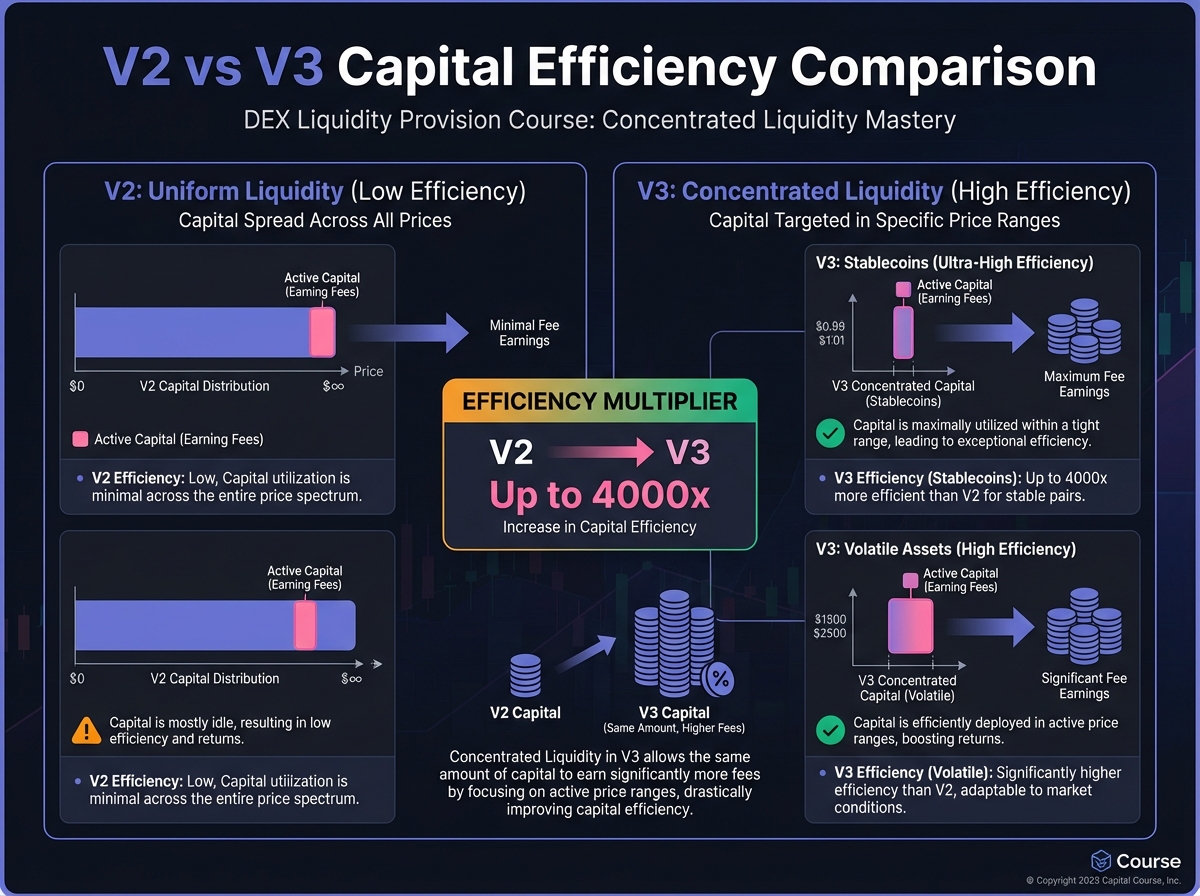
Uniswap V3's concentrated liquidity allows you to earn the same fees as V2 with 4000x less capital—but only if you manage it correctly. This lesson teaches you to master V3's most powerful and dangerous feature.
The V3 Revolution
V2 Problem: 99.9% of your capital sits idle, earning no fees V3 Solution: Concentrate liquidity in a price range where trades actually happen The Trade-off: Higher efficiency = higher risk if price exits your range
📊 Understanding Concentrated Liquidity
The Core Innovation
Instead of providing liquidity across the entire price curve (0 to ∞), V3 lets you choose a price range [P_min, P_max] where your liquidity is active.
Key Concept: Your liquidity only earns fees when the current price is within your range.
Capital Efficiency Example
Stablecoin Pair (USDC/DAI trading at $1.00):
V2: Need $4,000,000 to earn fees on $1,000,000 in volume
V3 (0.1% range): Need only $1,000 to earn the same fees
Efficiency Gain: 4000x
Volatile Pair (ETH/USDC):
V2: Need $100,000 for $10,000 in active liquidity
V3 (±10% range): Need only $5,000 for the same
Efficiency Gain: 20x

The Double-Edged Sword
When Price Stays in Range:
✅ You earn maximum fees per dollar
✅ Capital efficiency is incredible
✅ Returns can be 10-100x higher than V2
When Price Exits Range:
❌ Your position becomes 100% one asset
❌ You stop earning fees
❌ You're exposed to that asset's price movement
❌ IL is magnified
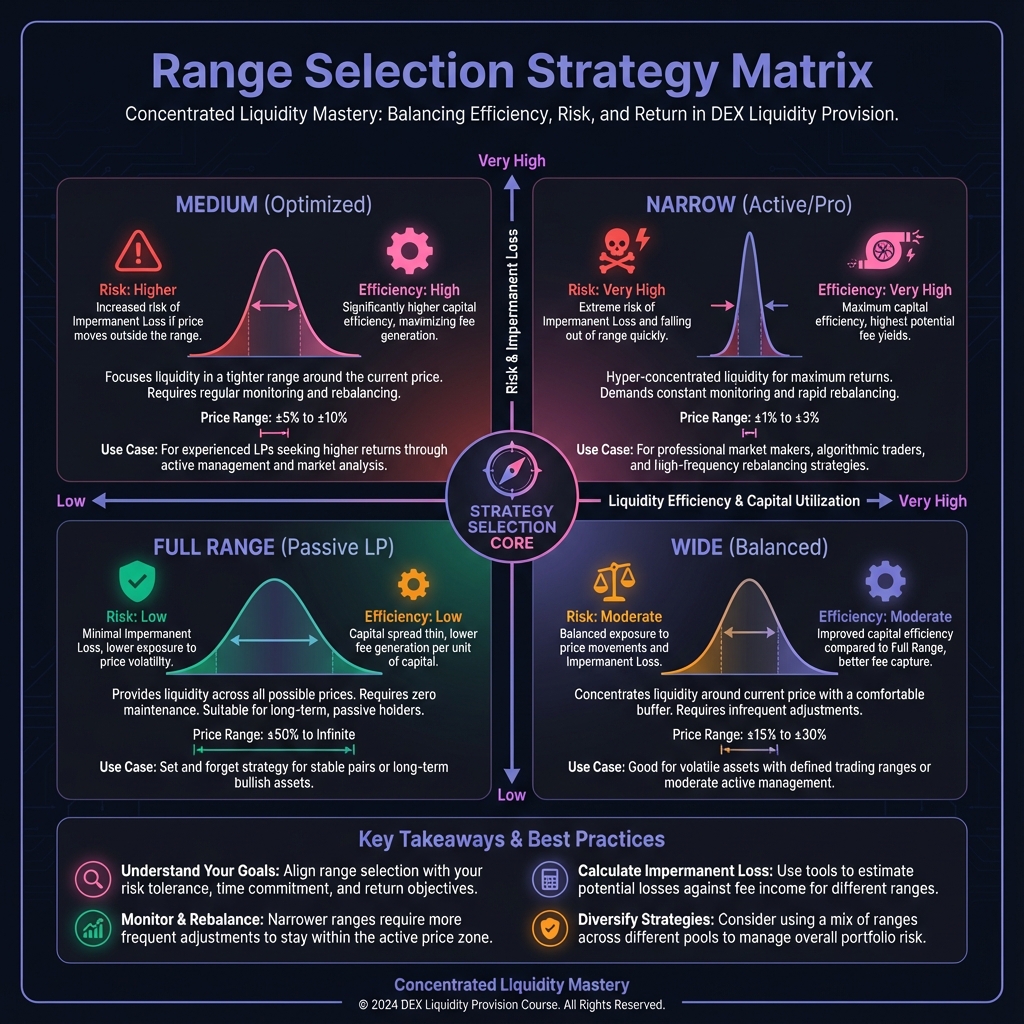
🎯 Range Selection Strategies
Strategy 1: Full Range (V2 Equivalent)
Range: Current price ± 50% or more
Risk: Low (rarely goes out of range)
Efficiency: Low (similar to V2)
Best For: Beginners, passive LPs, volatile pairs
Example: ETH at $2,000, range $1,000 - $3,000
Strategy 2: Wide Range
Range: Current price ± 20-50%
Risk: Moderate
Efficiency: Moderate (5-10x V2)
Best For: Moderate volatility, less active management
Example: ETH at $2,000, range $1,600 - $2,400
Strategy 3: Medium Range
Range: Current price ± 10-20%
Risk: Higher (needs monitoring)
Efficiency: High (10-20x V2)
Best For: Active LPs, correlated pairs
Example: ETH at $2,000, range $1,800 - $2,200
Strategy 4: Narrow Range (Advanced)
Range: Current price ± 1-5%
Risk: Very high (frequent rebalancing)
Efficiency: Very high (50-4000x V2)
Best For: Stablecoins, highly correlated pairs, professional LPs
Example: USDC/DAI at $1.00, range $0.999 - $1.001

🔢 Understanding Ticks
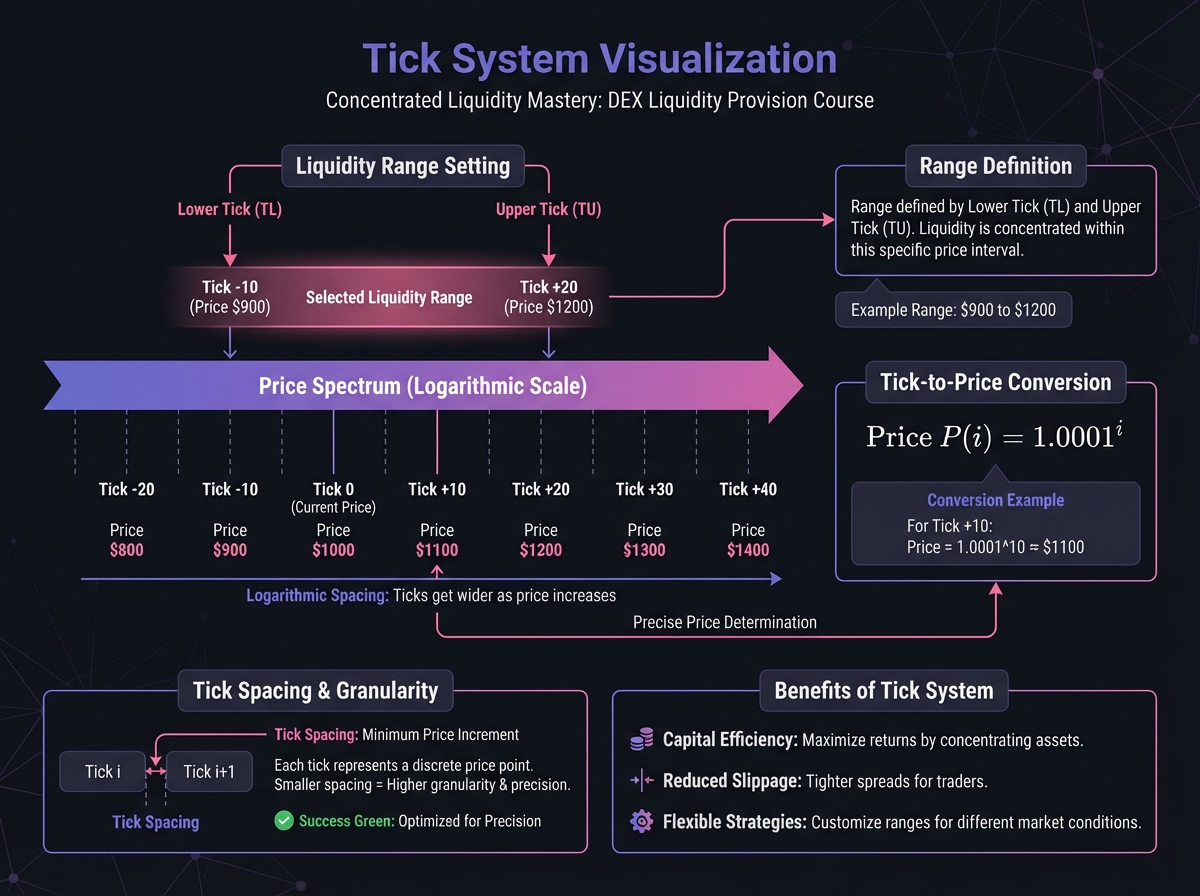
What Are Ticks?
Ticks are discrete price points where liquidity can be placed. The price at tick i is:
Key Properties:
Each tick = 0.01% (1 basis point) price change
Logarithmic spacing (consistent % changes)
Not every tick is usable (tick spacing)
Tick Spacing
To save gas, pools use "tick spacing":
0.01% fee tier: Tick spacing = 1 (every tick)
0.05% fee tier: Tick spacing = 10 (every 10th tick = 0.1% increments)
0.3% fee tier: Tick spacing = 60 (every 60th tick = 0.6% increments)
1% fee tier: Tick spacing = 200 (every 200th tick = 2% increments)
Implication: You can only set ranges at these tick boundaries.
Calculating Your Range in Ticks
Example: ETH/USDC pool, current price $2,000
Want range: $1,800 - $2,200 (±10%)
Step 1: Convert prices to ticks
Lower: $1,800 / $2,000 = 0.9
Upper: $2,200 / $2,000 = 1.1
Step 2: Find tick indices (simplified)
Use Uniswap interface (it calculates automatically)
Or use formula: tick = log₁.₀₀₀₁(price_ratio)
Result: Range might be tick -1000 to tick +1000 (example)

💰 Fee Accumulation in V3
How Fees Work Differently
V2: Fees auto-compound (stay in pool, increase LP token value) V3: Fees accumulate separately, must be collected manually
Why: Each position has unique ranges, can't auto-compound easily
Collecting Fees
When to Collect:
Before rebalancing (to avoid losing fees)
When fees exceed gas costs (on L2, collect more frequently)
Monthly for passive positions
Gas Costs:
L1: $20-50 per collection
L2: $0.20-1.00 per collection
Best Practice: On L2, collect weekly. On L1, collect monthly or when fees > $100.
⚠️ The Out-of-Range Problem
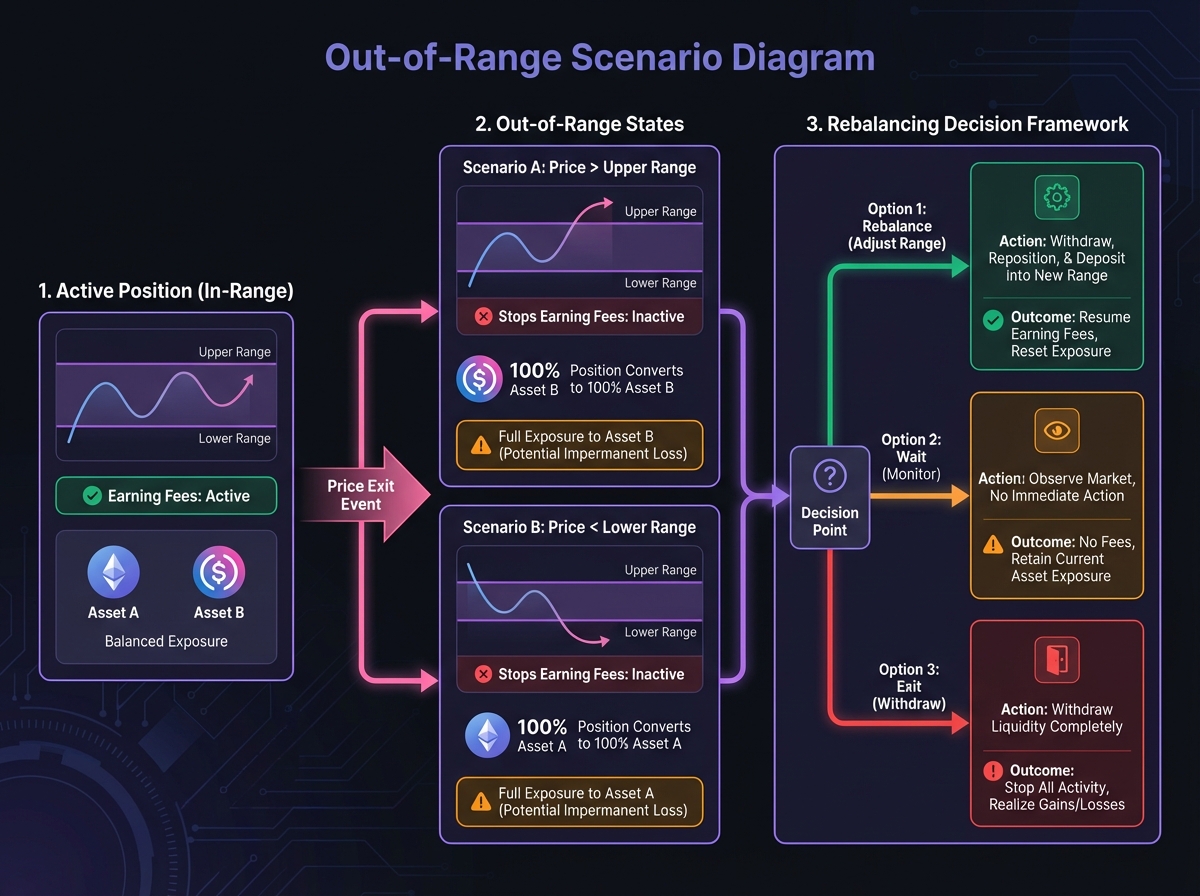
What Happens When Price Exits Range
Price Above Upper Bound:
Position becomes 100% quote asset (USDC)
Stops earning fees
Exposed to quote asset devaluation (usually minimal for stablecoins)
Price Below Lower Bound:
Position becomes 100% base asset (ETH)
Stops earning fees
Exposed to base asset price movement (can be significant)
The Panic Trap
Common Mistake: LP sees position is 100% ETH while price is crashing, panics and withdraws.
Why This Loses Money:
You effectively bought ETH at higher prices (within your range)
Now selling at lower price
Locking in IL + realized loss
Better Strategy:
Wait for price to return to range, OR
Rebalance to new range around current price
Rebalancing Strategy
When Price Exits Range:
Assess the Situation:
How far out of range? (5%? 20%? 50%?)
Is this a temporary move or trend?
What are gas costs vs. fees if you rebalance?
Decision Framework:
<5% out: Wait, likely to return
5-20% out: Consider rebalancing if trend continues
>20% out: Rebalance to new range (unless expecting reversal)
Rebalancing Process:
Withdraw old position (collect fees first!)
Swap tokens to correct ratio
Create new position around current price
Set appropriate range width

🎓 Beginner's Corner: V3 Common Mistakes
Mistake 1: Setting ranges too narrow
Fix: Start wide (±20-50%), narrow as you learn
Mistake 2: Not monitoring positions
Fix: Check weekly, set price alerts
Mistake 3: Forgetting to collect fees
Fix: Set calendar reminder, collect monthly
Mistake 4: Panic withdrawing when out of range
Fix: Wait or rebalance, don't panic
Mistake 5: Ignoring gas costs
Fix: Use L2, calculate total costs
Mistake 6: Setting ranges based on current price only
Fix: Consider volatility, set wider ranges for volatile assets
🔬 Advanced Deep-Dive: Virtual Liquidity Math
The Virtual Reserves Concept
V3 uses "virtual reserves" to simulate deeper pools:
Where L is liquidity, and virtual reserves are calculated to make the curve intercept your range boundaries.
Capital Efficiency Formula
For a range [P_a, P_b] around current price P:
Example: Range $1.99 - $2.01 around $2.00
Width: $0.02 / $2.00 = 1%
Efficiency: ~100x (simplified)
Optimal Range Width
For Stablecoins (volatility ~0.1%):
Optimal range: ±0.05-0.1%
Efficiency: 2000-4000x
For Correlated Pairs (volatility ~1%):
Optimal range: ±2-5%
Efficiency: 20-50x
For Volatile Pairs (volatility ~5%+):
Optimal range: ±10-20%
Efficiency: 5-10x
📈 Real-World V3 Strategy
Complete Example: ETH/USDC Position
Setup:
Current ETH price: $2,000
Capital: $10,000
Strategy: Medium range, active management
Range Selection:
Lower: $1,800 (10% below)
Upper: $2,200 (10% above)
Width: 20%
Position Details:
Deposit: 2.5 ETH + 5,000 USDC
Range: Tick -1000 to +1000 (example)
Fee tier: 0.05%
Month 1 (Price stays in range):
Fees earned: $150 (1.5% of capital)
IL: $20 (0.2%, minimal)
Net return: $130 (1.3% monthly = 15.6% APY)
Month 2 (Price exits range, drops to $1,700):
Position: 100% ETH (5.88 ETH, 0 USDC)
No fees earned (out of range)
IL: $500 (5% of capital)
Action: Rebalance to new range $1,530 - $1,870
Analysis:
Month 1: Profitable ✅
Month 2: Lost money due to IL ❌
Net: Still profitable if price returns
🎯 Key Takeaways
V3 offers 4000x efficiency for stablecoins, 20x for volatile pairs
Range selection is critical—too narrow = high risk, too wide = low efficiency
Monitor positions weekly—out-of-range positions earn no fees
Collect fees regularly—they don't auto-compound in V3
Rebalance strategically—don't panic when price exits range
Use L2—gas costs make active management viable
Start wide, narrow gradually—learn before optimizing
🚀 Next Steps
Lesson 6 explores other major DEX protocols (Aerodrome, Raydrome, Orca) and when to use each. Understanding multiple protocols lets you optimize across ecosystems.
Complete Exercise 5 to practice range selection and V3 position management.
Remember: V3 is powerful but requires active management. Start conservative, learn the mechanics, then optimize. The efficiency gains are real, but so are the risks.
← Back to Summary | Next: Exercise 5 → | Previous: Lesson 4 ←
Last updated