Exercise 1: Money Markets Knowledge Assessment

⏰ Time Investment: 30-45 minutes 🎯 Goal: Test your understanding of money market fundamentals and identify knowledge gaps

📚 Required Reading Integration 📖 Primary: Lesson 1: Understanding DeFi Money Markets Fundamentals 📖 Supporting: Lesson 2: The Mathematics of Lending and Borrowing

🔍 Phase 1: Knowledge Check (10 minutes)

Understanding Check

Answer these questions to assess your comprehension:

1. What is the fundamental difference between monolithic and modular money market architectures?

  • Your answer: _________________________________

2. How does over-collateralization protect lenders?

  • Your answer: _________________________________

3. What are the two paths to Aave and when would you use each?

  • Your answer: _________________________________

4. Why can't you be liquidated if you're only supplying assets (not borrowing)?

  • Your answer: _________________________________

5. What is the difference between LTV (Loan-to-Value) and Liquidation Threshold?

  • Your answer: _________________________________

📊 Phase 2: Architecture Comparison (15 minutes)

Monolithic vs Modular Analysis

Scenario: You're evaluating two protocols for a $10,000 USDC deposit.

Protocol A (Monolithic):

  • Single shared liquidity pool

  • Governance manages all parameters

  • All assets in same pool

  • Insurance fund covers all markets

Protocol B (Modular):

  • Isolated markets per asset pair

  • Permissionless market creation

  • Risk isolated to each market

  • No shared insurance fund

Exercise 1: Compare the risks and benefits of each approach:

Factor
Monolithic (Protocol A)
Modular (Protocol B)
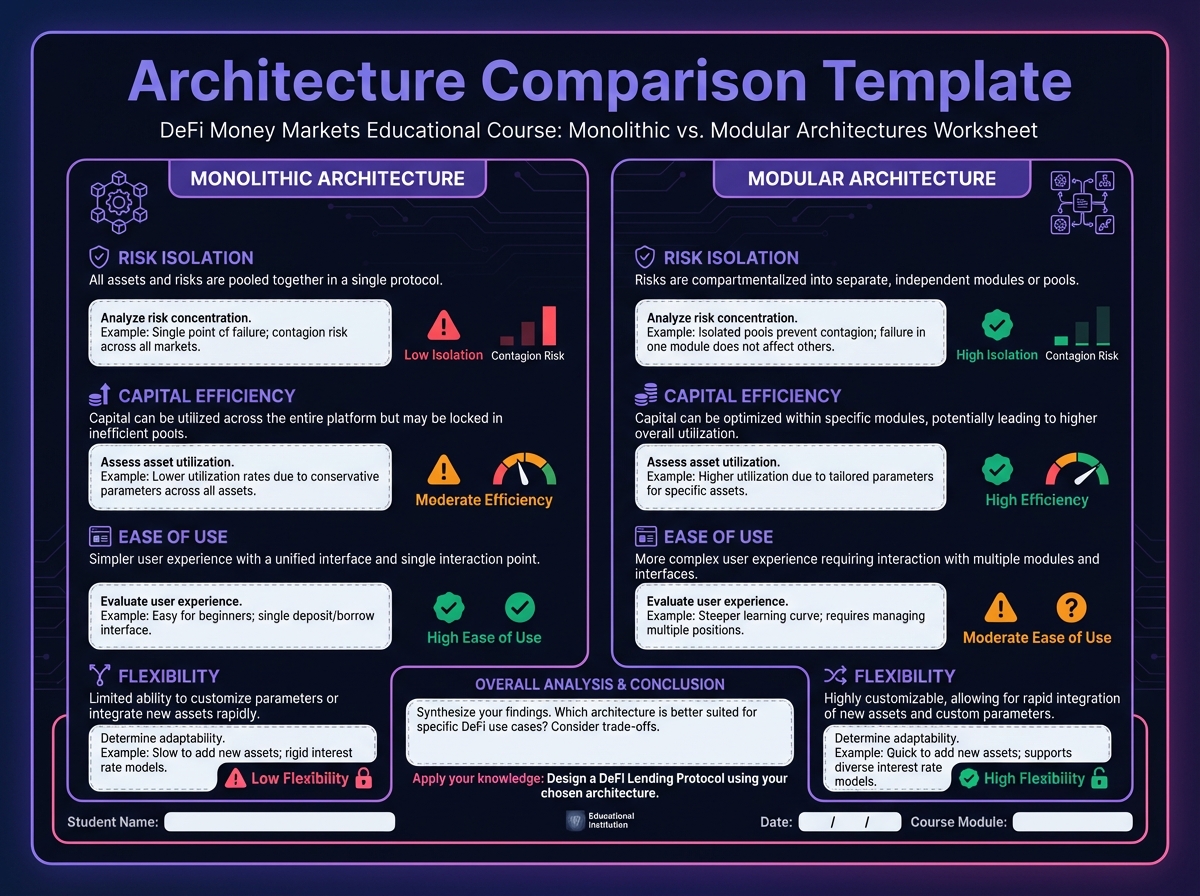
Risk Isolation

Capital Efficiency

Ease of Use

Flexibility

Exercise 2: Which would you choose for your first position and why?

  • Your choice: _________________________________

  • Reasoning: _________________________________

Architecture Comparison Template

💡 Phase 3: Real-World Application (10 minutes)

Protocol Selection Exercise

You want to earn yield on $5,000 USDC. Analyze these options:

Option 1: Aave App

  • APY: 6.5%

  • Insurance: $1M coverage

  • Interface: Mobile app, simple

  • Network: Ethereum (via app)

Option 2: Aave V3 on Arbitrum

  • APY: 5%

  • Insurance: Safety Module (shared)

  • Interface: Web dApp

  • Network: Arbitrum (low gas)

Option 3: Morpho Vault

  • APY: 5.5%

  • Insurance: None (isolated markets)

  • Interface: Web dApp

  • Network: Ethereum

Exercise 3: Compare and rank these options for a beginner:

Ranking (1 = Best, 3 = Least suitable):

  • Option 1: ___

  • Option 2: ___

  • Option 3: ___

Reasoning for #1 choice: _________________________________

📝 Phase 4: Key Concepts Review (10 minutes)

Fill in the Blanks

1. The _______________ model pools all assets together, while the _______________ model isolates markets.

2. When you supply assets to a protocol, you receive _______________ tokens that represent your deposit.

3. The _______________ is the percentage of the pool currently lent out and drives interest rates.

4. _______________ are bridges that feed off-chain price data to on-chain smart contracts.

5. The Aave App uses a "_____________" strategy: Fintech in the front, DeFi in the back.

✅ Self-Assessment

Rate your understanding (1 = Need more review, 5 = Fully understand):

Areas needing more review: _________________________________

🎯 Next Steps

If you scored < 4 on any topic:

  • Review Lesson 1 material on that topic

  • Re-read the Beginner's Corner sections

  • Look up additional resources on unclear concepts

If all topics ≥ 4:

  • Proceed to Exercise 2 (Calculation Practice)

  • Move forward with confidence!


← Back to Summary | Next: Lesson 2 →

Last updated