Exercise 10: Risk Management Framework Design

⏰ Time Investment: 60-75 minutes 🎯 Goal: Create a comprehensive risk management framework for your trading

📚 Required Reading Integration 📖 Primary: Lesson 10: Risk Management and Position Protection 📖 Supporting: Lesson 2: The Mathematics of Perpetual Trading, Lesson 4: Your First Perpetual Position

🔍 Phase 1: Risk Tolerance Assessment (15 minutes)
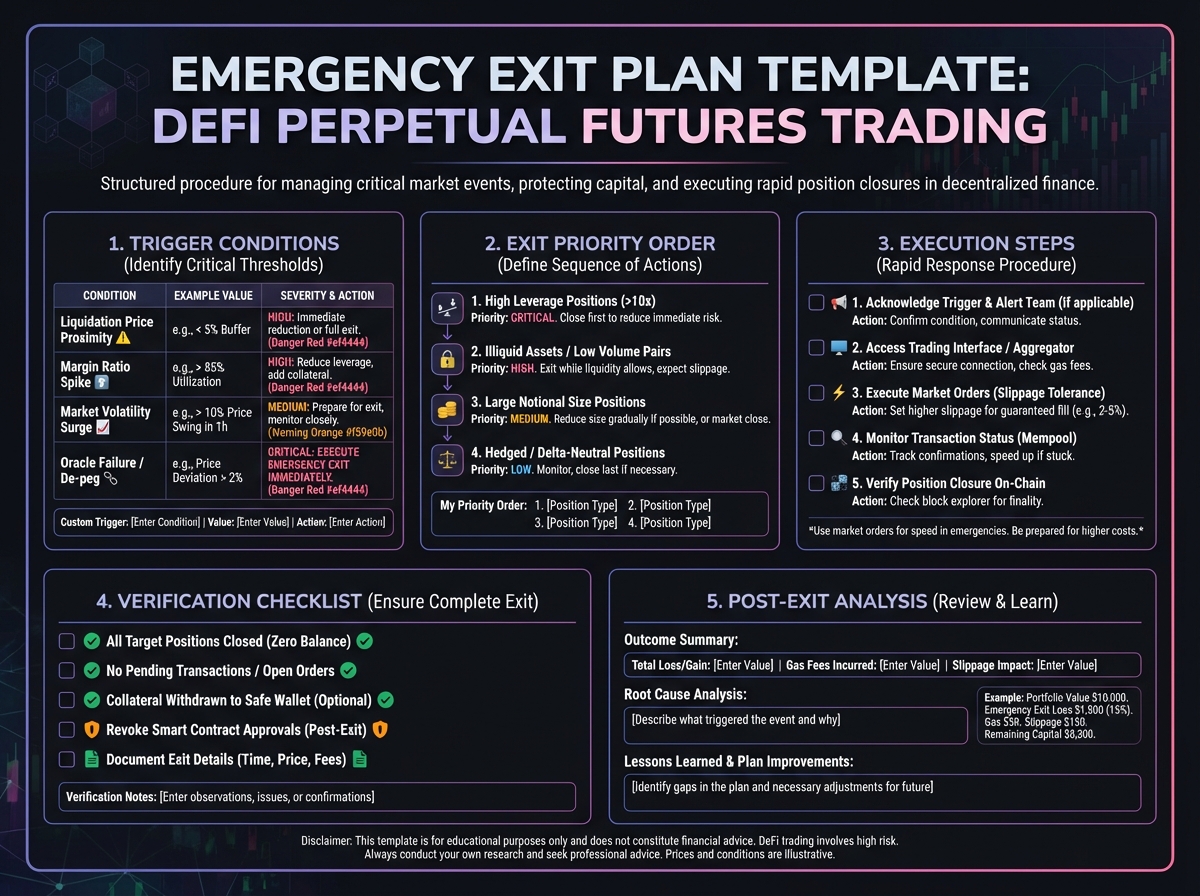
Emergency Exit Plan Template
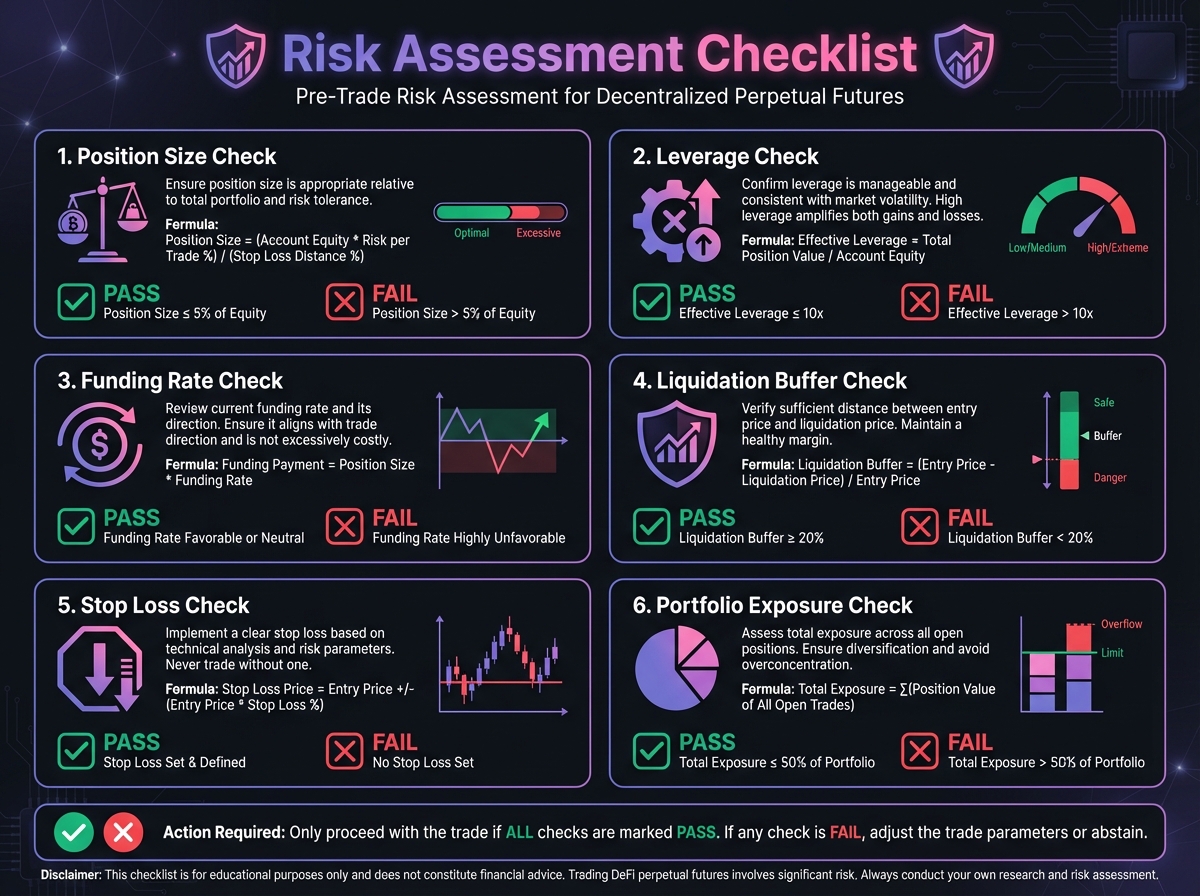
Risk Assessment Checklist
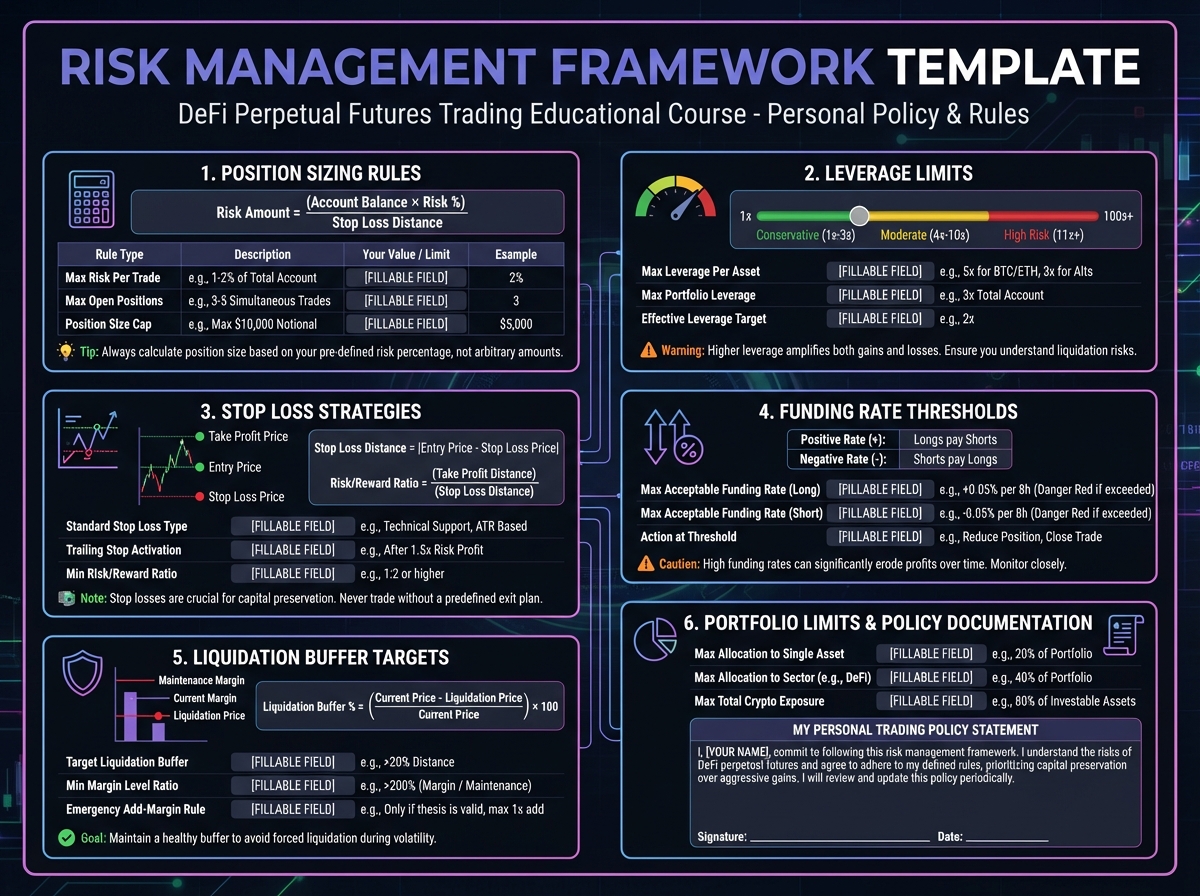
Risk Management Framework Template

Exercise 1: Personal Risk Profile

Your Profile:

  • Total Trading Capital: $_______

  • Risk Tolerance: Conservative / Moderate / Aggressive

  • Trading Experience: Beginner / Intermediate / Advanced

  • Time Available: Full-time / Part-time / Occasional

Risk Parameters:

  • Maximum risk per trade: _______% (recommended: 1-5%)

  • Maximum portfolio risk: _______% (recommended: <10%)

  • Maximum leverage: _______x

  • Maximum concurrent positions: _______

Exercise 2: Capital Allocation

Allocate Your Capital:

Category
Amount
Percentage
Purpose

Trading Capital

$_______

_______%

Active trading

Emergency Reserve

$_______

_______%

Safety buffer

Arbitrage Capital

$_______

_______%

Funding strategies

LP Capital

$_______

_______%

Liquidity provision

Total: $_______

Question: Why did you allocate this way?

  • Your reasoning: _________________________________

📊 Phase 2: Position Sizing Framework (20 minutes)

Exercise 3: Position Size Calculator

Create Your Formula:

Position Size = (Capital × Risk Per Trade) ÷ (Entry - Stop Loss)

Example Calculation:

  • Capital: $10,000

  • Risk: 2% = $_______

  • Entry: $2,500

  • Stop Loss: $2,400

  • Position Size: $_______

  • Margin Needed (5x): $_______

Exercise 4: Leverage Guidelines

Define Your Leverage Rules:

Asset Type
Maximum Leverage
Reasoning

BTC/ETH

_______x

_______

Mid-cap

_______x

_______

Volatile

_______x

_______

New/Meme

_______x

_______

Question: Why these limits?

  • Your answer: _________________________________

Exercise 5: Stop Loss Rules

Your Stop Loss Framework:

Mandatory Rules:

Placement Rules:

  • Long positions: Below _______ (support/resistance)

  • Short positions: Above _______ (support/resistance)

  • Buffer: _______% above liquidation

Example:

  • Entry: $2,500

  • Support: $2,400

  • Stop Loss: $_______

  • Liquidation: $2,000

  • Buffer: _______%

🛡️ Phase 3: Risk Protection Strategies (20 minutes)

Exercise 6: Liquidation Prevention Plan

Your Safety Buffer Rules:

  • Minimum buffer: _______% above liquidation

  • Warning threshold: Within _______% of liquidation

  • Action at warning: _________________________________

Margin Management:

  • When to add margin: _________________________________

  • How much to add: _________________________________

  • When to reduce position: _________________________________

Exercise 7: Funding Rate Management

Your Funding Rate Rules:

  • Maximum acceptable: _______% per hour

  • Annualized limit: _______% APR

  • Action if exceeded: _________________________________

Monitoring:

  • Check frequency: Daily / Hourly / Real-time

  • Alert threshold: _______% per hour

  • Exit condition: _________________________________

Exercise 8: Portfolio Health Monitoring

Key Metrics to Track:

Metric
Target
Warning
Danger
Action

Portfolio Health

>2.0

1.5-2.0

<1.5

_______

Margin Ratio

>20%

10-20%

<10%

_______

Funding Cost

<1%

1-2%

>2%

_______

Correlation

<0.7

0.7-0.9

>0.9

_______

⚠️ Phase 4: Risk Scenario Planning (15 minutes)

Exercise 9: Emergency Response Plan

Scenario 1: Approaching Liquidation

  • Current price: $2,400

  • Liquidation: $2,000

  • Distance: 16.7% (too close!)

Your Response:

Reasoning: _________________________________

Scenario 2: Funding Rate Spikes

  • Original: 0.01% per hour

  • Current: 0.08% per hour (8x increase!)

Your Response:

Reasoning: _________________________________

Scenario 3: Protocol Issue

  • Protocol announces potential issue

  • Your position: $10,000

Your Response:

Reasoning: _________________________________

Exercise 10: Risk Limits

Define Your Hard Limits:

Daily Loss Limit: $_______ (_______% of capital)

  • Action if hit: _________________________________

Weekly Loss Limit: $_______ (_______% of capital)

  • Action if hit: _________________________________

Monthly Loss Limit: $_______ (_______% of capital)

  • Action if hit: _________________________________

Maximum Drawdown: _______%

  • Action if hit: _________________________________

📋 Phase 5: Risk Management Checklist (10 minutes)

Exercise 11: Pre-Trade Checklist

Create Your Checklist:

Any unchecked items? Address before trading:

Exercise 12: Monitoring Schedule

Your Monitoring Plan:

Active Trading:

  • Position checks: Every _______ minutes

  • Portfolio review: Every _______ hours

  • Full analysis: Daily / Weekly

Swing Trading:

  • Position checks: Daily / Weekly

  • Portfolio review: Weekly / Monthly

  • Full analysis: Monthly

Alert Setup:

✅ Self-Assessment

Rate your risk management framework (1 = Incomplete, 5 = Comprehensive):

Framework Completeness: __/25

Areas needing more work: _________________________________

🎯 Next Steps

If your framework is incomplete:

  • Review Lesson 10 on missing areas

  • Refine your rules

  • Test with paper trading

  • Start with smallest positions

If framework is complete:

  • Proceed to Exercise 11 (Advanced Strategies)

  • Implement your framework

  • Track adherence


← Back to Summary | Next: Lesson 11 →

Last updated