Exercise 12: Complete System Integration

⏰ Time Investment: 90-120 minutes 🎯 Goal: Design your complete professional trading system integrating all course concepts

📚 Required Reading Integration 📖 Primary: Lesson 12: Building Your Professional Trading System 📖 Supporting: All previous lessons (comprehensive review)

📋 Phase 1: System Foundation (30 minutes)

Exercise 1: Due Diligence Framework

Create Your Protocol Evaluation Checklist:

Security (40% weight):

Economics (30% weight):

Technical (20% weight):

Overall Score: ___/10 Minimum to Use: 7/10

Exercise 2: Protocol Selection Matrix

Your Criteria (rank 1-6 by importance):

  1. _______ (most important)

  2. _______ (least important)

Protocol Scoring (1-10 for each):

Protocol
Criterion 1
Criterion 2
Criterion 3
Criterion 4
Criterion 5
Criterion 6
Total

Hyperliquid

___

___

___

___

___

___

___/60

GMX V2

___

___

___

___

___

___

___/60

Drift

___

___

___

___

___

___

___/60

EdgeX

___

___

___

___

___

___

___/60

Extended

___

___

___

___

___

___

___/60

Top 3 Choices:

  1. _______ (Score: ___/60)

  2. _______ (Score: ___/60)

  3. _______ (Score: ___/60)

💰 Phase 2: Risk Management System (30 minutes)

Exercise 3: Complete Risk Framework

Capital Allocation:

  • Total Capital: $_______

  • Trading Capital: $_______ (_______%)

  • Reserve: $_______ (_______%)

  • Arbitrage: $_______ (_______%)

  • LP: $_______ (_______%)

Risk Parameters:

  • Risk per trade: _______% (max: 5%)

  • Max portfolio risk: _______% (max: 10%)

  • Max leverage: _______x

  • Max positions: _______

Position Sizing Formula:

Position Size = (Capital × Risk%) ÷ (Entry - Stop Loss)

Example:

  • Capital: $_______

  • Risk: % = $

  • Entry: $_______

  • Stop: $_______

  • Position: $_______

Exercise 4: Stop Loss and Exit Rules
Stop Loss Framework:

Mandatory Rules:

Placement:

  • Long: Below support at $_______

  • Short: Above resistance at $_______

Exit Conditions:

  1. Stop loss hit: Close immediately

  2. Take profit hit: Close or partial

  3. Funding > _______%: Reassess or close

  4. Time limit: Close after _______ days

  5. Other: _________________________________

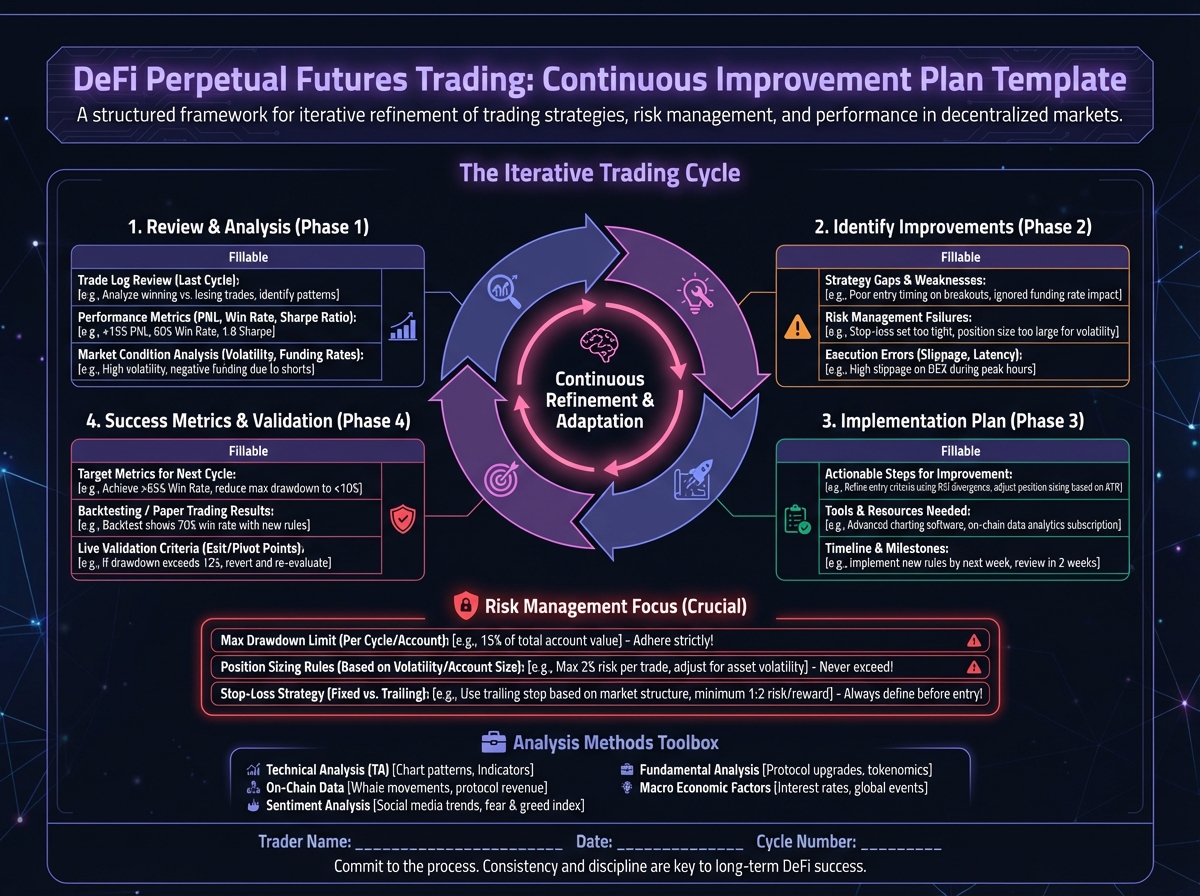
Continuous Improvement Plan Template
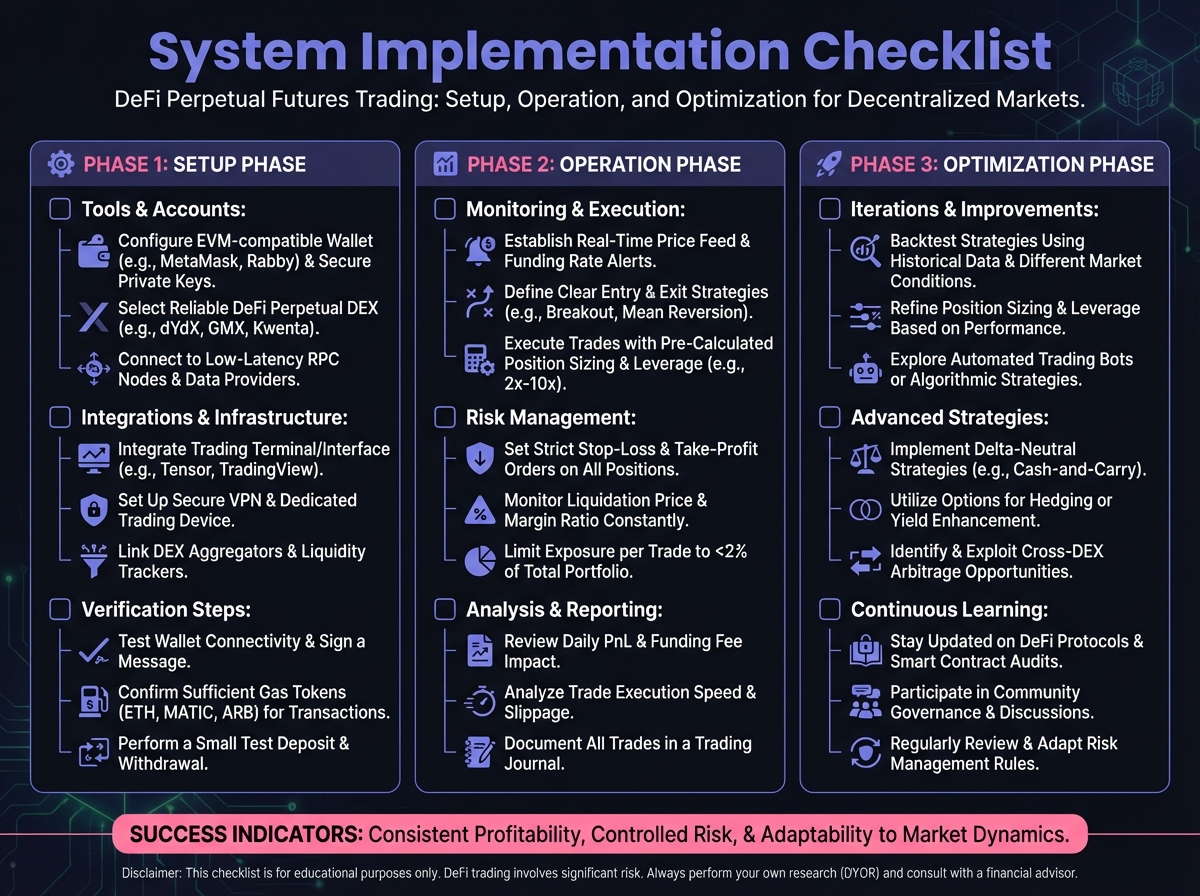
System Implementation Checklist
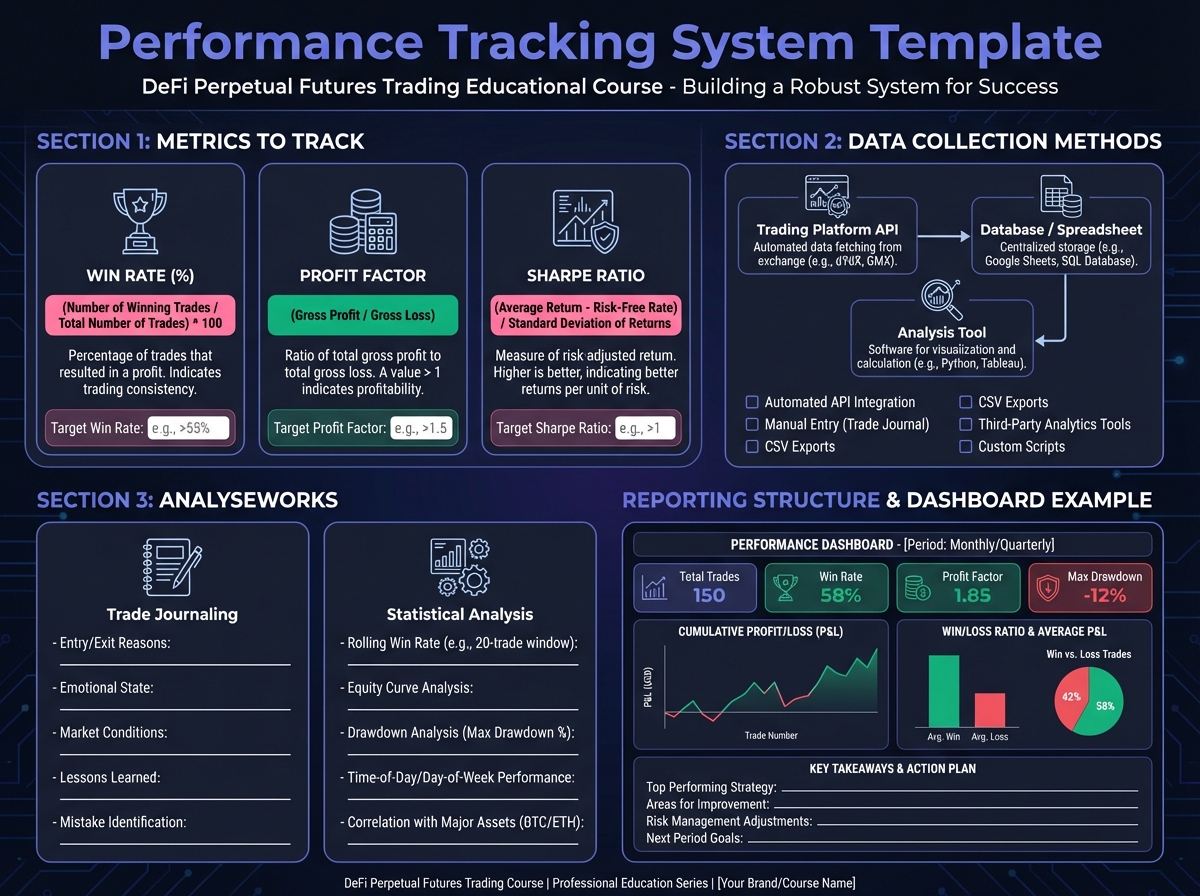
Performance Tracking System Template
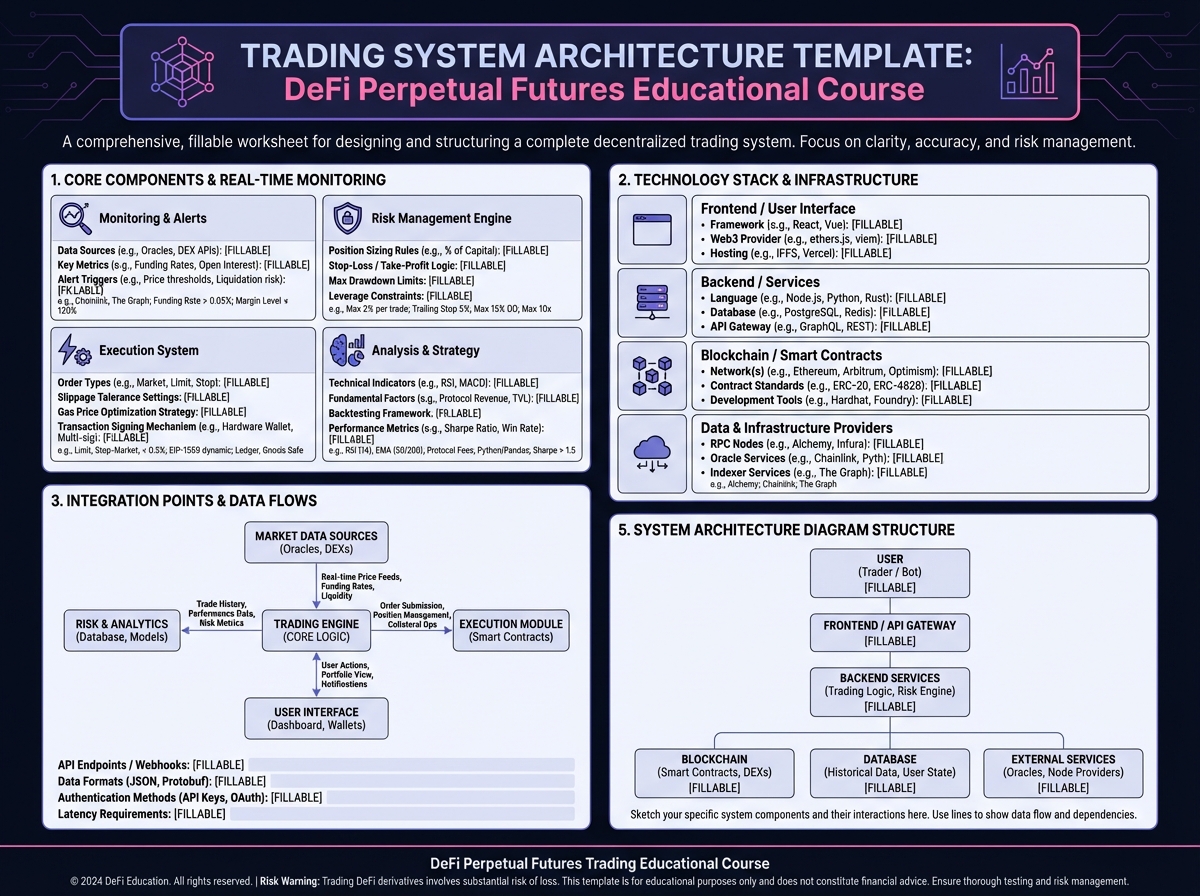
Trading System Architecture Template

Exercise 5: Monitoring System

Daily Monitoring:

Weekly Review:

Monthly Analysis:

Alerts:

📊 Phase 3: Strategy Framework (20 minutes)

Exercise 6: Multi-Strategy Allocation

Your Strategy Mix:

Strategy
Capital
%
Protocols
Expected Return
Risk

Directional

$_______

___%

_______

___%

___

Arbitrage

$_______

___%

_______

___%

___

LP

$_______

___%

_______

___%

___

Hedging

$_______

___%

_______

___%

___

Total: $_______

Diversification Analysis:

  • Asset diversification: Good / Moderate / Poor

  • Protocol diversification: Good / Moderate / Poor

  • Strategy diversification: Good / Moderate / Poor

Improvements Needed: _________________________________

Exercise 7: Protocol-Specific Strategies

For Each Protocol, Define:

Hyperliquid:

  • Primary use: _______

  • Strategy: _______

  • Capital: $_______

  • Why: _________________________________

GMX V2:

  • Primary use: _______

  • Strategy: _______

  • Capital: $_______

  • Why: _________________________________

Drift:

  • Primary use: _______

  • Strategy: _______

  • Capital: $_______

  • Why: _________________________________

🎯 Phase 4: Performance Tracking (20 minutes)

Exercise 8: Trade Journal Template

Create Your Template:

For Each Trade, Record:

  • Date/Time: _______

  • Protocol: _______

  • Market: _______

  • Direction: Long / Short

  • Entry: $_______

  • Exit: $_______

  • Size: $_______

  • Leverage: _______x

  • Reasoning: _________________________________

  • Outcome: Profit / Loss

  • Amount: $_______

  • Lessons: _________________________________

Exercise 9: Performance Metrics

Track These Metrics:

Monthly:

  • Total P&L: $_______

  • Win Rate: _______%

  • Average Win: $_______

  • Average Loss: $_______

  • Best Trade: $_______

  • Worst Trade: $_______

Quarterly:

  • System effectiveness: ___/10

  • Rule adherence: ___/10

  • Strategy performance: _______

  • Improvements made: _______

Exercise 10: System Refinement Process

Your Improvement Cycle:

Step 1: Review (Monthly)

  • Analyze: Performance data

  • Identify: Weaknesses

  • Document: Lessons learned

Step 2: Refine (Quarterly)

  • Update: Rules and strategies

  • Test: Changes with small positions

  • Implement: If successful

Step 3: Iterate (Ongoing)

  • Monitor: Results

  • Adjust: As needed

  • Evolve: With market

Example Refinement:

  • Issue: Funding rates eating profits

  • Solution: Add funding rate alerts

  • Test: Monitor for 1 month

  • Result: [To be filled after testing]

📋 Phase 5: Complete System Documentation (20 minutes)

Exercise 11: System Rules Summary

Document Your Complete System:

Protocol Selection:

Risk Management:

  • Risk per trade: _______%

  • Max leverage: _______x

  • Stop loss: Always / Sometimes / Never

  • Safety buffer: _______%

Position Sizing:

  • Formula: _______

  • Example: _______

Monitoring:

  • Frequency: _______

  • Alerts: _______

  • Review: _______

Exit Rules:

Exercise 12: Implementation Plan

Phase 1: Setup (Week 1)

Phase 2: Initial Trading (Weeks 2-4)

Phase 3: Scaling (Month 2+)

Timeline:

  • Start date: _______

  • First trade: _______

  • Review date: _______

✅ Final Self-Assessment

Rate your complete system (1 = Incomplete, 5 = Professional):

Overall System Score: ___/35

System Completeness: _______%

Ready to Trade? Yes / No

  • If no, what's missing? _________________________________

🎯 Next Steps

Before Trading:

  1. Complete all exercises above

  2. Review any areas scoring < 4

  3. Test system with paper trading

  4. Start with absolute minimum positions

  5. Monitor closely for first month

After First Month:

  1. Review performance

  2. Refine system

  3. Scale gradually

  4. Continue learning

Long-Term:

  1. Track performance continuously

  2. Refine system quarterly

  3. Stay updated on new protocols

  4. Join trading communities

  5. Never stop learning


Congratulations! 🎉

You've completed the Perpetual Futures Trading 101 course and designed your professional trading system. You now have:

  • ✅ Comprehensive understanding of perpetual futures

  • ✅ Knowledge of major protocols and architectures

  • ✅ Risk management framework

  • ✅ Strategy development skills

  • ✅ Complete trading system

Remember: Start small, learn from every trade, and continuously improve. Sustainable, consistent performance beats quick wins.


← Back to Summary | [Course Complete! 🎉]

Last updated