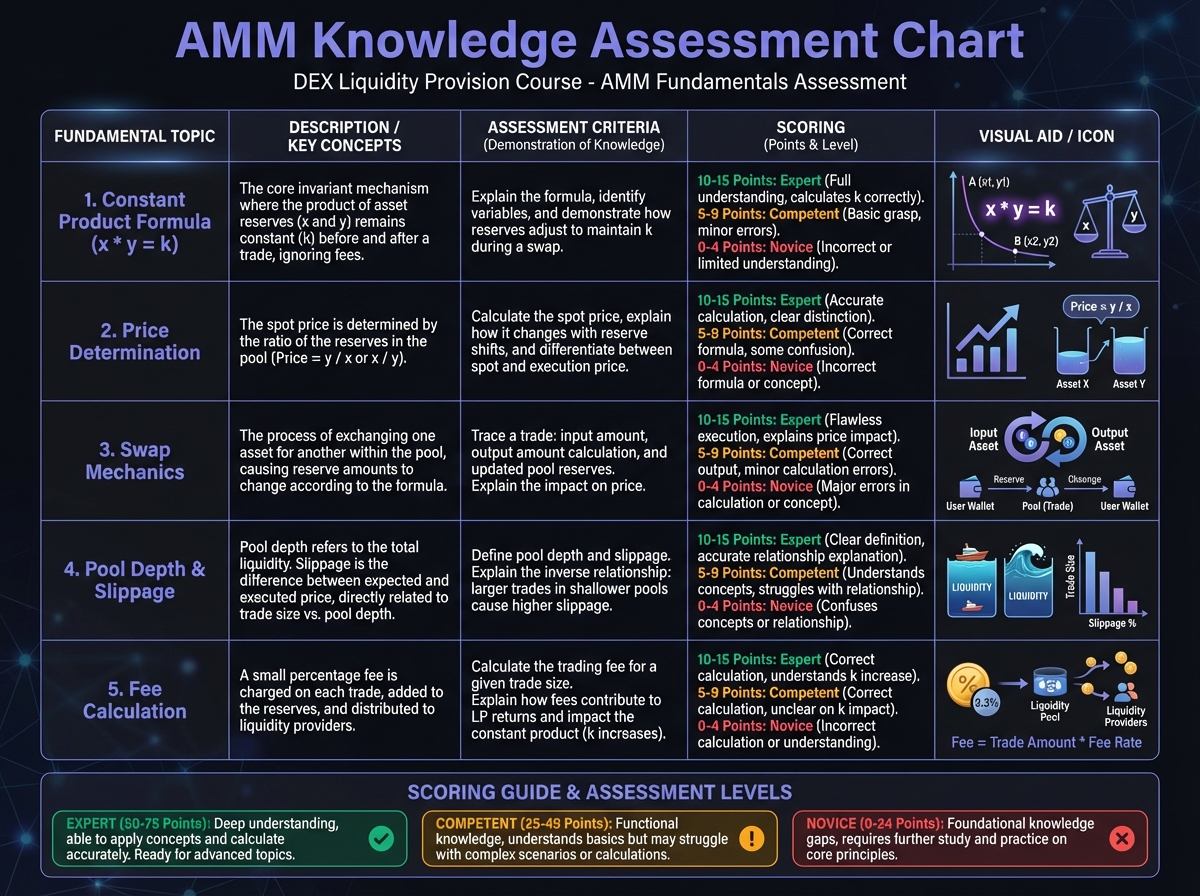
Exercise 1: AMM Fundamentals Assessment
⏰ Time Investment: 30-45 minutes 🎯 Goal: Test your understanding of AMM basics and identify knowledge gaps
📚 Required Reading Integration 📖 Primary: Lesson 1: Understanding AMM Fundamentals 📖 Supporting: Lesson 2: The Mathematics of Liquidity Provision
🔍 Phase 1: Knowledge Check (10 minutes)
Understanding Check
Answer these questions to assess your comprehension:
1. What is the constant product formula?
Your answer: _________________________________
2. How does an AMM determine prices?
Your answer: _________________________________
3. What happens to pool reserves when someone buys ETH?
Your answer: _________________________________
4. Why are liquidity pools called "automated" market makers?
Your answer: _________________________________
5. What is the difference between marginal price and average price?
Your answer: _________________________________
📊 Phase 2: Calculation Practice (15 minutes)
Swap Calculation Exercise
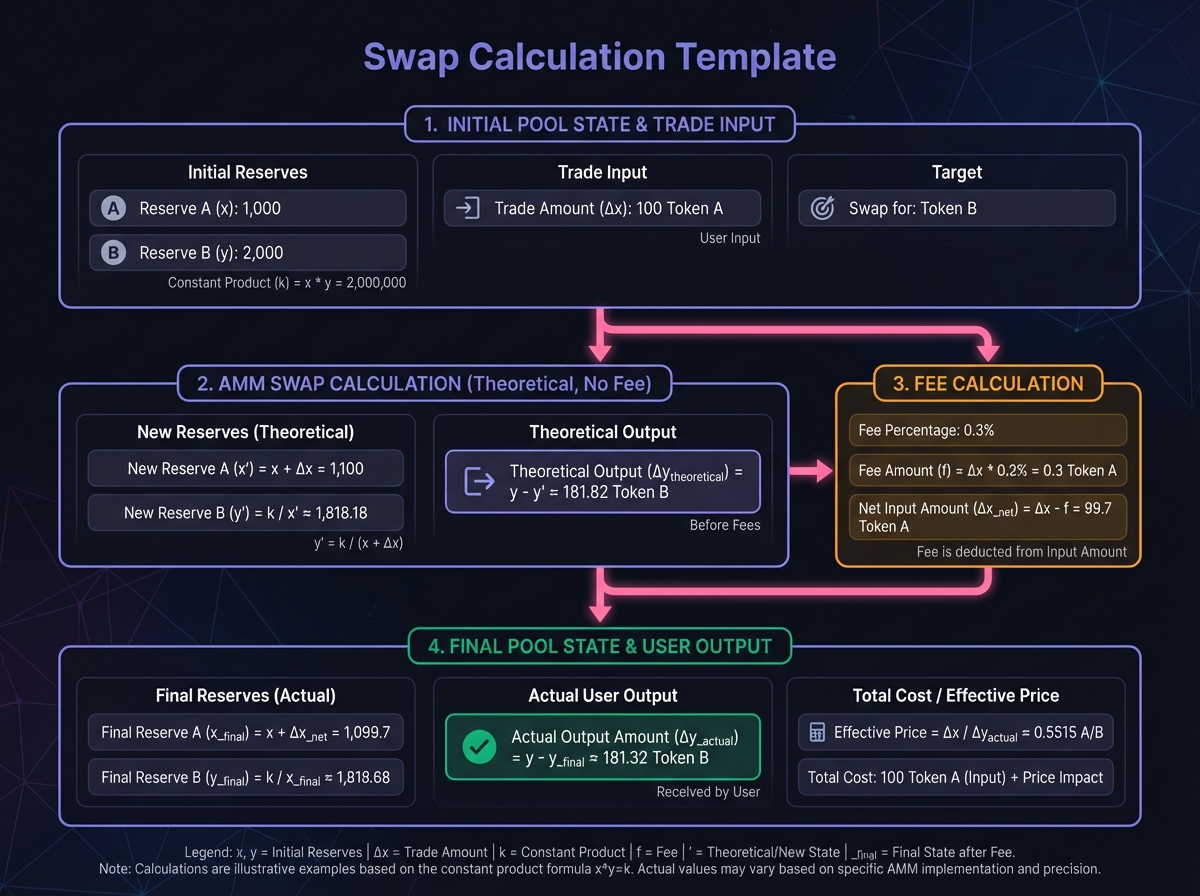
Scenario: Pool has 100 ETH and 200,000 USDC
Current price: 2,000 USDC per ETH
k = 100 × 200,000 = 20,000,000
Fee rate: 0.3%
Exercise 1: Calculate how much USDC is needed to buy 1 ETH
Step 1: New ETH reserves after trade
ETH_new = 100 + 1 = _____ ETH


Step 2: Required USDC to maintain k
USDC_new = 20,000,000 ÷ _____ = _____ USDC
Step 3: USDC needed (before fee)
USDC_needed = 200,000 - _____ = _____ USDC
Step 4: Add 0.3% fee
Fee = _____ × 0.003 = _____ USDC
Total cost = _____ + _____ = _____ USDC
Step 5: Effective price
Effective price = _____ USDC per ETH
Price impact = (_____ - 2,000) ÷ 2,000 = _____%
Pool Depth Exercise
Scenario: Two pools for ETH/USDC
Pool A: 50 ETH, 100,000 USDC (k = 5,000,000) Pool B: 200 ETH, 400,000 USDC (k = 80,000,000)
Exercise 2: Which pool can handle larger trades with less price impact?
Calculate depth for Pool A:
Depth_A = √(5,000,000) = _____
Calculate depth for Pool B:
Depth_B = √(80,000,000) = _____
Answer: Pool _____ has more depth and can handle larger trades.
💡 Phase 3: Real-World Application (10 minutes)
Pool Selection Exercise
You have $5,000 to provide liquidity. Analyze these pools:
Pool 1: ETH/USDC
TVL: $10,000,000
Daily Volume: $2,000,000
Fee Rate: 0.05%
Pool 2: USDC/USDT
TVL: $50,000,000
Daily Volume: $1,000,000
Fee Rate: 0.01%
Pool 3: MEME/USDC
TVL: $500,000
Daily Volume: $100,000
Fee Rate: 1%
Analysis:
Pool 1:
Your share: $5,000 ÷ $10,000,000 = _____%
Daily fees: $2,000,000 × 0.0005 × _____ = $_____
Volume/TVL ratio: $2,000,000 ÷ $10,000,000 = _____
Pool 2:
Your share: $5,000 ÷ $50,000,000 = _____%
Daily fees: $1,000,000 × 0.0001 × _____ = $_____
Volume/TVL ratio: $1,000,000 ÷ $50,000,000 = _____
Pool 3:
Your share: $5,000 ÷ $500,000 = _____%
Daily fees: $100,000 × 0.01 × _____ = $_____
Volume/TVL ratio: $100,000 ÷ $500,000 = _____
Which pool would you choose and why?
Your choice: Pool _____
Reasoning: _________________________________
🎯 Phase 4: Self-Assessment (10 minutes)
Knowledge Score
Rate your understanding (1-10) on each topic:
AMM Fundamentals:
Constant product formula: _____/10
Price determination: _____/10
Swap mechanics: _____/10
Pool depth: _____/10
Fee calculation: _____/10
Total Score: _____/50
Gap Identification
Topics I need to review:
Questions I still have:
📚 Next Steps
Last updated