Exercise 2: Mathematical Calculations and Analysis
⏰ Time Investment: 45-60 minutes 🎯 Goal: Master the mathematical foundations of AMMs through hands-on calculations
📚 Required Reading Integration 📖 Primary: Lesson 2: The Mathematics of Liquidity Provision 📖 Supporting: Lesson 1: Understanding AMM Fundamentals
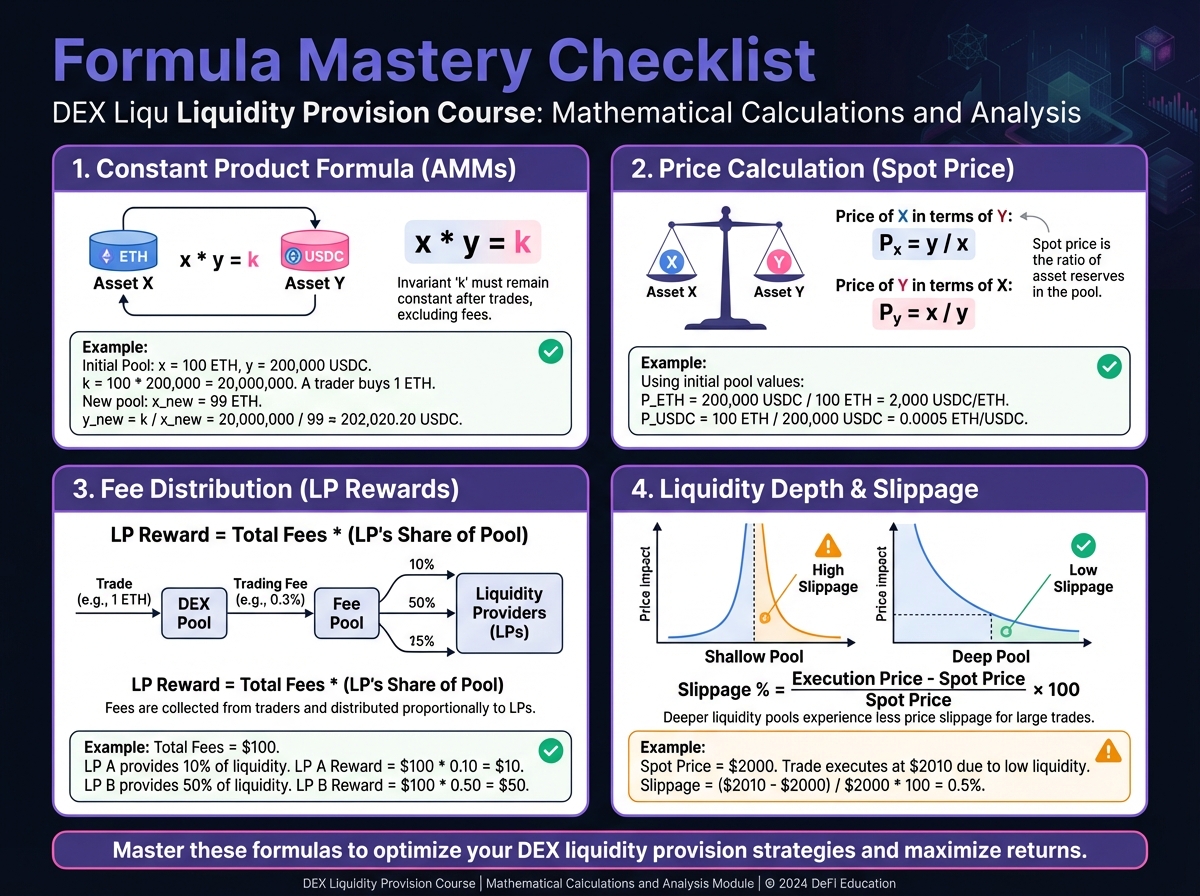
🔢 Phase 1: Formula Mastery (15 minutes)

Constant Product Formula Practice
Exercise 1: Complete the table
10
20,000
_____
_____
11
_____
200,000
_____
_____
18,181.82
200,000
2,000
9
_____
200,000
_____
Price Impact Calculation
Exercise 2: Calculate price impact for different trade sizes
Pool: 100 ETH, 200,000 USDC (k = 20,000,000)
Trade 1: Buy 0.1 ETH
New ETH: _____
New USDC: _____
Price impact: _____%
Trade 2: Buy 1 ETH
New ETH: _____
New USDC: _____
Price impact: _____%
Trade 3: Buy 10 ETH
New ETH: _____
New USDC: _____
Price impact: _____%
Observation: As trade size increases, price impact _____ (increases/decreases).
📊 Phase 2: Fee Mathematics (15 minutes)
Fee Distribution Exercise
Scenario:
Pool TVL: $1,000,000
Daily Volume: $500,000
Fee Rate: 0.3%
Your Capital: $10,000
Calculate:
Step 1: Your pool share
Share = $10,000 ÷ $1,000,000 = _____%
Step 2: Daily fees generated
Daily fees = $500,000 × 0.003 = $_____
Step 3: Your daily fee share
Your fees = $_____ × % = $
Step 4: Monthly fees
Monthly = $_____ × 30 = $_____
Step 5: Annual fees (before IL)
Annual = $_____ × 12 = $_____
Step 6: APY calculation
APY = ($_____ ÷ $10,000) × 100% = _____%
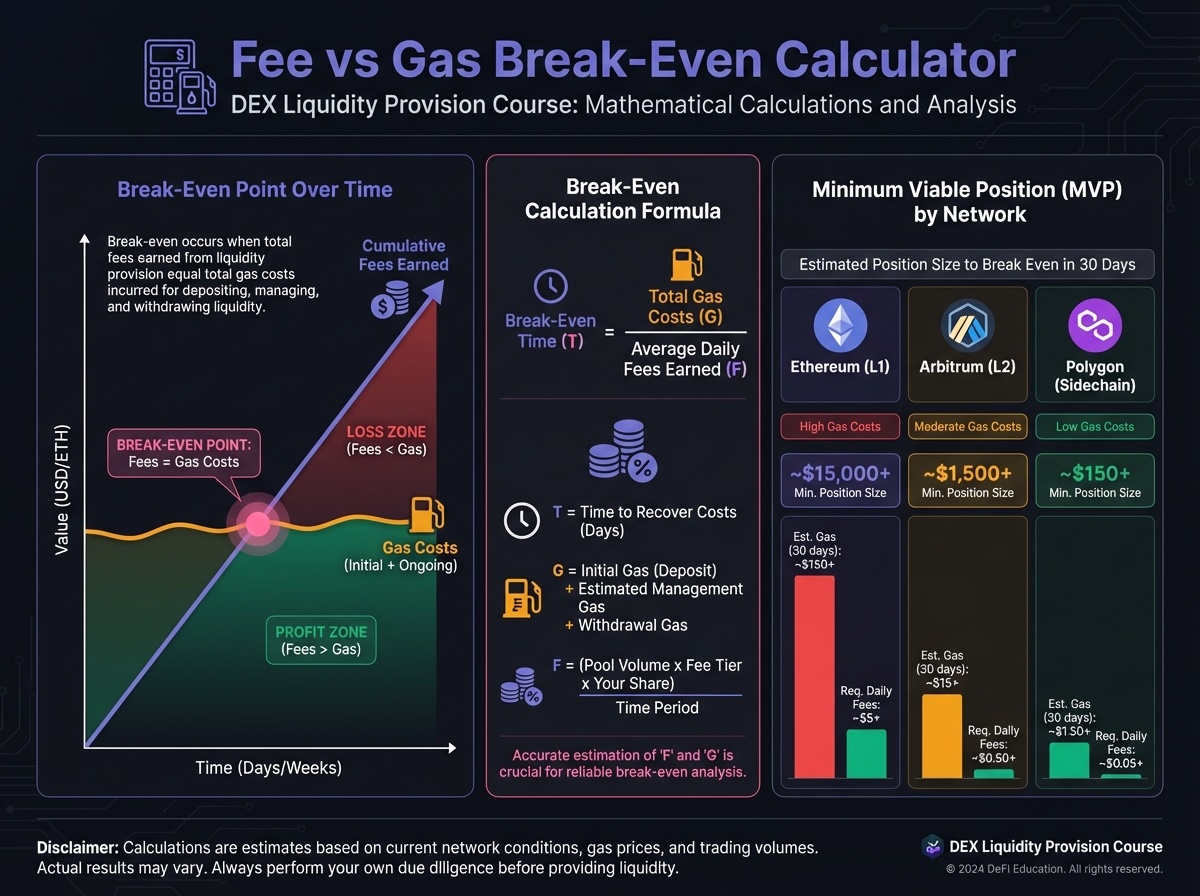
Fee vs. Gas Analysis
Scenario: You're considering providing liquidity on Ethereum L1
Setup:
Position: $5,000
Expected monthly fees: $50
Gas costs: $30 (deposit) + $20 (withdraw) = $50 total
Analysis:
Net monthly return: $50 - $50 = $_____
Is this profitable? _____ (Yes/No)
Minimum position size for profitability: $_____ (assuming same fees)
Conclusion: For L1, you need positions >$_____ to be profitable.
🧮 Phase 3: Advanced Calculations (20 minutes)
Liquidity Depth Comparison
Exercise 3: Compare three pools
Pool A: 20 ETH, 40,000 USDC Pool B: 100 ETH, 200,000 USDC Pool C: 500 ETH, 1,000,000 USDC
Calculate depth:
Depth_A = √(20 × 40,000) = √(_____) = _____
Depth_B = √(_____ × ) = √() = _____
Depth_C = √(_____ × ) = √() = _____
Which pool can handle a $100,000 trade with least impact?
Answer: Pool _____
Multi-Trade Analysis
Exercise 4: Calculate cumulative price impact
Pool: 100 ETH, 200,000 USDC (k = 20,000,000) Starting Price: 2,000 USDC/ETH
Trade Sequence:
Buy 1 ETH → New price: _____
Compare to single 3 ETH trade:
Single trade price: _____
Cumulative price: _____
Difference: _____
Observation: Splitting trades _____ (reduces/increases) price impact.
📈 Phase 4: Real-World Scenario (10 minutes)
Complete Pool Analysis
Scenario: You're analyzing an ETH/USDC pool on Arbitrum
Pool Data:
TVL: $5,000,000
Daily Volume: $1,000,000
Fee Rate: 0.05%
Your Capital: $25,000
Network: Arbitrum (L2)
Calculate Expected Returns:
Daily Analysis:
Your share: _____%
Daily fees: $_____
Daily gas (amortized): $_____
Net daily: $_____
Monthly Analysis:
Monthly fees: $_____
Monthly gas: $_____
Net monthly: $_____
Annual Analysis:
Annual fees: $_____
Annual gas: $_____
Net annual: $_____
APY: _____% (before IL)
Risk Assessment:
Minimum viable position: $_____ (based on gas costs)
Your position is _____ (viable/not viable) for active management
🎯 Phase 5: Mastery Check (10 minutes)
Self-Evaluation
Rate your confidence (1-10):
Calculating swap amounts: _____/10
Understanding price impact: _____/10
Fee distribution math: _____/10
Liquidity depth concepts: _____/10
Gas economics: _____/10
Total: _____/50
Key Formulas Mastered
Write from memory:
Constant Product Formula:
Formula: _____
What does k represent? _____
Price Calculation:
Formula: _____
How does it change with trades? _____
Fee Share:
Formula: _____
What factors affect your share? _____
📚 Next Steps
Last updated