Exercise 3: Risk Assessment and IL Analysis

⏰ Time Investment: 45-60 minutes 🎯 Goal: Master impermanent loss calculations and risk assessment

📚 Required Reading Integration 📖 Primary: Lesson 3: Impermanent Loss and Risk Fundamentals 📖 Supporting: Lesson 2: The Mathematics of Liquidity Provision

🔍 Phase 1: IL Calculation Practice (20 minutes)
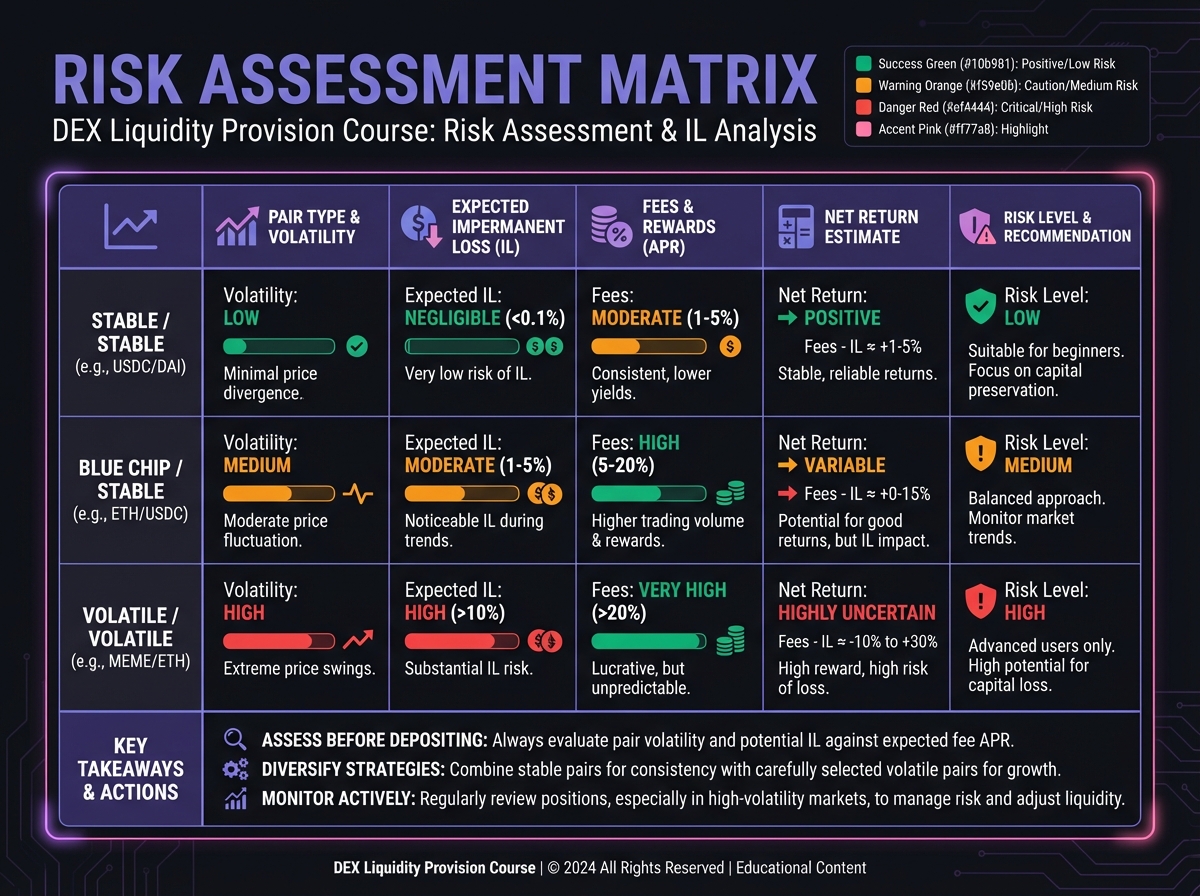
Risk Assessment Matrix
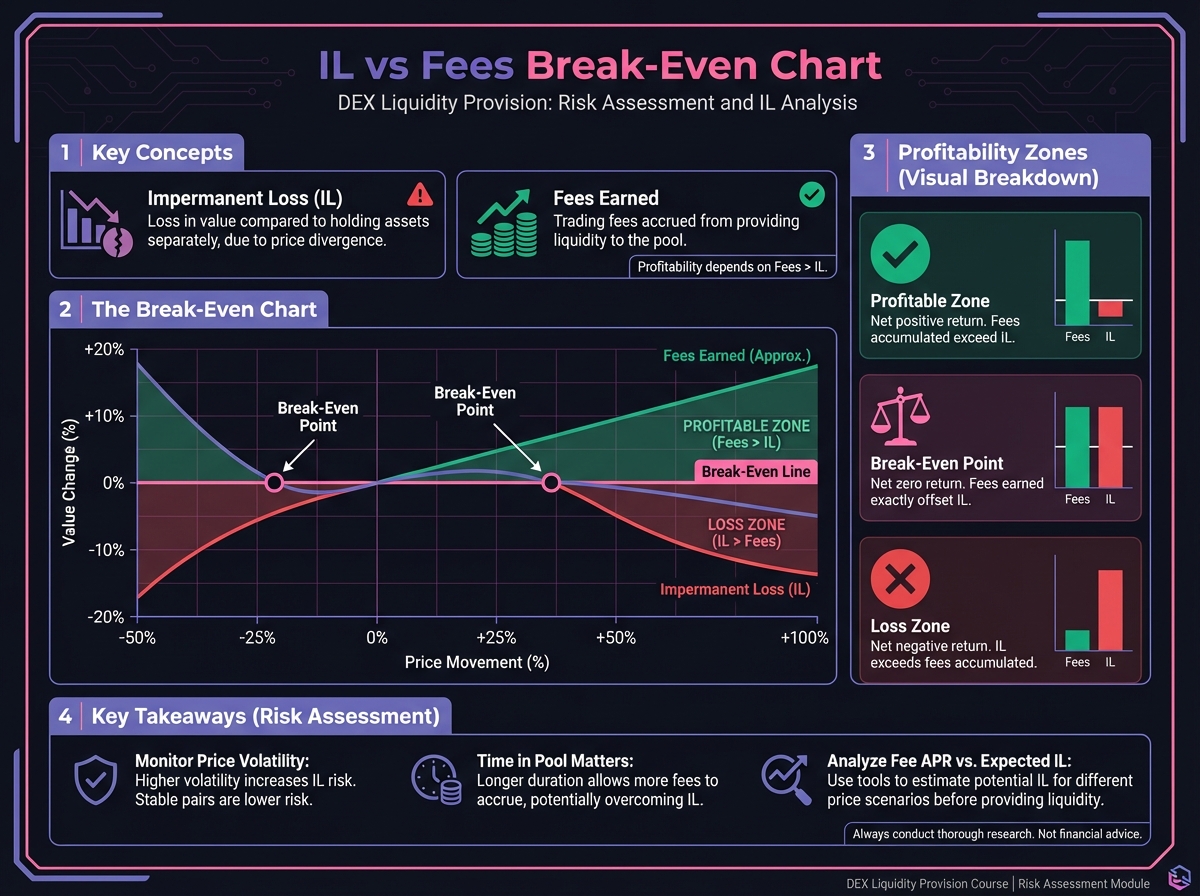
IL vs Fees Break-Even Chart
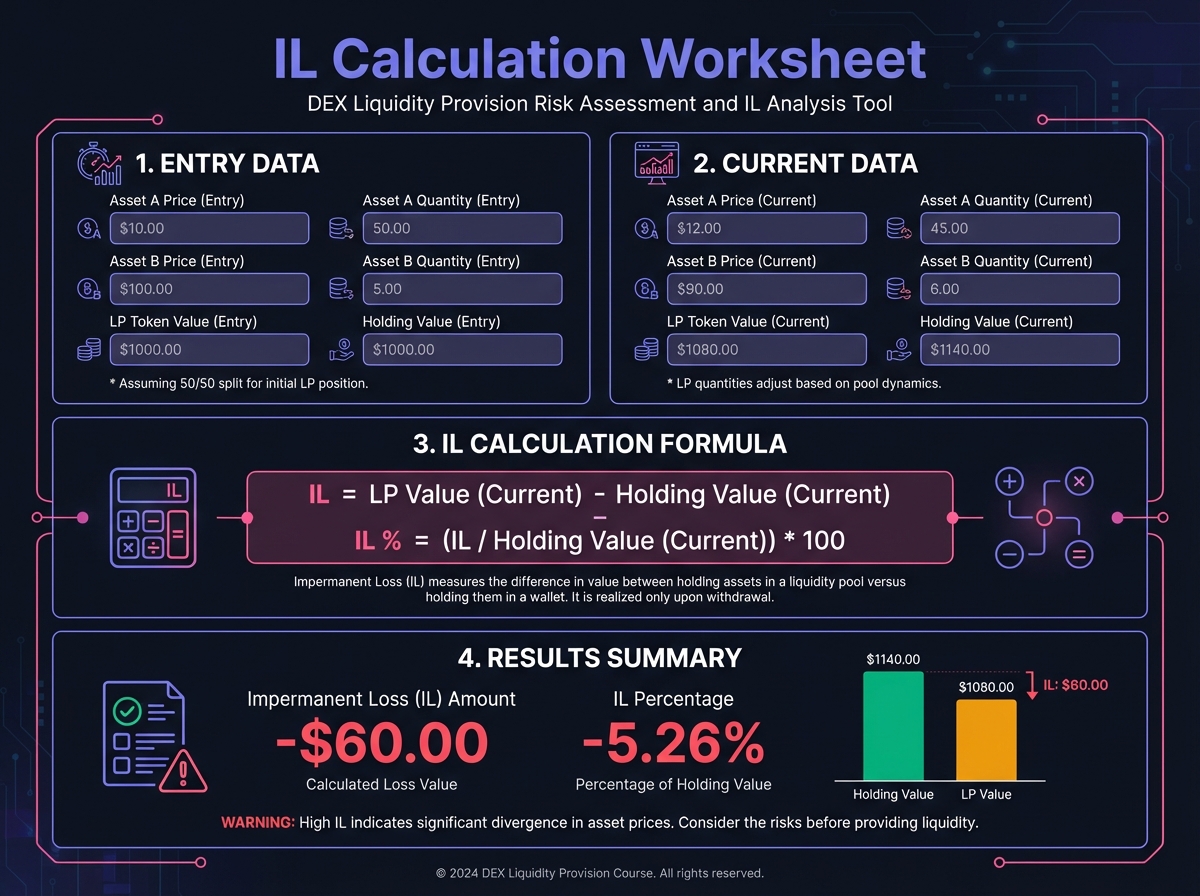
IL Calculation Worksheet

Basic IL Scenarios

Scenario: You deposit 1 ETH + 2,000 USDC when ETH = $2,000

  • Total value: $4,000

  • Pool ratio: 50/50

Exercise 1: Calculate IL for different price movements

Price Change: +25% (ETH → $2,500)

Step 1: Calculate new pool ratio

  • New price ratio: _____

  • Your new position: _____ ETH + _____ USDC

Step 2: Calculate values

  • LP position value: $_____

  • Holding value: $_____

  • IL: $_____ (_____%)

Price Change: +50% (ETH → $3,000)

  • LP value: $_____

  • Holding value: $_____

  • IL: $_____ (_____%)

Price Change: +100% (ETH → $4,000)

  • LP value: $_____

  • Holding value: $_____

  • IL: $_____ (_____%)

Price Change: -50% (ETH → $1,000)

  • LP value: $_____

  • Holding value: $_____

  • IL: $_____ (_____%)

IL Formula Application

Exercise 2: Use IL formula for price ratio r

Formula: IL% = 2 × (√r / (1 + r)) - 1

Calculate for r = 1.5 (50% increase):

  • IL% = 2 × (√1.5 / (1 + 1.5)) - 1

  • IL% = 2 × (_____ / _____) - 1

  • IL% = _____%

Calculate for r = 2.0 (100% increase):

  • IL% = _____

Calculate for r = 0.5 (50% decrease):

  • IL% = _____

📊 Phase 2: IL vs. Fees Analysis (15 minutes)

Break-Even Analysis

Scenario: ETH/USDC pool

  • Your capital: $10,000

  • Daily volume: $100,000

  • Fee rate: 0.3%

  • Your share: 1%

Calculate:

Daily Fees:

  • Daily fees = $100,000 × 0.003 × 0.01 = $_____

Annual Fees (before IL):

  • Annual = $_____ × 365 = $_____

IL Scenarios:

If ETH moves ±25%:

  • IL = 2% = $_____

  • Net return = $_____ - $_____ = $_____

  • Profitable? _____ (Yes/No)

If ETH moves ±50%:

  • IL = 5.7% = $_____

  • Net return = $_____ - $_____ = $_____

  • Profitable? _____ (Yes/No)

If ETH moves ±100%:

  • IL = 20% = $_____

  • Net return = $_____ - $_____ = $_____

  • Profitable? _____ (Yes/No)

Conclusion: This position is profitable only if ETH moves <_____%.

Risk Assessment Matrix

Exercise 3: Assess risk for different pairs

Pair
Volatility
Expected IL
Fees
Net Return
Risk Level

USDC/USDT

Low

_____%

_____%

_____%

_____

wstETH/ETH

Medium

_____%

_____%

_____%

_____

ETH/USDC

High

_____%

_____%

_____%

_____

MEME/USDC

Very High

_____%

_____%

_____%

_____

💡 Phase 3: LVR Understanding (10 minutes)

LVR vs. IL Comparison

Key Differences:

Impermanent Loss:

  • Reversible? _____ (Yes/No)

  • When does it occur? _____

  • How to minimize? _____

Loss Versus Rebalancing:

  • Reversible? _____ (Yes/No)

  • When does it occur? _____

  • How to minimize? _____

LVR Impact Analysis

Scenario: High volatility pair (σ = 50% annual)

LVR Formula: LVR = σ² / 8

Calculate:

  • LVR = (0.5)² / 8 = _____ / 8 = _____%

Annual Impact:

  • On $10,000 position: $_____ lost to LVR

  • This is _____ (reversible/irreversible)

Conclusion: In high volatility, LVR can exceed fees, making LPing unprofitable.

🎯 Phase 4: Risk Management Framework (15 minutes)

Position Risk Assessment

Your Portfolio: $50,000 total

Current Positions:

  • Position 1: $10,000 ETH/USDC (volatile)

  • Position 2: $15,000 USDC/USDT (stable)

  • Position 3: $10,000 wstETH/ETH (correlated)

  • Position 4: $15,000 MEME/USDC (very volatile)

Risk Analysis:

Position 1:

  • % of portfolio: _____%

  • Risk level: _____

  • Expected IL: _____%

  • Within limits? _____ (Yes/No)

Position 2:

  • % of portfolio: _____%

  • Risk level: _____

  • Expected IL: _____%

  • Within limits? _____ (Yes/No)

Position 3:

  • % of portfolio: _____%

  • Risk level: _____

  • Expected IL: _____%

  • Within limits? _____ (Yes/No)

Position 4:

  • % of portfolio: _____%

  • Risk level: _____

  • Expected IL: _____%

  • Within limits? _____ (Yes/No)

Portfolio Risk:

  • Total at risk: $_____

  • % of portfolio: _____%

  • Diversified? _____ (Yes/No)

  • Risk limits met? _____ (Yes/No)

Risk Mitigation Plan

Identify your highest risk position: Position _____

Mitigation strategies:

Action items:

📚 Next Steps


← Back to Lesson 3 | Next: Exercise 4 →

Last updated