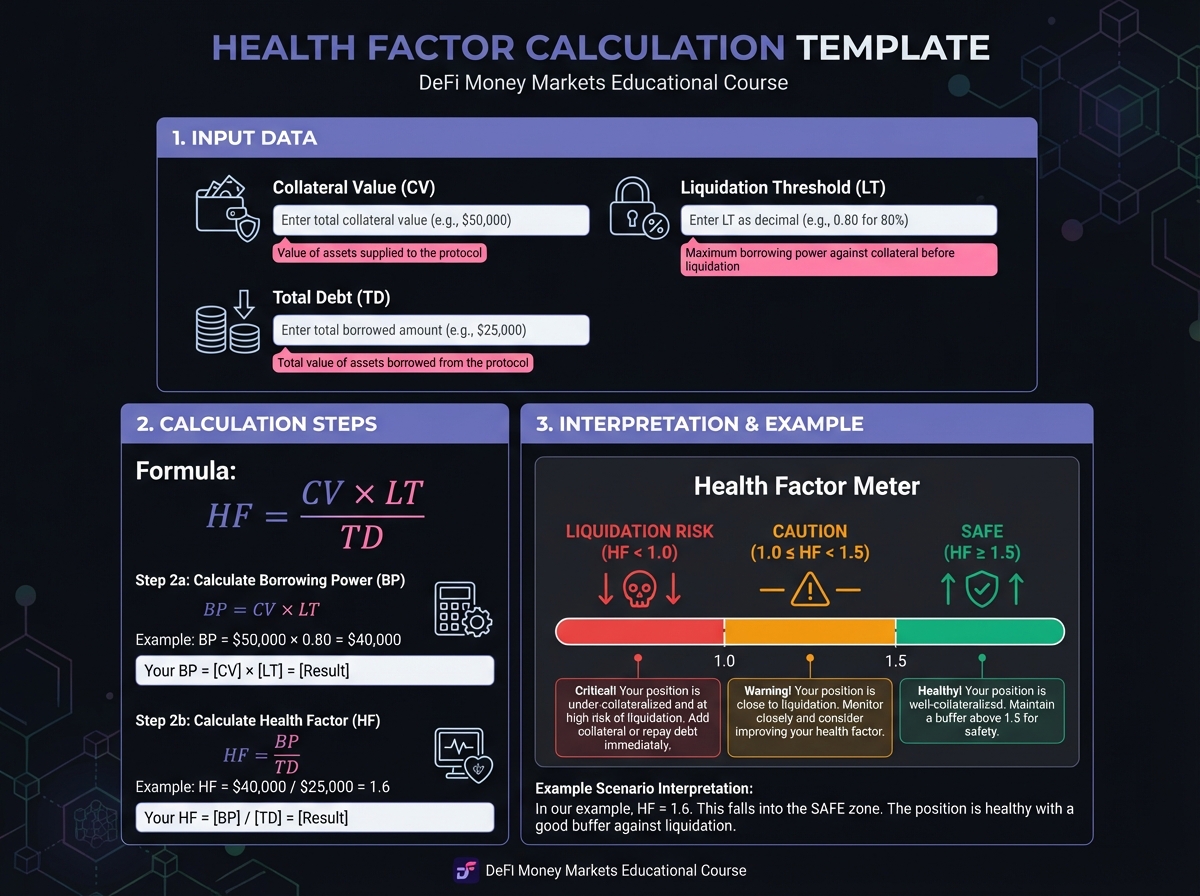
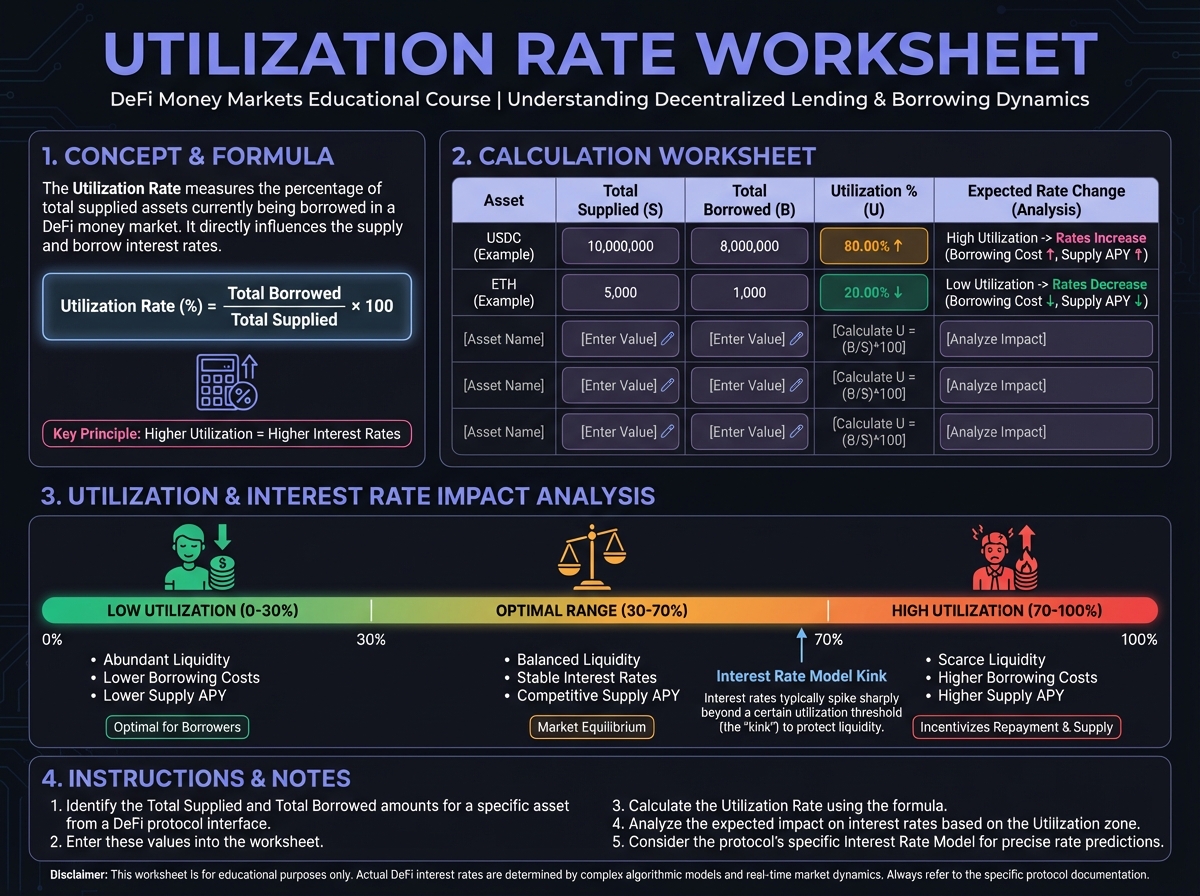
Exercise 2: Calculation Practice and Risk Metrics
⏰ Time Investment: 45-60 minutes 🎯 Goal: Master Health Factor calculations, LTV analysis, and interest rate mathematics
📚 Required Reading Integration 📖 Primary: Lesson 2: The Mathematics of Lending and Borrowing 📖 Supporting: Lesson 3: Risk Management Fundamentals
🔢 Phase 1: Health Factor Calculations (20 minutes)
Basic HF Calculation
Scenario: You deposit 5 ETH @ $2,000/ETH and borrow $6,000 USDC
Collateral: $10,000
Debt: $6,000
Liquidation Threshold: 85%
Exercise 1: Calculate Health Factor
Formula:
HF = (_____ × 0.85) ÷ _____ = _____
Exercise 2: What does this HF mean?
Your answer: _________________________________
HF with Price Changes
Scenario: ETH drops to $1,500
Exercise 3: Calculate new HF
New collateral value: _____
New HF = _____
Status: _____ (Safe/Warning/Danger)
Exercise 4: At what ETH price would liquidation trigger? (HF = 1.0)
Calculation: _____
Liquidation price: $_____

💧 Phase 2: Utilization and Interest Rates (15 minutes)
Utilization Calculation
Pool Statistics:
Total Supplied: 100 USDC
Total Borrowed: 70 USDC
Exercise 5: Calculate utilization rate
Utilization = _____ ÷ _____ = _____%
Exercise 6: If utilization is 70%, what happens to rates?
Supply rate trend: _____
Borrow rate trend: _____
Interest Rate Impact
Scenario: Pool utilization spikes to 95% (above kink)
Exercise 7: What happens?
Supply rate: _____ (increases dramatically)
Borrow rate: _____ (increases dramatically)
Risk: _____ (liquidity freeze possible)

📊 Phase 3: LTV Analysis (10 minutes)
Maximum Borrowing Capacity
Scenario:
Collateral: $20,000 ETH
Maximum LTV: 75%
Liquidation Threshold: 80%
Exercise 8: Calculate maximum borrow
Max borrow = $20,000 × _____ = $_____
Exercise 9: If you borrow $12,000, what's your safety buffer?
Current LTV: $12,000 ÷ $20,000 = _____%
Safety buffer: _____% - _____% = _____%
✅ Self-Assessment
Rate your calculation skills:
Areas needing practice: _________________________________
Last updated